June 8, 2026
Global Energy Infrastructure Under Transformation
The convergence of artificial intelligence expansion and geopolitical energy realignments is reshaping fundamental assumptions about natural gas consumption patterns worldwide. Qatar LNG demand driven by AI and Europe represents a significant shift in market dynamics, as traditional forecasting models built around industrial growth cycles prove inadequate for capturing sustained electricity requirements. Furthermore, this transformation coincides with structural shifts in global energy security priorities, particularly as major importers reconfigure supply chains away from pipeline dependencies.
These parallel developments suggest that energy markets are entering a phase where baseload power demand will grow more rapidly than historical patterns indicate. The implications extend beyond simple volume increases to encompass infrastructure investment timelines, shipping logistics optimisation, and strategic positioning of major producers in anticipation of tighter market conditions.
When big ASX news breaks, our subscribers know first
The Artificial Intelligence Energy Revolution: Understanding LNG's New Demand Drivers
Data Centers as Baseload Power Consumers
The emergence of artificial intelligence computing infrastructure represents a fundamental departure from traditional electricity consumption patterns. Unlike conventional industrial operations that experience cyclical demand fluctuations, AI data centres require continuous, high-intensity power delivery to maintain processing capabilities around the clock. Consequently, this creates what industry experts characterise as sustained, baseload power requirements that differ markedly from variable load profiles.
Qatar's Energy Minister has observed that artificial intelligence and data centre requirements represent a new category of electricity demand that has stepped up the need for gas much more than previously anticipated. This assessment reflects growing recognition among energy producers that digital infrastructure expansion will create persistent demand anchors in regional electricity markets, fundamentally altering risk-return calculations for long-term natural gas supply investments.
The regional distribution of planned AI facilities reveals concentrated development in areas with existing natural gas infrastructure. For instance, in markets where reliable baseload power generation remains dependent on gas-fired generation, this trend becomes particularly pronounced. Japan exemplifies this pattern, where data centres are becoming a major driver of baseload power needs, creating sustained demand for LNG imports that supplements existing consumption.
Quantifying the AI Impact on Natural Gas Demand
Energy market participants are revising their demand growth projections as the scale of AI infrastructure investments becomes clearer. The acceleration in expected demand reflects not only traditional economic growth drivers but also computing infrastructure requiring uninterrupted power supply. This has led to fundamental reassessments of supply-demand balance timelines, with some forecasts suggesting that anticipated oversupply conditions could transition to shortage scenarios by 2030.
AI Data Centre Power Requirements by Region (2026-2030)
| Region | Current Capacity (GW) | Projected 2030 (GW) | Primary Fuel Source | LNG Demand Impact |
|---|---|---|---|---|
| Japan | 1.2 | 3.8 | Natural Gas | High |
| Southeast Asia | 0.8 | 2.9 | Coal/Gas Mix | Medium-High |
| India | 0.6 | 2.1 | Coal/Gas Mix | Medium |
| Europe | 2.1 | 5.4 | Gas/Renewables | High |
Source: Regional energy planning documents and industry capacity announcements
The sustained nature of AI-driven electricity demand creates particular advantages for natural gas as a generation fuel. Unlike renewable energy sources requiring backup generation during low-wind or cloudy periods, gas-fired power plants provide consistent output that data centre operations require. This reliability premium becomes increasingly valuable as computing infrastructure represents a larger share of total electricity consumption.
In addition, major technology companies are incorporating baseload power procurement into capital planning processes, moving beyond traditional cost minimisation approaches toward strategies prioritising supply reliability and carbon intensity reduction. This shift drives longer-term power purchase agreements with natural gas generators, creating more predictable revenue streams that justify infrastructure expansion investments.
Europe's Strategic Pivot: From Pipeline Dependency to LNG Market Leadership
The Geopolitical Catalyst Behind European LNG Adoption
Europe's transition away from Russian pipeline gas has accelerated dramatically following regulatory changes that formally phase out these imports. The European Union's adoption of new regulations in January 2026 to eliminate Russian pipeline gas and LNG imports represents a definitive policy commitment that transforms Europe into what industry participants characterise as a structural LNG buyer.
This regulatory framework shift creates sustained import demand that operates independently of traditional price optimisation considerations. However, European policymakers have prioritised energy security over cost minimisation, establishing long-term contracting mechanisms that provide greater supply certainty but potentially at higher average prices than historical hub-based procurement strategies.
The infrastructure investments required to support this transition extend beyond terminal capacity to encompass storage expansion, pipeline network modifications, and shipping fleet development. European LNG import terminals are operating at higher utilisation rates than originally designed, creating bottlenecks that justify additional capacity investments whilst highlighting logistical complexities of replacing pipeline volumes.
Market Structure Transformation in European Gas Trading
The evolution from hub-based pricing mechanisms to long-term contract structures reflects broader changes in how European energy markets balance supply security against cost optimisation. Traditional gas trading models that relied on flexible spot market purchases are giving way to arrangements emphasising supply reliability and counterparty diversification.
This structural transformation has implications for European industrial competitiveness, as manufacturers must adapt to potentially higher and more volatile energy costs. The challenge becomes particularly acute for energy-intensive industries like chemicals, steel, and aluminium, where natural gas costs represent a significant portion of total production expenses.
European storage capacity expansion serves as a complement to terminal infrastructure development, providing seasonal demand management capabilities that become more important when supply comes from international shipping rather than pipeline flow. Furthermore, storage operators are investing in additional capacity to accommodate timing mismatches between LNG cargo deliveries and end-user consumption patterns.
"European energy security imperatives have created persistent demand for LNG that operates independently of traditional price optimisation factors, fundamentally altering the risk calculations for long-term supply contracts."
What Does Qatar's Capacity Expansion Strategy Reveal About Global Supply Dynamics?
Scale Economics in LNG Production and Distribution
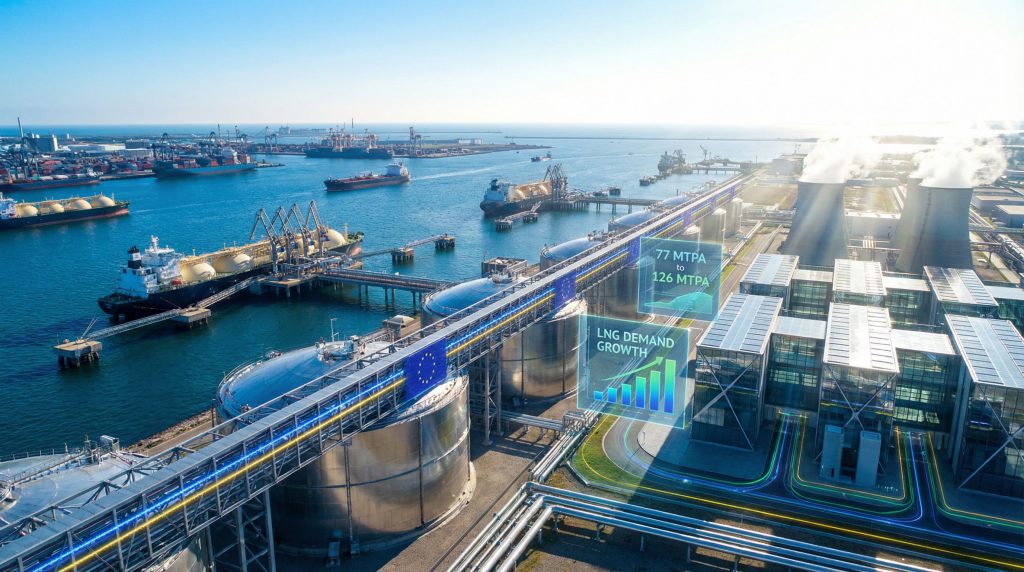
Qatar's expansion from 77 million tonnes per annum to 126 million tonnes per annum by 2027 represents one of the most significant capacity additions in global LNG markets. This 64% increase in production capability reflects confidence in sustained Qatar LNG demand driven by AI and Europe that extends well beyond current contract commitments. The scale of this expansion suggests Qatari planners anticipate supply tightness developing faster than many industry forecasts project.
The integrated nature of Qatar's expansion strategy, encompassing both production capacity and shipping fleet development, creates operational flexibility enabling cargo optimisation across multiple regional markets. QatarEnergy's plan to operate approximately 200 LNG vessels by 2035 provides logistical infrastructure necessary to redirect supplies based on seasonal demand patterns, price arbitrage opportunities, or supply disruption responses.
This shipping fleet investment signals confidence in a market environment where vessel availability becomes constraining and operational flexibility commands premium pricing. The capital commitment required for 200 vessels represents multi-billion dollar investments that only make economic sense if planners expect sustained high utilisation rates and favourable charter market conditions.
Investment Patterns in Global LNG Infrastructure
The Qatar expansion timeline coincides with capacity additions from other major producers, including development of approximately 18 million tonnes per annum at the Golden Pass LNG export terminal in the United States. This coordinated global capacity expansion suggests multiple producers are making similar assessments about future demand trajectories and supply adequacy.
Technology deployment for efficiency gains and emissions reduction represents an increasingly important component of these expansion projects. Carbon capture and sequestration capacity targeting 9 million tonnes of CO2 per year by 2030, expanding to 11-13 million tonnes per year by 2035, demonstrates how environmental considerations are being integrated into large-scale infrastructure development.
The financing mechanisms for these expansion projects rely on long-term contract commitments from buyers who are similarly confident in sustained demand growth. Consequently, the ability to secure 15-20 year purchase agreements provides revenue certainty necessary to justify substantial capital investments for both production facilities and associated shipping infrastructure.
LNG Capacity Expansion Timeline: Major Projects (2026-2030)
| Producer | Current Capacity (MTPA) | Planned Capacity (MTPA) | Target Completion | Investment ($B) |
|---|---|---|---|---|
| Qatar | 77 | 126 | 2027 | 45-50 |
| United States | 115 | 145 | 2029 | 35-40 |
| Australia | 88 | 95 | 2028 | 15-18 |
| Russia | 65 | 85 | 2030 | 25-30 |
Note: Investment figures represent estimated capital expenditure for capacity expansion projects
Are Traditional LNG Demand Forecasts Underestimating Future Requirements?
Reassessing Supply-Demand Balance Projections
Industry forecasters are revising market balance assessments as new demand drivers emerge faster than anticipated. Original projections for the second half of the 2020s assumed a period of market looseness, with oversupply conditions potentially persisting until 2030 or beyond. However, the combination of European structural buying, AI-driven electricity demand, and continued Asian growth is compressing these timelines significantly.
The acceleration in demand affects not only the magnitude of future LNG consumption but also timing of when global markets transition from surplus to deficit conditions. What industry participants once expected to be gradual tightening extending into the 2030s may now occur by 2030, creating more urgent investment imperatives for both production capacity and supporting infrastructure.
Moreover, methodology changes in demand modelling now incorporate continuous baseload electricity requirements that differ from traditional industrial or residential consumption patterns. This represents a fundamental shift from forecasting approaches that emphasised economic growth correlations toward models accounting for infrastructure-driven demand operating independently of business cycle fluctuations.
The Acceleration Timeline: From Oversupply to Shortage
The revised market balance projections reflect three primary acceleration factors not fully captured in earlier forecasting models. European demand has transformed from price-sensitive, seasonal purchasing to strategic, security-driven importing that creates persistent baseline consumption. Asian markets continue to represent core demand anchors, with India's policy objective of raising natural gas from 6-7% to 15% of its energy mix creating substantial incremental import requirements.
The artificial intelligence and data centre component represents an entirely new demand category operating on different economic principles than traditional gas consumption. These facilities require continuous power supply at consistent output levels, creating sustained demand for gas-fired generation that supplements rather than competes with renewable energy deployment.
LNG Demand Growth Scenarios by End-Use Sector (2026-2035)
| Sector | Base Case Growth (%/year) | Accelerated Case (%/year) | Key Drivers |
|---|---|---|---|
| Power Generation | 3.2 | 4.8 | AI data centres, backup generation |
| Industrial | 2.1 | 2.9 | Economic growth, fuel switching |
| Residential/Commercial | 1.8 | 2.3 | Population growth, infrastructure |
| Marine Fuel | 12.5 | 18.2 | IMO regulations, fleet conversion |
| Total Market | 3.1 | 4.2 | Combined effects |
Growth rates represent compound annual growth assumptions under different scenarios
Critical inflection points in global LNG market balance depend on the pace of capacity additions relative to demand acceleration. Investment lead times for major LNG projects typically require 4-7 years from final investment decision to first production, creating potential gaps if demand growth exceeds current expansion plans. Risk factors that could further accelerate demand include faster AI adoption rates, European industrial recovery, or supply disruptions forcing additional fuel switching.
How Are Asian Markets Evolving Beyond Traditional LNG Applications?
Industrial Transformation in Major Asian Economies
India's energy transition strategy exemplifies how policy-driven demand creates sustained import requirements extending beyond traditional economic growth correlations. The target of increasing natural gas from approximately 6-7% to 15% of the country's energy mix represents a deliberate infrastructure investment programme requiring substantial LNG regasification capacity expansion and pipeline network development.
This energy mix transition reflects broader decarbonisation strategies where natural gas serves as a transitional fuel displacing higher-carbon alternatives while renewable energy infrastructure scales up. The timeline for achieving these energy mix targets creates predictable import demand supporting long-term contracting arrangements and infrastructure investments.
Additionally, China's role as a demand anchor encompasses both direct consumption and participation in LNG trading and distribution networks. Chinese companies are developing downstream LNG infrastructure in Southeast Asian markets, creating supply chain relationships that integrate regional demand growth with Chinese logistical capabilities and financing resources.
Technology-Driven Demand in Advanced Asian Markets
Japan's experience with data centre expansion illustrates how technology infrastructure requirements create new categories of baseload electricity demand in developed markets. The continuous power requirements of AI processing facilities supplement Japan's existing industrial and residential consumption patterns, providing additional justification for LNG import infrastructure investments.
South Korea's industrial decarbonisation strategies increasingly incorporate natural gas as a transitional fuel in sectors like steel production and chemicals manufacturing. These applications create sustained demand for LNG imports operating independently of economic cycles, providing more predictable consumption patterns supporting long-term supply arrangements.
The integration of LNG with renewable energy systems for grid stability represents an emerging application where natural gas provides backup generation and load balancing capabilities. This grid services application becomes more valuable as renewable energy represents a larger share of electricity generation, creating premium pricing opportunities for flexible gas-fired generation.
Furthermore, Southeast Asian maritime fuel switching and transportation sector growth reflect regulatory drivers mandating lower-sulphur marine fuels. LNG bunkering infrastructure development in major shipping hubs creates additional demand streams complementing traditional power generation and industrial applications.
The next major ASX story will hit our subscribers first
What Investment Implications Emerge from Shifting LNG Market Dynamics?
Capital Allocation Strategies in Energy Transition
The scale of Qatar's capacity expansion and fleet development signals confidence in investment returns justifying substantial capital commitments during global energy transition uncertainty. The decision to expand from 77 to 126 million tonnes per annum whilst simultaneously building a 200-vessel shipping fleet represents multi-billion dollar investments assuming sustained high utilisation rates and favourable pricing conditions.
Risk-return profiles for LNG infrastructure investments are being reassessed as demand drivers become more diversified and persistent. However, traditional project financing models emphasising seasonal demand variations are giving way to approaches accounting for structural policy-driven demand and technology infrastructure requirements operating independently of traditional market cycles.
In addition, capital raising strategies for large-scale capacity expansion projects increasingly rely on long-term purchase agreements providing revenue certainty over 15-20 year periods. These arrangements enable project developers to secure favourable financing terms whilst providing buyers with supply security during periods of anticipated market tightness.
Market Concentration and Competitive Positioning
Strategic advantages of vertically integrated LNG operations become more apparent as market conditions tighten and logistical flexibility commands premium pricing. Companies controlling both production capacity and shipping assets can optimise cargo routing, arbitrage between regional markets, and respond more effectively to supply disruptions or demand surges.
The combination of production, shipping, and trading capabilities creates operational flexibility enabling suppliers to redirect cargoes across regions based on seasonal demand patterns, price differentials, or force majeure events. This integrated approach provides competitive advantages justifying higher capital investment levels but also creates barriers to entry for smaller market participants.
Technology differentiation in carbon capture and emissions reduction is becoming a more important competitive factor as buyers incorporate environmental considerations into procurement decisions. Suppliers offering lower-carbon LNG products may command premium pricing, though market acceptance of these premiums remains limited in current market conditions.
Investment Risk Assessment: LNG Market Expansion
What are the investment risks in LNG market expansion? Key risks include demand growth assumptions, regulatory changes affecting climate policies, shipping infrastructure bottlenecks, and geopolitical disruptions to supply chains, balanced against persistent structural demand from energy security priorities and technology infrastructure requirements.
Carbon Management and Environmental Considerations in LNG Growth
Technology Solutions for Emissions Reduction
Carbon capture and sequestration capacity expansion represents a significant component of major LNG infrastructure investments, with targets of capturing 9 million tonnes of CO2 per year by 2030, expanding to 11-13 million tonnes per year by 2035. These environmental investments reflect growing recognition that emissions reduction capabilities may become necessary for market access in regions with strict climate policies.
Efficiency improvements in LNG production and transportation are being driven by both cost optimisation and emissions reduction objectives. Technology deployments reducing energy consumption during liquefaction processes or improving shipping fuel efficiency create operational cost savings whilst reducing carbon intensity per unit of delivered LNG.
Blue hydrogen integration with natural gas operations represents an emerging opportunity where carbon capture infrastructure developed for LNG production can support hydrogen production from natural gas feedstocks. This integration creates additional revenue streams from infrastructure investments whilst supporting hydrogen economy development.
Regulatory Frameworks and Sustainability Standards
European due diligence requirements for LNG suppliers are creating compliance costs and operational complexities that may influence supply chain decisions and contract structures. Suppliers must demonstrate adherence to environmental and social governance standards extending beyond traditional commercial and technical specifications.
However, market acceptance of cost premiums for low-carbon LNG products remains limited, with buyers generally unwilling to pay significantly higher prices for environmental attributes. This creates tension between policy objectives promoting lower-carbon energy sources and commercial realities where cost minimisation continues driving procurement decisions.
The long-term viability of natural gas in decarbonisation pathways depends partly on the pace of renewable energy deployment and partly on development of carbon capture, utilisation, and storage technologies. Natural gas may serve as a transitional fuel during renewable energy scaling, but sustained demand growth assumes gas can maintain competitiveness in lower-carbon energy systems.
Strategic Scenarios: How Different Outcomes Could Reshape LNG Markets
Accelerated Demand Scenario Analysis
Faster AI adoption could significantly increase electricity infrastructure requirements beyond current projections, creating additional baseload power demand favouring natural gas generation. If artificial intelligence deployment accelerates across multiple sectors simultaneously, cumulative electricity requirements could exceed infrastructure capacity expansion timelines, creating supply tightness driving premium pricing for reliable power generation.
European industrial recovery effects on natural gas consumption could amplify structural demand created by energy security policies. If European manufacturing activity rebounds whilst maintaining import diversification strategies, the combination of industrial and strategic demand could create sustained high utilisation of LNG infrastructure, justifying additional capacity investments.
Furthermore, Asian economic growth trajectories and energy intensity patterns remain critical variables that could significantly affect global LNG demand projections. Higher growth rates in India, Southeast Asia, or other emerging markets could accelerate the timeline for capacity tightness, whilst slower growth could extend periods of market balance or surplus conditions.
Supply Response and Market Adaptation Mechanisms
Flexibility options in LNG production and distribution systems become more valuable as demand patterns become less predictable and more geographically dispersed. Suppliers with shipping assets and multiple production sources can adapt to regional demand variations more effectively than those with fixed supply chain arrangements.
Price discovery mechanisms in evolving market structures may need to account for sustained, baseload nature of new demand drivers rather than traditional seasonal or cyclical pricing patterns. For instance, long-term contract arrangements may become more important relative to spot market transactions, creating different risk management requirements for both buyers and sellers.
Risk management strategies for supply-demand imbalances must account for the possibility that demand acceleration could create shortage conditions faster than supply capacity can respond. This creates incentives for buyers to secure long-term supply arrangements even at potentially higher costs, whilst providing revenue certainty enabling suppliers to justify capacity expansion investments.
Scenario Analysis: LNG Market Balance Under Different Growth Assumptions
| Scenario | 2030 Demand (MTPA) | Supply Capacity (MTPA) | Market Condition | Price Impact |
|---|---|---|---|---|
| Base Case | 485 | 510 | Balanced | Moderate |
| Accelerated AI | 520 | 510 | Tight | High |
| European Recovery | 510 | 510 | Balanced-Tight | Moderate-High |
| Combined Acceleration | 545 | 510 | Shortage | Very High |
Assumptions include currently committed capacity additions through 2030
Navigating the New Era of Global LNG Markets
Key Strategic Implications for Market Participants
The convergence of artificial intelligence infrastructure expansion, European energy security priorities, and sustained Asian demand growth creates LNG market conditions differing fundamentally from historical patterns. Traditional forecasting approaches emphasising cyclical demand variations and price-sensitive consumption prove inadequate for capturing sustained, baseload characteristics of emerging demand drivers. Moreover, these developments align with broader energy transition challenges facing global markets.
Strategic positioning requirements for the evolving LNG landscape favour participants with integrated operations encompassing production, shipping, and trading capabilities. The ability to optimise cargo routing, arbitrage between regional markets, and adapt to supply disruptions provides competitive advantages justifying higher capital investment levels whilst creating barriers to entry for smaller market participants.
Investment priorities in an accelerating demand environment must account for the possibility that market tightness could develop faster than currently projected. This creates incentives for capacity expansion investments even amidst energy transition uncertainties, provided financing structures can accommodate long-term revenue commitments from creditworthy counterparties. These considerations intersect with broader global oil market trends affecting energy sector investment decisions.
Risk mitigation approaches for supply chain participants should incorporate the structural nature of emerging demand drivers operating independently of traditional economic cycles. European energy security demand, AI infrastructure requirements, and Asian energy transition policies create persistent consumption patterns reducing demand volatility whilst potentially accelerating timelines for capacity constraints.
Qatar LNG demand driven by AI and Europe reflects broader changes in energy systems where reliability, security, and environmental considerations become as important as cost optimisation in procurement decisions. Market participants who can adapt their strategies to address these evolving priorities whilst maintaining operational flexibility will be best positioned to capitalise on opportunities created by these fundamental market shifts. Additionally, understanding AI data center electricity demands becomes crucial for strategic planning, whilst monitoring natural gas price forecast trends provides essential context for investment timing decisions.
Interested in the Next Major Energy Discovery?
Discovery Alert's proprietary Discovery IQ model delivers instant notifications on significant mineral discoveries across the energy transition sector, including critical minerals essential for LNG infrastructure and AI-powered data centres. Join thousands of investors already positioning themselves ahead of market-moving announcements and explore historic examples of exceptional returns from major discoveries, then begin your 14-day free trial to gain your competitive advantage.