July 17, 2026
The global energy system operates on interconnected supply chains where disruptions in one region cascade rapidly across continents. Complex infrastructure networks, specialised transport requirements, and geographically concentrated production facilities create structural vulnerabilities that become apparent only during crisis moments. Furthermore, the Qatar LNG production halt demonstrates how individual production facilities can influence worldwide energy pricing and availability when operational disruptions occur.
Why Qatar's Production Shutdown Matters for Global Energy Security
The concentration of liquefied natural gas production in specific geographic locations creates amplified market risks when operational disruptions occur. Moreover, Qatar's position within the global LNG ecosystem demonstrates how single-country production capabilities can influence worldwide energy pricing and availability. This situation has prompted analysts to examine US natural gas forecast models more closely.
The Scale of Qatar's LNG Dominance
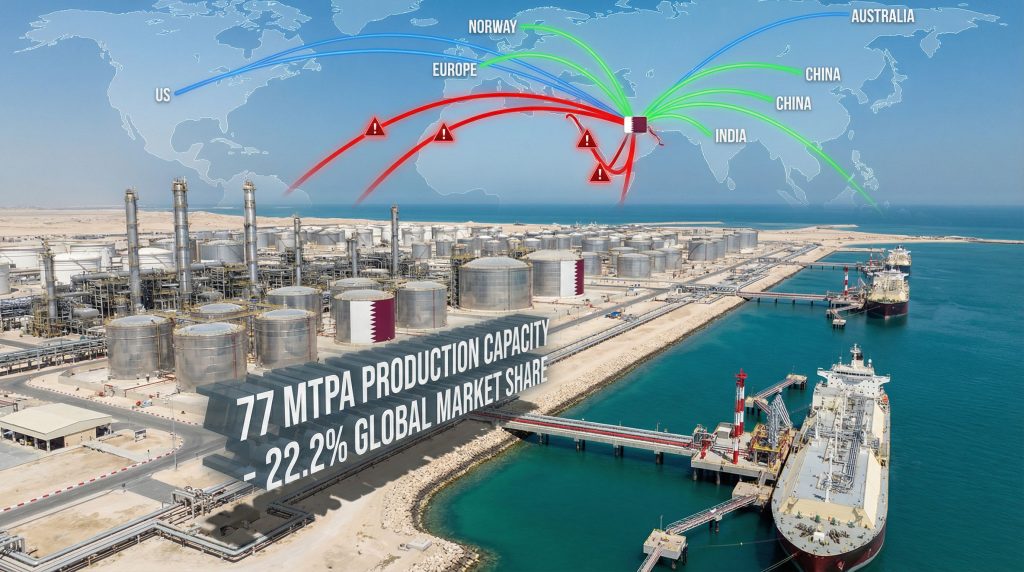
Qatar maintains approximately 20-21% of global LNG export capacity, positioning the nation as the world's largest liquefied natural gas exporter by volume. This market concentration represents roughly 77 million tonnes per annum (MTPA) of production capacity across integrated facilities that serve import-dependent markets across Asia, Europe, and other regions.
The North Field reservoir serves as the foundation for Qatar's LNG dominance, containing an estimated 1,700+ trillion cubic feet of natural gas reserves. This geological formation represents the world's largest confirmed natural gas field, providing the resource base that supports Qatar's extensive liquefaction infrastructure and long-term export contracts.
Qatar's production facilities operate through sophisticated integrated systems that require:
- Liquefaction terminals utilising cryogenic cooling technology to achieve -162°C temperatures
- Specialised storage infrastructure with insulated containment systems
- Loading facilities designed for LNG carrier vessels with advanced safety protocols
- Pipeline networks connecting offshore production platforms to onshore processing facilities
The interdependency between these infrastructure elements means that disruptions affecting multiple facilities simultaneously create exponentially greater impacts than proportional capacity reductions might suggest.
Immediate Market Response and Price Volatility
Spot market pricing for LNG has reached $25 per million British thermal units (MMBtu), representing approximately double the contracted long-term rates typically negotiated at $12-13/MMBtu levels. This price escalation reflects both supply constraints and increased transportation costs associated with alternative routing requirements.
European TTF natural gas futures and Asian LNG spot markets demonstrate interconnected pricing mechanisms where supply disruptions in the Middle East influence global commodity valuations. Consequently, oil price movements have also experienced volatility due to these interconnected energy markets. The premium structure emerges from:
- Transportation cost increases for alternative supply sources
- Insurance premium escalation for vessels operating in conflict zones
- Inventory management pressures at importing terminals with limited storage capacity
- Contract renegotiation dynamics as force majeure declarations suspend normal supply obligations
When big ASX news breaks, our subscribers know first
What Are the Immediate Supply Chain Disruptions?
Maritime transportation networks for LNG demonstrate acute vulnerability to chokepoint closures, particularly when specialised vessel requirements prevent simple cargo rerouting. In addition, the Strait of Hormuz represents the most critical single transit point for Middle Eastern LNG exports.
Critical Shipping Route Dependencies
The Strait of Hormuz serves as a transit route for approximately 20.8 million barrels per day of crude oil and refined products, representing roughly 33% of global seaborne crude exports. For LNG specifically, approximately 20% of global shipments pass through this narrow waterway, creating concentrated geopolitical risk exposure.
Vessel transit data illustrates the rapid market response to conflict escalation:
| Transit Period | Daily Vessel Count | Percentage Change | Market Impact |
|---|---|---|---|
| February 2026 Average | 135 vessels | Baseline | Normal operations |
| February 28, 2026 | 91 vessels | -33% | Initial risk perception |
| March 4, 2026 | 26 vessels | -81% | Critical disruption |
This transit reduction demonstrates how rapidly commercial shipping responds to security concerns, with maritime insurance considerations and vessel safety protocols driving operational decisions independent of contractual obligations.
Regional Production Capacity Analysis
Qatar's LNG production infrastructure concentrates around two primary industrial zones that together represent the majority of the country's export capacity:
| Production Facility | Annual Capacity (MTPA) | Current Status | Global Market Share |
|---|---|---|---|
| Ras Laffan Industrial City | 42.0 | Production Halted | 12.1% |
| Mesaieed Industrial City | 35.0 | Production Halted | 10.1% |
| Combined Qatar Output | 77.0 | Operations Suspended | 22.2% |
The simultaneous targeting of both facilities suggests strategic coordination rather than incidental conflict damage. Furthermore, Ras Laffan Industrial City houses the larger production capacity with multiple LNG trains and associated processing infrastructure, while Mesaieed Industrial City operates additional liquefaction units that collectively provide integrated production capabilities.
According to Qatar Energy's official statement, the company has declared force majeure on all LNG shipments following the attacks on its facilities.
Critical Infrastructure Insight: The clustering of LNG production facilities provides operational efficiencies through shared utilities, workforce, and supply chains, but creates vulnerability to simultaneous disruption that affects the entire production system rather than individual units.
How Are Major Importing Nations Responding?
Import-dependent economies face immediate supply security challenges when long-term contract suppliers invoke force majeure provisions. However, the cascade effects extend beyond direct LNG users to downstream industries and consumer sectors that rely on natural gas as feedstock or fuel.
India's Energy Security Challenge
India imports approximately 27 million tonnes of LNG annually, with Qatar supplying 40% of this volume through long-term contracts and spot market purchases. This dependency creates acute vulnerability when Qatari production capabilities cease operations, affecting industrial feedstock availability and domestic energy distribution networks.
Petronet LNG, India's largest LNG importer, maintains contracts to purchase 8.5 million tonnes per annum from Qatar under long-term agreements, supplemented by additional spot market acquisitions. The company has issued force majeure notices affecting three LNG carrier vessels—Disha, Raahi, and Aseem—unable to transit to Ras Laffan loading facilities due to Strait of Hormuz closure.
The supply disruption cascades through India's energy infrastructure:
- Industrial consumers face up to 40% supply cuts affecting steel, fertiliser, and petrochemical production
- City gas distribution companies experience feedstock constraints that impact CNG vehicle refuelling and residential cooking gas availability
- Power generation facilities utilising natural gas must seek alternative fuel sources or reduce capacity factors
- Downstream distributors including GAIL, Indian Oil Corporation, and Bharat Petroleum receive force majeure notifications
China's Strategic Positioning
As the world's largest LNG importer, China faces supply portfolio management challenges when major suppliers experience operational disruptions. Chinese companies maintain diversified sourcing strategies that include contracts with US, Australian, Russian, and Middle Eastern suppliers, providing greater flexibility during regional supply interruptions.
The strategic response involves:
- Alternative supplier activation through existing contract flexibility provisions
- Spot market procurement despite elevated pricing to maintain industrial production schedules
- Strategic reserve utilisation to bridge short-term supply gaps while alternative sources ramp up capacity
European Union's Diversification Acceleration
European natural gas markets demonstrate reduced direct exposure to Qatari LNG compared to Asian importing nations, but indirect price effects influence regional energy costs. Moreover, European gas prices have rallied more than 30% following Qatar's production halt. The European response emphasises:
- Norwegian pipeline gas increased utilisation where infrastructure permits
- US LNG cargo diversion from Asian markets to European terminals when economically viable
- Strategic storage drawdown to maintain supply security during supply chain disruptions
What Alternative Supply Sources Can Fill the Gap?
Global LNG production capacity outside Qatar faces operational and economic constraints that limit the ability to rapidly replace 77 MTPA of offline capacity. However, alternative suppliers operate existing facilities at high utilisation rates, reducing available spare capacity.
US LNG Export Capacity Utilisation
United States LNG export terminals currently operate at maximum capacity with limited ability to increase short-term output beyond design specifications. Major facilities include:
- Sabine Pass LNG: 36 MTPA capacity across four operational trains
- Corpus Christi LNG: 15 MTPA capacity with expansion projects under development
- Cameron LNG: 12 MTPA capacity serving both term contracts and spot markets
- Freeport LNG: 15 MTPA capacity (subject to operational status and maintenance schedules)
Market Reality Check: US export terminals are operating at maximum sustainable capacity, with limited ability to increase short-term output. Spot market prices reaching $25/MMBtu make alternative supplies economically challenging for price-sensitive industrial consumers in developing markets.
Australian LNG Production Ramp-Up
Australia maintains significant LNG production capacity through integrated projects that combine offshore gas production with onshore liquefaction facilities:
- Gorgon LNG: 15.4 MTPA capacity with potential for operational optimisation
- Wheatstone: 8.9 MTPA capacity serving primarily Asian markets
- North West Shelf: 16.9 MTPA capacity representing Australia's longest-operating LNG facility
- Ichthys LNG: 8.9 MTPA capacity with integrated offshore production capabilities
Australian facilities benefit from established shipping relationships with Asian importers and shorter transit times compared to alternative Atlantic Basin suppliers, providing logistical advantages during supply chain disruptions.
Russian LNG Alternatives
Russian LNG production capacity offers potential alternative supply sources, though geopolitical constraints limit European purchases while Asian markets remain accessible:
| Russian Facility | Capacity (MTPA) | Current Utilisation | Market Access |
|---|---|---|---|
| Yamal LNG | 16.5 | 90-95% | Asia, limited Europe |
| Sakhalin-2 | 10.9 | 85-90% | Asia-Pacific |
| Arctic LNG 2 | 19.8 | Development phase | Future capacity |
How Will This Crisis Transform Long-Term Energy Strategies?
Supply disruptions of this magnitude catalyse strategic policy reviews across import-dependent economies, accelerating diversification initiatives and infrastructure resilience investments that extend beyond immediate crisis response. Furthermore, the Qatar LNG production halt reinforces the importance of comprehensive energy transition insights for long-term planning.
Accelerated Energy Transition Implications
The Qatar LNG production halt reinforces arguments for renewable energy deployment as a supply security strategy rather than purely environmental policy. Import-dependent economies face trade-offs between:
- Short-term supply replacement through alternative fossil fuel sources
- Medium-term infrastructure investments in renewable generation capacity
- Long-term energy independence through domestic renewable resource development
Green hydrogen project development receives increased policy attention as governments seek alternatives to imported natural gas for industrial processes, particularly in steel production, ammonia manufacturing, and chemical processing sectors.
Infrastructure Resilience Requirements
Strategic LNG storage capacity expansion emerges as a critical infrastructure priority for import-dependent economies. Current storage capabilities typically provide 10-14 days of operational inventory, insufficient for extended supply disruptions lasting weeks or months.
Enhanced infrastructure requirements include:
- Floating Storage Regasification Units (FSRUs) providing flexible import capacity that can be relocated between terminals
- Underground storage facilities utilising salt caverns or depleted gas fields for long-term strategic reserves
- Pipeline interconnection projects enabling alternative supply routing during chokepoint closures
- Dual-fuel capability installations allowing industrial facilities to switch between natural gas and alternative fuels
Geopolitical Risk Premium Integration
Energy markets increasingly incorporate geopolitical risk assessments into long-term pricing structures and supply contract negotiations. The risk premium structure reflects:
| Risk Scenario | Estimated Price Impact | Duration Range | Mitigation Approach |
|---|---|---|---|
| Chokepoint Closure | +$15-20/MMBtu | 2-6 weeks | Alternative routing |
| Facility Damage | +$10-15/MMBtu | 1-3 months | Emergency procurement |
| Regional Conflict | +$25-30/MMBtu | 3-12 months | Supply diversification |
What Are the Industrial Sector Impacts?
Natural gas serves as both feedstock and fuel across multiple industrial sectors, creating cascading effects when supply constraints emerge. Different industries demonstrate varying abilities to substitute alternative inputs or reduce production levels.
Petrochemical Manufacturing Disruptions
Petrochemical production relies heavily on natural gas as both energy source and chemical feedstock for producing:
- Methanol production requiring natural gas as primary input for synthesis processes
- Polymer manufacturing utilising natural gas-derived ethane and propane as raw materials
- Ammonia production combining natural gas with nitrogen for fertiliser manufacturing
- Plastic resin production dependent on natural gas derivatives for polymerisation processes
Supply disruptions force producers to either halt operations or procure alternative feedstock at significantly higher costs, affecting profit margins and production schedules across global supply chains.
Power Generation Sector Adjustments
Natural gas-fired power plants face operational constraints when fuel supply becomes unreliable or economically unviable. Grid operators must compensate through:
- Coal-fired generation increased utilisation despite environmental concerns
- Renewable generation maximum output where weather conditions permit
- Energy storage deployment utilising battery systems to manage grid stability
- Demand response programmes reducing electricity consumption during peak periods
Fertiliser Industry Supply Constraints
Nitrogen fertiliser production depends heavily on natural gas as feedstock for ammonia synthesis. Production halts during critical agricultural seasons create food security implications:
- Urea production suspension affects soil preparation for spring planting seasons
- Ammonium nitrate shortages impact crop yield potential across grain-producing regions
- Price escalation for available fertiliser supplies increases agricultural production costs
- Alternative nitrogen sources including organic fertilisers face capacity constraints for large-scale agriculture
The next major ASX story will hit our subscribers first
How Should Investors Position for Market Recovery?
Energy sector disruptions create both risks and opportunities across different asset classes and investment strategies. Portfolio positioning requires assessing recovery timelines, alternative supply development, and long-term structural changes in energy markets. In addition, understanding tariffs' market impact becomes crucial for investment decisions.
Energy Sector Investment Opportunities
Infrastructure development projects gain increased investment attractiveness during supply security crises:
- LNG terminal development projects offering strategic import capacity for underserved markets
- Pipeline construction companies benefiting from diversification infrastructure investments
- Energy storage technology providers supplying grid flexibility solutions during fuel supply interruptions
- Alternative fuel development companies advancing biofuels, hydrogen, and synthetic fuel production
Risk Management Strategies
Investment portfolios exposed to energy price volatility require hedging mechanisms and diversification strategies. Consequently, market volatility hedging strategies become particularly important:
- Commodity price hedging through futures contracts and options strategies
- Geographic diversification across energy-producing regions to reduce single-country exposure
- Supply chain resilience investments in companies with diversified sourcing strategies
- Technology diversification balancing traditional energy assets with renewable energy investments
Long-Term Portfolio Considerations
Structural changes in global energy markets influence long-term investment themes:
- Energy security premium valuations for companies providing supply diversification capabilities
- Infrastructure resilience investments in companies developing redundant supply systems
- Transition energy technology exposure balancing near-term natural gas needs with renewable energy development
What Recovery Scenarios Should Markets Prepare For?
Recovery timeline projections require assessing both conflict resolution possibilities and infrastructure repair requirements. Different scenarios create varying market impacts and investment implications.
Optimistic Resolution Timeline (2-4 weeks)
Rapid diplomatic intervention could restore shipping lane access and production capabilities through:
- Ceasefire agreements enabling vessel transit through the Strait of Hormuz
- Production facility assessment determining extent of infrastructure damage
- Gradual capacity restoration as facilities restart operations following safety protocols
Market normalisation indicators include:
- Spot price convergence toward pre-crisis levels as supply expectations improve
- Force majeure withdrawal by suppliers and importers as contractual obligations resume
- Shipping route reopening demonstrated by increased vessel transit volumes
Extended Disruption Scenario (2-6 months)
Prolonged supply constraints require structural adjustments across global energy markets:
- Alternative supply activation from US, Australian, and other producing regions
- Demand destruction in price-sensitive industrial sectors unable to sustain elevated energy costs
- Strategic reserve utilisation by importing nations to bridge supply gaps
This scenario creates opportunities for:
- Alternative energy suppliers with spare production capacity or development projects
- Energy efficiency technology providers serving cost-reduction market demand
- Transportation infrastructure companies enabling alternative supply routing
Structural Market Shift Scenario (6+ months)
Permanent supply chain reconfiguration accelerates energy transition investments and creates new geopolitical alliance patterns:
- Supply diversification mandates driving long-term contract restructuring across importing nations
- Infrastructure redundancy investments in multiple supply sources and transportation routes
- Energy independence policies accelerating domestic renewable energy development programmes
Strategic Market Intelligence: The Qatar LNG production halt represents more than a temporary supply disruption. It serves as a catalyst for fundamental changes in global energy security strategies, supply chain resilience requirements, and long-term investment priorities across the comprehensive energy ecosystem.
Key Takeaways for Energy Market Participants
Market participants require immediate tactical responses combined with strategic planning adjustments to navigate current disruptions while positioning for long-term energy market evolution.
Immediate Action Items
Critical near-term considerations include:
- Contract review processes examining force majeure clauses and alternative supplier provisions
- Price risk management through hedging strategies and flexible procurement arrangements
- Supply chain assessment identifying vulnerable dependencies and alternative sourcing options
- Inventory management optimisation balancing holding costs against supply security benefits
Strategic Planning Considerations
Long-term energy market participation requires:
- Geographic diversification reducing concentration risk in single-source supply arrangements
- Technology portfolio balancing traditional energy investments with transition energy alternatives
- Infrastructure resilience prioritising suppliers and partners with redundant capability systems
- Regulatory compliance preparation for potential energy security legislation and import requirements
The intersection of geopolitical risk, infrastructure vulnerability, and energy transition dynamics creates a complex investment environment where traditional energy security strategies must evolve to address contemporary supply chain realities and long-term sustainability objectives.
Ready to Capitalise on Energy Market Disruptions?
Discovery Alert's proprietary Discovery IQ model delivers real-time alerts on significant ASX mineral discoveries, including critical energy transition metals, instantly empowering subscribers to identify actionable opportunities ahead of the broader market. Understand why historic discoveries can generate substantial returns by visiting Discovery Alert's dedicated discoveries page, showcasing exceptional market outcomes from major mineral finds.