July 17, 2026
Copper, Capital, and the Art of the Contrarian Bet
Few investment decisions reveal more about an investor's conviction than placing capital into a structurally sound but financially distressed business at precisely the moment when the underlying commodity it produces is entering a sustained price rally. This is the paradox at the heart of the UAE firm investment in Paranapanema, a Brazilian copper processing giant currently navigating judicial recovery while copper prices climb to levels that would, under normal circumstances, make its operations highly profitable.
Understanding why a Dubai-headquartered holding company would propose injecting US$40 million into a company under bankruptcy-like protection requires stepping back from the headline and examining the deeper forces shaping global copper markets, cross-regional capital flows, and the mechanics of distressed asset investing in Latin America.
When big ASX news breaks, our subscribers know first
The Structural Copper Deficit: Why Timing Matters More Than Ever
Copper is not simply another industrial metal. It is the connective tissue of the global energy transition. Every electric vehicle requires roughly two to four times more copper than a conventional internal combustion engine vehicle. Every kilometre of grid infrastructure built to carry renewable electricity demands substantial copper wiring. Every solar installation, offshore wind turbine, and battery storage system adds to a demand curve that analysts across institutions including the International Energy Agency have consistently revised upward over the past five years.
The supply side presents a starkly different picture. Global copper mine grades have been declining for decades. The average ore grade processed at major copper mines has fallen from above 2% copper content in the early twentieth century to well below 0.6% at many of today's largest operations, meaning miners must move significantly more rock to produce the same quantity of refined copper. New mine development timelines routinely extend beyond fifteen years from discovery to production, and the geographic concentration of primary copper supply gap in Chile, Peru, and the Democratic Republic of Congo introduces persistent political and logistical risk.
The result is a structural supply-demand gap that is increasingly well-documented. What is less appreciated, however, is how this deficit narrative is reshaping the behaviour of non-traditional capital. Sovereign wealth funds, family offices, and holding companies from the Gulf region are no longer passive observers of this dynamic. They are actively constructing entry points into copper processing infrastructure, and distressed producers offer uniquely attractive entry valuations. The copper supply crunch is, consequently, accelerating the urgency with which sophisticated investors seek exposure.
Paranapanema: Industrial Heritage Under Financial Pressure
Paranapanema occupies a distinctive position within Brazil's metals and mining landscape. As one of the country's most significant copper cathode producers and wire rod manufacturers, the company sits at a critical node in the domestic industrial supply chain. Its output feeds directly into electrical cable manufacturing, construction, and automotive component production sectors that are central to Brazil's industrial economy.
Copper cathodes, it is worth clarifying for those less familiar with the metal's processing chain, represent the refined output of copper smelting. Achieving the 99.99% purity standard required for cathode certification is a technically demanding process, and Paranapanema's established infrastructure represents years of capital investment that cannot easily be replicated or replaced. Wire rod, manufactured by hot-rolling copper cathodes, is the intermediate product that cable manufacturers and electrical component producers depend on. These are not interchangeable commodities sourced freely from global markets at will; domestic supply relationships and logistical proximity matter enormously.
The financial pressures that brought Paranapanema to seek judicial recovery protection under Brazil's Law No. 11,101/2005 reflect a combination of structural debt accumulated during periods of lower copper prices, working capital constraints, and the broader volatility that has historically afflicted mid-scale metals processors exposed to commodity price cycles. Crucially, the company's operational assets remain intact. The smelting capacity, the wire rod production lines, the established customer relationships and distribution networks persist through the restructuring process.
This distinction between financial distress and operational failure is central to understanding the investment thesis being pursued here.
Brazil's Judicial Recovery Framework: A Structured Entry Point
Brazil's recuperação judicial system differs meaningfully from corporate insolvency frameworks in other major economies. Unlike a straightforward liquidation, judicial recovery is designed to preserve operational continuity while a company negotiates a restructuring plan with its creditor classes under court supervision.
| Feature | Brazil Judicial Recovery | U.S. Chapter 11 Bankruptcy |
|---|---|---|
| Legal Framework | Law No. 11,101/2005 | U.S. Bankruptcy Code |
| Management Control | Company retains operational control | Debtor-in-possession or trustee |
| Creditor Negotiation | Restructuring plan voted by creditors | Court-supervised plan confirmation |
| Foreign Investment | Permitted with court oversight | Permitted with court oversight |
| Typical Duration | 2 to 4 years | 1 to 3 years |
One underappreciated aspect of this framework is how it creates layered capital entry opportunities for sophisticated investors. A company in judicial recovery is simultaneously constrained in its access to conventional financing and motivated to accept structured investment from credible external parties. This compression of negotiating leverage creates conditions where a patient investor with genuine capital can negotiate terms that would be unavailable in a normal operating environment.
For HW Holding, the judicial recovery context offers something particularly valuable: legal clarity over the hierarchy of claims. Entering as a debenture holder provides a secured creditor position that ranks above equity in any distribution or repayment scenario, while the raw material financing tranche creates a direct operational relationship with the company's production process.
Deconstructing the US$40 Million Two-Tranche Structure
The architecture of HW Holding's binding proposal is not arbitrary. The decision to divide the investment into two roughly equal components of approximately US$20 million each reflects a deliberate risk segmentation strategy.
The first tranche involves acquiring Paranapanema's existing debentures. In the context of a judicial recovery, debentures function as secured debt instruments whose holders occupy a priority position in the creditor hierarchy. This is structurally distinct from purchasing equity in a distressed company, where holders face the risk of total loss if the restructuring plan does not generate sufficient value. Debenture acquisition gives HW Holding a defensible balance sheet position regardless of the restructuring outcome, while simultaneously providing potential upside if the plan converts debt instruments into equity stakes.
The second tranche targets working capital and raw material procurement directly. This is arguably the more operationally significant component. Paranapanema's production throughput is constrained not by its physical infrastructure or its workforce, but by its inability to procure sufficient copper raw materials at scale due to liquidity limitations. US$20 million directed at raw material acquisition, at current copper price levels, can unlock a disproportionate quantity of production output.
Furthermore, understanding copper price drivers is essential to appreciating why this tranche carries such significance. When a high-purity copper processing facility is running below capacity due to raw material scarcity rather than technical limitation, each additional tonne of copper feedstock procured generates revenue at the prevailing copper price. In an elevated price environment, the revenue generated per dollar of working capital deployed is considerably higher than historical averages.
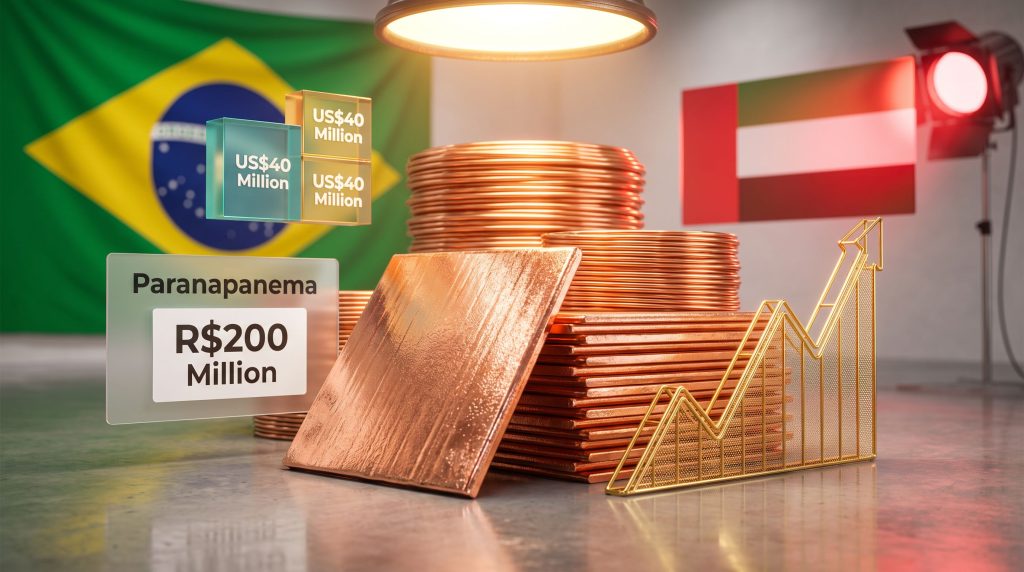
At current BRL/USD exchange rates, the total US$40 million commitment translates to approximately R$200 million, representing a substantial injection relative to the constrained liquidity position the company has been managing through the judicial recovery period.
HW Holding and the Expanding Gulf Capital Footprint in South America
The profile of HW Holding as a Dubai-based holding company places this transaction within a broader and accelerating pattern of Gulf-region capital targeting commodity assets outside the hydrocarbon sector. Since approximately 2022, UAE-based investment vehicles have systematically increased their exposure to base metals, agricultural commodities, and logistics infrastructure across Latin America, Africa, and Southeast Asia.
This diversification imperative is not difficult to understand. Gulf sovereign and private capital accumulated through decades of hydrocarbon exports now confronts a structural transition in the global energy system that, over time, reduces the primacy of oil and gas revenues. Repositioning capital into the metals and materials that enable that same energy transition is a logical, if somewhat ironic, strategic response.
Dubai's emergence as a structuring hub for cross-border resource investments reflects its regulatory environment, its network of bilateral investment treaties, and its established financial infrastructure. Brazil and the UAE maintain investment frameworks that facilitate cross-border structuring, and the absence of significant capital controls on inbound foreign direct investment into Brazil's industrial sector further reduces execution friction. In addition, the role of mining private equity in shaping these cross-regional capital flows has grown considerably, with Gulf-linked vehicles increasingly mirroring strategies pioneered by established resource-focused fund managers.
Four Strategic Scenarios Worth Modelling
From HW Holding's perspective, multiple exit and return pathways exist simultaneously:
- Debt-to-equity conversion – If the restructuring plan converts debentures to equity, HW Holding could emerge as a significant shareholder in a fully restructured copper processor at a historically low entry valuation.
- Secured creditor exit – If copper revenues recover sufficiently to service restructured debt, debenture holders receive priority repayment with contractual interest, providing a defined return independent of equity outcomes.
- Offtake agreement leverage – Raw material financing creates a commercial relationship that could be formalised into long-term offtake agreements for copper cathodes or wire rod, securing a physical commodity supply stream.
- Supply chain integration – Paranapanema's output, directed toward Gulf-region trading networks, positions the investor within a broader commodity supply chain benefiting from South American copper access at potentially advantageous contract terms.
Those evaluating comparable opportunities may also find value in reviewing copper investment strategies that address how structured entry into distressed producers can be positioned alongside other forms of copper market exposure.
The next major ASX story will hit our subscribers first
Downstream Industrial Implications for Brazil's Copper Supply Chain
A successful capital injection into Paranapanema carries consequences beyond the company itself. Brazil's electrical cable manufacturers, construction materials suppliers, and automotive component producers have historically relied on domestic copper cathode and wire rod supply to avoid the currency and logistics costs associated with importing refined copper products from international sources.
Reduced Paranapanema output during the judicial recovery period has increased the cost burden on these downstream industries. Restoration of full production capacity would normalise domestic supply dynamics and, given the current copper price environment, create potential for export-oriented revenue that could significantly strengthen the restructuring entity's financial position.
The precedent-setting dimension of this deal should not be overlooked. A successful foreign investment into a Brazilian industrial company navigating judicial recovery would demonstrate that Brazil's restructuring framework can attract and accommodate sophisticated cross-regional capital. This has implications for other distressed industrial assets across the country's mining, metals, and manufacturing sectors.
Risk Factors That Informed Investors Must Weigh
No analysis of this transaction would be complete without a clear-eyed assessment of the risks that remain embedded in the proposal as it stands.
- Court and creditor approval risk: The binding proposal remains subject to judicial recovery court approval and creditor committee endorsement. Opposition from existing creditor classes, or judicial concerns about the terms of the investment, could delay or derail the transaction entirely.
- Currency volatility: Brazil's real (BRL) has demonstrated significant volatility against the US dollar over multi-year periods. If the BRL weakens materially, the real-terms value of the US$40 million injection relative to BRL-denominated operational costs could erode, compressing the working capital benefit.
- Copper price reversal: The entire investment thesis is partially premised on a sustained copper price environment that makes production commercially compelling. A significant correction in copper prices, whether driven by a global growth slowdown, demand destruction from technology substitution, or supply surprises, would reduce the margin rationale for the raw material financing tranche.
- Execution timeline risk: Paranapanema has not confirmed a specific timeline for completing the transaction, which indicates that the judicial recovery process contains procedural complexity. Extended delays could shift the investment's timing relative to the optimal copper market window.
For broader context on how distressed asset restructuring intersects with commodity cycles, publicly available deal analysis and financial news sources provide useful comparative frameworks.
Disclaimer: This article is intended for informational purposes only and does not constitute financial or investment advice. The analysis presented here involves forward-looking assessments and scenario modelling that are inherently speculative. Readers should conduct independent due diligence before making any investment decisions.
Frequently Asked Questions
What exactly has HW Holding proposed for Paranapanema?
HW Holding, operating from Dubai in the UAE, has submitted a binding investment proposal totalling US$40 million structured across two equal tranches. The first targets acquisition of Paranapanema's corporate debentures, while the second is directed toward working capital support, specifically raw material procurement to restore production throughput during the ongoing judicial recovery process.
What is recuperação judicial and how does it work?
Recuperação judicial is Brazil's legal framework for corporate restructuring, governed by Law No. 11,101/2005. It allows a financially distressed company to continue operating under court supervision while negotiating a restructuring plan with its creditors. Unlike liquidation, the framework prioritises preserving the business as a going concern, making it structurally compatible with foreign investment proposals that inject operational capital. The World Bank's overview of insolvency frameworks offers a useful comparative perspective for those seeking further context.
Why would a UAE holding company target a Brazilian copper producer?
The investment reflects a convergence of factors: the global copper supply deficit driven by energy transition demand, the asymmetric valuation opportunity presented by a financially distressed but operationally capable processor, and Gulf capital's broader strategic imperative to diversify into commodity assets outside the hydrocarbon sector. The UAE firm investment in Paranapanema is, in many respects, a textbook example of contrarian positioning within a structurally favourable commodity cycle.
What are debentures and why does their acquisition matter in this context?
Debentures are corporate debt instruments, essentially bonds issued by the company. In a judicial recovery scenario, acquiring debentures positions the investor as a secured creditor with priority claims over equity holders. This provides downside protection while preserving access to potential restructuring upside, including the possibility of debt-to-equity conversion if the restructuring plan incorporates such a mechanism.
Has the deal been completed?
As of the proposal stage, the investment remains a binding proposal subject to judicial recovery court approval and creditor committee processes. No specific execution timeline has been confirmed by Paranapanema, reflecting the procedural complexity inherent in Brazil's judicial recovery framework. The UAE firm investment in Paranapanema will, however, be closely watched by investors monitoring distressed asset opportunities across Latin America's metals and mining sector.
Want to Know When the Next Major Copper Discovery Hits the ASX?
Discovery Alert's proprietary Discovery IQ model scans ASX announcements in real time, delivering instant alerts on significant copper and base metal discoveries so subscribers can act ahead of the broader market — explore historic discovery returns that demonstrate just how transformative early positioning can be, and begin a 14-day free trial to gain an immediate market edge.