July 16, 2026
Global energy markets stand at a critical juncture where traditional supply chains face unprecedented restructuring pressures. The convergence of geopolitical tensions, infrastructure constraints, and shifting demand patterns creates complex scenarios that demand strategic analysis beyond conventional market frameworks. Understanding these dynamics requires examining how major suppliers navigate between competing strategic partnerships while managing massive capacity expansions that will fundamentally reshape energy flows through 2030, particularly as Qatar LNG supply expansion becomes a defining factor in global energy security.
Qatar's Strategic Position in Global Energy Architecture
The Middle Eastern emirate's transformation into the world's dominant LNG supplier represents more than capacity scaling. This evolution reflects a comprehensive restructuring of global energy supply chains with implications extending far beyond traditional commodity trading patterns. Furthermore, Qatar's expansion trajectory positions the nation to control approximately 40% of all new LNG supplies globally by 2029, fundamentally altering competitive dynamics across regional markets.
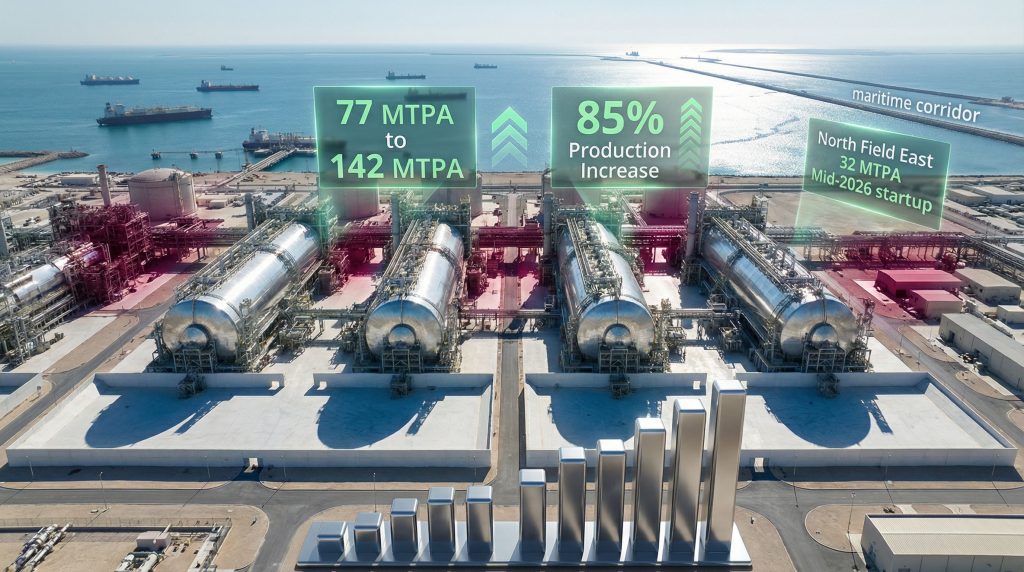
The scale of this transformation becomes apparent when examining production metrics. Qatar's current output of 77 million tonnes per annum (MTPA) will expand to 142 MTPA by decade's end, representing a 65 MTPA increase that dwarfs most competitors' total capacity. This growth occurs against a backdrop of global LNG trading volumes reaching 404 million MTPA in 2023, with industry projections indicating 625-685 million MTPA by 2040.
North Field Development Framework
The expansion strategy centres on the world's largest natural gas reservoir, spanning 9,700 square kilometers across Qatar's North Field and Iran's South Pars sections. This shared resource contains an estimated 51 trillion cubic meters of non-associated natural gas and 50 billion barrels of natural gas condensates, creating both enormous potential and strategic vulnerability.
Key Development Phases:
- North Field East (NFE): Four mega-trains producing 32 MTPA with mid-2026 startup targeting European supply security
- North Field South (NFS): Two additional trains contributing 16 MTPA by 2027-2028 for Asian market penetration
- North Field West (NFW): Extended capacity of 13+ MTPA operational by 2029-2030 providing strategic flexibility
- Golden Pass (Texas): Qatar's 70% ownership stake delivers 12.6 MTPA from the 18 MTPA facility starting Q2 2026
The technical specifications reveal the scale of engineering complexity involved. Each mega-train operates at 8 MTPA capacity, with the Golden Pass facility already processing approximately 300 million cubic feet of gas daily during development phases. However, these developments must be viewed alongside broader oil price movements that continue to influence LNG project economics.
When big ASX news breaks, our subscribers know first
Geopolitical Realignment and Market Access Strategies
Qatar's strategic positioning underwent dramatic transformation following Russia's February 2022 invasion of Ukraine. The emirate's initial orientation toward Chinese buyers through major long-term contracts shifted decisively westward under intense diplomatic pressure from Washington, London, and Paris.
Timeline of Strategic Pivot
Pre-Ukraine Positioning (2021-2022):
- March 2021: Sinopec agreement for 2 million MTPY over decade-long period
- December 2021: Guangdong Energy Group contract securing 1 million MTPY from 2024-2034
- Early 2022: Multiple Chinese supply agreements suggesting eastward strategic alignment
Western Pressure Campaign (2022):
- February 24, 2022: Russia's invasion triggers LNG emergence as primary emergency energy source
- March 2022: High-level engagements between Qatar's Emir Sheikh Tamim bin Hamad Al Thani and German economy minister Robert Habeck
- March 2022: Former President Joe Biden designates Qatar as "major non-NATO ally"
- December 2022: QatarEnergy and ConocoPhillips finalise 15-year German supply agreements
This diplomatic realignment reflects broader energy security imperatives. Unlike pipeline infrastructure requiring extensive build-out periods, LNG provides immediate supply flexibility through spot market purchases and rapid deployment to demand centres experiencing supply disruptions. Moreover, these shifts intersect with US–China trade impacts that continue to reshape global energy partnerships.
European Energy Security Integration
Qatar's pivot toward European markets addresses critical supply vulnerabilities exposed by Russian supply disruptions. The emirate's commitment to deliver 25+ MTPA to European buyers through 2026 represents approximately one-third of its new capacity allocation, fundamentally altering Continental energy security architecture.
Germany emerges as the primary beneficiary of this strategic realignment. Berlin's historical dependence on Russian hydrocarbons, particularly its reluctance to diversify following the 2014 Crimea annexation, created vulnerabilities that Russian leadership likely factored into invasion calculations. Consequently, Qatar's long-term German commitments directly address these structural weaknesses whilst supporting Qatar's latest LNG mega-award strategy that signals full alignment with Western markets.
Uncontracted Capacity and Market Volatility Scenarios
Approximately 75% of Qatar's new production capacity remains uncontracted, representing roughly 49 MTPA of floating supply entering spot markets between 2026-2030. This unprecedented volume creates multiple strategic scenarios with profound implications for global pricing dynamics.
Supply Saturation Analysis
Scenario Framework:
| Market Condition | Timeline | Price Impact | Strategic Implications |
|---|---|---|---|
| Oversupply Phase | 2027-2029 | Spot price compression | Marginal producer stress |
| Security Premium | 2028-2030 | Geopolitical price floors | Strategic buyer advantage |
| Market Equilibrium | 2030+ | Contract optimisation | Technology integration |
The absorption capacity of global markets faces significant testing. With 404 million MTPA traded globally in 2023, Qatar's 49 MTPA uncontracted volume represents more than 12% additional supply requiring market integration over a compressed timeframe.
Regional Competition Dynamics
Qatar's westward strategic shift creates supply gaps in Asian markets that competing suppliers must address:
- U.S. LNG exporters positioned to capture Asian premium pricing previously accessible to Qatari volumes
- Australian suppliers gaining opportunities for expanded regional market penetration
- Russian pipeline gas maintaining Asian foothold despite Western sanctions pressure
This competitive rebalancing occurs as Chinese buyers, previously anticipating expanded Qatari supply access, must identify alternative sourcing strategies to meet growing domestic demand. In addition, natural gas trends suggest increasing volatility as markets adjust to new supply patterns.
Infrastructure Dependencies and Strategic Vulnerabilities
What Are the Key Chokepoint Risks?
Qatar's geographic position creates critical single-point-of-failure risk, with approximately one-fifth of global LNG supply transiting the Strait of Hormuz. This maritime chokepoint vulnerability generates multiple risk factors:
Critical Dependencies:
- Maritime security during regional conflicts affecting shipping lanes
- Insurance premium fluctuations impacting transportation economics
- Limited alternative routing through pipeline infrastructure
- Specialized LNG carrier fleet concentration in Persian Gulf operations
The shared North Field/South Pars reservoir with Iran adds complexity to risk assessment. Any regional conflict disrupting Iranian gas operations could impact reservoir pressure dynamics affecting Qatari production efficiency. Furthermore, these risks must be evaluated alongside Saudi exploration impact on regional energy dynamics.
Technology Integration Challenges
The Qatar LNG supply expansion includes ambitious carbon intensity reduction targets of 35% by 2035, requiring integration of carbon capture and storage technologies alongside traditional LNG production. The North Field West project demonstrates this approach, generating 175,000 barrels of oil equivalent daily in condensate, ethane, and liquefied petroleum gas beyond core LNG output.
Technical Integration Requirements:
- Advanced compression systems for enhanced recovery rates
- Carbon capture deployment across mega-train facilities
- Green hydrogen integration potential for future expansion phases
- Enhanced reservoir management across shared Iran border
Investment Opportunities and Contractor Dynamics
Engineering and Technology Provider Revenue Streams
Qatar's mega-project awards signal substantial revenue opportunities for specialised contractors. Technip Energies' recent contract exceeding EUR 1 billion for North Field West mega-trains demonstrates the scale of commercial opportunity.
Contractor Category Analysis:
- EPC Contractors: Multi-billion dollar opportunities in liquefaction facility construction
- Equipment Suppliers: Specialised compression and processing technology demand
- Marine Logistics: LNG carrier requirements surge supporting specialised fleet expansion
- Technology Integration: Carbon capture and advanced reservoir management systems
The technical complexity of mega-train construction requires specialised expertise available from limited supplier pools, creating pricing power for established contractors with proven LNG delivery capabilities. However, projects must navigate challenges similar to those affecting Canada's energy transition, particularly regarding carbon compliance requirements.
Downstream Market Development Potential
Qatar's capacity expansion enables vertical integration opportunities extending beyond traditional LNG supply:
- Petrochemical feedstock development utilising 175,000 barrels daily condensate production from NFW
- Industrial gas supply partnerships serving manufacturing sectors in target markets
- Power generation joint ventures leveraging long-term supply security
- Technology licensing opportunities from advanced LNG processing capabilities
Long-Term Strategic Implications for Energy Markets
Market Structure Transformation
Qatar's expansion fundamentally alters global LNG market structure through several mechanisms:
Supply Concentration: Single-supplier dominance of new capacity additions creates pricing influence previously distributed across multiple regional producers.
Contract Portfolio Optimisation: Long-term European commitments provide revenue stability enabling aggressive spot market competition with uncontracted volumes.
Geopolitical Integration: Western strategic partnership consolidation creates durable competitive advantages through diplomatic protection and technology access. Additionally, energy policy research suggests these decisions will fundamentally reshape global market dynamics.
Risk Assessment Framework
Political Stability Factors:
- Domestic energy subsidy sustainability amid production growth
- Regional conflict spillover potential affecting infrastructure security
- International sanctions compliance requirements given Iran reservoir sharing
Economic Resilience Metrics:
- Break-even pricing analysis across full cost curves including carbon compliance
- Currency stability and sovereign wealth fund management strategies
- Economic diversification progress reducing hydrocarbon revenue dependence
The next major ASX story will hit our subscribers first
Timeline Scenarios for Market Development
Phase 1: Capacity Ramp-Up (2026-2027)
Initial production from North Field East coincides with Golden Pass startup, delivering approximately 44.6 MTPA of new capacity. European contract fulfilment begins, testing infrastructure integration and establishing benchmark pricing for long-term agreements.
Phase 2: Market Saturation Testing (2028-2029)
Full expansion capacity operational with 65 MTPA additional supply entering global markets. Uncontracted volume absorption requires spot market expansion, potentially triggering price discovery mechanisms and competitive responses from alternative suppliers.
Phase 3: Strategic Equilibrium (2030+)
Long-term contract portfolio optimisation balances revenue stability with market flexibility. Technology integration reaches maturity, enabling carbon-neutral LNG marketing strategies and next-generation expansion planning incorporating renewable energy integration.
The success of Qatar LNG supply expansion will largely determine whether global energy markets experience oversupply-driven price compression or maintain strategic premium pricing through supply security considerations. For investors and policymakers, this transformation demands careful attention to infrastructure dependencies, geopolitical risk factors, and technological integration challenges shaping energy market dynamics throughout the decade ahead.
Disclaimer: This analysis contains forward-looking statements and market projections based on current available information. Energy market conditions, geopolitical developments, and technological factors may significantly impact actual outcomes. Readers should conduct independent research and consult qualified professionals before making investment or policy decisions related to energy markets.
Ready to Capitalise on Energy Market Transformations?
Discovery Alert provides instant notifications on significant ASX mineral discoveries, including those in the critical minerals sector powering global energy transitions, using its proprietary Discovery IQ model. Experience how major discoveries can generate substantial returns by exploring Discovery Alert's discoveries page and begin your 14-day free trial today to position yourself ahead of evolving energy markets.