July 19, 2026
When a Single City Powers the World: The Fragility Behind Global LNG Supply
The global liquefied natural gas market has long operated under a structural paradox: extraordinary geographic concentration of supply feeding an extraordinarily dispersed network of demand. A handful of industrial complexes scattered across Qatar, Australia, and the United States collectively determine whether factories in South Korea stay warm, whether power grids in Germany remain stable, and whether Asian spot prices spike or settle. Within that concentration, one location stands above all others in terms of raw throughput capacity and geopolitical exposure: Ras Laffan Industrial City on Qatar's northeastern coastline.
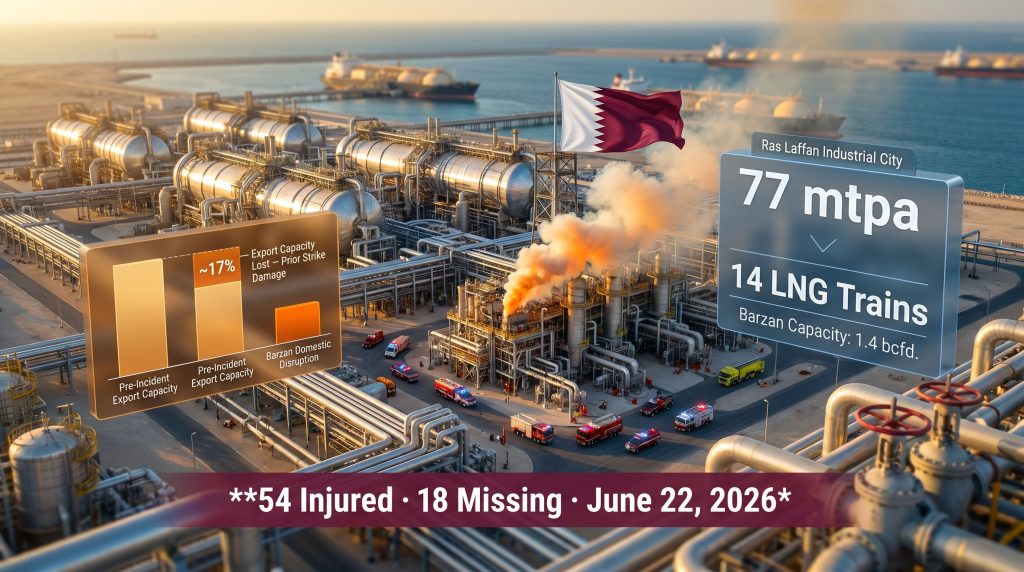
On the evening of Sunday, 22 June 2026, that concentration became a liability again. An explosion and fire erupted at the Barzan Gas Plant inside Ras Laffan Industrial City during start-up operations, injuring 54 people and leaving 18 individuals missing, according to Qatar's Interior Ministry. This Qatar Ras Laffan explosion prompted rapid emergency response deployment, with teams bringing the blaze under control. Authorities classified the event as a technical accident, explicitly stating that no threat to public safety existed and that there was no evidence of hostile action.
However, the incident does not exist in isolation. It arrives at a moment when Qatar's energy infrastructure is already operating under significant strain, and it raises questions that extend well beyond the boundaries of Ras Laffan itself.
When big ASX news breaks, our subscribers know first
Understanding Ras Laffan Industrial City
The Scale That Makes This Location Irreplaceable
Ras Laffan Industrial City is not simply a large industrial facility. It is arguably the single most consequential piece of energy infrastructure on Earth when measured by the volume of LNG produced within one geographic footprint. The complex operates 14 LNG processing trains with a combined output capacity of 77 million metric tons per annum (mtpa), making it one of the largest LNG production hubs globally.
To contextualise that figure: global LNG trade in 2023 totalled approximately 404 million metric tons, according to the International Gas Union. Ras Laffan alone, at full capacity, represents roughly 19% of that total from a single industrial city. Understanding the global LNG supply outlook is therefore essential context for assessing what any disruption here truly means.
| Metric | Detail |
|---|---|
| Total LNG Production Capacity | 77 million metric tons per annum |
| Number of LNG Processing Trains | 14 |
| Barzan Gas Plant Capacity | 1.4 billion cubic feet per day |
| Barzan Primary Function | Domestic gas supply and power generation |
| Secondary Outputs | Ethane, condensate, LPG, sulfur |
The Barzan Gas Plant's Distinct Role
A common misconception in early media coverage of the Qatar Ras Laffan explosion is the assumption that the Barzan facility is part of Qatar's LNG export infrastructure. It is not. The Barzan plant operates with a fundamentally different mandate:
- Its primary function is to supply pipeline gas to Qatar's domestic industries and power generation sector
- Secondary production streams include ethane, condensate, liquefied petroleum gas (LPG), and sulfur
- These secondary outputs serve both domestic processing needs and export markets, but they are distinct from LNG train operations
- With a processing capacity of 1.4 billion cubic feet per day, Barzan is a substantial piece of Qatar's internal energy architecture
This distinction matters enormously when assessing the explosion's market impact. The incident does not directly reduce Qatar's LNG export capacity in the way that earlier strike damage did. Furthermore, disruption to domestic gas supply carries its own cascading implications.
The Technical Context: Why Start-Up Operations Carry Elevated Risk
Process Hazards During Recommissioning
The Qatari Interior Ministry's classification of this as a technical accident during start-up operations reflects a well-documented pattern in industrial process safety literature. Restart and recommissioning phases in hydrocarbon processing facilities are statistically among the most hazardous operational windows, for specific technical reasons.
According to QatarEnergy's confirmed incident report, the event occurred during a particularly sensitive operational phase. The following factors compound risk during such periods:
- Pressurisation sequences require introducing hydrocarbons into previously depressurised systems, creating conditions where undetected leaks can rapidly escalate
- Purging and inerting procedures must be executed with precision to displace residual oxygen before hydrocarbon introduction
- Mechanical integrity checks on seals, flanges, and instrumentation are critical but may not capture micro-fractures or corrosion that developed during shutdown
- Instrumentation calibration under live process conditions differs from calibration during static testing, creating windows for sensor error
International process safety standards including IEC 61511 (functional safety in the process industry) and API Recommended Practice 750 (management of process hazards) both emphasise rigorous Pre-Startup Safety Reviews as mandatory steps following any non-routine shutdown. The specific circumstances of the Barzan restart will be central to any formal investigation.
"The elevated risk profile of restart operations is not unique to Qatar. Industrial accident databases consistently identify commissioning, startup, and shutdown phases as disproportionately represented in major process industry incidents relative to steady-state production hours."
Casualties and the Challenge of Early Incident Reporting
What the Official Figures Tell Us
Qatar's Interior Ministry confirmed 54 people injured and 18 persons listed as missing following the Barzan explosion. Confirmed fatalities had not been officially reported at the time of initial publication.
| Category | Number |
|---|---|
| Injured | 54 |
| Missing Persons | 18 |
| Confirmed Fatalities (official) | Not confirmed at time of reporting |
Why Casualty Figures in Major Industrial Incidents Evolve
Several structural factors explain why initial figures from large industrial accidents are routinely revised:
- Large hydrocarbon facilities operate across multiple contractor tiers, with different companies managing construction, operations, maintenance, and specialised services simultaneously
- Workforce mustering systems in emergency scenarios must reconcile personnel from dozens of subcontractors, creating accountability delays rather than confirmed casualties
- The "missing" designation in industrial emergencies frequently reflects mustering discrepancies that resolve as personnel are accounted for at alternate muster points
- Official bodies typically adopt conservative reporting postures in early phases, with figures subject to revision as search and rescue operations conclude
It is worth noting that figures circulating on social media platforms in the hours following the explosion cited numbers that were not verified by authoritative sources. Early reports from regional outlets confirmed injuries but emphasised the evolving nature of casualty data. The figures published by Qatar's Interior Ministry represent the confirmed baseline for responsible reporting.
The Prior Damage Context: Iran-Linked Strikes and Compounding Infrastructure Stress
Qatar's LNG Capacity Before June 22, 2026
The Barzan explosion did not occur within a normal operational environment. Qatar's LNG infrastructure entered mid-2026 already managing significant capacity losses from an earlier period of geopolitical conflict:
- Two LNG processing trains at Ras Laffan were damaged during strikes linked to the U.S.-Israeli conflict with Iran
- One of Qatar's two gas-to-liquids (GTL) facilities sustained damage during the same period
- The combined effect removed approximately 17% of Qatar's total LNG export capacity from operation
- Repair timelines for this damage are projected to extend over multiple years
Is There a Connection Between the Strike Damage and the Barzan Incident?
No credible or official reporting has established a causal link between the earlier strike damage and the June 22 technical accident at Barzan. These are classified as separate, independent events. However, a more nuanced analytical point deserves attention.
"When industrial facilities operate under the strain of managing simultaneous repair programmes, the allocation of engineering resources, safety oversight capacity, and management bandwidth becomes a critical constraint. Facilities attempting to recommission damaged infrastructure while also managing unrelated restart operations face a compounded operational complexity that industrial safety frameworks explicitly flag as a risk multiplier."
| Event | Facility Affected | Capacity Impact | Classification |
|---|---|---|---|
| Iran-linked strikes (2026) | 2 LNG trains + 1 GTL plant | ~17% LNG export capacity loss | External attack damage |
| June 22 explosion | Barzan Gas Plant | Domestic supply disruption (TBC) | Technical accident |
Market Implications: Separating Domestic Disruption From Export Impact
Why the Barzan Outage Differs From the Strike Damage in Market Terms
For LNG market participants assessing the Qatar Ras Laffan explosion's commercial significance, the Barzan plant's domestic mandate is the critical differentiating factor:
- The facility does not feed LNG export trains directly, which limits the incident's immediate effect on global LNG spot market supply
- Qatar's export disruption from prior strike damage is the dominant supply-side variable already priced into LNG markets
- The Barzan outage's primary financial exposure falls within Qatar's domestic energy system rather than international trade flows
Potential Cascading Effects Within Qatar
Despite its domestic focus, a prolonged Barzan outage carries meaningful secondary risks:
- Power generation capacity could be constrained if pipeline gas supply to electricity producers is disrupted, particularly during summer peak demand periods
- Petrochemical and downstream facilities dependent on Barzan's ethane and condensate streams would face feedstock shortages
- LPG and sulfur export volumes may be reduced depending on the extent of physical plant damage, affecting international buyers of those commodities
- Domestic energy stress within Qatar could indirectly affect QatarEnergy's operational focus and resource allocation across the broader Ras Laffan complex
The Risk Premium Question in Global LNG Markets
Qatar holds its position as one of the world's leading LNG exporters. With export capacity already reduced by approximately 17% from prior strike damage and repair timelines measured in years rather than months, the supply-side risk profile for global LNG had already shifted materially before June 22.
Consequently, any additional operational uncertainty, even from a domestically-oriented facility, reinforces the risk premium that LNG buyers and traders embed in their pricing and procurement decisions. This dynamic is reshaping how buyers assess Asian LNG tariff pressures and how traders position around European gas price impact scenarios simultaneously.
Disclaimer: The above analysis reflects publicly available information at the time of writing and should not be construed as investment advice. LNG market dynamics involve numerous variables beyond those discussed here, and forward-looking assessments are inherently subject to uncertainty.
The next major ASX story will hit our subscribers first
The Systemic Vulnerability That This Incident Exposes
Single-Point Concentration Risk in Global Energy Infrastructure
The Qatar Ras Laffan explosion, viewed alongside the earlier strike damage, surfaces a structural vulnerability that energy security analysts have long discussed but markets have historically underpriced: the extreme geographic concentration of LNG supply capacity.
When a single industrial city can account for close to one-fifth of global LNG trade, the risk calculus for energy buyers changes fundamentally. The diversification logic that governs sound portfolio construction applies with equal force to national energy procurement strategies. Events at Ras Laffan, whether technical accidents or geopolitical in origin, create supply disruption risk that is difficult to hedge at short notice.
Long-term LNG buyers who have structured their supply portfolios around Qatar as a cornerstone supplier will be reassessing the prudence of that concentration. This dynamic is likely to accelerate interest in alternative supply sources. In particular, the North West Shelf extension in Australia represents one of the more significant options being evaluated, alongside U.S. Gulf Coast export projects and emerging African LNG developments. However, Australia's energy export challenges remain a consideration for buyers seeking to diversify away from Qatari supply concentration.
What Investigators Will Focus On
In the wake of the Barzan explosion, the formal investigation will likely centre on several interconnected questions:
- Was a full Pre-Startup Safety Review completed before restart operations commenced?
- Were there any mechanical integrity findings from the pre-restart inspection phase that warranted further remediation?
- Did the operational timeline for restart reflect domestic energy demand pressure that may have compressed safety review windows?
- Are there any shared infrastructure interfaces between Barzan's pipeline systems and adjacent LNG facilities that require assessment?
The answers to these questions will shape not only the Barzan recovery timeline but also the regulatory and operational review protocols applied across the broader Ras Laffan complex.
FAQ: Qatar Ras Laffan Explosion
What caused the Qatar Ras Laffan explosion on June 22, 2026?
Qatar's Interior Ministry attributed the incident to a technical malfunction that occurred during the start-up of operations at the Barzan Gas Plant within Ras Laffan Industrial City. Authorities confirmed there was no evidence of hostile action.
How many people were injured?
Qatar's Interior Ministry reported 54 people injured and 18 individuals listed as missing. Confirmed fatalities had not been officially reported at the time of initial publication.
Does the Barzan plant affect LNG exports?
No. The Barzan facility primarily supplies pipeline gas to Qatar's domestic industries and power generation sector. It does not directly feed LNG export trains, though it produces secondary commodities including ethane, LPG, condensate, and sulfur.
How much LNG capacity has Qatar already lost in 2026?
Prior to this incident, strike damage linked to the U.S.-Israeli conflict with Iran had already removed approximately 17% of Qatar's LNG export capacity, affecting two LNG processing trains and one of Qatar's two gas-to-liquids facilities.
What is the total LNG capacity of Ras Laffan Industrial City?
The complex operates 14 LNG processing trains with a combined production capacity of 77 million metric tons per annum.
Will global LNG prices be affected?
The domestic nature of the Barzan facility limits direct export market exposure. However, given the supply-side pressure Qatar's export infrastructure is already under, additional uncertainty at Ras Laffan reinforces existing risk premiums embedded in global LNG pricing.
Want to Stay Ahead of Energy-Driven Mineral Discoveries on the ASX?
When supply shocks reshape global energy markets, the ripple effects often surface in ASX-listed resource stocks — and Discovery Alert's proprietary Discovery IQ model delivers real-time alerts the moment significant mineral discoveries hit the exchange, turning complex market signals into actionable investment opportunities. Explore how historic ASX discoveries have generated substantial returns and start your 14-day free trial today to ensure you're positioned before the broader market reacts.