June 22, 2026
The Hidden Architecture of Global LNG Vulnerability
Every energy market has a single point of failure that participants quietly acknowledge but rarely discuss openly. For seaborne liquefied natural gas, that point has long been Ras Laffan Industrial City on Qatar's northeastern coastline. The Qatar Ras Laffan LNG explosion of June 2026 did not simply damage a facility. It exposed, in real time, the structural fragility embedded within a global supply chain that had quietly concentrated an extraordinary share of the world's gas trade into one industrial complex, one shipping lane, and one geopolitical neighbourhood.
Understanding what happened at Ras Laffan requires more than reading casualty figures and price movements. It demands an appreciation of how LNG infrastructure actually works at the engineering level, why restart phases carry risks that steady-state operations do not, and what a compounding sequence of geopolitical and technical shocks means for the long-term architecture of global gas supply. Furthermore, the broader LNG supply outlook heading into this period had already been under significant pressure.
When big ASX news breaks, our subscribers know first
Ras Laffan and the Myth of Diversified LNG Supply
How One Industrial City Came to Anchor Global Gas Trade
Ras Laffan Industrial City was developed as a purpose-built energy export hub over several decades, transforming Qatar's vast North Field gas reserves, among the largest in the world, into liquefied form for shipment to energy-hungry markets across Europe and Asia. The scale of what was achieved is genuinely remarkable by engineering standards.
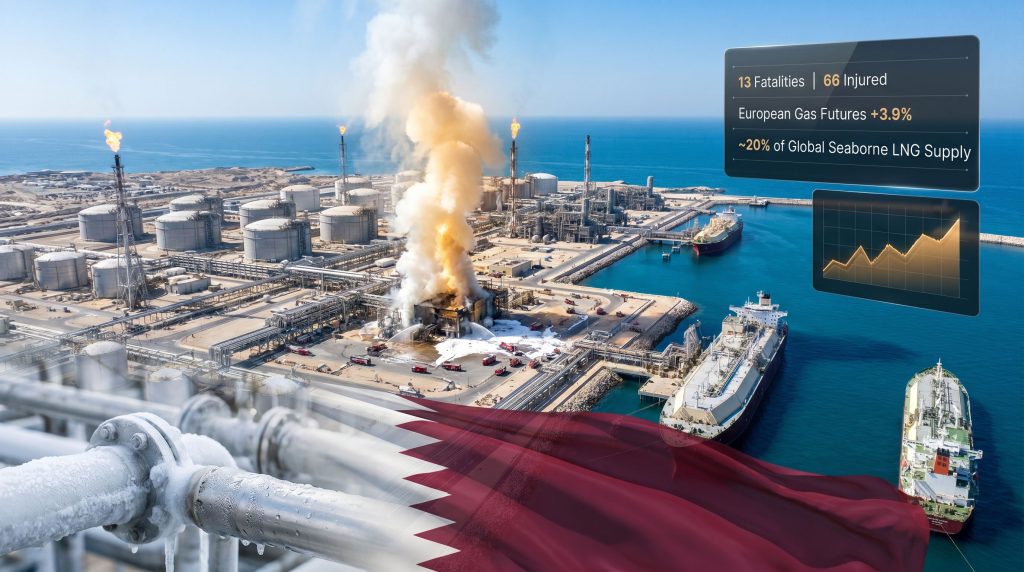
The complex is responsible for approximately one-fifth of all global seaborne LNG supply, a figure that demands pause. In a diversified global commodity market, no single facility should realistically command that kind of share. Yet the economics of LNG infrastructure, which require enormous upfront capital investment and benefit from tightly integrated production, storage, and export logistics, naturally push toward consolidation. Ras Laffan became the inevitable outcome of those economic forces.
Multiple LNG production trains, each capable of processing billions of cubic feet of natural gas annually, operate alongside a dedicated port capable of handling the world's largest LNG tankers. The entire ecosystem is co-located within the same industrial perimeter, which creates extraordinary operational efficiency under normal conditions and extraordinary systemic risk when conditions are not normal.
The Barzan Facility: Domestic Infrastructure With Global Consequences
A critical distinction that was not widely understood in early reporting is the difference between the Barzan gas supply facility and the LNG export infrastructure at Ras Laffan. Barzan is oriented toward Qatar's domestic natural gas grid rather than international export markets. It processes and delivers gas to meet local demand within the country.
The significance of this distinction is twofold. First, a direct hit to Barzan does not automatically impair LNG export train operations, which run on separate process streams. Second, any operational disruption at Barzan creates reputational pressure on QatarEnergy at precisely the moment the operator is working hardest to re-establish its credentials as a dependable long-term supplier after months of forced inactivity.
What Happened at Ras Laffan: Incident Chronology and Technical Context
A Technical Accident During a High-Risk Restart Window
The Qatar Ras Laffan LNG explosion occurred on June 21–22, 2026, at the Barzan gas supply facility within Ras Laffan Industrial City. Official classification described it as a technical accident occurring during restart operations. According to Reuters, the blast was of sufficient force to be felt in central Doha, more than 70 kilometres away, an indication of the explosive energy involved.
| Event | Detail |
|---|---|
| Date | June 21–22, 2026 |
| Location | Barzan gas supply facility, Ras Laffan Industrial City |
| Initial reports | 54 injured, 18 missing |
| Confirmed casualties | 13 fatalities, 66 injured |
| Blast reach | Felt in central Doha, 70+ km from site |
| Official classification | Technical accident during restart operations |
| Fire outcome | Brought under control; no public safety threat declared |
The accident did not unfold during routine operations. Production at Ras Laffan had been suspended since early 2026 following Iranian military attacks that forced QatarEnergy to declare force majeure on its LNG delivery obligations. The Barzan explosion occurred specifically during the restart of systems that had been offline for months, a phase of operations that carries risks qualitatively different from steady-state production.
Why Restarting LNG Infrastructure Is More Dangerous Than Running It
This point is rarely communicated clearly in mainstream energy coverage, yet it is arguably the most important technical insight for understanding the Ras Laffan incident. LNG production trains operate at temperatures approaching negative 162 degrees Celsius, at which point natural gas transitions from its gaseous state into liquid form at roughly one six-hundredth of its original volume.
Getting these systems back online after a prolonged shutdown is not a matter of flicking a switch. Engineers must:
-
Gradually cool cryogenic systems from ambient temperature to operating temperature, a process that can take days and must proceed within tightly controlled thermal gradients to prevent material stress fractures.
-
Re-pressurize process streams through precisely staged increments, because premature pressure introduction can cause catastrophic equipment failure in pipework, heat exchangers, and compressor systems.
-
Conduct sequential integrity checks across hundreds of interconnected components before any gas flow is introduced.
-
Manage fugitive gas risks during line purging and pressure testing, where the risk of ignition is at its highest.
The Barzan incident illustrates that restart phases represent a distinct and elevated operational risk window that experienced engineers know well but that is often invisible to external market observers.
Market Reaction: How Gas Traders Priced the Uncertainty
European Futures Spike and Partial Recovery
European natural gas futures surged by as much as 3.9% in the immediate aftermath of news breaking about the Qatar Ras Laffan LNG explosion. The speed and magnitude of that move reflects the psychological weight Ras Laffan carries in global gas markets, even while the facility itself had been offline for months. In addition, Asian LNG demand dynamics had already been shifting heading into this period of disruption.
The partial recovery that followed after QatarEnergy's CEO publicly confirmed that LNG export infrastructure remained undamaged illustrates a nuanced dynamic in commodity markets: price movements at moments of geopolitical or industrial shock are frequently driven by uncertainty rather than confirmed supply disruption. Once a credible authority reduced that uncertainty, the premium partially deflated.
The near-4% intraday spike on a facility that was already offline demonstrates how deeply gas traders had priced in the expectation of Qatari supply returning to market. The explosion threatened that timeline, and markets moved accordingly before facts could catch up.
Force Majeure: The Legal and Reputational Dimension
QatarEnergy had already invoked force majeure on LNG deliveries following the Iranian attack-related shutdown earlier in 2026. Force majeure is a legally significant declaration under international contract law that suspends a party's delivery obligations when extraordinary circumstances beyond their control make performance impossible. It protects the supplier legally but carries significant reputational costs in a market where buyers value predictability above almost everything else.
The Barzan explosion lands into this already-sensitive context. Buyers who had structured supply agreements around Qatari volumes were watching the restart timeline as a signal of when supply certainty would return. Consequently, any further complication to that timeline extends their planning uncertainty and strengthens the commercial case for accelerating diversification discussions with alternative suppliers. These energy trade disruptions compound an already volatile environment for global commodity buyers.
Export Status and Tanker Movements: Reading the Operational Signals
QatarEnergy's Official Export Position
QatarEnergy's CEO Saad al-Kaabi stated publicly at a press conference in Doha that LNG export facilities, the Ras Laffan port, and all associated logistical operations remained unaffected by the explosion. Export capabilities were confirmed as unimpaired, and domestic gas supply within Qatar was declared stable. An independent investigation into the cause of the accident was confirmed as initiated.
The stated target is to restore approximately 80% of Ras Laffan's LNG production capacity within two months of the Strait of Hormuz being declared safely navigable for tanker transit.
Tanker Movements as a Leading Indicator
Ship-tracking data captures a real-time picture of operational intent that official statements alone cannot fully provide. Four LNG tankers, either owned by Qatar's shipping arm or operating under long-term charter arrangements with QatarEnergy, were tracked transiting the Strait of Hormuz toward Ras Laffan without concealing their positions.
This transparent vessel movement carries meaningful signal value. In maritime logistics, the decision to transmit AIS (Automatic Identification System) data openly, rather than operating dark as some vessels do during periods of heightened regional tension, indicates a degree of confidence in transit safety. Qatar was moving empty tankers toward Ras Laffan in preparation for resuming export shipments.
The Strait of Hormuz: A Chokepoint That Defines Qatar's Export Ceiling
Geography as Structural Risk
Every cubic metre of LNG that leaves Ras Laffan must pass through the Strait of Hormuz, the narrow maritime corridor separating the Persian Gulf from the Gulf of Oman. Approximately 20 to 30% of all global LNG trade transits this passage, making it the most consequential single chokepoint in the seaborne energy system.
Qatar has no alternative routing. Unlike pipeline exporters who can switch transit nations, or Pacific Basin LNG producers whose shipping routes bypass the Middle East entirely, Qatar's entire export geography is pinned to Hormuz passage. This creates a structural dependency that geopolitical risk in the Persian Gulf automatically amplifies. Indeed, the interplay of trade and geopolitics has rarely been more consequential for energy infrastructure than in 2026.
The gradual resumption of vessel traffic through the Strait, evidenced by the four tracked tankers, suggests incremental normalisation. However, incremental normalisation and full operational confidence are not the same thing, and the gap between them represents sustained uncertainty for global gas markets.
The next major ASX story will hit our subscribers first
Who Benefits From Qatar's Extended Disruption?
Alternative Suppliers Positioned to Fill the Gap
The sustained constraint on Qatari LNG output creates commercial opportunity for competing producers, even as it represents a systemic challenge for global supply security. The competitive landscape is not uniform, and different suppliers carry different advantages depending on the buyer's geography and contract preferences.
| Supplier | Competitive Advantage | Constraint |
|---|---|---|
| U.S. LNG (Sabine Pass, Freeport, Corpus Christi) | Flexible destination clauses; significant spare capacity | Higher shipping costs to Asia |
| Australian LNG (Gorgon, Wheatstone, QCLNG) | Proximity to Asian buyers; established long-term contracts | Limited spot availability |
| East African LNG (Mozambique emerging) | Long-term development potential | Not yet at commercial scale |
| Russian Arctic LNG | Discounted pricing for non-Western buyers | Western sanctions limit buyer access |
The net effect of Qatar's multi-month disruption is an accelerated renegotiation of the long-term supply agreement landscape. Buyers that had historically relied heavily on Qatari volumes are now engaging more seriously with U.S. exporters whose flexible destination contracts offer supply chain diversification without requiring the buyer to abandon existing Qatari relationships entirely.
The Cryogenic Equipment Bottleneck: A Multi-Year Constraint
Perhaps the least-discussed but most consequential detail to emerge from the Ras Laffan situation is the three-to-five year repair timeline for the two LNG production trains that sustained damage in earlier Iranian attack-related incidents. This timeline is not driven primarily by engineering hours. It reflects a global supply chain constraint on cryogenic-grade industrial components.
LNG trains depend on:
- Plate heat exchangers and spiral-wound heat exchangers engineered for sustained operation at negative 162 degrees Celsius
- Cryogenic centrifugal pumps capable of handling liquid methane without cavitation
- Specialty metallurgical alloys, particularly nickel steel and austenitic stainless steel, that maintain structural integrity under extreme cold
- Precision-insulated piping systems that prevent heat ingress across distances of hundreds of metres
Very few manufacturers globally produce these components at the required specification and scale. When multiple facilities simultaneously require cryogenic repair equipment, lead times extend sharply. This is why the three-to-five year figure represents a genuine ceiling on how quickly Qatar can restore its full production capacity regardless of political will or financial resources.
Long-Term Structural Implications for Global LNG Architecture
Concentration Risk as the Central Lesson
The Qatar Ras Laffan LNG explosion, viewed within its full context of geopolitical disruption, force majeure declarations, cryogenic equipment shortages, and Hormuz transit uncertainty, presents the global energy industry with a structural argument it can no longer defer. This scale of energy market shock has forced a fundamental reassessment of how buyers structure long-term supply security.
Routing approximately one-fifth of global seaborne LNG supply through a single industrial complex, dependent on a single maritime chokepoint, in a geopolitically active region, creates a systemic risk profile that no amount of engineering excellence fully mitigates. The 2026 disruptions have made this visible in a way that theoretical risk assessments never could.
The practical implications for long-term energy planning include:
- Buyers accelerating offtake agreements with geographically diversified producers
- Project developers in the United States and Australia facing improved economics for incremental capacity additions
- Sovereign wealth funds and institutional energy investors reassessing the risk-adjusted returns on single-source supply dependency
- Insurance and reinsurance markets repricing political risk coverage for Persian Gulf energy infrastructure
Frequently Asked Questions: Qatar Ras Laffan LNG Explosion
What exploded at Ras Laffan in June 2026?
The explosion occurred at the Barzan gas supply facility within Ras Laffan Industrial City. Barzan processes natural gas for Qatar's domestic energy grid rather than for LNG export, and the blast was officially classified as a technical accident during restart operations following an earlier period of suspension.
How many people were killed or injured?
Early reports from international outlets including Reuters and AP News cited 54 injured and 18 missing. Updated and confirmed casualty figures are 13 fatalities and 66 people injured, reflecting the progression of search, rescue, and medical assessment operations at the site.
Will the explosion affect global LNG supply?
QatarEnergy's official position, confirmed publicly by its CEO, is that LNG export infrastructure was not damaged and export capabilities remain intact. However, the broader context, including prior shutdown from Iranian attack damage, a separate three-to-five year repair timeline for two LNG trains, and ongoing Strait of Hormuz transit uncertainty, means Qatari LNG supply remains constrained through the near-to-medium term regardless of the Barzan incident's direct impact.
How far away was the explosion felt?
The blast was felt in central Doha, located more than 70 kilometres from the Ras Laffan industrial site, indicating the scale of the explosion event.
When will Qatar resume full LNG production?
Qatar is targeting restoration of approximately 80% of Ras Laffan's LNG production capacity within two months of the Strait of Hormuz being confirmed safely navigable. Full production capacity restoration, accounting for the two previously damaged LNG trains, carries a separate and significantly longer timeline of three to five years, contingent on the global availability of specialist cryogenic repair components.
Disclaimer: This article contains forward-looking assessments regarding supply recovery timelines, market dynamics, and geopolitical scenarios. These projections involve material uncertainty and should not be interpreted as investment advice. Readers are encouraged to consult primary sources including QatarEnergy official communications and independent energy market analysis for the most current operational updates.
Want to Stay Ahead of the Next Major Energy or Mineral Discovery?
While the Ras Laffan disruption reshapes global LNG supply chains, the ripple effects extend deep into commodity markets, creating real-time opportunities for investors who can act quickly. Discovery Alert's proprietary Discovery IQ model instantly identifies significant ASX mineral discoveries across 30+ commodities, delivering actionable alerts ahead of the broader market — explore historic discoveries and their returns to see what early positioning can mean, then begin your 14-day free trial to secure your market-leading advantage.