August 6, 2026
The Qatar Sulphur Price: A Benchmark That Moves Markets
When a commodity that most people never think about starts moving at 55% in four months, it rarely stays invisible for long. Sulphur occupies a peculiar position in global trade: unglamorous, chemically uncomplex, and yet absolutely foundational to the fertilizer systems that feed billions of people. Understanding why QatarEnergy raises June sulphur price to $805/t FOB requires looking beyond the headline number and into the interlocking pressures of geopolitics, freight economics, and agricultural supply chain fragility that are reshaping this market in real time.
Understanding the QSP Mechanism
The Qatar Sulphur Price, published monthly by QatarEnergy Marketing, is an official selling price applied to sulphur exported from two of the Gulf's most significant industrial hubs: Ras Laffan and Mesaieed. What makes this benchmark particularly influential is not merely the volume of sulphur Qatar exports, but the signalling function the QSP performs across the entire sulphur and phosphate fertilizer trading ecosystem.
Unlike spot markets that adjust continuously, the QSP is a deliberate monthly price-setting exercise. Buyers across South Asia, East Asia, and sub-Saharan Africa use it as a contractual anchor, and any upward revision creates an immediate cascade effect through downstream procurement budgets. When the QSP moves, fertilizer manufacturers, sulphuric acid producers, and agricultural input suppliers all recalibrate simultaneously.
The 2026 Repricing Trajectory
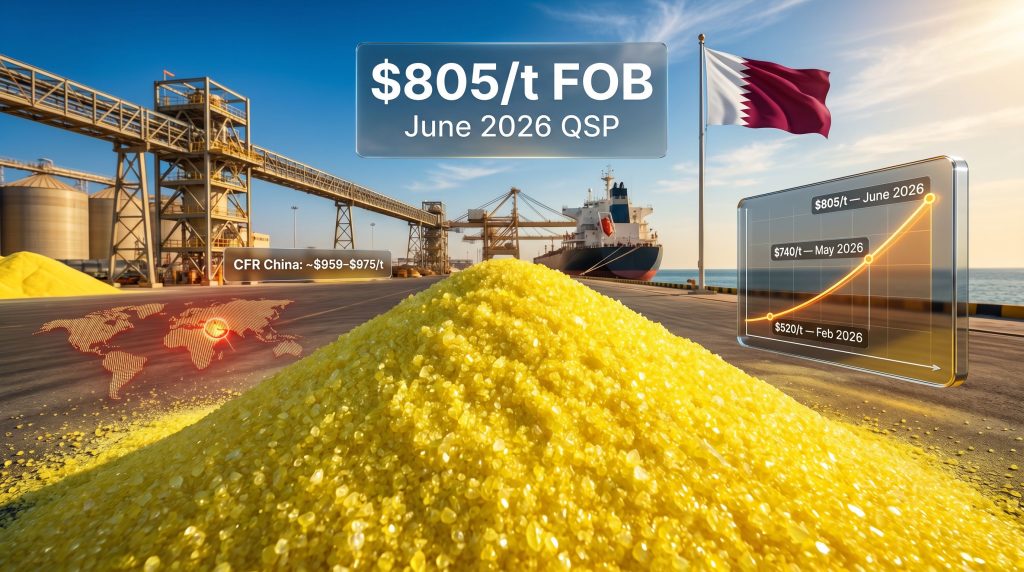
The speed of the current sulphur repricing cycle is striking even by historical standards. The following table illustrates the scale of the shift:
| Month | QSP FOB Price (Ras Laffan/Mesaieed) | Month-on-Month Change |
|---|---|---|
| February 2026 | $520/t | Baseline |
| May 2026 | $740/t | Record high at the time |
| June 2026 | $805/t | +$65/t increase |
The cumulative appreciation from February to June represents roughly ~55% uplift across just four months. The June figure of $805/t FOB establishes a new pricing frontier for Middle East sulphur exports and raises serious questions about whether this trajectory reflects a temporary supply shock or a more durable structural repricing.
A key but underappreciated aspect of the QSP is that it is set on a free-on-board basis, meaning buyers bear all freight and insurance costs separately. At current freight rates, the gap between the FOB price and what a buyer in Asia actually pays is substantial and widening. Argus Media has tracked this surge closely, noting the May 2026 price of $740/t already represented a record high before June's further escalation.
When big ASX news breaks, our subscribers know first
The Strait of Hormuz Variable: Geopolitical Risk Embedded in Every Tonne
Why Hormuz Matters for Sulphur Trade Specifically
The Strait of Hormuz is the primary maritime exit corridor for a significant share of Middle East sulphur exports. Its importance to energy markets is widely understood, but its role in sulphur logistics is less commonly appreciated. Sulphur produced as a byproduct of natural gas processing at facilities like Ras Laffan must physically transit Hormuz to reach Asian, African, and South Asian buyers.
The onset of the US-Iran conflict introduced material uncertainty around safe passage through the strait. Longer effective delivery timelines, elevated war-risk insurance premiums, and the logistical complexity of rerouting vessels have collectively added a geopolitical risk premium to every tonne of Middle East-origin sulphur. The Strait of Hormuz oil risk extends well beyond crude, encompassing the sulphur byproduct streams that flow from the same regional gas processing infrastructure.
Reports emerging in late May 2026 suggested that a draft ceasefire framework included provisions for Tehran to restore commercial shipping volumes through Hormuz to pre-conflict levels within one month. However, as of the end of May 2026, no ratified agreement existed, and significant disagreements remained between Washington and Tehran over Hormuz governance arrangements and the pace of sanctions relief.
This unresolved tension creates a binary risk for sulphur buyers: they must either accept elevated delivered costs and supply uncertainty from the Middle East, or pay a premium for supply from origins that carry no Hormuz exposure at all.
Furthermore, geopolitical trade disruption of this nature rarely resolves linearly, and buyers who assume a swift normalisation risk being caught short when procurement windows close.
The Freight Cost Amplification Effect
As of late May 2026, freight rates for standard 30,000–35,000 tonne sulphur shipments to Chinese ports were assessed at $154–$170/t, according to Argus Media. Applied against the June QSP of $805/t FOB, the implied delivered cost to Chinese buyers ranges from approximately $959 to $975/t CFR, before insurance loadings are applied.
| Cost Component | Estimated Range |
|---|---|
| QSP FOB (June 2026) | $805/t |
| Freight to China (30–35kt vessel) | $154–$170/t |
| Implied CFR China (pre-insurance) | $959–$975/t |
| Post-insurance effective delivered cost | Above $975/t |
This cost stack has created a counterintuitive market condition: Vancouver FOB sulphur prices, typically trading at a discount to Middle Eastern supply, have risen to $990–$1,100/t FOB as buyers willingly absorb a higher headline price in exchange for supply certainty unencumbered by Hormuz risk. This pricing inversion is a direct market signal that delivery reliability now commands a tangible monetary premium.
India's Demand-Side Response: Deferral as a Price Negotiation Tool
The IPL Tender Collapse and What It Reveals
India Potash Limited (IPL), purchasing on behalf of eight Indian companies, issued a tender seeking 593,500 tonnes of sulphur across June, July, and August 2026 delivery windows. The scale of this tender alone reflects the magnitude of India's upstream sulphur dependency for its domestic fertilizer manufacturing complex.
The tender results were commercially incompatible with prevailing market assessments:
- East coast June–July offers arrived at $1,170–$1,295/t CFR, well above market
- August delivery offers came in at $1,065–$1,098/t CFR
- West coast India attracted no full cargo offers; only two parcels of 3,000 tonnes each were offered at $1,400/t CFR
- Argus-assessed granular sulphur prices for India were running at $1,000–$1,100/t CFR at the time
- One unusually low offer of $565/t CFR covering approximately 593,000 tonnes was received but widely considered illegitimate and likely disqualified at an early stage
IPL entered price negotiations with traders following the tender's close, but was ultimately unable to bridge the gap. The tender was scrapped entirely.
The abandonment of this tender is a textbook example of demand deferral functioning as a market force. When buyers conclude that sellers are operating above fair value, the rational response is to wait, reduce inventory burn rates, and reenter the market at a more favourable inflection point. If this behaviour is replicated across multiple major importers simultaneously, a price correction window in H2 2026 becomes plausible.
DAP Inventories and the Agricultural Pressure Building Underneath
Sulphur's relevance to Indian agriculture extends far beyond the molecule itself. Sulphur is the primary upstream input for sulphuric acid production, which is in turn the key reagent in manufacturing diammonium phosphate (DAP), one of India's most important agricultural fertilizers. Disruptions to the phosphate supply chain at this level reverberate all the way through to farm gate economics.
Indian DAP inventories recovered marginally to approximately 1.93 million tonnes at the start of May 2026, according to Argus estimates based on data from the Fertilizer Association of India (FAI). Despite the modest recovery, stocks remain more than 1 million tonnes below the average for the equivalent period across 2022–2024.
Further compounding the picture:
- DAP imports for January–April 2026 totalled only 298,000 tonnes, representing just 39% of India's DAP import volume over the same period in 2025
- India produced approximately 303,000 tonnes of DAP in April 2026, just 10,000 tonnes below the same month last year
- January–April 2026 DAP production of 1.175 million tonnes exceeded the 933,000 tonnes produced in the equivalent period of 2025
- Yet domestic DAP sales reached 326,000 tonnes in April 2026, surpassing the prior year by 114,000 tonnes, with year-to-date offtake running 49% higher than January–April 2025
The arithmetic is unforgiving. Strong domestic consumption combined with constrained imports and tightening upstream raw material availability creates a structural tension that elevated sulphur prices are actively worsening. A prolonged period of expensive sulphur will ultimately either compress DAP producer margins or translate into higher agricultural input costs for Indian farmers.
New Supply Entrants: Colombia's Ecopetrol and the Atlantic Basin Pivot
A Modest But Symbolically Important Development
Colombian national oil company Ecopetrol announced its first containerised sulphur export from its 200,000 b/d Cartagena refinery, with the inaugural shipment of approximately 1,100 metric tonnes scheduled for June 2026. Destination markets include Tanzania and Peru, reflecting an initial focus on African and Latin American buyers rather than the higher-volume Asian markets currently dominated by Middle East and Canadian supply.
Ecopetrol has indicated a planned regular export cadence of approximately 1,000 tonnes per month of containerised sulphur, with July volumes under active commercial negotiation. The company also recently commissioned a new pelletizing plant at Cartagena, producing solid sulphur for Colombia's domestic fertilizer, chemical, mining, and water treatment sectors.
While these volumes are negligible relative to Qatar's export scale, the strategic significance extends beyond the numbers. Ecopetrol's entry represents the broadening of an Atlantic Basin sulphur supply base that carries zero Hormuz exposure and is geographically proximate to emerging market buyers in Africa and Latin America who are actively seeking supply chain diversification.
Comparing Supply Origins: A Strategic Perspective
| Supply Origin | Current FOB Price Range | Hormuz Exposure | Delivery Reliability | Volume Scale |
|---|---|---|---|---|
| Qatar (Ras Laffan/Mesaieed) | $805/t | High | Disrupted | Very Large |
| Vancouver (Canada) | $990–$1,100/t | None | High | Large |
| Colombia (Cartagena) | Nascent/TBD | None | High | Very Small |
| Broader Middle East | Elevated | High | Disrupted | Large |
The table above captures a dynamic that experienced commodity traders recognise well: when a dominant supply origin is structurally disadvantaged by geopolitical risk, even small alternative supply sources acquire commercial leverage disproportionate to their volume.
Downstream Exposure: Who Bears the Cost of Elevated Sulphur Prices?
Fertilizer Sector Vulnerabilities
The sulphur-to-sulphuric-acid-to-phosphate fertilizer production chain is one of the most direct transmission mechanisms between commodity prices and agricultural costs. Sustained sulphur prices above $800/t FOB place meaningful upward pressure on the production economics of:
- DAP (diammonium phosphate): The primary phosphate fertilizer globally, requiring both sulphuric acid and ammonia
- MAP (monoammonium phosphate): An alternative phosphate source with similar upstream sulphur dependency
- SSP (single superphosphate): A lower-concentration product particularly relevant for smaller farm operations in emerging markets
Regions with heavy dependence on imported sulphur for domestic fertilizer production face the sharpest exposure. India, Brazil, and parts of Southeast Asia sit at the highest risk end of the spectrum. Brazil, as both a major agricultural producer and a significant phosphate fertilizer consumer, is particularly sensitive to sustained Middle East sulphur price inflation given its reliance on imported supply chains.
Industrial and Mining Sector Exposure
Beyond agriculture, elevated sulphur pricing creates cost pressures across several industrial segments that are less visible but economically material:
- Hydrometallurgical mining operations: Sulphuric acid is the primary leaching agent for copper and uranium extraction. Understanding copper leaching economics becomes increasingly important as sustained sulphur inflation translates directly into higher operating costs for heap leach and tank leach copper mines, particularly in Chile, Peru, and Zambia
- Specialty chemical manufacturing: Applications spanning synthetic dyes, pharmaceutical intermediates, and rubber vulcanization all incorporate sulphur-derived feedstocks
- Municipal water treatment: Sulphur compounds play a role in water purification processes across water-stressed developing markets
In addition, Chilean copper exposure is particularly acute, given Chile's position as the world's largest copper producer and its heavy reliance on sulphuric acid-based leaching across major operations. World Fertilizer has also noted that rising Middle Eastern sulphur prices are compounding input cost pressures across multiple downstream industries simultaneously.
Three Scenarios for Sulphur Markets Through H2 2026
Scenario 1: Hormuz Normalises, Prices Correct
If a US-Iran ceasefire agreement is ratified and commercial passage through Hormuz returns toward pre-conflict volumes, the geopolitical risk premium embedded in current Middle East sulphur pricing would logically compress. Freight rates would ease as vessel routing normalises, insurance loadings would decline, and the Vancouver price premium over Middle East FOB levels would narrow or disappear.
In this scenario, deferred demand from buyers like IPL re-enters the market at lower prices, creating a period of strong volume absorption before the market rebalances at a sustainably lower price level.
Scenario 2: Prolonged Disruption Accelerates Structural Shifts
Continued Hormuz uncertainty through Q3 and Q4 2026 would sustain the current freight and insurance burden on Middle East supply. Buyers would accelerate their diversification toward Atlantic Basin and other non-Hormuz origins. New entrants like Ecopetrol would gain commercial momentum faster than their initial modest volumes suggest. Phosphate fertilizer costs would remain structurally elevated through the Northern Hemisphere autumn application season.
This scenario is arguably the more transformative one for the long-term geography of global sulphur trade. Supply chain reconfiguration, once begun, tends to create durable commercial relationships that persist even after the original disruption resolves.
Scenario 3: Demand Destruction Triggers a Market Reset
The IPL tender collapse provides an early data point for this scenario. If sustained sulphur prices above $800/t FOB drive systematic demand deferral across multiple major buying nations, the supply-demand balance could shift more rapidly than current price momentum suggests. Fertilizer producers operating at compressed margins would reduce run rates or substitute where technically feasible.
Agricultural buyers would delay forward procurement. A supply overhang could emerge in late Q3 or Q4 2026, particularly if Hormuz uncertainty eases simultaneously. Consequently, QatarEnergy raises June sulphur price to $805/t FOB may ultimately prove to be near the cyclical peak rather than a midpoint in a longer upward trajectory.
Disclaimer: The scenarios presented above are analytical frameworks based on publicly available market data and represent possible future pathways rather than forecasts or investment recommendations. Commodity markets are subject to rapid change driven by geopolitical, logistical, and macroeconomic variables that cannot be fully anticipated.
The next major ASX story will hit our subscribers first
Frequently Asked Questions
What does it mean that QatarEnergy raises June sulphur price to $805/t FOB?
It means QatarEnergy Marketing set its official selling price for sulphur exported from its Ras Laffan and Mesaieed industrial terminals at $805 per tonne on a free-on-board basis for June 2026, representing a $65/t increase over the May 2026 level.
Why are delivered sulphur costs to Asia so much higher than the FOB price?
Because the FOB price excludes freight and insurance. Applying late-May 2026 freight assessments of $154–$170/t for shipments to Chinese ports generates an implied CFR China cost of $959–$975/t before insurance premiums, which push effective delivered costs above $975/t when applied.
What is the connection between sulphur and food prices?
Sulphur is converted into sulphuric acid, which is the key reagent in producing phosphate fertilizers including DAP and MAP. These fertilizers underpin crop yield across grain, oilseed, and horticultural production globally. Sustained sulphur price inflation therefore has a transmission pathway, with a lag, into agricultural input costs and ultimately farm gate economics.
Why is Vancouver sulphur currently priced above Middle Eastern FOB levels?
The inversion reflects buyer willingness to pay a supply certainty premium for Canadian-origin sulphur that does not require transit through the Strait of Hormuz. When delivery risk from a lower-priced origin exceeds the cost savings, rational buyers shift to more expensive but more reliable alternatives.
How significant is Ecopetrol's entry into sulphur exports?
The initial volumes are modest at approximately 1,000 tonnes per month, but the strategic significance is disproportionate. It signals a broadening of the Atlantic Basin sulphur supply base and creates a new commercial option for African and Latin American buyers seeking Hormuz-independent supply. The longer-term trajectory will depend on how aggressively Ecopetrol scales its pelletizing and containerisation infrastructure at Cartagena.
Want to Track the Next Major Commodity Discovery Before the Market Does?
Discovery Alert's proprietary Discovery IQ model scans ASX announcements in real time, instantly converting complex mineral and commodity data into actionable investment insights — so subscribers are positioned ahead of the broader market the moment a significant discovery is announced. Explore historic discoveries and their returns to understand what early positioning can mean, then begin your 14-day free trial at Discovery Alert to secure your market-leading edge.