August 5, 2026
Qatar's announcement to halt sulphur production at its Ras Laffan facility represents a critical juncture in global commodity markets, where geopolitical tensions intersect with concentrated production capacity to create extraordinary supply chain vulnerabilities. The interconnected nature of modern industrial supply chains makes global fertilizer production susceptible to sudden disruptions that cascade through agricultural supply networks worldwide, particularly when considering the broader US‑China trade war impact on commodity flows.
Understanding these systemic risks requires analyzing how integrated production models, geographic concentration, and seasonal demand patterns combine to create potential crisis scenarios where seemingly local disruptions reshape entire commodity markets within days rather than months.
Understanding the Strategic Context Behind Qatar to Stop Sulphur Production
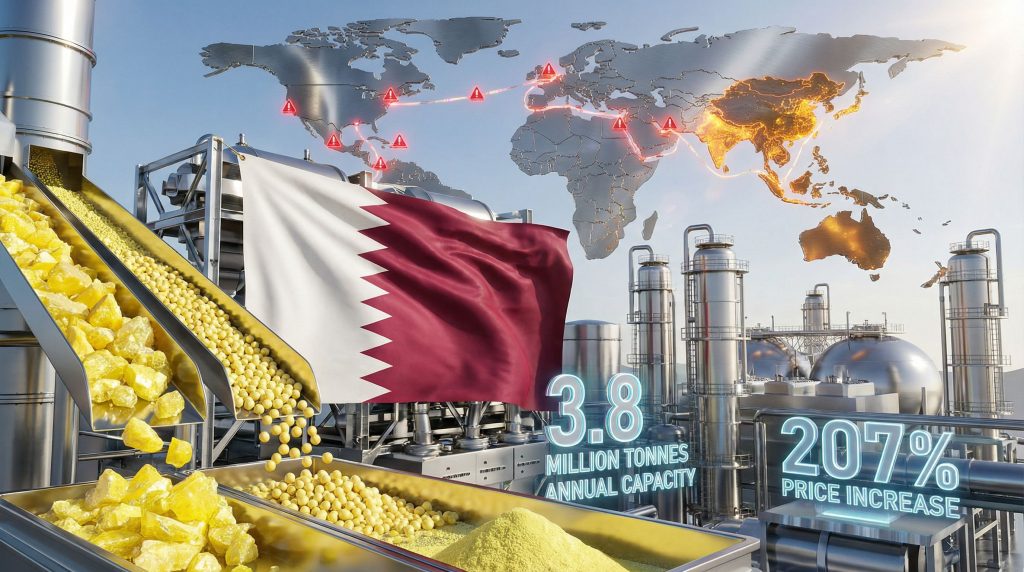
The announcement that Qatar to stop sulphur production represents far more than a temporary industrial interruption. QatarEnergy's decision to halt operations at the Ras Laffan facility removes 3.8 million tonnes of annual sulphur capacity from global markets, eliminating approximately 8 percent of worldwide seaborne sulphur trade.
The production halt followed drone strikes on March 3, 2026, targeting Qatar's industrial infrastructure as part of broader regional conflicts. This timing creates acute vulnerability in supply chains already experiencing price pressures and demand destruction concerns.
Production Facility Specifications
The Ras Laffan complex operates as one of the world's most significant integrated energy facilities, processing multiple product streams simultaneously:
- Daily liquid sulphur output: 10,000 tonnes per day
- LNG export capacity: 77 million tonnes annually
- 2025 export volumes: 3.4 million tonnes of sulphur
- Product integration: LNG, LPG, ethane, sulphur, and natural gas liquids
The facility's strategic importance extends beyond volume metrics. Its position within established trade corridors to Asia-Pacific markets and integration with Qatar's massive LNG operations creates economic advantages that standalone sulphur operations cannot replicate.
Compound Regional Impact Analysis
The Qatar production halt coincides with damage to Saudi Arabia's Ras Tanura refinery, which operates 102,000 tonnes per year of sulphur capacity. State-controlled Saudi Aramco shut the facility after sustaining damage from intercepted Iranian drone debris, removing an additional 2.8 percent of regional production capacity.
This convergence of multiple facility disruptions within the same geographic zone demonstrates how regional conflicts create cascading supply losses across interconnected industrial complexes. The timing particularly affects global supply chains because both facilities share dependence on safe passage through the Strait of Hormuz for export logistics.
When big ASX news breaks, our subscribers know first
What Makes Qatar's Sulphur Production Strategically Critical?
Qatar's position in global sulphur markets derives from unique structural advantages that competing suppliers cannot easily replicate. The nation's integrated LNG-sulphur production model creates economic efficiencies and quality consistency that establish it as a preferred supplier for major Asian fertilizer manufacturers.
Byproduct Economics and Integration Advantages
Sulphur emerges as a mandatory byproduct when natural gas contains hydrogen sulfide compounds during LNG processing. The desulfurization process required to meet international LNG specifications generates substantial sulphur volumes as a recoverable byproduct through the Claus process.
This integration creates economics where sulphur production carries minimal marginal cost beyond collection and processing, enabling competitive pricing relative to dedicated mining operations. The industrial-grade sulphur achieves 99.5 percent purity specifications required for phosphate fertilizer manufacturing, where sulphuric acid comprises 85 percent of total sulphur consumption applications.
Infrastructure Synergies and Logistics Integration
| Facility Component | Capacity/Specification | Strategic Advantage |
|---|---|---|
| Port Operations | Multi-product terminals | Shared infrastructure costs |
| Pipeline Network | Integrated distribution | Reduced transportation expenses |
| Storage Facilities | Combined product handling | Optimised throughput management |
| Quality Control | Consistent 99.5% purity | Meets fertiliser manufacturing specs |
The Ras Laffan complex accommodates multiple product streams including crude oil, LNG, LPG, and sulphur through shared port facilities, reducing per-unit logistics costs through facility utilisation optimisation. Pipeline infrastructure connects production units directly to storage and loading terminals, enabling efficient throughput management without intermediate handling requirements.
Market Positioning and Trade Corridor Dominance
Qatar's 3.4 million tonnes of annual sulphur exports flow primarily through established distribution networks to Asia-Pacific consuming regions. These trade relationships have developed over multiple years, creating contractual obligations and logistical dependencies that cannot be rapidly substituted when supply disruptions occur.
The strategic positioning creates disproportionate market influence relative to absolute volume share. While Qatar represents approximately 8 percent of global seaborne trade, its concentration within Asian supply corridors means certain regional markets face acute dependencies approaching 28 percent of total requirements.
Which Global Regions Face the Greatest Supply Vulnerability?
The suspension of Qatar to stop sulphur production creates asymmetric impacts across different geographic markets, with Asia-Pacific regions experiencing the most severe exposure while other areas may benefit from price arbitrage opportunities and market share capture.
Asia-Pacific: Maximum Exposure Analysis
China's dependency metrics reveal extraordinary vulnerability to Middle Eastern supply disruptions. As the world's largest sulphur importer with 9.61 million tonnes consumed in 2025, China sources approximately 28 percent of requirements from Middle Eastern suppliers, including Qatar's substantial contribution.
The timing of Qatar's production halt coincides with spring agricultural application seasons across Northern Hemisphere farming regions, creating inflexible demand windows when fertiliser manufacturers cannot easily delay production schedules or substitute alternative feedstocks. Furthermore, the evolving geopolitical mining landscape adds additional complexity to supply chain planning.
India's agricultural impact concentrates in Gujarat and Maharashtra states, where major phosphate fertiliser production facilities depend on continuous sulphuric acid supply. These industrial complexes typically maintain 60-90 day operating inventories, creating vulnerability windows as stocks deplete during extended supply disruptions.
Southeast Asia manufacturing operations in Thailand and Malaysia face potential feedstock shortages affecting:
- Copper and zinc extraction processes requiring consistent sulphuric acid supply
- Tyre manufacturing operations using sulphur compounds
- Petroleum refining processes dependent on sulphur specifications
- Battery production facilities using sulphuric acid for lithium extraction
Alternative Supply Corridor Capacity Assessment
The following regional capacity analysis demonstrates expansion limitations preventing rapid substitution for Qatar's lost production:
| Region | Current Capacity (Mt/yr) | Expansion Potential (Mt/yr) | Development Timeline |
|---|---|---|---|
| North America | 8.2 | 1.5 | 18-24 months |
| Russia/CIS | 6.8 | 2.1 | 12-18 months |
| Middle East (ex-Qatar) | 12.4 | 0.8 | 6-12 months |
| Other Regions | 4.1 | 0.6 | 24+ months |
The capacity breakdown confirms that no single region possesses rapid expansion capability exceeding 2.1 million tonnes, insufficient to fully replace Qatar's 3.4 million tonne annual export volume within reasonable timeframes.
Shipping Distance Economics and Transit Vulnerabilities
Alternative sourcing creates substantial logistics challenges beyond simple capacity constraints. Additionally, effective market volatility hedging becomes crucial during such disruptions:
Transit time comparisons:
- Qatari sourcing: 14-21 days to Asian ports
- North American alternatives: 40-50 days via Cape of Good Hope
- Russian sourcing: 30-40 days via available routing options
- Working capital impact: 50-150 percent increase for equivalent tonnage in transit
Strait of Hormuz bottleneck effects compound the supply shortage. Approximately 47 percent of global sulphur exports transit through this strategic chokepoint, where shipping costs have increased by 35-50 percent due to elevated war risk premiums affecting all regional suppliers.
How Do Geopolitical Tensions Amplify Market Volatility?
The decision for Qatar to stop sulphur production occurs within a broader context of Middle Eastern supply chain vulnerabilities, creating compound risk factors that traditional market forecasting models struggle to predict accurately. According to Argus Media's latest analysis, these disruptions highlight critical vulnerabilities in global commodity markets.
Regional Conflict Escalation Patterns
The drone strikes targeting Qatar's Ras Laffan facility represent part of coordinated retaliation following US and Israeli missile strikes initiated February 28, 2026. This escalation pattern affects multiple energy infrastructure facilities simultaneously, preventing market participants from treating individual facility outages as isolated incidents.
Recent military actions demonstrate how strategic energy complexes hosting multiple product streams become priority targets during regional conflicts. The physical co-location of LNG, LPG, and petrochemical operations with sulphur production creates shared vulnerability where targeting one product stream necessitates shutting down complementary operations.
Insurance Premium Impacts and Shipping Cost Inflation
War risk premiums have increased shipping costs by 35-50 percent for all Middle Eastern exports, affecting not only Qatar but also alternative regional suppliers. Vessels diverting around the Cape of Good Hope add 14-21 days to delivery schedules, increasing working capital requirements for importers during seasonal demand peaks.
The insurance cost inflation creates pricing pressure even for facilities continuing normal operations, as elevated transportation expenses get passed through to end consumers regardless of production disruption status. Similarly, trade route disruptions continue affecting multiple commodity flows through the region.
Market Psychology and Price Discovery Mechanisms
Chinese domestic sulphur prices demonstrate rapid market reassessment following conflict announcements. Prices surged 5 percent to 4,250 yuan per tonne ex-works on March 3, 2026, compared to 4,045-4,055 yuan per tonne on February 27, representing approximately $19 per tonne value change on an import parity basis.
This immediate price adjustment reflects market participants' assessment that Qatar to stop sulphur production eliminates the lowest-cost supply source serving the world's largest consuming region during inflexible seasonal application windows.
What Price Dynamics Should Markets Expect?
Historical analysis of comparable supply disruptions provides frameworks for understanding potential price trajectories and market adjustment mechanisms following Qatar's decision to stop sulphur production.
Short-Term Elasticity Patterns and Demand Response
The sulphur market experienced dramatic price volatility even before the production halt announcement. Prices increased 207 percent from $173 per tonne fob on January 30, 2025, to $531.50 per tonne fob on January 29, 2026, demonstrating extreme sensitivity to supply concerns.
Market correction signals emerged as affordability constraints began impacting consumption. Prices dropped 7 percent to $495 per tonne on February 26, 2026, indicating demand destruction thresholds where industrial consumers reduce purchases rather than accept continued price escalation.
The Qatar production halt reverses this stabilisation trajectory, removing supply availability rather than addressing affordability concerns that were beginning to moderate price increases.
QatarEnergy Marketing Pricing Strategy Adjustments
QatarEnergy Marketing postponed announcing its March Qatar Sulphur Price (QSP) from March 1 to March 4, 2026, citing geopolitical developments. February's QSP was set at $520 per tonne fob, with market participants anticipating substantial downward correction prior to the facility attacks.
This pricing postponement reflects unprecedented market uncertainty where traditional supply-demand fundamentals become secondary to geopolitical risk assessment and logistics availability rather than production economics.
Medium-Term Rebalancing Scenario Framework
Rapid Resolution Scenario (2-3 months):
- Price normalisation toward $400-450 per tonne range
- Inventory restocking drives temporary demand surge above normal consumption
- Alternative suppliers capture permanent market share gains in Asia-Pacific regions
- Shipping route diversification reduces Strait of Hormuz dependency
Extended Disruption Scenario (6-12 months):
- Sustained pricing above $500 per tonne threshold triggering widespread demand destruction
- Accelerated investment in non-Middle Eastern production capacity expansion
- Structural shift toward regional supply chain localisation and diversification strategies
- Development of strategic sulphur reserve programmes by major importing nations
Prolonged Instability Scenario (12+ months):
- Technology investments in sulphur recovery from alternative industrial sources
- Fundamental restructuring of global trade patterns reducing Middle East dependency
- Agricultural productivity impacts from delayed or reduced fertiliser applications
- Battery supply chain disruptions affecting electric vehicle production schedules
Which Industries Face the Greatest Downstream Impact?
The decision for Qatar to stop sulphur production creates ripple effects throughout interconnected industrial ecosystems, with varying degrees of substitution possibilities and demand elasticity across different applications. These disruptions align with broader trends in the mining industry evolution, where supply chain resilience becomes increasingly critical.
Fertiliser Manufacturing: Primary Impact Zone
Phosphate fertiliser production represents the largest consumption category for sulphur, where 85 percent of global sulphur consumption supports sulphuric acid manufacturing for rock acidulation processes. The timing of Qatar's production halt coincides with Northern Hemisphere spring application seasons from March through June.
Seasonal demand inflexibility characteristics:
- Peak fertiliser demand cannot be delayed beyond optimal application windows
- Inventory depletion during spring creates acute shortages if supply disruptions extend beyond facility restart capabilities
- Crop yield implications from delayed fertiliser applications compound food security concerns globally
Regional fertiliser production vulnerabilities:
- Indian facilities in Gujarat and Maharashtra states face feedstock shortages
- Chinese phosphate manufacturers lose lowest-cost supply source during peak demand
- Southeast Asian production facilities lack alternative sourcing within economic shipping distances
Secondary Industrial Applications and Supply Chain Dependencies
Mining operations requiring sulphuric acid for copper and zinc extraction face input cost pressures that may force production curtailments if alternative sourcing proves uneconomical. These facilities typically operate with longer-term supply contracts, creating contractual disputes and force majeure claims.
Chemical manufacturing processes in tyre production and petroleum refining depend on consistent sulphur specifications for product quality maintenance. Substituting alternative suppliers may require process modifications and quality testing periods that delay production schedules.
Battery production facilities using sulphuric acid for lithium extraction could experience supply chain disruptions affecting electric vehicle manufacturing timelines, particularly in Asian production centres where Qatar supplied significant volumes.
Agricultural Productivity and Food Security Implications
The timing of Qatar to stop sulphur production creates particular vulnerability for global food production systems entering critical application periods. Delayed or reduced fertiliser applications during optimal windows can impact crop yields for entire growing seasons.
Crop yield relationship factors:
- Phosphorus availability affects root development and grain formation
- Timing sensitivity means delayed applications provide reduced effectiveness
- Soil nutrient depletion accelerates without consistent fertiliser replacement
- Regional food security depends on maintaining agricultural productivity levels
The next major ASX story will hit our subscribers first
How Should Strategic Buyers Adapt Their Procurement Strategies?
The Qatar production halt necessitates fundamental reassessment of sulphur procurement approaches, moving beyond traditional spot market reliance toward sophisticated risk management frameworks addressing geopolitical supply vulnerabilities.
Portfolio Diversification Implementation Strategies
Geographic spread requirements involve establishing supply relationships across minimum three continental regions, preventing over-dependency on any single geographic zone subject to coordinated disruption risks. This diversification strategy accepts higher logistics costs in exchange for supply security during crisis periods.
Contract structure innovations should implement force majeure clauses with alternative sourcing triggers, enabling automatic contract modifications when primary suppliers face production disruptions. These contractual arrangements require pre-negotiated backup suppliers and pricing mechanisms.
Inventory buffer optimisation calculations must account for:
- Historical disruption frequency and duration patterns
- Seasonal demand variations and application timing requirements
- Working capital costs versus supply security benefits
- Storage facility capacity and handling infrastructure limitations
Long-Term Partnership Development and Integration Approaches
Integrated supply agreements involve negotiating multi-year contracts with production capacity reservations, providing suppliers with demand certainty in exchange for guaranteed availability during market disruptions. These arrangements may require advance payments or capacity fees.
Technology collaboration opportunities include joint investment in alternative sulphur recovery technologies, enabling buyers to participate in capacity expansion projects while securing preferential access to production outputs. These opportunities often feature prominently at industry gatherings such as the resources innovation expo.
Regional hub strategies focus on establishing distribution centres in politically stable jurisdictions, creating intermediate storage and blending facilities that reduce dependency on direct shipments from production facilities during volatile periods.
What Investment Opportunities Emerge from This Disruption?
Market dislocations created by Qatar to stop sulphur production generate asymmetric opportunities for strategic investors willing to commit capital toward supply chain resilience and alternative production capacity development.
Infrastructure Development Investment Priorities
Port expansion projects targeting facilities capable of handling increased sulphur volumes from alternative sources represent immediate investment opportunities. These projects focus on regions with expanding production capacity but limited export infrastructure.
Strategic reserve facility development in major consumption regions addresses supply security concerns while creating commercial storage and logistics businesses. These facilities generate revenue through storage services while providing market stabilisation during disruption periods.
Transportation network investments in rail and pipeline infrastructure reduce maritime shipping dependencies, particularly for facilities serving inland consumption centres. These projects offer long-term returns through reduced logistics costs and improved supply reliability.
Technology Innovation and Alternative Production Investments
Sulphur recovery enhancement technologies focus on extracting sulphur from previously uneconomic industrial sources, including petroleum refining operations and metal smelting facilities currently releasing sulphur compounds as waste products.
Recycling process development targets industrial sulphur recovery from waste streams and byproducts, creating distributed production capacity less vulnerable to geographic concentration risks affecting traditional facilities.
Synthetic alternative research explores chemical processes reducing dependence on elemental sulphur inputs for specific industrial applications, particularly where quality specifications allow substitution possibilities.
Market Share Capture Opportunities for Alternative Suppliers
North American and Russian suppliers positioned to increase production capacity face unprecedented market access opportunities in Asia-Pacific regions traditionally served by Middle Eastern suppliers. These opportunities require rapid capacity expansion and logistics network development.
Investment requirements include:
- Production facility expansion and efficiency improvements
- Shipping capacity contracts and logistics network development
- Quality certification and customer relationship establishment
- Working capital for extended supply chain financing requirements
The most successful market participants will recognise that Qatar to stop sulphur production represents a fundamental shift rather than temporary disruption, requiring strategic repositioning toward supply chain resilience and alternative production technologies.
This transformation accelerates trends toward regional self-sufficiency and diversified sourcing that were emerging from previous geopolitical tensions, creating lasting changes in global commodity trade patterns and industrial supply chain management approaches.
This analysis is based on publicly available market data and industry reports. Commodity markets involve significant risks, and past performance does not guarantee future results. Investors should conduct independent research and consult qualified advisors before making investment decisions.
Considering Investment Opportunities in Commodity Supply Chain Disruptions?
Discovery Alert's proprietary Discovery IQ model delivers real-time alerts on significant ASX mineral discoveries, instantly empowering subscribers to identify actionable opportunities ahead of the broader market during periods of heightened commodity volatility. Explore how historic discoveries can generate substantial returns by visiting Discovery Alert's dedicated discoveries page, and begin your 14-day free trial today to position yourself ahead of the market.