August 14, 2026
Global energy markets face unprecedented disruption patterns as geopolitical tensions increasingly target critical infrastructure nodes. The interconnected nature of modern energy supply chains means that single-point failures at major production facilities can cascade through international markets, affecting everything from industrial operations to household heating costs. Understanding these vulnerability mechanics becomes essential as conflicts expand beyond traditional battlefields into strategic economic infrastructure, particularly with recent developments involving Qatar LNG force majeure declarations that threaten global supply stability.
Understanding Force Majeure in Energy Markets
Force majeure declarations in energy contracts serve as legal protection mechanisms when parties cannot fulfill delivery obligations due to circumstances beyond reasonable control. These contractual clauses typically encompass natural disasters, acts of war, terrorism, government interventions, and civil unrest that prevent normal commercial operations.
The Qatar LNG force majeure situation demonstrates how these legal frameworks operate in practice. When geopolitical events disrupt production facilities, energy companies invoke force majeure provisions to suspend contractual obligations without facing financial penalties. This differs significantly from operational shutdowns, where companies temporarily halt production for maintenance or market reasons whilst remaining contractually bound to deliver agreed volumes.
Key Legal Framework Components:
• Written notice requirements within 5-15 business days of triggering events
• Documentation proving the nature and expected duration of disruptions
• Evidence of mitigation efforts and alternative supply arrangements
• Buyer notification procedures including impact assessments
Long-term LNG contracts typically span 15-25 years with take-or-pay obligations ranging from 80-100% of contracted volumes. These extended timeframes create substantial exposure for both buyers and sellers when force majeure events occur, particularly in concentrated supply markets where alternative sources remain limited.
The contractual protection extends beyond simple delivery suspensions. Energy buyers cannot seek compensation during legitimate force majeure periods, though they gain freedom to source alternative supplies in spot markets. However, this flexibility proves challenging when major suppliers declare force majeure simultaneously, creating supply shortages that drive prices significantly higher.
When big ASX news breaks, our subscribers know first
Why Qatar's Position Makes This Crisis Unprecedented
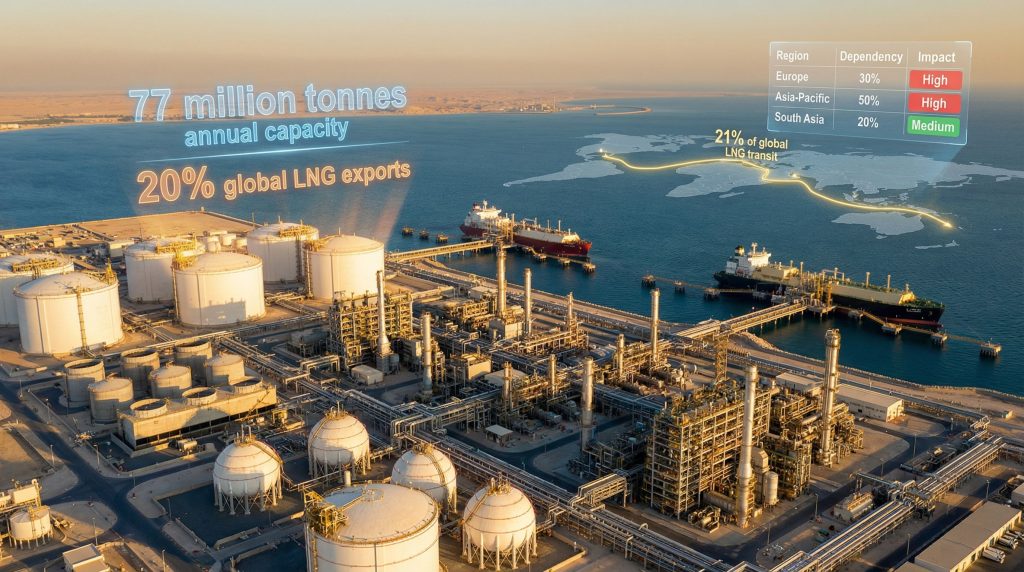
Qatar's dominance in global LNG markets creates systemic vulnerabilities that extend far beyond typical supply disruptions. The country controls approximately 20-22% of global LNG exports, representing roughly 77 million tonnes per annum (MTPA) of production capacity concentrated at the Ras Laffan Industrial City complex.
| Production Facility | Capacity (MTPA) | Operational Since | Key Partners |
|---|---|---|---|
| Qatargas 1 & 2 | 35 MTPA | 1997-2009 | Shell, ExxonMobil |
| RasGas 2 & 3 | 42 MTPA | 2009-2011 | ExxonMobil, Total |
| Total Capacity | 77 MTPA | Multiple JVs |
This concentration represents the world's largest integrated LNG production facility, featuring 14 storage tanks with combined capacity of 5.5 million cubic metres and export infrastructure capable of simultaneously loading three LNG carriers. The facility's strategic importance stems from Qatar's proven natural gas reserves of approximately 24 trillion cubic metres, the world's third-largest after Russia and Iran.
Buyer Dependency Analysis:
• European Union: 15-18% of total LNG imports from Qatar (8-10 MTPA annually)
• Asia-Pacific region: 22-25% dependency on Qatari supplies
• South Asia: 30-45% of LNG imports sourced from Qatar's facilities
No other single LNG producer commands comparable market influence. Australia operates multiple smaller facilities across different geographic regions, whilst the United States relies on distributed shale gas production feeding numerous export terminals. Qatar's integrated model creates efficiency advantages but concentrates risk in ways that mirror OPEC production impact in crude oil markets.
The Qatar LNG force majeure declaration affects buyers differently based on their supply diversification strategies. European buyers, already constrained by reduced Russian gas supplies, face particular vulnerability as alternative suppliers like Norway and Algeria lack spare capacity to compensate for Qatari shortfalls. Asian buyers benefit from Australian and Malaysian supply options, though at significantly higher transportation costs.
Reserve adequacy calculations indicate Qatar's 24 trillion cubic metre reserves could sustain current production levels for over 310 years. This resource base underpins long-term supply agreements that buyers depend on for energy security planning. When force majeure disrupts these arrangements, importing nations must rapidly adjust consumption patterns or accept substantial price premiums for spot market purchases.
How Regional Conflicts Reshape Energy Infrastructure Vulnerability
The Strait of Hormuz functions as the most critical chokepoint in global energy infrastructure, handling approximately 20-21% of worldwide LNG supplies annually. This narrow waterway, measuring just 21 nautical miles at its widest point with shipping channels of 2 nautical miles per direction, creates unavoidable geographic concentration for Middle Eastern energy exports.
Strategic Chokepoint Metrics:
• LNG transit volume: 15-16 MTPA annually through Hormuz
• Channel depth: 21-23 metres limiting carrier operations during adverse weather
• Annual vessel transits: 200-250 LNG carriers among 8,000-10,000 total ships
• Transit duration: 12-18 hours for complete Strait passage
Historical disruptions demonstrate the Strait's vulnerability to military conflicts. During the 1987-1988 Tanker War, Iraqi-Iranian attacks on commercial shipping reduced transit flows by 20-30% during peak conflict periods. Recovery required coordinated naval intervention and several weeks to restore normal operations.
The 2019 Saudi Aramco facilities attack provided a more recent example of infrastructure targeting. Coordinated drone and cruise missile strikes on the Abqaiq processing facility temporarily removed 5.7 million barrels per day from global oil supply, causing immediate 15-20% price spikes. Recovery required 6-12 weeks for full capacity restoration, demonstrating how modern precision weapons can effectively disable major energy facilities.
Furthermore, Iran's strategic capabilities pose particular threats to Gulf energy infrastructure. The country operates Shahed-series drones with ranges of 1,200-2,400 kilometres and payload capacities sufficient to damage critical production equipment. These systems, combined with ballistic missile capabilities and naval fast-attack craft, create multi-vector threat scenarios against stationary targets like Ras Laffan.
Critical Insight: Unlike crude oil production distributed across multiple continents, LNG infrastructure demonstrates acute geographic vulnerability. Qatar's 77 MTPA capacity fundamentally depends on Hormuz access, with alternative routing through the Suez Canal adding 15-20 transit days and rendering spot market transactions economically unviable.
Regional Proxy Network Assessment:
Iran maintains documented proxy forces across Iraq, Syria, Yemen, and Lebanon that have conducted over 200 documented attacks on regional energy infrastructure since 2015. These forces operate with varying degrees of Iranian coordination, creating attribution challenges for defensive responses whilst maintaining persistent disruption capabilities.
The concentration of Qatar's production at Ras Laffan creates single-point-of-failure vulnerabilities that distributed production models avoid. Liquefaction trains, storage tanks, export docks, power generation facilities, and desalination plants operate within a 10-kilometre radius, enabling coordinated attacks to cascade through integrated production chains.
Consequently, this presents challenges similar to those explored in our oil price rally analysis regarding supply chain vulnerabilities.
What Are the Immediate Market Consequences of Qatar's Shutdown
The Qatar LNG force majeure declaration triggers immediate supply tightening across global markets already stressed by reduced Russian gas flows to Europe. With Qatar controlling 20-22% of worldwide LNG exports, buyers face limited alternatives for replacing contracted volumes, particularly during peak demand seasons.
Regional Impact Analysis:
| Region | Qatar Dependency | Alternative Suppliers | Expected Price Impact |
|---|---|---|---|
| Europe | 15-18% of imports | US, Norway, Algeria | +25-40% |
| Asia-Pacific | 22-25% of imports | Australia, Malaysia | +20-35% |
| South Asia | 30-45% of imports | Limited alternatives | +50-70% |
European gas markets demonstrate particular vulnerability following the 2022 Russian supply cuts that eliminated approximately 40% of previous import sources. European storage facilities currently operate at 65-75% capacity, providing 2-3 months of buffer during extended disruptions. However, winter heating demands could exhaust these reserves rapidly without alternative supply arrangements.
LNG Cargo Scheduling Disruptions:
• Immediate impact: 25-30 LNG cargoes per month typically loaded at Ras Laffan
• Storage utilisation: Existing facility tanks contain 3-4 cargoes worth of inventory
• Buyer notification: Force majeure declarations provide 5-15 day contractual notice periods
• Alternative sourcing: Spot market premiums of $15-25 per MMBtu above contracted prices
Industrial downstream effects extend beyond simple energy costs. Fertiliser production facilities depend on natural gas both as feedstock and fuel source, with extended LNG shortages threatening urea and ammonia production across importing regions. European fertiliser manufacturers already operating at reduced capacity due to high energy costs face potential shutdowns if alternative gas supplies remain unavailable.
In addition, petrochemical operations similarly depend on consistent LNG deliveries for both energy and chemical feedstock requirements. Aluminium smelting operations, among the most energy-intensive industrial processes, cannot easily adjust to supply interruptions without risking permanent equipment damage from uncontrolled cooling.
According to QatarEnergy's official announcement, the force majeure declaration affects all scheduled deliveries, creating uncertainty for buyers globally.
Storage and Inventory Management:
LNG import terminals typically maintain 5-10 days of working inventory under normal operations. Extended force majeure periods require strategic reserve utilisation and emergency protocols that most importing nations have developed following previous supply shocks. However, these measures provide temporary relief rather than sustainable alternatives to major supplier outages.
Shipping fleet redeployment attempts to optimise available cargo capacity, though LNG carriers require 2-3 weeks for long-distance route changes. Vessels currently en route to Qatar face difficult decisions about waiting near Ras Laffan for potential loading versus seeking alternative supply sources in Australia or the United States.
The situation reflects broader challenges in natural gas trends where supply disruptions create cascading effects throughout global markets.
How Do Energy Companies Navigate Force Majeure Declarations
Energy companies employ sophisticated risk management strategies to minimise exposure during force majeure events, though the Qatar situation tests these mechanisms given Qatar's outsized market influence. Contractual frameworks typically suspend take-or-pay obligations during legitimate force majeure periods, providing legal protection for suppliers whilst forcing buyers to secure alternatives.
Risk Management Protocol Components:
• Portfolio diversification: Spreading supply agreements across multiple suppliers and regions
• Insurance coverage: Political risk and business interruption policies for geopolitical events
• Emergency storage: Strategic reserves maintained at import terminals and distribution hubs
• Alternative supplier arrangements: Pre-negotiated agreements for spot market purchases during disruptions
Take-or-pay clause suspensions during force majeure represent double-edged contractual mechanisms. Whilst buyers avoid penalties for undelivered volumes, they lose guaranteed supply access precisely when alternatives become most expensive. This creates particular challenges for utilities and industrial consumers with inflexible demand profiles.
Operational Response Strategies:
- Inventory optimisation: Maximising existing storage utilisation and extending supplies through demand reduction
- Fleet reallocation: Redirecting LNG carriers to alternative suppliers with available capacity
- Customer prioritisation: Implementing contractual priority schedules for essential services during shortages
- Fuel switching: Temporarily converting gas-fired power plants to alternative fuels where technically feasible
Insurance mechanisms provide limited protection against extended force majeure events. Political risk insurance typically covers 80-90% of contracted values but excludes consequential damages from market price volatility. Business interruption coverage requires specific force majeure language that matches actual contract terms, creating potential gaps between insurance protection and commercial exposure.
Long-term supply agreement structures increasingly incorporate flexibility mechanisms designed to address supply disruptions. These include destination flexibility clauses allowing cargo redirection, supplier substitution rights enabling buyers to source from alternative facilities, and volume adjustment mechanisms that modify delivery schedules based on force majeure duration.
Emergency Communication Protocols:
• Buyer notification: Immediate alerts to affected customers with impact assessments
• Regulatory coordination: Communications with energy regulators and emergency response agencies
• Market transparency: Public disclosure requirements for force majeure declarations affecting public utilities
• Stakeholder management: Coordinated messaging to investors, partners, and government agencies
The Qatar situation demonstrates how even sophisticated risk management frameworks struggle with systemic supply disruptions. Companies with diverse supplier portfolios fare better than those heavily dependent on Qatari supplies, though all buyers face elevated costs and supply uncertainty during extended outages.
What Communication Strategies Work Best During Disruptions?
Effective crisis communication requires immediate transparency with stakeholders whilst maintaining operational flexibility. Energy companies must balance disclosure requirements with competitive sensitivities, particularly when alternative sourcing negotiations are ongoing.
Best practices include establishing pre-drafted communication templates for various force majeure scenarios, maintaining 24/7 stakeholder contact systems, and coordinating messaging across legal, commercial, and public relations teams to ensure consistency.
The next major ASX story will hit our subscribers first
What Long-Term Strategic Shifts Will This Crisis Accelerate
The crisis accelerates structural changes in global energy security policies that governments and companies have contemplated since the 2022 Russian supply disruptions. Import-dependent nations increasingly prioritise supply diversification over cost optimisation, fundamentally altering LNG market dynamics and investment priorities.
Energy Security Policy Evolution:
• Strategic reserve mandates: Government requirements for 60-90 day LNG storage capacity at major import terminals
• Supply diversification rules: Regulatory limits on single-supplier dependencies (typically 25-30% maximum)
• Infrastructure investment incentives: Public financing for floating storage and additional regasification capacity
• Emergency response frameworks: Coordinated protocols between importing nations for supply sharing during crises
European Union energy policy demonstrates these shifting priorities. The REPowerEU plan originally focused on Russian supply replacement, but Qatar's force majeure exposes continued vulnerabilities in concentrated supply chains. New policies under consideration include mandatory LNG storage requirements of 25-30% of annual consumption and supplier diversification mandates limiting single-country dependencies.
These policy shifts reflect broader economic concerns similar to how tariffs impact markets across various sectors, as governments prioritise security over efficiency.
Infrastructure Resilience Investment Priorities:
- Floating storage capacity: Mobile LNG storage vessels providing strategic reserves and supply flexibility
- Terminal expansion: Additional regasification capacity reducing bottlenecks during supply disruptions
- Pipeline interconnections: Enhanced connectivity between import terminals and distribution networks
- Defensive systems: Security infrastructure protecting critical energy facilities from military threats
Market structure evolution reflects buyer preferences for supply security over long-term price optimisation. Traditional 20-25 year LNG contracts face pressure as buyers seek shorter terms with greater flexibility. New contract structures emphasise destination flexibility, volume adjustments, and supplier substitution rights that provide alternatives during force majeure events.
Strategic Shift: The Qatar crisis demonstrates that supply concentration creates systemic vulnerabilities that traditional risk management cannot fully address. This realisation drives fundamental changes in energy security thinking, prioritising resilience over efficiency.
Regional Hub Development:
The crisis accelerates development of regional LNG trading hubs designed to reduce dependence on individual suppliers. Asia-Pacific initiatives include expanded storage capacity in Japan and Singapore, whilst European efforts focus on integrated terminal networks spanning multiple countries.
| Region | Hub Development | Storage Capacity | Timeline |
|---|---|---|---|
| Europe | Netherlands/Germany | 15-20 bcm | 2027-2029 |
| Asia-Pacific | Singapore/Japan | 25-30 bcm | 2026-2028 |
| North America | Gulf Coast expansion | 40-50 bcm | 2025-2027 |
Investment patterns shift toward distributed production models that reduce single-point-of-failure risks. United States shale gas developments feeding multiple export terminals provide greater resilience than integrated facilities like Ras Laffan, despite efficiency disadvantages. Australian LNG projects similarly benefit from geographic distribution across different regulatory jurisdictions.
Technology and Innovation Acceleration:
• Small-scale LNG: Distributed production reducing transportation dependencies
• Floating production units: Mobile facilities less vulnerable to onshore military threats
• Advanced storage systems: Underground cavern storage providing extended strategic reserves
• Alternative energy integration: Renewable power reducing gas demand during supply constraints
According to Aljazeera's analysis, the disruption could reshape global gas markets permanently, accelerating transitions to more resilient supply structures.
However, these changes must be viewed within the context of broader economic impacts, particularly considering how US economy tariffs affect global trade patterns and energy security strategies.
The Qatar LNG force majeure situation catalyses recognition that energy security requires fundamental supply chain restructuring rather than marginal improvements to existing systems. This drives policy frameworks and investment strategies that prioritise resilience over cost optimisation, permanently altering global LNG market dynamics.
Disclaimer: This analysis contains forward-looking statements about energy markets, geopolitical developments, and infrastructure investments. These projections involve substantial uncertainties including regulatory changes, technological developments, and political events that could materially differ from stated expectations. Readers should conduct independent research before making investment or policy decisions based on this analysis.
Want to Stay Ahead of Energy Market Disruptions?
Discovery Alert's proprietary Discovery IQ model delivers instant notifications on significant ASX mineral discoveries, including energy sector developments that could reshape commodity markets during global supply disruptions. Start your 14-day free trial today and gain actionable insights that position you ahead of market volatility, ensuring you never miss opportunities when geopolitical events create investment winners and losers.