June 27, 2026
When Alliance Architecture Meets Geopolitical Complexity: The Quad's Defining Moment
Multilateral security frameworks rarely announce their own fragility. Instead, they reveal it through gaps, deferrals, and procedural workarounds that only close observers notice. The Quad, a four-nation alignment bringing together the United States, India, Japan, and Australia, entered 2026 carrying the weight of one such gap: a full year of Indian chairmanship that concluded without the Leaders' Summit it was meant to produce. Against that backdrop, the Quad foreign ministers meeting in New Delhi in late May 2026 carries a significance that extends well beyond its formal agenda.
This is not merely a routine diplomatic gathering. It is a test of whether the Quad can convert institutional credibility back into strategic momentum at a moment when the geopolitical environment is arguably more complex than at any point in the grouping's recent history.
When big ASX news breaks, our subscribers know first
Understanding the Quad Framework Before Evaluating the New Delhi Meeting
The Quadrilateral Security Dialogue operates as a flexible, agenda-driven alignment rather than a treaty-based military alliance. It lacks the binding mutual defence commitments of arrangements like ANZUS or the US-Japan Security Treaty, which means its cohesion depends almost entirely on sustained political will and consistent senior-level engagement across four governments with distinct domestic priorities.
The four member states engage through two primary formats:
- Foreign Ministers' Meetings, which handle ongoing cooperation, agenda-setting, and communiqué commitments
- Leaders' Summits, which signal the highest level of political commitment and are typically the moments when major framework agreements are announced
The Indo-Pacific is the Quad's primary operational theatre. Its strategic logic centres on maintaining an open, rules-based regional order in the face of mounting pressure from Chinese maritime expansion, technology export controls, and infrastructure diplomacy. Critically, the Quad does not describe itself as an anti-China alliance, instead framing its purpose around constructive regional contributions. However, the China variable remains the unspoken organising principle behind nearly every agenda item the grouping produces.
The Diplomatic Timeline: What Has and Has Not Happened
Context is essential to understanding why the New Delhi meeting matters. The table below captures the key events and gaps that define the Quad's recent trajectory.
| Date | Event | Location | Significance |
|---|---|---|---|
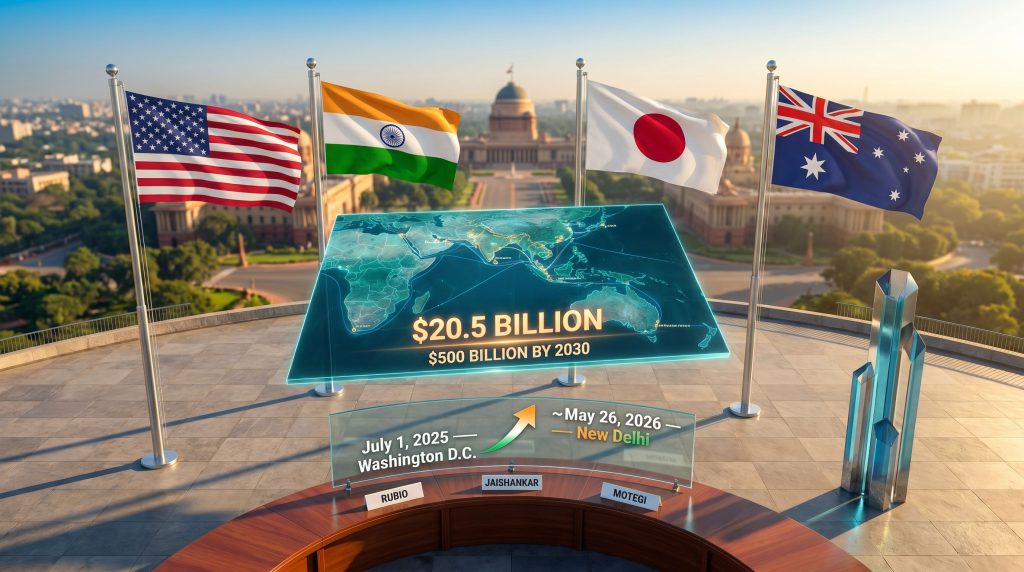
| July 1, 2025 | Quad Foreign Ministers' Meeting | Washington, D.C. | Last confirmed senior-level engagement before New Delhi |
| 2025 (full year) | India's rotating Quad chair term | New Delhi | Concluded without a Leaders' Summit |
| Late 2025 | Planned India-hosted Leaders' Summit | Cancelled/delayed | No confirmed rescheduling as of May 2026 |
| ~May 26, 2026 | Quad Foreign Ministers' Meeting | New Delhi | First Quad FM meeting on Indian soil since 2023 |
The approximately ten-month gap between the July 2025 Washington engagement and the planned New Delhi meeting is not merely a scheduling footnote. Within a grouping whose strategic value is partly performative — that is, signalling cohesion to both allies and adversaries — prolonged silence carries a reputational cost. The New Delhi meeting is, at its core, a course-correction exercise.
It is also worth noting a procedural dimension: Australia was originally understood to be the designated host for the next Foreign Ministers' Meeting in 2026. India proceeding as host represents a deviation from that expectation, the full rationale for which has not been formally documented in public statements from any of the four governments.
What the July 2025 Washington Meeting Committed To
The July 2025 communiqué from Washington established four priority cooperation areas that were to form the operational backbone of Quad engagement going forward:
- Maritime and transnational security — including freedom of navigation and counter-piracy cooperation
- Economic prosperity and supply chain resilience — targeting single-point vulnerabilities in critical industrial inputs
- Critical and emerging technologies — spanning semiconductors, artificial intelligence infrastructure, and quantum computing
- Humanitarian assistance and disaster relief (HADR) — as both a standalone cooperation mechanism and a platform for building operational interoperability
The Washington meeting also pointed explicitly toward an India-hosted Leaders' Summit before the end of 2025, a commitment that subsequently lapsed. No official explanation has been published by any member government detailing precisely why that summit did not proceed.
The New Delhi foreign ministers meeting represents an attempt to re-anchor Quad credibility after a period of visible institutional drift, with the four-nation grouping needing to demonstrate that its commitments remain operative rather than aspirational.
Who Is Coming to New Delhi and What Their Presence Signals
Participation status varies across the four delegations, and those variations are themselves diplomatically informative.
| Representative | Country | Status | Additional Context |
|---|---|---|---|
| Marco Rubio | United States | Confirmed | Bilateral visit to New Delhi scheduled on the eve of the Quad meeting |
| S. Jaishankar | India | Confirmed | Host nation; first Quad FM meeting in India since 2023 |
| Foreign Minister (Japan) | Japan | Signalled availability | Not formally confirmed as of latest reporting |
| Representative | Australia | Uncertain | Participation status unconfirmed as of May 2026 |
The most diplomatically layered element of the attendance picture involves Rubio's itinerary. His decision to schedule a bilateral meeting with Indian counterparts on the day before the multilateral Quad gathering creates a deliberate two-tier structure. US-India engagement occurs first, one-on-one, before the four-nation framework convenes. Furthermore, this sequencing sends a message about where Washington places the US-India bilateral relationship within the broader Quad architecture: it is a priority track in its own right, not simply a subset of multilateral cooperation.
US Ambassador to India Sergio Gor publicly signalled his anticipation of Rubio's arrival through a post on the social media platform X, a move that functioned as an informal but visible diplomatic signal of the visit's importance to the US side. You can view details of the Quad foreign ministers' joint statement on the Indian Ministry of External Affairs website.
Australia's uncertain participation status, if confirmed as an absence, would represent a significant procedural irregularity and would inevitably generate questions about Canberra's current prioritisation of Quad commitments relative to its bilateral considerations.
The Strategic Agenda: Five Dimensions of the New Delhi Discussions
Critical Minerals and Technology Governance
Critical minerals demand has moved from a peripheral Quad discussion item to a central one over the past two years. The strategic logic is straightforward: Chinese dominance in rare earth processing and refined material supply creates structural vulnerability for economies that depend on these inputs for defence manufacturing, semiconductor fabrication, and clean energy infrastructure.
The Quad's four members collectively represent significant production, processing, and consumption capacity across the critical minerals spectrum. Australia holds major reserves of lithium, cobalt, and rare earth elements. India is investing in domestic processing capacity. Japan brings advanced technology manufacturing expertise. The United States provides the market scale and defence procurement demand that gives the supply chain coordination commercial viability beyond pure geopolitical signalling.
Concerns around rare earth supply chains are closely linked to emerging technology governance, covering semiconductors, AI infrastructure deployment, and quantum computing standards, because fabrication infrastructure depends on secure mineral inputs. Consequently, expect these two agenda items to be discussed as an integrated framework rather than separately.
Supply Chain Resilience and the Pharmaceutical Pivot
India's pharmaceutical sector has emerged as the most financially substantive expression of the US-India supply chain partnership. The data from the 2026 SelectUSA Investment Summit illustrates this with striking clarity:
| Investment Category | Value | Share of Total |
|---|---|---|
| Total Indian investment commitments to the US | $20.5 billion | 100% |
| Pharmaceutical sector investment | $19.1 billion | 93.2% |
| Greenfield and expansion projects (12 companies) | $1.1 billion | 5.4% |
The concentration of investment in pharmaceuticals reflects a structural reality in both economies. India holds a globally recognised comparative advantage in generic drug manufacturing and active pharmaceutical ingredient (API) production. The United States, having identified significant supply chain concentration risk in pharmaceutical inputs, has strong incentives to diversify sourcing away from current dependencies.
These complementary interests have translated into a commercial and strategic alignment that now accounts for the overwhelming majority of announced Indian investment into the United States. The broader supply chain resilience agenda extends beyond pharmaceuticals to steel, connectivity infrastructure, and energy supply chains, though the pharmaceutical figure dominates the headline numbers.
Maritime Security and the HADR Framework
Chinese assertiveness across both the East China Sea and the South China Sea continues to provide the primary threat framing for Quad maritime discussions. The Quad's approach to this challenge has consistently operated on two levels simultaneously.
At the overt level, Quad nations conduct naval exercises, freedom of navigation operations, and domain awareness sharing that signal collective resolve. At a quieter level, the HADR framework functions as a dual-use mechanism: building operational interoperability between four militaries and coast guards under a non-confrontational public banner. The practical effect is that Quad forces develop coordination capacities through disaster response scenarios that translate directly into maritime security operations when needed.
Counter-Terrorism and Transnational Security
The expansion of the Quad's security mandate beyond maritime domains into counter-terrorism and transnational threat networks reflects a broader recognition that security challenges in the Indo-Pacific do not confine themselves to territorial waters. This dimension of the agenda is less publicly prominent than maritime security but represents a meaningful broadening of what the Quad is willing to coordinate on.
Leaders' Summit Planning
Perhaps the most consequential item on the New Delhi agenda is the one least likely to produce a public deliverable: preliminary discussion about finally scheduling the long-delayed Quad Leaders' Summit. India's interest in hosting remains evident, given the reputational cost of a full chairmanship year without a summit. However, aligning four heads of government across four countries with distinct electoral calendars, domestic political pressures, and bilateral considerations with China is logistically and politically complex in ways that foreign minister consultations are well-positioned to begin resolving.
The next major ASX story will hit our subscribers first
The China Variable: Complexity, Not Contradiction
The New Delhi meeting does not occur in a geopolitical vacuum. It follows directly in the wake of US President Donald Trump's visit to China, a sequencing that introduces interpretive complexity the Quad cannot simply ignore. The broader geopolitical mining landscape further compounds these tensions, as resource competition increasingly intersects with alliance diplomacy.
The juxtaposition of a US presidential China visit immediately preceding a Quad Foreign Ministers' Meeting in New Delhi is not coincidental. It reflects a dual-track approach in US foreign policy: engaging Beijing on bilateral terms while simultaneously reinforcing the Indo-Pacific multilateral architecture that provides structural ballast against Chinese regional dominance.
For Japan and Australia, the Trump-China visit creates a specific anxiety: will Washington's willingness to engage Beijing directly translate into a softening of its commitments to Indo-Pacific allies? This concern is not new — it has characterised alliance management under multiple US administrations — but the timing of the China visit makes it acutely relevant for New Delhi. The ongoing US-China trade war adds yet another layer of complexity to these multilateral dynamics.
India's decision to host the meeting can itself be read as a deliberate assertion. By placing the Quad's first foreign ministers gathering on Indian soil since 2023 in the immediate aftermath of the Trump-China visit, New Delhi signals that the grouping's strategic rationale remains operative regardless of what bilateral recalibrations may be occurring between Washington and Beijing.
The $20.5 Billion Signal: Economic Architecture Reinforcing Strategic Logic
The investment figures announced at the 2026 SelectUSA Investment Summit in Maryland deserve careful attention because they represent far more than a commercial milestone. Indian companies announcing $20.5 billion in total US investment commitments at a single summit — exceeding the cumulative total of all previous SelectUSA announcements from India combined — constitutes an economic statement of strategic intent.
The scale of pharmaceutical investment specifically, $19.1 billion committed to US manufacturing, research and development, and new facility construction, reflects a deliberate effort to embed Indian commercial interests deep within US industrial infrastructure. Companies that build factories and employ workers in American states develop political constituencies and institutional relationships that outlast any individual government.
Twelve additional Indian companies announced more than $1.1 billion in new greenfield and expansion projects across manufacturing, technology, and engineering sectors, and India recorded the largest number of investment announcements by any country at the 2026 Summit.
US Ambassador Gor articulated the broader framing at the Summit's opening reception, describing the goal of doubling bilateral trade to $500 billion by 2030 as a central objective connecting the economic and strategic dimensions of the partnership. That target, if achieved, would represent a transformation in the commercial relationship that would make the Quad's economic pillar substantially more tangible than it currently appears in communiqué language.
India's Hosting Role and What It Signals About Indo-Pacific Strategy
The fact that the New Delhi meeting will be the first Quad foreign ministers gathering on Indian soil since 2023 amplifies its symbolic weight. India's hosting affirms its self-conception as a central node in the Indo-Pacific security architecture rather than a peripheral participant deferring to US or Japanese agenda-setting.
India's strategic orientation, sometimes described through the lens of its "Act East" policy, positions the country as both a continental and maritime power with interests spanning from the Indian Ocean to Southeast Asia and the broader Pacific. The Quad provides a multilateral framework that aligns with this self-positioning without requiring India to subordinate its historically valued strategic autonomy to binding alliance commitments.
The absence of a confirmed Quad Leaders' Summit, despite the foreign ministers meeting proceeding, reveals an important distinction in how the grouping functions. Foreign minister meetings manage and maintain the cooperative relationship. Leaders' Summits define its political ceiling. The gap between those two levels reflects the continuing complexity of four governments finding genuine alignment at the highest level of political commitment. In addition, critical minerals energy security considerations are increasingly shaping how the Quad frames its long-term strategic agenda at both levels.
Three Scenarios for What the New Delhi Meeting Produces
Analysts and policymakers tracking the Quad's trajectory should evaluate the New Delhi meeting against three plausible outcome scenarios:
Scenario 1: High Momentum
The meeting produces a concrete timeline for a Leaders' Summit, launches a formal critical minerals coordination framework, and issues a joint communiqué that addresses Chinese maritime conduct with specific language. This outcome would represent genuine institutional recovery.
Scenario 2: Moderate Progress
The meeting reaffirms July 2025 Washington commitments, establishes working-group timelines for the five agenda areas, and advances Leaders' Summit planning without confirming a date. This is the most statistically probable outcome given the procedural and participation uncertainties already visible.
Scenario 3: Symbolic Continuity
The meeting proceeds without major new deliverables, functioning primarily as a signal that the Quad remains alive and capable of convening, rather than as a platform for substantive strategic advances.
The determining variables include Australia's final participation status, the degree to which Rubio's bilateral messaging constrains or enables strong collective language on China, and Japan's appetite for expanded security commitments given its own bilateral dynamics with Beijing.
Frequently Asked Questions
What is the Quad foreign ministers meeting in New Delhi?
The Quad foreign ministers meeting in New Delhi is a high-level diplomatic gathering of senior diplomats from the United States, India, Japan, and Australia, scheduled for approximately May 26, 2026. It is the first such meeting hosted in India since 2023 and aims to advance cooperation across Indo-Pacific security, critical minerals, supply chain resilience, and emerging technology governance.
Why is the Quad meeting occurring after Trump's China visit?
The timing follows US President Donald Trump's visit to China. The New Delhi meeting is widely understood as a signal that US engagement with Beijing does not diminish Washington's commitment to the Indo-Pacific Quad framework. India's hosting in this specific window reinforces the alliance architecture's continuity amid ongoing US-China bilateral dynamics.
Who is representing the United States at the Quad foreign ministers meeting in New Delhi?
US Secretary of State Marco Rubio is confirmed to attend, and has additionally scheduled a bilateral visit to New Delhi on the eve of the Quad meeting to engage Indian counterparts separately before the four-nation gathering convenes.
What topics will the Quad foreign ministers discuss?
Expected agenda items include critical minerals and emerging technology coordination, maritime security, HADR cooperation frameworks, supply chain resilience (with particular emphasis on pharmaceuticals), counter-terrorism, and preliminary planning for the long-delayed Quad Leaders' Summit.
What does India's $20.5 billion investment commitment to the US represent?
Indian companies committed a record $20.5 billion to US investment at the 2026 SelectUSA Investment Summit, with $19.1 billion concentrated in the pharmaceutical sector. These announcements exceeded the cumulative total from all prior SelectUSA summits combined and represented the largest country total at the 2026 event, reinforcing the economic dimension of the US-India strategic partnership.
Has a Quad Leaders' Summit been confirmed?
As of May 2026, no Quad Leaders' Summit has been confirmed despite India having held the rotating Quad chairmanship throughout 2025. The New Delhi foreign ministers meeting is expected to advance planning for a future summit without yet confirming one.
This article is based on publicly available reporting and diplomatic analysis. Statements regarding future meeting outcomes, investment timelines, and strategic scenarios represent analytical assessments, not confirmed facts. Readers should consult official government sources for authoritative positions on Quad commitments and bilateral arrangements.
Want to Stay Ahead of the Critical Minerals Discoveries Driving Indo-Pacific Strategy?
As the Quad nations accelerate coordination on critical minerals supply chains and emerging technology governance, the race to identify significant ASX mineral discoveries has never been more consequential — Discovery Alert's proprietary Discovery IQ model delivers real-time alerts the moment major discoveries hit the ASX, transforming complex geological data into actionable investment insights. Explore historic discoveries and their remarkable returns to understand what's at stake, and begin your 14-day free trial today to position yourself ahead of the market.