August 14, 2026
Revolutionary Quantum Battery Technology Emerges from Australian Research
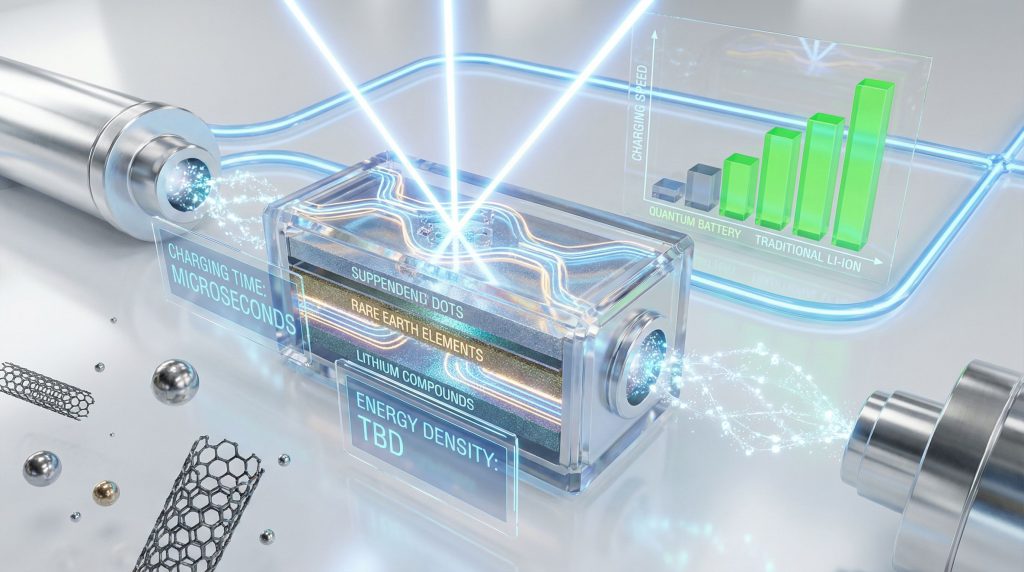
The quantum battery breakthrough achieved by Australian scientists represents a fundamental shift in energy storage capabilities, with profound implications for critical minerals demand and mining industry strategies. Furthermore, this technological advancement demonstrates charging speeds that exceed conventional battery systems by several orders of magnitude, creating unprecedented opportunities for energy-intensive industries.
Recent developments at CSIRO showcase prototype systems capable of charging in microseconds rather than hours, challenging established assumptions about energy storage limitations. However, the commercial viability of these systems depends on overcoming significant technical hurdles and developing entirely new supply chains for quantum-grade materials.
The intersection of quantum physics and practical energy storage creates unique positioning opportunities for mining companies to establish strategic footholds in emerging value chains. Understanding the technical foundations, material requirements, and commercial timelines becomes essential for navigating future market dynamics and resource allocation decisions.
When big ASX news breaks, our subscribers know first
Understanding Quantum Energy Storage Fundamentals
Quantum batteries operate through fundamentally different mechanisms compared to traditional electrochemical systems. These devices harness quantum mechanical phenomena including superposition, entanglement, and coherence to store and release energy at unprecedented speeds. The core architecture relies on quantum systems that can exist in multiple energy states simultaneously.
The CSIRO quantum battery breakthrough utilises multi-layered organic microcavity structures charged via laser systems. This approach represents a significant departure from lithium-ion technology, which depends on ion movement between electrodes through electrolyte solutions. Instead, quantum systems manipulate energy states at the atomic level.
Key technical components include:
• Photonic waveguide systems for energy transfer
• Two-level atomic configurations for quantum state management
• Polariton-based retention mechanisms
• Harmonic oscillator coupling for energy conversion
• Single-atom battery designs for fundamental research
The photonic approach enables wireless energy transfer capabilities, potentially eliminating physical connection requirements between charging infrastructure and devices. This wireless functionality could revolutionise industrial applications where traditional cable-based charging systems prove impractical or inefficient.
Quantum Mechanical Principles in Energy Storage
Superposition allows quantum batteries to exist in multiple energy states simultaneously, creating storage capacity that scales differently from conventional systems. Entanglement between quantum particles enables rapid energy transfer across multiple storage units, whilst quantum coherence maintains system stability during charge and discharge cycles.
These principles create counterintuitive scaling effects where larger quantum battery systems charge faster than smaller units. This phenomenon directly contradicts traditional battery behaviour, where increased size typically reduces charging efficiency and speed. The implications for industrial-scale energy storage could be transformative, particularly for mining operations requiring rapid equipment charging capabilities.
Moreover, the Australia lithium innovations currently being developed may need to evolve alongside quantum technologies to maintain market relevance.
Revolutionary Charging Speed Capabilities
The most significant advantage of quantum battery technology lies in its extraordinary charging speeds. Whilst conventional lithium-ion batteries require 30-60 minutes for full charging, quantum battery prototypes demonstrate charging capabilities measured in microseconds. This speed differential represents a potential paradigm shift for energy-intensive industries.
Charging Speed Comparison:
| Battery Type | Charging Time | Energy Density | Retention Period | Commercial Status |
|---|---|---|---|---|
| Lithium-ion | 30-60 minutes | 150-250 Wh/kg | Years | Commercial |
| Solid-state | 15-30 minutes | 300-500 Wh/kg | Years | Development |
| Quantum (prototype) | Microseconds | Under research | Microseconds-hours | Research |
Counterintuitive Scaling Advantages
Research findings from CSIRO demonstrate that quantum batteries exhibit faster charging rates as system size increases. Dr. James Quach, leading the research team, emphasised that this scaling behaviour represents a fundamental departure from conventional battery physics.
Traditional batteries become less efficient at larger scales due to increased internal resistance and heat generation. However, quantum systems benefit from enhanced entanglement effects. This scaling advantage could prove particularly valuable for mining operations where large-scale energy storage systems are essential.
Heavy machinery requiring substantial power could theoretically charge within seconds rather than hours, dramatically improving operational efficiency and equipment utilisation rates. The quantum speed limit breakthrough addresses fundamental constraints that have limited charging speeds in conventional systems.
Critical Materials for Quantum Battery Manufacturing
The transition to quantum battery technology will create new demand patterns for critical minerals whilst maintaining requirements for traditional battery materials. In addition, the critical minerals energy transition will be significantly influenced by these emerging technologies.
Mining companies must understand these evolving material needs to position their operations strategically for future market opportunities. Consequently, both traditional and advanced materials will play crucial roles in quantum battery manufacturing.
Essential Traditional Materials
Lithium remains crucial for hybrid quantum-classical systems and supporting infrastructure. Quantum batteries will likely integrate with conventional power management systems, maintaining lithium demand for grid-scale applications and backup power systems.
Graphite and carbon nanotubes serve structural functions in quantum battery assemblies, providing conductive pathways and mechanical support for microcavity structures. The precision requirements for quantum applications may demand higher-grade graphite than current battery applications.
Cobalt and nickel continue to play roles in electrode interfaces where quantum systems connect with conventional electrical infrastructure. These materials remain essential for hybrid system configurations and charging equipment.
Advanced Quantum Materials
Quantum battery manufacturing requires specialised materials beyond traditional battery supply chains:
• Rare earth elements for quantum dot fabrication and photonic components
• Topological insulators for quantum state maintenance
• Superconducting materials for coherence preservation
• Specialised substrates for microcavity construction
• High-purity optical materials for photonic waveguide systems
The precision requirements for quantum-grade materials exceed current industrial standards. Manufacturing tolerances measured in atomic scales demand ultra-pure feedstock materials and specialised processing techniques. This creates opportunities for mining companies capable of delivering premium-grade materials with enhanced purity specifications.
Geographic Distribution Considerations:
Quantum battery manufacturing will likely concentrate in regions with existing semiconductor and photonics industries. This geographic clustering could influence mineral demand patterns, with proximity to manufacturing centres becoming increasingly valuable for mining operations.
Technical Limitations and Engineering Challenges
Despite promising breakthroughs, the quantum battery breakthrough faces significant technical hurdles that mining companies and investors must understand when evaluating commercial timelines and material demand projections.
Energy Storage Duration Constraints
Current quantum battery prototypes store energy for microseconds to hours, compared to years for conventional batteries. This limitation stems from quantum decoherence effects, where environmental interference disrupts quantum states and causes energy loss.
Critical Limitation: Present quantum battery systems cannot maintain stored energy for extended periods, limiting their applicability to scenarios requiring immediate energy deployment rather than long-term storage.
Decoherence occurs when quantum systems interact with their environment, causing the loss of quantum properties essential for energy storage. Temperature fluctuations, electromagnetic interference, and mechanical vibrations all contribute to decoherence effects that reduce storage efficiency.
Manufacturing Precision Requirements
Quantum battery production demands unprecedented manufacturing precision:
• Clean room environments exceeding semiconductor industry standards
• Atomic-scale tolerance control for quantum component fabrication
• Ultra-pure material requirements with impurity levels measured in parts per billion
• Specialised assembly techniques for maintaining quantum coherence
These manufacturing constraints create substantial cost barriers for commercial production. Current estimates suggest quantum battery manufacturing costs could exceed conventional battery production by orders of magnitude until manufacturing processes mature and achieve economies of scale.
Integration Infrastructure Challenges
Quantum batteries require specialised support infrastructure different from conventional battery systems. Power conditioning equipment, quantum state monitoring systems, and environmental isolation mechanisms add complexity and cost to deployment scenarios.
Integration with existing electrical grids presents additional challenges, as rapid charging capabilities may require substantial infrastructure upgrades to handle instantaneous high-power demands.
Mining Industry Demand Implications
The emergence of quantum battery technology will create distinct phases of mineral demand growth, each with different characteristics and opportunities for mining companies. Furthermore, this development will interact with other factors such as terbium demand impact from various market forces.
Research and Development Phase (2026-2030)
Current quantum battery development focuses on laboratory-scale prototypes and proof-of-concept demonstrations. This phase generates limited but specialised mineral demand characterised by:
• High-purity material requirements for research applications
• Small volume, high-value orders from research institutions
• Specialised rare earth elements for quantum dot research
• Ultra-pure graphite for experimental microcavity structures
Research institutions and technology companies are beginning to establish supply relationships for quantum-grade materials. Mining companies with capabilities to produce ultra-pure materials may capture premium pricing during this development phase.
Pilot Commercial Applications (2029-2035)
As quantum battery technology matures, pilot commercial deployments in niche applications will drive increased mineral consumption. Projected demand growth could reach 15-25% increases for specialised rare earth elements used in quantum applications.
Priority application sectors include:
• Aerospace and defence systems requiring rapid energy deployment
• Medical equipment needing instant charging capabilities
• Telecommunications infrastructure supporting quantum computing systems
• Research facilities with specialised power requirements
Commercial Scale Deployment (2035-2045)
Widespread commercial adoption would fundamentally alter critical minerals demand patterns. Conservative projections suggest quantum battery deployment could consume significant portions of global rare earth element production, particularly for specialised quantum applications.
Supply chain security becomes increasingly important as quantum battery technology scales. Countries and companies controlling critical mineral supplies may gain strategic advantages in quantum technology deployment and manufacturing capabilities.
The next major ASX story will hit our subscribers first
Global Research Leadership and Competitive Positioning
Understanding the global quantum battery research landscape helps identify future supply chain partnerships and technology transfer opportunities for mining companies. Moreover, mining industry innovation will be crucial for adapting to these technological changes.
Leading Research Institutions
Australia maintains strong competitive positioning through CSIRO's breakthrough microcavity technology and collaborative networks with RMIT University and the University of Melbourne. This research ecosystem creates opportunities for Australian mining companies to establish early supply relationships with quantum technology developers.
International research landscape:
| Country | Key Institutions | Focus Areas | Estimated Research Investment |
|---|---|---|---|
| Australia | CSIRO, RMIT, Melbourne | Prototype development | $50M+ annually |
| Japan | RIKEN Centre | Topological quantum designs | $75M+ annually |
| United States | MIT, Stanford | Theoretical modelling | $100M+ annually |
| China | Tsinghua, CAS | Manufacturing scale-up | $80M+ annually |
Australian Strategic Advantages
Australia's quantum battery research benefits from several competitive advantages:
• Proximity to critical mineral resources reducing supply chain complexity
• Established research collaboration networks between institutions and industry
• Government quantum technology initiatives providing research funding support
• Strong semiconductor and photonics research capabilities supporting quantum applications
The geographic concentration of quantum research in Australia creates opportunities for mining companies to establish direct relationships with technology developers, potentially securing long-term supply agreements as commercial deployment approaches.
Investment Strategy Implications for Mining Companies
Quantum battery development creates both opportunities and risks that mining companies must evaluate when developing investment strategies and resource allocation plans. Additionally, the US tariff landscape on critical minerals will influence global supply chain decisions.
Strategic Positioning Opportunities
Critical minerals portfolio optimisation becomes essential as quantum applications create new demand patterns. Companies controlling high-purity graphite, rare earth elements, and specialised materials may command premium valuations as commercialisation approaches.
Research partnership development offers early access to quantum technology developers and potential supply agreement negotiations. Mining companies investing in research collaborations could secure advantageous positions in emerging supply chains.
Supply agreement timing presents strategic considerations, as early commitments may provide price advantages but carry technology risk if quantum battery deployment timelines extend beyond projections.
Risk Assessment Framework
Technology maturation uncertainty remains the primary risk factor for quantum battery commercialisation. Current prototype limitations suggest commercial viability may require longer development timelines than initially projected.
Competition from alternative technologies including solid-state batteries, supercapacitors, and hydrogen fuel cells could limit quantum battery market penetration. Mining companies should diversify material portfolios to address multiple technology pathways.
Regulatory framework development will influence quantum battery deployment rates and safety requirements. Changes in government policies could accelerate or delay commercialisation timelines significantly.
Capital allocation strategies should balance quantum battery exposure with traditional battery material investments, maintaining flexibility as technology develops and market demand patterns evolve.
Competitive Technology Analysis
Quantum batteries compete with several emerging energy storage technologies, each offering distinct advantages and requiring different material inputs. Understanding this competitive landscape helps mining companies assess market opportunities and risks.
Alternative Energy Storage Technologies
Solid-state batteries offer improved energy density and safety compared to conventional lithium-ion systems whilst using similar material inputs. Commercial deployment appears closer than quantum batteries, potentially capturing market share in applications where instant charging provides limited advantages.
Hydrogen fuel cells provide long-duration energy storage capabilities that quantum batteries cannot match. The complementary nature of these technologies suggests both will find distinct market niches rather than direct competition.
Supercapacitors already offer rapid charging capabilities but with limited energy density. Quantum batteries could eventually replace supercapacitors in applications requiring both speed and capacity.
Market Differentiation Factors
Charging speed advantages represent quantum batteries' primary competitive differentiator. Applications requiring instant energy deployment will likely drive initial commercial adoption.
Wireless charging capabilities unique to quantum systems could create new application categories impossible with conventional technologies. This functionality may prove particularly valuable for mobile industrial equipment.
Energy density potential remains uncertain for quantum systems, creating both opportunities and risks for commercial viability. If quantum batteries achieve high energy density alongside rapid charging, they could dominate multiple market segments.
Commercial Deployment Timeline Projections
Understanding realistic timelines for quantum battery commercialisation helps mining companies plan investment strategies and supply chain development initiatives.
Development Phase Milestones
2026-2028: Laboratory Optimisation
Current research focuses on extending energy retention duration and improving manufacturing repeatability. Key milestones include achieving hour-long energy storage and demonstrating consistent performance across multiple charge cycles.
2029-2032: Pilot Commercial Applications
Specialised applications in aerospace, defence, and research sectors may begin deploying quantum battery systems despite high costs and technical limitations. These early markets will tolerate premium pricing for unique capabilities.
2033-2040: Market Penetration Expansion
Cost reduction through manufacturing scale and technological improvements could enable broader market adoption. Consumer electronics and automotive applications may become viable as production costs decline.
2040+: Mass Market Integration
Widespread deployment across multiple sectors could occur if the quantum battery breakthrough achieves cost parity with conventional alternatives whilst maintaining performance advantages.
Performance Monitoring Indicators
Energy retention improvements from microseconds to hours, then days, will signal technology maturation progress. Australian scientists report current research targets achieving energy storage durations comparable to conventional batteries.
Manufacturing cost reductions through economies of scale and process optimisation will determine commercial viability timelines. Quantum battery costs must decline significantly to compete with existing technologies.
Commercial partnership announcements between quantum research institutions and industrial companies will indicate approaching commercialisation and validate technology readiness.
Preparing Mining Strategies for Quantum Technology Integration
Mining companies can take several strategic actions to position themselves advantageously for the quantum battery revolution whilst managing associated risks and uncertainties.
Portfolio Development Recommendations
Diversified material exposure across quantum battery requirements and alternative energy storage technologies provides flexibility as market dynamics evolve. Companies should balance traditional battery materials with emerging quantum applications.
Quality upgrade initiatives for existing operations could capture premium pricing as quantum applications demand higher-purity materials. Investment in processing capabilities may yield substantial returns as technology commercialises.
Strategic partnership exploration with quantum research institutions offers early access to technology developments and potential supply agreement opportunities. Collaborative relationships could provide competitive advantages in emerging markets.
Market Timing Considerations
The extended development timeline for quantum battery commercialisation suggests mining companies have time to develop strategic positions without immediate capital deployment pressure. However, early positioning could prove valuable as research transitions toward commercial applications.
Supply chain security will become increasingly important as quantum applications scale. Companies controlling critical material supplies may command strategic premiums and long-term supply agreement opportunities.
Geographic proximity to quantum manufacturing centres could influence operational planning and expansion decisions. Understanding likely deployment patterns helps optimise logistical capabilities.
The quantum battery breakthrough represents the beginning of a transformative period in energy storage technology with profound implications for critical minerals demand and mining industry strategy. Whilst commercial deployment remains years away, the foundational technological achievements demonstrated by Australian and international researchers indicate significant potential for market disruption.
Mining companies should monitor quantum battery development closely whilst maintaining balanced exposure to multiple technology pathways. The unique material requirements and counterintuitive scaling advantages of quantum systems create new opportunities for strategic positioning, particularly for companies capable of delivering ultra-pure materials and developing research partnerships.
Disclaimer: This analysis contains forward-looking statements and projections based on current research developments and industry assessments. Actual commercialisation timelines, technology performance, and market adoption may differ significantly from projections. Investment decisions should consider technology risks, market uncertainties, and alternative development pathways. Material demand projections are estimates based on current research and may change substantially as technology develops.
Looking to Capitalise on Breakthrough Battery Technologies?
Discovery Alert's proprietary Discovery IQ model delivers real-time alerts on significant ASX mineral discoveries, instantly empowering subscribers to identify actionable opportunities in critical minerals and energy storage sectors ahead of the broader market. Begin your 14-day free trial today and secure your market-leading advantage as revolutionary quantum battery technologies reshape mineral demand patterns.