August 3, 2026
The Investment Logic Behind Jurisdiction Selection in Critical Minerals
When capital allocators evaluate where to place long-duration bets in the critical minerals sector, they rarely start with geology. They start with governance. The question of whether a jurisdiction will honour its regulatory commitments over a 30 to 40 year mine life matters far more to institutional and sovereign investors than the precise tonnage sitting beneath the ground. This investment psychology is reshaping how Australian states compete for global minerals capital, and it is within this context that the Queensland critical minerals strategy deserves serious attention.
The global energy transition is not a theoretical force. It is a procurement cycle. Electric vehicles, utility-scale battery storage, offshore wind turbines, and defence electronics all require physical inputs, many of which are currently sourced from a narrow band of producing nations. As critical minerals energy security becomes a board-level concern for manufacturers, utilities, and governments alike, the search for geopolitically stable, technically capable, and investment-friendly mineral jurisdictions has intensified considerably.
When big ASX news breaks, our subscribers know first
Queensland's Geological Foundation: More Than a Single Commodity Story
One of the most underappreciated aspects of Queensland's position in the critical minerals landscape is the sheer breadth of its endowment. Unlike jurisdictions that have built their minerals identity around a single commodity, Queensland hosts meaningful concentrations across several technology-critical materials simultaneously.
The Julia Creek and Richmond region in the state's northwest represents one of the world's notable vanadium-bearing marine shale deposits. Vanadium is increasingly relevant not just as a steel additive but as the active material in vanadium redox flow batteries, a grid-scale storage technology particularly suited to renewable energy firming applications where long discharge duration is required.
The Mount Isa corridor, long associated with copper, lead, and zinc production, also contains significant polymetallic mineralisation relevant to the clean energy economy, including cobalt occurrences that co-occur with copper systems in the region. Elsewhere across the state, graphite, rare earth elements, tungsten, nickel, and manganese occurrences broaden the commodity exposure considerably.
Furthermore, rare earth supply chains are becoming increasingly central to Queensland's strategic positioning, particularly given their role in permanent magnets used across wind turbines and electric motors.
Queensland's mineral endowment spans multiple technology-critical commodities, giving the state a rare ability to serve several clean energy supply chains simultaneously, from battery storage systems to permanent magnet supply chains used in wind turbines and electric motors.
This multi-commodity profile is strategically significant. It means Queensland can participate in several distinct industrial supply chains rather than being exposed to the fortunes of a single commodity cycle, a meaningful risk diversification argument for investors constructing portfolio exposure to the energy transition.
What the Queensland Critical Minerals Strategy Actually Contains
The Policy Architecture: Four Pillars and a Dedicated Coordination Body
The Queensland critical minerals strategy is structured around four operational pillars: moving faster through the approvals and project development pipeline, maximising investment attraction, building integrated value chains from extraction through to processed product, and fostering research alongside measurable ESG performance.
Critically, the strategy treats these four elements as interdependent rather than sequential. The creation of Critical Minerals Queensland as a dedicated coordination office reflects a recognition that fragmented government interfaces have historically been a friction point for investors trying to navigate state systems. A single point of coordination reduces the transaction costs associated with project facilitation and signals institutional seriousness to foreign capital.
From the Original Package to the 2026-30 Refresh
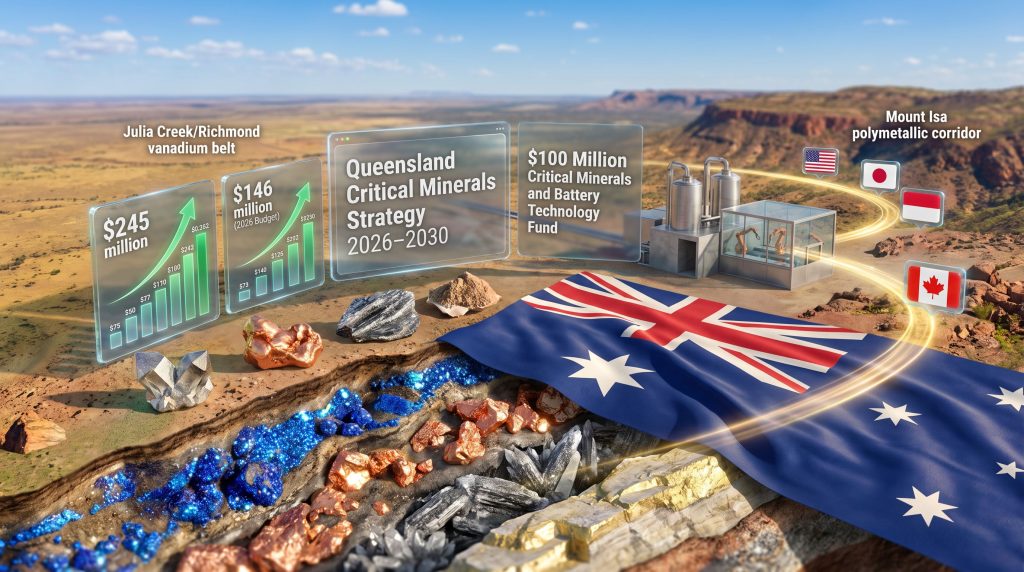
The evolution of Queensland's critical minerals policy reveals a maturing strategic ambition rather than a reactive policy response. The original strategy framework, backed by a $245 million package, focused primarily on laying the foundations: exploration enablement, supply chain mapping, and initial investment attraction. You can review the full scope of Queensland's approach through the Queensland Critical Minerals Strategy published by the state government.
The refreshed Delivering Queensland's Critical Minerals Future 2026-30 strategy shifts the centre of gravity meaningfully toward downstream processing, sovereign industrial capability, and structured international partnership frameworks. The Queensland Government committed $146 million in its 2026 Budget to advance this next phase.
| Strategy Phase | Budget Commitment | Primary Strategic Focus |
|---|---|---|
| Original Strategy | $245 million | Exploration, extraction, supply chain foundations |
| 2026-30 Refresh | $146 million (2026 Budget) | Downstream processing, sovereign capability, export readiness |
The $100 Million Critical Minerals and Battery Technology Fund
Within the 2026-30 framework, the $100 million Critical Minerals and Battery Technology Fund represents the most direct mechanism for project-level capital deployment. The fund is structured to support projects across the full supply chain continuum, from mine gate to processed product, rather than restricting eligibility to exploration or early-stage development.
For junior explorers and mid-tier developers, this is particularly material. Early-stage companies frequently face a capitalisation gap between completing a definitive feasibility study and securing project finance from commercial lenders. A state-administered fund that bridges this gap, even partially, can be the difference between a project advancing and stalling for years in the pre-development phase.
Regulatory Reform and the Cost of Doing Business in Queensland
Zero Exploration Permit Rent: A Concrete Cost-Relief Signal
Among the suite of incentives embedded in Queensland's critical minerals strategy, the reduction of exploration permit rent to $0 for five years is perhaps the most immediately tangible for early-stage explorers. Exploration programmes are capital-intensive and cash-flow negative for extended periods. Eliminating holding costs on exploration tenure, even modestly, allows companies to direct more of their limited capital toward actual drilling and geological work rather than administrative overhead.
This type of fiscal concession also sends a directional signal to the market. It indicates that the Queensland Government understands the economics of the exploration lifecycle and is willing to share some of the carrying cost during the highest-risk phase of project development.
Critical Minerals Zones: Concentrating Infrastructure Investment
The designation of specific critical minerals zones, most notably in the Julia Creek and Richmond corridor and around Mount Isa, reflects a place-based development model designed to avoid the inefficiencies of scattered project development. When multiple projects cluster within a defined geographic area, infrastructure investment in roads, energy, water, and logistics can be shared across participants rather than duplicated independently by each operator.
This approach also creates what might be described as an exploration cluster effect, where geological knowledge generated by one project flows into the broader understanding of the region, reducing the discovery cost for subsequent entrants.
International Investment Interest: The Capital Flows Behind the Strategy
Japan, Indonesia, and the Long-Duration Capital Thesis
Perhaps the most revealing insight into Queensland's investment attraction story is the nature of the international capital expressing interest. Japanese corporations and sovereign-linked investors operate on fundamentally different time horizons than typical equity market participants. Where a listed company might evaluate returns over a three to five year cycle, Japanese industrial groups routinely assess project viability across three to four decades.
Queensland's ability to offer policy stability across that timeframe is a genuine differentiator. The state's stable democratic governance structure, rule of law, and track record of honouring resource tenure commitments give long-duration investors the confidence that their capital will be protected over the full project lifecycle. Indonesian interest adds a further bilateral dimension, reflecting both geographic proximity and emerging partnership dynamics in the region's clean energy economy.
How PDAC Trade Mission Engagement Converted to Funded Projects
The trajectory from Queensland's North American trade mission and engagement at PDAC conference insights to concrete funded project outcomes is instructive. Three distinct projects progressed to funded status as a direct result of engagement during that mission: Graphinex in Townsville, EQ Resources, and RZ Resources.
The Graphinex project in Townsville is particularly notable as a case study in how government-facilitated introductions can compress typical project development timelines. Graphinex is developing anode material processing capability, a midstream function that sits between graphite mining and the battery cell manufacturing stage, and represents precisely the kind of downstream value-add activity the Queensland strategy is designed to cultivate.
A foundational meeting with the EXIM Bank in Washington created the network connection that ultimately underpinned the financing of all three projects. This illustrates a less-discussed dynamic in critical minerals investment: sovereign-level diplomatic engagement often precedes and enables private sector deal flow in ways that are difficult to replicate through purely commercial channels.
Fortnightly US Consul General Meetings: Reading the Signal
The frequency of engagement between Queensland government officials and the US Consul General, described as approaching a fortnightly cadence, is a data point worth examining carefully. Diplomatic meetings of this regularity around a specific commercial theme are uncommon and suggest that the US-Australia Critical Minerals Framework signed in October 2025 has generated genuine, active follow-through at the state level rather than remaining a federal-level framework document.
For foreign investors evaluating country risk, this kind of sovereign-level endorsement functions as a form of de-risking. When a major allied government is actively engaged in facilitating deal flow within a jurisdiction, it reduces the perceived political and regulatory uncertainty that typically inflates the discount rates applied to long-duration infrastructure investments.
The Downstream Processing Imperative: Queensland's Next Industrial Frontier
Why Processing Captures the Majority of Economic Value
A tonne of raw graphite ore and a tonne of battery-grade spherical graphite are not the same economic proposition. The transformation from extracted mineral to refined, specification-grade product captures the vast majority of the economic value in any critical minerals supply chain. China's dominance of critical minerals processing has been built precisely on this understanding, with the country controlling an estimated 60-80% of processing capacity across several key battery materials.
Queensland's ambition to build sovereign processing and manufacturing capability represents an attempt to capture more of this value domestically. The strategy's emphasis on retaining ore processing onshore rather than exporting raw material reflects both an economic logic and an emerging national security calculation about sovereign industrial capability.
Technology Adoption in Queensland's Manufacturing Base
An underreported dimension of Queensland's industrial evolution is the degree to which existing manufacturers in the state are already integrating automation, robotics, and AI-enabled process optimisation into their operations. This technological readiness is relevant because it suggests that the workforce and operational culture required to run sophisticated processing facilities is not starting from zero.
For the downstream processing ambition to materialise at scale, this technological foundation needs to be matched by investment in workforce training pipelines that can bridge the skills gap between extraction-focused roles and the more technical requirements of chemical processing and materials refining. In addition, critical minerals demand growth projections suggest the window for establishing this capability is narrowing, making workforce investment increasingly urgent.
The next major ASX story will hit our subscribers first
Key Risks That Investors Should Understand
Infrastructure Constraints in Remote Mineral Zones
The Julia Creek and Mount Isa regions host world-class mineralisation, but they also sit in remote northwest Queensland where infrastructure costs are non-trivial. Energy supply, water availability, and logistics connectivity all represent genuine constraints on the economic viability of in-situ processing versus coastal hub models.
The economics of processing remotely versus transporting ore concentrate to a coastal facility for final processing is a project-specific calculation that varies considerably by commodity and grade. For high-value, low-volume materials like rare earths, remote processing may be viable. For bulk materials, however, the transport cost equation often favours coastal processing hubs.
Commodity Price Volatility Against Long-Duration Capital Requirements
Processing infrastructure requires long-duration capital commitments. A processing plant has a 20 to 30 year economic life and requires project financing structures that extend across multiple commodity price cycles. The mismatch between short-term price volatility, which can rapidly alter the commercial attractiveness of individual projects, and the decade-long development timelines needed for processing infrastructure is a structural challenge that no amount of policy stability can fully resolve.
This article contains forward-looking analysis and references to government policy frameworks. It does not constitute financial or investment advice. Readers should conduct their own due diligence before making any investment decisions.
Queensland Critical Minerals Strategy: Key Facts at a Glance
| Metric or Policy Element | Detail |
|---|---|
| Strategy Period | 2026-2030 |
| 2026 Budget Commitment | $146 million |
| Original Strategy Package | $245 million |
| Battery Technology Fund | $100 million |
| Exploration Permit Rent | $0 for five years |
| Dedicated Coordination Body | Critical Minerals Queensland |
| Key Mineral Zones | Julia Creek and Richmond, Mount Isa |
| International Partners | USA, Japan, Indonesia, Canada |
| Funded Projects via Trade Mission | Graphinex, EQ Resources, RZ Resources |
Frequently Asked Questions: Queensland Critical Minerals Strategy
What minerals are covered under the Queensland critical minerals strategy?
Queensland's critical minerals framework covers a broad range of commodities considered essential to clean energy technology and national security supply chains. Key minerals include:
- Vanadium (grid-scale battery storage and steel strengthening)
- Cobalt (lithium-ion battery cathodes)
- Graphite (battery anode materials)
- Rare earth elements (permanent magnets for EVs and wind turbines)
- Tungsten (industrial tooling and defence applications)
- Copper, nickel, and manganese (battery chemistries and electrical infrastructure)
The critical minerals list is subject to periodic review as technology requirements and geopolitical conditions evolve, meaning new commodities can be added as supply chain priorities shift.
How does the 2026-30 strategy differ from the original plan?
The original strategy concentrated on exploration enablement and establishing the basic architecture of Queensland's critical minerals supply chain. The 2026-30 refresh places substantially greater emphasis on downstream processing, sovereign manufacturing capability, and structured international partnership frameworks. In short, the evolution moves from building supply to building value. Further detail on what defines these minerals and why they are being prioritised is available via the Queensland Government's overview of the sector.
What is Critical Minerals Queensland and why does it matter to investors?
Critical Minerals Queensland is the dedicated coordination office established to serve as a central interface between government departments, industry proponents, international investors, and affected communities. For investors, a dedicated body of this kind reduces the friction associated with navigating multiple government agencies and provides a single accountability point for project facilitation, which materially improves the investment experience in a competitive global market for minerals capital.
What incentives are available for critical minerals explorers in Queensland?
- Zero exploration permit rent for five years, reducing early-stage carrying costs.
- Access to the $100 million Critical Minerals and Battery Technology Fund for qualifying projects across the supply chain.
- Critical minerals zone designations, which concentrate infrastructure investment and reduce logistical costs for cluster participants.
- Streamlined approvals processes designed to reduce project development timeframes without compromising environmental or community standards.
Queensland's Role in Australia's National Critical Minerals Agenda
Queensland's 2026-30 strategy does not exist in isolation. It operates within a broader federal policy environment oriented toward establishing Australia as a preferred critical minerals supplier to allied nations. The US-Australia Critical Minerals Framework signed in October 2025 provides a bilateral structure through which Queensland projects can access North American capital, offtake relationships, and development financing mechanisms including EXIM Bank instruments.
The strategic window represented by the 2026-30 period is real. As allied nations accelerate their efforts to reduce dependence on single-source critical minerals supply chains, the jurisdictions that have processing infrastructure operating and offtake agreements signed by the late 2020s will be structurally advantaged over those still in the development phase. Queensland's policy investments today are, in part, a bet on capturing that first-mover positioning within a restructuring global supply chain landscape.
Ongoing coverage of Queensland's critical minerals policy environment and sector developments across Australia's resources industry is available through Australian Mining at australianmining.com.au.
Want to Position Yourself Ahead of the Next Major ASX Critical Minerals Discovery?
Discovery Alert's proprietary Discovery IQ model delivers real-time alerts on significant ASX mineral discoveries — instantly transforming complex geological and commodity data into actionable investment insights across vanadium, graphite, rare earths, and beyond. Explore how historic mineral discoveries have generated substantial returns and begin your 14-day free trial today to secure a market-leading edge as Australia's critical minerals sector accelerates.