May 15, 2026
Queensland's strategic approach to Queensland fast-tracks coal and gold projects reflects sophisticated regulatory innovation targeting economic growth through accelerated development timelines. The state's comprehensive approval framework demonstrates how jurisdictions can balance environmental oversight with investment attraction, creating competitive advantages in global resource markets. Furthermore, understanding permitting essentials becomes crucial as these regulatory changes reshape development pathways.
Understanding Queensland's Coordinated and Prescribed Project Classifications
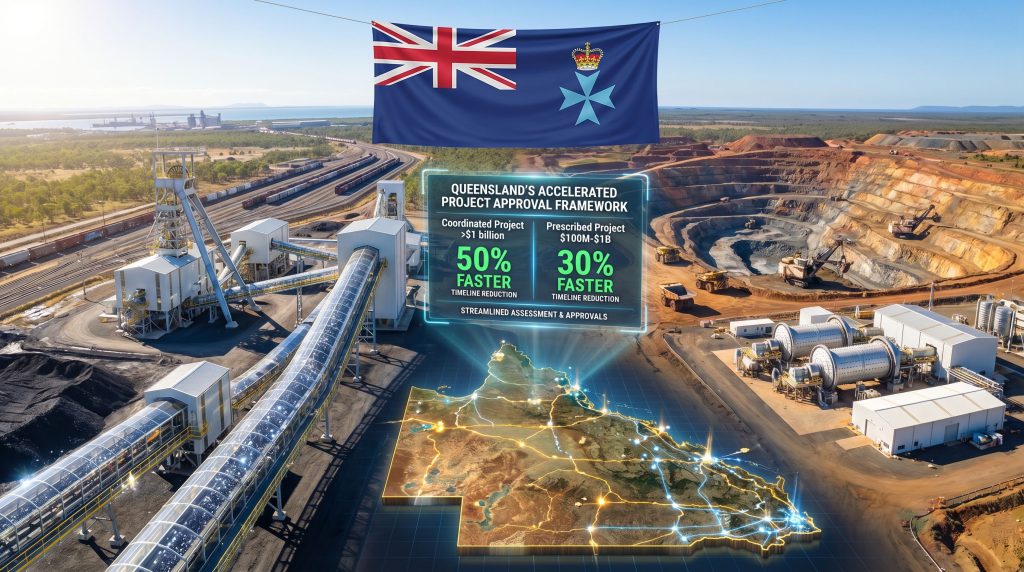
Queensland's accelerated approval architecture operates through a sophisticated dual-tier system engineered to streamline high-value resource developments while maintaining comprehensive environmental oversight. The framework distinguishes between Coordinated Projects requiring extensive Environmental Impact Statements paired with inter-agency coordination, and Prescribed Projects receiving expedited processing for developments meeting specific investment thresholds.
Project Classification Framework:
| Classification | Investment Threshold | Processing Method | Timeline Advantage |
|---|---|---|---|
| Coordinated Project | >$1 billion | Full EIS coordination | 30-40% acceleration |
| Prescribed Project | $100M-$1B | Streamlined assessment | 20-30% acceleration |
| Standard Approval | <$100M | Regular process | Baseline timeline |
Recent applications demonstrate this framework's practical implementation. The Corvus Metallurgical Coal Project, representing A$1.24 billion investment, achieved Coordinated Project status under Coordinator-General Gerard Coggan's administration. This underground longwall operation, positioned 17 kilometers north of Emerald, exemplifies comprehensive development receiving expedited coordination through the Coordinator-General's office while maintaining full Environmental Impact Statement requirements.
Simultaneously, the Big Vein South Gold Project, valued at A$400 million, secured Prescribed Project classification. Located 120 kilometers north of Richmond, this open-cut operation demonstrates the framework's effectiveness for mid-tier investments requiring expedited assessment without full Coordinated Project procedures.
The classification system creates measurable advantages through parallel assessment processes across multiple agencies, integrated stakeholder consultation frameworks, and streamlined environmental impact evaluation. These mechanisms eliminate bureaucratic bottlenecks while preserving environmental protection standards, generating competitive advantages for Queensland-based developments.
Government policy positioning emphasises confidence restoration following previous administration challenges. Deputy Premier Jarrod Bleijie articulated this strategic shift, stating that previous bureaucratic constraints trapped major projects, causing investment confidence deterioration and regional economic impacts. The current administration's fast-track approach signals systematic regulatory reform targeting investor certainty restoration.
When big ASX news breaks, our subscribers know first
Economic Multipliers Driving Queensland's Resource Project Prioritisation
Queensland's strategic resource development prioritisation centres on projects delivering maximum economic leverage through employment generation, export revenue optimisation, and regional development impact amplification. The selection criteria emphasise developments capable of generating substantial direct employment while creating significant indirect economic multiplier effects throughout regional economies.
Coal Sector Investment Profile Analysis
Ultra-low ash metallurgical coal represents premium market positioning within global steel production supply chains. The Corvus project specifications target 10.5 million tonnes per annum production over a 25-year operational lifecycle, with approximately 90% designated for global steel markets through Port of Gladstone export infrastructure. This production profile positions Queensland metallurgical coal within premium pricing segments commanding significant price differentials over standard thermal coal commodities.
Underground longwall operations deliver extended production lifecycles with reduced surface disturbance compared to open-cut alternatives. The technology enables efficient extraction from deeper coal seams while maintaining operational efficiency and environmental impact minimisation. Export infrastructure integration through established port facilities maximises logistics efficiency and reduces transportation cost burdens.
Gold Sector Investment Profile Analysis
Open-cut gold operations enable rapid production ramp-up with lower initial capital requirements compared to underground alternatives. The Big Vein South project specifications include processing 1.95 million tonnes per annum of ore while producing approximately 100,000 ounces of gold doré annually. This represents approximately 5.1% ore-to-doré conversion efficiency, indicating substantial gold grades suitable for economic extraction.
Regional processing capacity optimisation supports value-add opportunities while reducing transportation costs and export dependency. Processing technology integration maximises recovery rates through advanced metallurgical techniques, enhancing project economics and operational efficiency. Moreover, these developments align with broader industry evolution trends that emphasise technological advancement and operational excellence.
Employment Generation and Economic Multiplier Analysis:
| Project Component | Coal Project Impact | Gold Project Impact | Combined Regional Effect |
|---|---|---|---|
| Construction Phase | 284 positions | 980 positions | 1,264 temporary roles |
| Operational Phase | 500 positions | 380 positions | 880 permanent positions |
| Economic Multiplier | 2.1x indirect jobs | 1.8x indirect jobs | 1,950+ total employment |
The employment multiplier calculations reflect standard input-output analysis for resource sector developments. Coal operations typically generate higher operational employment due to continuous extraction requirements, while gold projects create intensive construction employment during development phases. Combined regional impact exceeds 1,950 total employment positions when accounting for indirect economic effects.
Regional economic development benefits extend beyond direct employment through supplier network integration, community infrastructure investment, and regional service provider capacity expansion. These multiplier effects support sustainable economic growth throughout project operational lifecycles.
Infrastructure Readiness Factors Influencing Project Selection
Queensland's approval acceleration prioritises developments leveraging existing infrastructure networks while minimising additional capital requirements for transportation, processing, and export facilities. Infrastructure readiness assessments evaluate proximity to established rail corridors, port capacity availability, electrical grid connections, and regional service provider networks.
Coal Project Infrastructure Optimisation
The Corvus project's positioning 17 kilometers north of Emerald provides strategic access to established Queensland rail infrastructure supporting coal transportation to Port of Gladstone. Existing rail network capacity reduces initial capital requirements while ensuring efficient transportation logistics throughout the 25-year operational period.
Port of Gladstone represents Queensland's premier coal export facility with established infrastructure supporting large-scale metallurgical coal exports to Asian markets. The port's existing capacity and specialised coal handling facilities eliminate the need for new port infrastructure development, reducing project risk and capital requirements.
Regional workforce availability in Central Queensland provides skilled mining professionals and support services, minimising recruitment costs and operational complexity. Established mining service provider networks support equipment maintenance, supply chain management, and technical services required for underground longwall operations.
Gold Project Development Efficiency
The Big Vein South project's greenfield location enables optimised facility design incorporating modern mining technologies and processing techniques. While requiring new infrastructure development, the project benefits from regional service provider networks and established transportation corridors supporting equipment mobilisation and operational logistics.
Processing technology selection focuses on maximising gold recovery rates while minimising environmental impact through advanced metallurgical techniques. On-site processing capabilities reduce transportation requirements and enhance project economics through value-addition at the extraction location. These developments occur against a backdrop where gold price surge explained creates favourable market conditions.
Regional accommodation and service infrastructure supports workforce requirements during construction and operational phases. Established community infrastructure reduces the need for extensive new residential or commercial development, lowering overall project costs and community impact.
Regulatory Efficiency Mechanisms Enabling Faster Approvals
The Crisafulli administration implemented systematic approval process reforms targeting bureaucratic bottlenecks and inter-agency coordination gaps that previously extended development timelines. These mechanisms create measurable efficiency improvements while maintaining environmental protection standards and community consultation requirements.
Coordinated Project Pathway Optimisation
Single-point coordination through the Coordinator-General's office eliminates multiple agency interface requirements that previously created assessment delays. This centralized approach enables parallel assessment processes across environmental, planning, and regulatory agencies while maintaining comprehensive evaluation standards.
Integrated stakeholder consultation frameworks streamline community engagement requirements through coordinated consultation processes. Rather than sequential consultations with multiple agencies, projects benefit from comprehensive stakeholder engagement managed through unified coordination mechanisms.
Environmental impact evaluation maintains rigorous assessment standards while reducing timeline requirements through parallel processing and agency coordination. The framework preserves environmental protection objectives while eliminating redundant assessment procedures and administrative delays.
Prescribed Project Pathway Efficiency
Expedited assessment timelines provide predictable development schedules for mid-tier investments requiring faster approval processes than Coordinated Project procedures. Reduced documentation requirements eliminate redundant reporting while maintaining essential environmental and community protection standards.
Fast-track community consultation procedures ensure meaningful stakeholder engagement within compressed timelines. Accelerated permit issuance provides certainty for project planning and investment decision-making while preserving regulatory oversight requirements.
The regulatory efficiency improvements specifically target investment confidence restoration following previous administration challenges. Government messaging emphasises clearing approval backlogs and streamlining processes to signal Queensland fast-tracks coal and gold projects through responsible resource development and economic growth.
Global Market Dynamics Influencing Queensland's Resource Strategy
International commodity markets and supply chain considerations drive strategic project prioritisation decisions, with emphasis on developments serving premium market segments and supporting supply chain diversification objectives. Queensland's resource strategy aligns with global demand patterns while capitalising on quality advantages and geographic positioning.
Metallurgical Coal Market Positioning
Global steel production growth drives sustained demand for premium metallurgical coal specifications, particularly ultra-low ash varieties required for high-quality steel manufacturing. Queensland's ultra-low ash metallurgical coal commands significant price premiums over standard metallurgical coal due to superior quality specifications and reduced impurity content.
Supply chain diversification considerations support Queensland's strategic positioning as Asian markets seek reduced concentration risk and alternative supply sources. Established trade relationships and port infrastructure provide competitive advantages in serving key steel-producing regions throughout Asia.
Quality specifications align with international steelmaker requirements for premium metallurgical coal inputs. Ultra-low ash content reduces steel production costs and improves final product quality, creating sustained demand for Queensland's premium coal specifications.
Gold Market Strategic Considerations
Precious metals demand provides economic stability buffers during commodity price volatility periods, supporting portfolio diversification for resource-dependent regional economies. Gold's investment demand characteristics create market stability supporting long-term project planning and investment decision-making.
Processing capacity expansion enables value-addition opportunities beyond raw ore export, increasing regional economic benefits and reducing export dependency. Advanced processing capabilities support product differentiation and premium pricing strategies.
Regional production clustering enhances operational efficiency through shared infrastructure and service provider networks. Concentrated gold production regions benefit from specialised technical expertise and equipment availability, reducing operational costs and improving efficiency. Additionally, these developments intersect with the broader critical minerals strategy that shapes resource prioritisation.
Employment Generation Models Maximising Regional Economic Impact
Project approval decisions emphasise sustainable employment creation patterns that generate lasting regional economic benefits beyond initial development phases. The employment generation approach prioritises developments creating substantial operational employment while supporting regional skill development and community sustainability.
Construction Phase Employment Impact
The Big Vein South Gold Project represents Queensland's largest single construction employment generator among current fast-tracked developments, creating 980 construction positions during development phases. This construction workforce requires diverse skill sets including earthmoving, electrical, mechanical, and construction management expertise.
The Corvus Coal Project generates 284 construction positions focused on underground infrastructure development, specialised mining equipment installation, and surface facility construction. Coal project construction emphasises technical mining expertise and underground development capabilities.
Combined construction employment of 1,264 temporary positions creates significant regional economic activity during development phases. Construction employment generates immediate economic benefits through accommodation, food services, and retail spending in regional communities.
Operational Phase Employment Sustainability
Long-term operational employment provides sustained economic benefits supporting regional community development. The Corvus Coal Project creates 500 operational positions over a 25-year operational lifecycle, providing employment security and career development opportunities for regional workers.
Gold project operations generate 380 permanent positions supporting processing, maintenance, administration, and technical functions. Operational employment combines skilled technical positions with administrative and support roles, creating diverse career opportunities within regional communities.
Economic Multiplier Effect Analysis
Coal project employment generates a 2.1x economic multiplier, creating additional indirect employment through supplier networks, service providers, and community spending effects. This multiplier reflects the complex supply chain requirements for underground coal operations and extended operational timelines.
Gold project employment produces a 1.8x economic multiplier, generating indirect employment through processing equipment suppliers, maintenance services, and regional economic spending. The slightly lower multiplier reflects more concentrated operational requirements compared to coal operations.
Total regional employment impact exceeds 1,950 positions when combining direct operational employment with multiplier effects. This represents substantial economic impact for regional Queensland communities, supporting population growth and community infrastructure development.
The next major ASX story will hit our subscribers first
Environmental Assessment Frameworks Balancing Development and Protection
Queensland's expedited approval system maintains comprehensive environmental oversight while reducing assessment timelines through process optimisation and inter-agency coordination. The framework preserves environmental protection standards while eliminating bureaucratic delays that previously extended development timelines without enhancing environmental outcomes.
Coal Project Environmental Management
Underground longwall operations minimise surface disturbance compared to open-cut alternatives, reducing environmental impact while maintaining production efficiency. Subsidence management protocols ensure surface infrastructure protection while enabling efficient coal extraction from deeper seam depths.
Water management systems incorporate advanced groundwater protection measures preventing contamination of regional water resources. Underground operations require sophisticated drainage and water treatment systems managing groundwater interaction throughout operational periods.
Progressive rehabilitation planning ensures post-mining land use optimisation supporting agricultural, recreational, or conservation applications. Rehabilitation bonds and management plans provide financial security for environmental restoration following operational completion.
Gold Project Environmental Integration
Open-cut mining design incorporates progressive rehabilitation strategies minimising total environmental disturbance through staged development and restoration procedures. Modern mining techniques reduce waste generation while maximising ore recovery efficiency.
Tailings management systems prevent environmental contamination through engineered containment structures and water treatment facilities. Advanced tailings management reduces long-term environmental liability while ensuring community safety throughout operational periods.
Biodiversity offset programs maintain regional ecological balance through habitat protection and restoration initiatives. Offset calculations ensure net positive environmental outcomes while enabling economic development within sustainable frameworks.
Investment Confidence Indicators Signalling Market Response
Government policy shifts toward development facilitation create measurable investor confidence improvements reflected in project inquiry volumes, development timeline acceleration, and regional economic activity indicators. These confidence metrics demonstrate regulatory reform effectiveness while signalling broader market response to improved business environments.
Regulatory Certainty Enhancement
Approval timeline predictability increases investment planning accuracy by providing definitive development schedules supporting capital allocation decisions. Investors can model project development timelines with greater precision, reducing risk premiums and improving project economics.
Process transparency reduces development risk through clear assessment criteria and coordination mechanisms. Transparent regulatory frameworks enable better risk assessment and more accurate project development cost estimation, improving investment confidence and project viability.
Government commitment signals regarding long-term policy stability provide confidence for multi-decade investment commitments required for major resource developments. Policy stability assurance supports investment decision-making for projects requiring sustained operational periods. These developments align with broader executive mineral policy trends affecting investment decisions.
Market Response Measurement
Resource sector investment inquiry volumes provide quantitative indicators of investor confidence in Queensland's regulatory environment. Increased inquiry volumes suggest improved perceptions of regulatory efficiency and investment attractiveness.
Project development timeline acceleration demonstrates practical benefits of regulatory reform initiatives. Faster development timelines improve project economics while reducing development risk, creating positive feedback effects encouraging additional investment.
Regional economic activity measurements track broader economic impacts of resource sector investment including employment, supplier network development, and community infrastructure investment. These indicators demonstrate systemic benefits beyond individual project impacts.
Global Supply Chain Considerations Influencing Project Prioritisation
International trade relationships and supply security considerations drive strategic resource development decisions, emphasising developments that enhance supply chain resilience and support strategic mineral security objectives. Queensland's positioning within global supply chains creates competitive advantages for developments serving critical mineral and energy security requirements.
Critical Minerals and Energy Security
Metallurgical coal supports steel production independence for key trading partners seeking supply chain diversification and security enhancement. Queensland's established trade relationships and quality specifications provide strategic advantages in serving long-term supply agreements and partnership arrangements.
Gold reserves provide economic stability assets supporting currency diversification and monetary stability during economic uncertainty periods. Gold production contributes to strategic reserve accumulation while supporting export revenue generation and economic stability.
Regional processing capacity development reduces export dependency while adding value within Queensland's economy. Processing capabilities support supply chain integration and product differentiation, enhancing competitiveness and economic returns.
Export Market Integration
Asian market integration through established trade relationships provides stable demand foundations for Queensland resource exports. Long-term trading relationships support project viability while reducing market risk for major capital investments.
Port of Gladstone infrastructure capacity supports expanded production volumes enabling multiple project development without infrastructure constraints. Existing port capacity provides competitive advantages for Queensland projects compared to jurisdictions requiring new port development.
Quality specifications alignment with international buyer requirements ensures market access and premium pricing opportunities. Queensland's reputation for high-quality resource products supports market positioning and customer relationship development.
Long-Term Economic Development Scenarios Emerging from Accelerated Approvals
Queensland fast-tracks coal and gold projects creating foundation conditions for sustained resource sector growth while positioning the state as a preferred destination for international mining investment. The strategic approach generates compounding economic benefits through project clustering, infrastructure utilisation optimisation, and regional economic development acceleration.
Five-Year Economic Impact Modelling
Combined project investment exceeding A$1.6 billion represents substantial capital commitment to Queensland resource development, creating demonstration effects encouraging additional investment and development applications. This investment level signals market confidence in Queensland's regulatory environment and resource potential.
Regional employment growth supporting community sustainability extends beyond direct project employment through service provider development, infrastructure investment, and population growth supporting local businesses and services. Sustained employment growth creates positive demographic trends supporting regional development.
Export revenue generation enhancing state economic performance contributes to broader Queensland economic growth while supporting government revenue through royalties, taxes, and economic activity. Resource sector performance improvements benefit state finances and economic development capacity.
Strategic Infrastructure Development
Transport network optimisation creates capacity for future project development while improving efficiency for existing operations. Infrastructure investment benefits extend beyond individual projects through network effects and shared utilisation opportunities.
Processing facility expansion enables value-addition opportunities supporting economic diversification and regional development sustainability. Processing capabilities attract related industries and create downstream economic opportunities.
Regional service provider network strengthening creates competitive advantages for future project development while supporting existing operations through improved service availability and cost efficiency. Service network development generates sustainable regional economic benefits.
Investment Climate Transformation
Regulatory efficiency improvements create competitive advantages positioning Queensland favourably against alternative jurisdictions for international mining investment. Improved regulatory reputation supports investment attraction and capital allocation decisions.
Demonstration effects from successful fast-track approvals encourage additional project applications and investment commitments. Success stories create positive momentum supporting continued investment growth and economic development acceleration.
Regional economic resilience enhancement through diversified resource development reduces economic vulnerability while supporting sustainable growth patterns. Diversified resource base provides stability during commodity price cycles and market volatility periods.
Queensland's accelerated project approval framework represents systematic regulatory innovation targeting economic growth, employment generation, and investment confidence restoration through streamlined development processes. The dual-tier classification system successfully balances comprehensive environmental assessment requirements with development timeline optimisation, creating measurable competitive advantages in global resource markets.
The strategic emphasis on infrastructure-ready projects with established market demand demonstrates sophisticated project prioritisation supporting long-term economic development objectives. Through regulatory efficiency innovation, Queensland fast-tracks coal and gold projects positioning itself as a preferred destination for international resource sector investment while maintaining environmental protection standards and community consultation requirements essential for sustainable development.
Investment decisions should consider commodity price volatility, regulatory changes, and operational risks associated with resource sector development. This analysis is for informational purposes and should not be considered investment advice.
Want to Capitalise on Queensland's Resource Boom?
Discovery Alert's proprietary Discovery IQ model delivers instant notifications on significant ASX mineral discoveries, empowering subscribers to identify actionable opportunities as Queensland's fast-tracked projects drive market momentum. With historic discoveries generating substantial returns, explore Discovery Alert's dedicated discoveries page and begin your 14-day free trial today to position yourself ahead of the market.