August 5, 2026
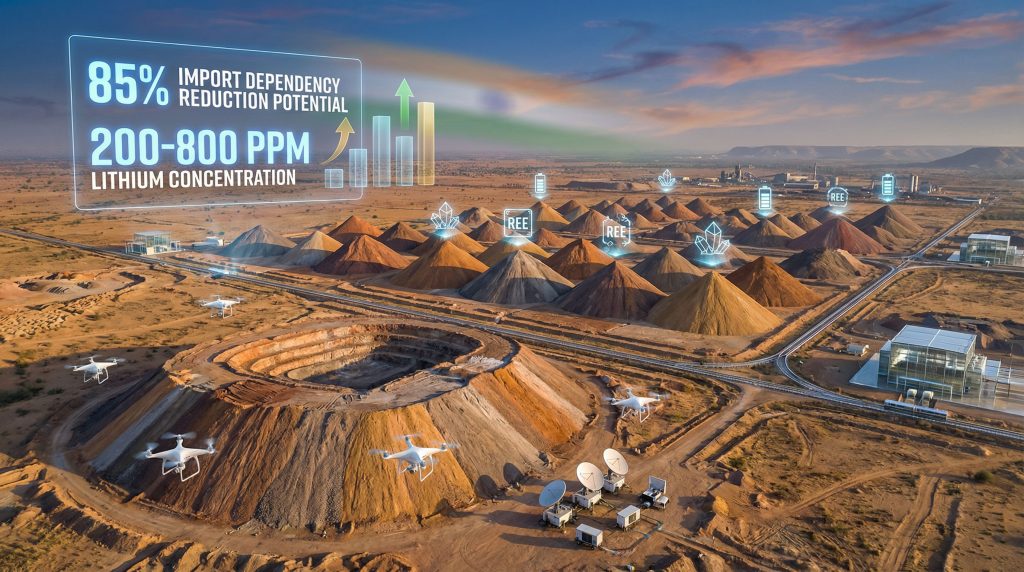
Rajasthan's mine waste transformation represents a paradigm shift in India's approach to critical mineral security, converting decades of accumulated mining waste into strategic resources. This initiative addresses the nation's growing dependency on imported battery metals and rare earth elements while demonstrating innovative approaches to environmental remediation and resource recovery.
Historical Context Shaping India's Strategic Mineral Independence
India's quest for critical mineral security reflects deeper structural vulnerabilities that extend far beyond current supply chain disruptions. For decades, the nation's industrial growth has remained tethered to overseas dependencies, particularly for battery metals and rare earth elements essential to renewable energy infrastructure and defence applications.
The concentration of global mineral processing in China represents more than market dominance; it embodies strategic leverage that can influence entire industrial ecosystems. China controls approximately 60% of global lithium refining capacity and 85-90% of rare earth element separation facilities, creating bottlenecks that extend across multiple critical supply chains.
This asymmetry becomes particularly acute when examining India's annual critical mineral imports, which exceeded $2 billion in 2023 according to the Department for Promotion of Industry and Internal Trade. The country imports virtually 100% of its lithium requirements and maintains 70-80% import dependency for rare earth elements despite possessing domestic reserves.
When big ASX news breaks, our subscribers know first
Revolutionary Assessment Technologies Transforming Resource Recovery
Rajasthan's mine waste transformation initiative represents a technological paradigm shift in mineral exploration methodology. Traditional prospecting methods, dependent on geological intuition and surface sampling, are being superseded by integrated data-driven mining operations that combine satellite imagery, machine learning algorithms, and advanced mineralogical characterisation.
Machine Learning Applications in Waste Assessment
Modern AI in mining techniques process multi-dimensional geospatial datasets to identify mineral associations that human analysts might overlook in complex geological environments. These systems integrate spectral signatures from hyperspectral sensors like AVIRIS and Sentinel-2 with historical assay databases and geological contact mapping.
Recent research published in Computers & Geosciences demonstrated that machine learning models achieved 45-52% accuracy improvement in mineral prospectivity mapping compared to traditional methods. This enhancement stems from the technology's capacity to process simultaneous variables including alteration patterns, structural geology, and geochemical anomalies across large geographical areas.
Advanced Analytical Techniques for Legacy Materials
The characterisation of aged tailings requires specialised analytical approaches that account for weathering, oxidation, and mineral transformation over decades of exposure. X-ray diffraction analysis enables identification of mineral phases at detection limits of approximately 0.1%, providing quantitative mineralogy essential for process design.
Scanning electron microscopy with energy-dispersive X-ray spectroscopy creates elemental maps at micrometer-scale resolution, revealing grain liberation characteristics and mineral associations that directly inform metallurgical flowsheet optimisation. Modern automated mineral liberation analysis can process over 50,000 particles per sample within 2-4 hours, generating statistically robust datasets for engineering calculations.
South Africa's legacy tailings recovery programme employed these integrated analytical techniques to identify previously unmapped secondary rare earth and titanium concentrations in historic gold operations, demonstrating the value of comprehensive characterisation in waste assessment.
Geographic Distribution and Strategic Significance of Rajasthan's Legacy Resources
Rajasthan's extensive mining heritage spans over 75 years of post-independence industrial extraction, supplemented by approximately 80 years of colonial-era operations. This cumulative activity has generated substantial waste accumulations across geologically diverse districts, each containing distinctive mineral assemblages reflecting regional geology.
The state's polymetallic heritage distinguishes it from single-commodity mining regions. Historic operations targeted zinc-lead, copper, rare earths, phosphates, gypsum, and iron ore deposits, creating legacy dumps that potentially contain multiple strategic elements within individual sites. This diversity enables integrated processing strategies that can recover several commodities simultaneously, improving overall project economics.
Mineral Associations Across Districts
| Regional Zone | Primary Historical Operations | Target Recovery Elements | Geological Context |
|---|---|---|---|
| Udaipur Complex | Zinc-lead mining | Lithium (200-800 ppm), zinc, cadmium | Pegmatite-associated mineralisation |
| Ajmer-Bhilwara Belt | Beach placer operations | Heavy rare earths, thorium | Monazite and xenotime concentrations |
| Jodhpur-Barmer Zone | Phosphate extraction | Apatite, gypsum, trace elements | Sedimentary phosphate deposits |
| Eastern Districts | Iron ore operations | Iron, manganese, rare earth co-products | Banded iron formations |
Historical Mining Legacy and Accumulation Patterns
The Udaipur zinc-lead operations historically produced tailings containing residual zinc concentrations of 1-3%, lead at 0.1-0.5%, and associated cadmium at 50-200 ppm levels. These toxic but recoverable elements reflect incomplete historical recovery technologies. Lithium occurrence within these dumps likely stems from associated pegmatite mineralisations or later hydrothermal alteration processes.
Ajmer-Bhilwara region operations focused on monazite [(Ce,La,Th)PO₄] and xenotime (YPO₄) recovery from beach placer or primary rare earth mineralisation. These deposits are particularly valuable because they contain heavy rare earth elements including dysprosium, terbium, and ytterbium, which are essential for permanent magnet applications and command premium prices.
Economic Feasibility Analysis for Waste-to-Resource Conversion
The economic attractiveness of legacy waste processing depends on the intersection of commodity prices, processing costs, and capital investment requirements. Current market conditions create favourable economics for several critical minerals, though price volatility remains a significant risk factor.
Processing Cost Advantages
International benchmarking indicates waste processing costs typically range from $1,500-5,000 per tonne depending on complexity, commodity type, and technology requirements. This compares favourably to primary greenfield ore extraction and initial processing, which typically costs $6,000-15,000 per tonne for rare earths and battery metals.
The cost advantages stem from several factors:
- Reduced mining operations: No drilling, blasting, or waste rock movement required
- Existing infrastructure: Access roads, power supply, and water resources often available
- Simplified permitting: Environmental approvals streamlined for remediation projects
- Community acceptance: Converting environmental liabilities to economic assets generates local support
Capital Investment Requirements
A modular rare earth extraction facility processing 50,000 tonnes annually requires approximately $50-150 million in capital expenditure according to Australian Minerals Council assessments. Smaller pilot-scale operations processing 5,000-10,000 tonnes per year can be developed for $5-20 million, enabling phased development approaches that reduce initial investment risk.
At current lithium carbonate prices of $12,000-18,000 per tonne, processing costs of $2,000-4,000 per tonne yield sufficient margins to support commercial operations. However, lithium price volatility poses significant risk; if prices fall below $10,000 per tonne, most projects become economically unviable.
Environmental Cost Avoidance Benefits
Lifecycle assessment studies confirm that tailings reprocessing generates 40-70% lower greenhouse gas emissions compared to primary mining operations. Furthermore, this reduction stems from eliminated drilling, blasting, waste rock movement, and ore transportation requirements.
Lithium extraction from primary brine deposits typically generates 15 tonnes CO₂-equivalent per tonne of lithium, while direct extraction from aged pegmatite tailings produces approximately 4-5 tonnes CO₂-equivalent per tonne according to International Energy Agency assessments.
Strategic Mineral Recovery Potential Assessment
The technical feasibility of critical mineral recovery from Rajasthan's legacy dumps depends on mineral concentration, liberation characteristics, and metallurgical complexity of aged materials. Different commodities present varying recovery challenges and economic opportunities.
Lithium Extraction Opportunities
Lithium concentrations of 200-800 ppm in legacy tailings approach the threshold for commercial extraction using direct lithium extraction technologies. These advanced processes can achieve 70-90% lithium recovery from suitable feedstocks, significantly higher than traditional processing methods.
The critical minerals energy transition requires a 25% compound annual growth rate through 2030, creating favourable timing for recovery projects. India's domestic lithium production could reduce import dependencies while supporting the nation's electric vehicle manufacturing targets of 50 GWh battery capacity by 2030.
Rare Earth Element Potential
Heavy rare earth elements command premium pricing due to supply concentration and strategic applications. Dysprosium trades at $350-400 per kilogram, while terbium reaches $1,200-1,500 per kilogram, making even low-grade recovery potentially economic.
Monazite and xenotime occurrence in Rajasthan's legacy dumps represents particular strategic value because these minerals contain the full spectrum of rare earth elements plus thorium, enabling integrated processing of multiple commodities from single operations.
Battery Metal Co-Products
Cobalt and nickel recovery potential from historic copper-zinc operations could provide additional revenue streams while supporting India's battery material supply chain development. Manganese availability from iron ore tailings could serve battery cathode material requirements for emerging lithium iron manganese phosphate chemistries.
Global Benchmarking and Technology Transfer Opportunities
International mine waste recovery programmes provide operational precedents and technology transfer opportunities for Rajasthan's mine waste transformation. These established programmes demonstrate both technical feasibility and economic viability under appropriate conditions.
Comparative International Performance
| Project Location | Target Elements | Recovery Technology | Operational Results |
|---|---|---|---|
| Chilean Copper Tailings | Copper, molybdenum | Flotation, hydrometallurgy | 15-25% additional metal recovery |
| South African Gold Dumps | Gold, uranium | Cyanide leaching | 0.3-0.8 g/t gold extraction |
| Australian Iron Tailings | Iron, rare earths | Magnetic separation | 35-45% iron grade improvement |
| Canadian Oil Sands | Rare earths, titanium | Dense media separation | Pilot-stage development |
Chile's copper tailings recovery operations achieved 15-25% additional copper recovery from legacy dumps using advanced flotation and hydrometallurgical techniques. These operations generate $50-75 per tonne in recovered metal value, establishing economic benchmarks for similar polymetallic recovery projects.
Western Australia's Rio Tinto pilot programme recovered rare earth concentrates worth $50-75 per tonne from iron ore tailings containing 0.05-0.1% combined rare earth elements. This demonstrates that even modest rare earth concentrations can support commercial operations at appropriate scale and commodity prices.
Technology Transfer Considerations
Successful international programmes emphasise modular processing designs that enable phased capacity expansion as markets and technical understanding develop. Equipment standardisation across multiple sites reduces operating costs and enables shared maintenance expertise.
Collaboration opportunities exist with established waste recovery operators for equipment optimisation, process design, and operational training. These partnerships can accelerate technology deployment while reducing development risks associated with unproven processing routes.
The next major ASX story will hit our subscribers first
Implementation Strategy and Development Timelines
Rajasthan's mine waste transformation requires systematic phasing to manage technical, financial, and market risks while building operational capability and regulatory frameworks. The implementation approach balances comprehensive assessment requirements with commercial urgency.
Phase-Based Development Approach
Assessment Phase (2025-2026): Comprehensive resource quantification across 80+ identified sites using integrated analytical techniques. This phase establishes baseline data for mineral concentrations, tailings volumes, and metallurgical characteristics essential for process design.
Pilot Development (2026-2027): Construction and operation of pilot-scale processing facilities to validate recovery technologies and optimise process parameters. Multiple pilot programmes testing different commodities and processing routes reduce technical risk for commercial-scale development.
Commercial Construction (2027-2029): Development of full-scale processing facilities based on proven pilot results. Modular design enables capacity expansion as markets develop and additional sites come online.
Production Scaling (2029+): Full commercial operation with systematic expansion to additional high-priority sites. Technology platform standardisation enables rapid deployment across multiple locations.
Financial Structure and Investment Requirements
The comprehensive programme requires estimated capital investment of $500 million to $1 billion depending on commodity focus and processing scale. This investment can be structured through multiple funding mechanisms:
- Government support: Policy incentives and infrastructure development through RSMET and national mining programmes
- Private sector participation: Joint ventures with mining companies and technology providers
- International financing: Development bank support for strategic mineral security initiatives
- Export revenue generation: Foreign exchange earnings from recovered critical mineral exports
Regulatory Framework Evolution and Policy Integration
Successful implementation of Rajasthan's mine waste transformation requires supportive regulatory frameworks that streamline approvals while maintaining environmental and safety standards. Current mining regulations were designed for traditional extraction operations and require adaptation for waste recovery projects.
What Regulatory Changes Are Needed for Waste Recovery Projects?
Waste-to-resource projects should qualify for expedited environmental approvals because they convert environmental liabilities into economic assets while reducing overall environmental impact. Simplified permitting procedures could reduce development timelines from 7-10 years typical for greenfield projects to 2-3 years for waste recovery operations.
Intellectual property protection becomes critical as proprietary processing technologies are developed and deployed. Clear frameworks for technology ownership and licensing enable private sector investment while maintaining strategic national interests in critical mineral production.
Integration with National Strategic Objectives
The National Mineral Policy framework supports domestic resource development and import substitution objectives that align directly with waste recovery initiatives. Integration with Make in India manufacturing programmes creates synergies between domestic mineral production and value-added processing industries.
Export revenue potential from recovered critical minerals supports foreign exchange objectives while reducing trade deficits associated with mineral imports. Strategic stockpile development using domestically recovered materials enhances national security while providing market stability for recovery operations.
Scalability Analysis Across Indian Mining Regions
Rajasthan's initiative provides a template that could be replicated across India's other major mining states, each with distinctive geological characteristics and historical mining legacies. Systematic expansion could significantly enhance India's critical mineral security while converting widespread environmental liabilities into economic assets.
Regional Adaptation Requirements
Odisha's iron ore and chromite mining legacy creates opportunities for manganese and rare earth recovery from historic tailings. The state's established mining infrastructure and port access provide logistical advantages for export-oriented recovery operations.
Jharkhand's coal mining waste contains rare earth elements and battery metals associated with coal seam geology. However, different processing technologies may be required to handle carbonaceous materials and varying mineral associations.
Chhattisgarh's bauxite and iron ore operations generated tailings with potential aluminium, rare earth, and titanium recovery opportunities. The state's central location provides access to both domestic manufacturing centres and export infrastructure.
Technology Platform Standardisation
Standardised assessment methodologies and processing technologies enable rapid deployment across multiple states while reducing development costs and operational complexity. Shared expertise and equipment resources improve overall programme efficiency and technical performance.
National coordination ensures optimal site prioritisation based on strategic mineral requirements, market conditions, and technical feasibility. This systematic approach maximises economic and strategic benefits while minimising development risks and resource conflicts.
Environmental Impact and Sustainability Benefits
The environmental implications of Rajasthan's mine waste transformation extend far beyond traditional mining operations. In addition to reducing extraction-related impacts, these projects actively remediate existing environmental liabilities while generating economic value.
How Does Waste Recovery Compare to Traditional Mining Environmentally?
Mine reclamation innovations demonstrate that tailings reprocessing generates significantly lower environmental impact than primary extraction. Water consumption decreases by 30-50% because existing tailings contain residual moisture and require less intensive processing compared to fresh ore.
Land disturbance virtually eliminates new surface impacts while progressively reducing the footprint of existing tailings facilities. Successfully processed tailings can be backfilled into historic mine workings or converted to productive land use, creating net positive environmental outcomes.
Air quality improvements result from reduced dust generation as tailings surfaces are stabilised through processing activities. According to government assessments, particulate matter emissions decrease by 60-80% once active processing begins compared to unmanaged tailings facilities.
Long-term Ecosystem Benefits
Habitat restoration becomes possible as tailings facilities are progressively processed and remediated. Native vegetation establishment on processed areas creates wildlife corridors and biodiversity enhancement opportunities that benefit regional ecosystem health.
Water quality improvements occur through removal of acid-generating materials and heavy metal contamination from legacy tailings. Groundwater protection enhances as potential contamination sources are eliminated through systematic processing and remediation.
Risk Assessment and Success Probability Analysis
Realistic evaluation of technical, commercial, and market risks enables informed decision-making and appropriate risk mitigation strategies. Mine waste recovery projects face unique challenges that differ significantly from traditional mining operations.
Technical and Metallurgical Risks
Aged tailings materials exhibit complex mineralogy due to decades of weathering, oxidation, and secondary mineral formation. These changes can significantly impact processing behaviour and recovery efficiency compared to fresh ore materials. Comprehensive metallurgical testing is essential to validate processing routes and predict commercial performance.
Market price volatility poses significant risk to project economics. Lithium prices fluctuated from $60,000 per tonne in late 2022 to $12,000-15,000 per tonne by 2024, demonstrating the extreme volatility that can render projects economically unviable within short timeframes.
Infrastructure development costs may exceed initial estimates, particularly for remote sites lacking adequate road access, power supply, or water resources. These ancillary investments can significantly impact overall project economics and development timelines.
Success Probability Scenarios
Conservative Scenario: 20-30% of assessed sites demonstrate commercial viability under current market conditions and technology capabilities. This outcome would still represent significant strategic value while maintaining realistic expectations for technical and economic challenges.
Optimistic Scenario: 50-60% of sites achieve positive economic returns through combination of favourable commodity prices, successful technology deployment, and supportive regulatory frameworks. This outcome would substantially enhance India's critical mineral security and establish global leadership in waste recovery technologies.
Critical success factors include sustained commodity prices above breakeven thresholds, successful technology performance at commercial scale, and continued government support through policy incentives and infrastructure development.
Long-Term Strategic Implications for Resource Security
Rajasthan's mine waste transformation represents more than a regional development project; it embodies a strategic approach to resource security that could influence global approaches to critical mineral supply chain resilience. Success could position India as a leader in sustainable mining practices while reducing strategic dependencies.
Supply Chain Resilience Development
Domestic critical mineral production reduces exposure to international market disruptions and geopolitical tensions that can severely impact industrial operations. The 2010-2015 Chinese rare earth export restrictions demonstrated how supply concentration creates strategic vulnerabilities for importing nations.
Strategic stockpile development using domestically recovered materials provides market stability while maintaining emergency reserves for national security applications. These stockpiles can buffer against supply disruptions while supporting long-term industrial planning and investment.
Innovation Ecosystem Creation
The technical expertise developed through waste recovery operations creates intellectual property and technological capabilities that can be exported to other developing nations facing similar challenges. This knowledge transfer generates additional revenue while establishing India as a technology leader in sustainable resource recovery.
University-industry collaboration strengthens research capabilities in mineral processing, analytical chemistry, and metallurgical engineering. These partnerships develop human capital essential for long-term competitiveness in advanced materials industries.
Research and development investments generate proprietary technologies that provide competitive advantages in global markets while supporting domestic industrial development objectives. Intellectual property creation establishes sustainable competitive advantages beyond commodity production.
Future Outlook for India's Mining Transformation
The broader implications of Rajasthan's mine waste transformation extend well beyond state boundaries. This initiative represents a fundamental shift in how India approaches resource security and environmental stewardship within the mining industry evolution towards sustainable practices.
Consequently, successful implementation could establish a new paradigm for developing nations worldwide, demonstrating that environmental liabilities can be transformed into strategic assets through innovative technology deployment and supportive policy frameworks.
Investment and technical analysis involves inherent uncertainties regarding commodity prices, technology performance, and market conditions. Prospective investors should conduct independent due diligence and consult qualified professionals before making investment decisions. Past performance of similar projects does not guarantee future results, and mineral recovery operations involve significant technical and financial risks.
Ready to Discover the Next Major Mineral Breakthrough?
Rajasthan's mine waste transformation demonstrates how advanced technologies can unlock hidden value in legacy resources, converting environmental liabilities into strategic assets. Discovery Alert's proprietary Discovery IQ model instantly identifies such emerging opportunities across ASX-listed mining companies, delivering real-time alerts on significant mineral discoveries that could transform portfolios before the broader market recognises their potential.