May 17, 2026
The global rare earth elements sector continues experiencing heightened geopolitical attention as supply chain vulnerabilities and technology dependencies reshape international relations. However, beneath policy rhetoric and strategic commentaries lies a fundamental disconnect between perceived resource abundance and actual production capabilities. This gap becomes particularly pronounced when examining rare earth claims Africa reality and the continent's role in global rare earth markets, where political narratives often overstate mineral endowments relative to verified geological surveys and operational capacity assessments.
Understanding this disparity requires systematic analysis of mineral deposit tiers, production statistics, and development timelines rather than reliance on aggregated claims mixing different mineral categories. The distinction between critical minerals broadly defined and rare earth elements specifically matters significantly for investment decisions, supply chain planning, and geopolitical risk assessment.
What Are Africa's Actual Rare Earth Reserves Compared to Global Totals?
USGS Data vs. Political Commentary – The Numbers Don't Align
According to the U.S. Geological Survey Mineral Commodity Summaries published in January 2024, global rare earth element reserves total approximately 120 million tonnes of rare earth oxide equivalent. This figure represents proven reserves under current economic and technological extraction conditions, not speculative geological potential or undiscovered resources.
The distribution of these verified reserves reveals significant geographic concentration:
| Country | Reserve Volume (Million Tonnes) | Global Share |
|---|---|---|
| China | 44 | 36.7% |
| Vietnam | 22 | 18.3% |
| Brazil | 22 | 18.3% |
| Russia | 12 | 10.0% |
| India | 7 | 5.8% |
| Others | 13 | 10.9% |
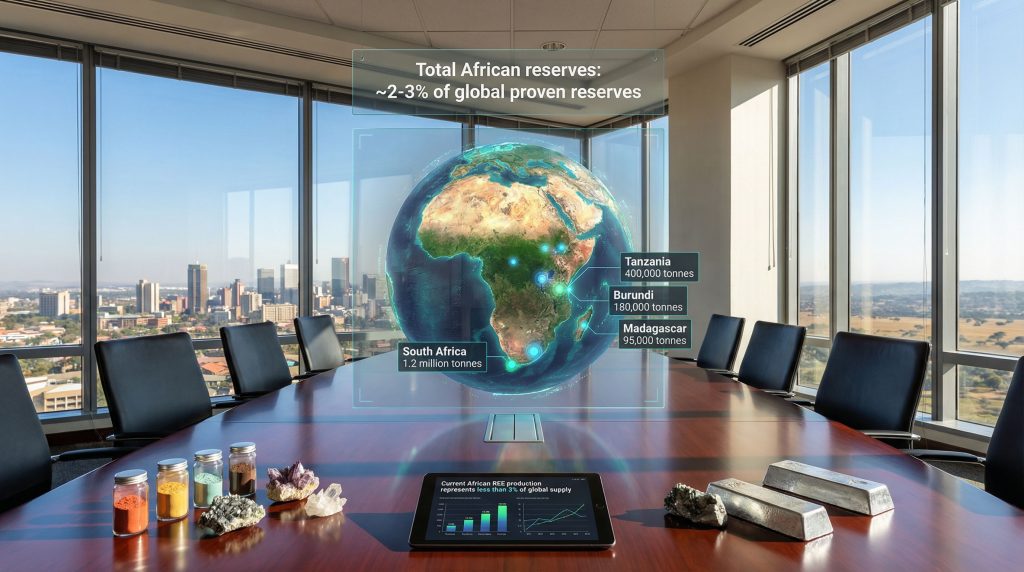
Africa's verified rare earth reserves, based on the same USGS methodology, account for approximately 2.6 to 3.2 million tonnes, representing just 2.2 to 2.7 percent of global proven reserves. This figure includes:
- South Africa: 1.2 million tonnes
- Tanzania: 400,000 tonnes
- Burundi: 180,000 tonnes
- Madagascar: 95,000 tonnes
- Kenya: 62,000 tonnes
- Malawi: 50,000 tonnes
The substantial gap between Africa's actual reserve base and frequently cited higher percentages stems from categorical confusion between different mineral classifications and geographical survey methodologies.
The 30% Claim Under Scrutiny
Political commentary occasionally references figures suggesting Africa contains approximately 30 percent of global rare earth resources. However, this statistic appears to conflate several distinct categories:
- Potential resources (speculative geological occurrences with limited data)
- Critical minerals broadly (including cobalt, manganese, graphite, platinum group metals)
- Rare earth elements specifically (the 17 lanthanide elements plus scandium and yttrium)
Africa indeed holds substantial endowments of critical minerals energy security technologies. The continent contains approximately 70 percent of global cobalt reserves, 60 percent of manganese, and significant platinum group metal deposits. These minerals are frequently grouped under critical materials frameworks, creating statistical aggregation that obscures rare earth element specifics.
When minerals enter geopolitical arguments, precision becomes essential for accurate risk assessment and investment planning.
Professional geological surveys distinguish between measured, indicated, and inferred resource categories under international reporting standards such as the Joint Ore Reserves Committee Code and National Instrument 43-101. African rare earth claims mixing these categories with exploration targets and conceptual resources create systematic overestimation of near-term extraction potential.
When big ASX news breaks, our subscribers know first
How Do Africa's Current REE Production Levels Compare to Reserve Claims?
Production Reality Assessment
Global rare earth element production in 2024 reached approximately 300,000 tonnes of rare earth oxide equivalent, with production concentrated in a small number of operational facilities. China maintains production dominance at 60 percent of global output, despite holding 37 percent of reserves, indicating that processing infrastructure and supply chain integration capabilities determine production capacity more than raw mineral availability.
Current African rare earth production represents less than 3 percent of global supply:
- Madagascar: 6,000 tonnes annually (2% of global output)
- South Africa: Less than 500 tonnes (negligible commercial production)
- Tanzania: Zero commercial production
- Other African countries: Zero commercial production
This production profile reveals that Africa's rare earth sector remains in early development stages rather than underutilised operational capacity. Furthermore, Madagascar's production comes primarily from monazite extraction as a co-product of ilmenite and zircon mining operations, not dedicated rare earth facilities.
Supply Chain Integration Analysis
The gap between Africa's reserve percentages and production shares reflects structural constraints rather than geological limitations:
- Processing infrastructure absence: Most African countries lack rare earth separation and refining facilities
- Metallurgical complexity: African deposits often contain lower grades and more complex mineral assemblages
- Capital requirements: Primary rare earth operations require $150 million to $1.2 billion development investment
- Regulatory frameworks: Mining permitting and environmental approval processes remain underdeveloped
- Transportation networks: Limited port access and rail infrastructure for bulk mineral transport
These bottlenecks explain why Africa's current production remains disproportionately low relative to its proven reserve base, distinguishing operational constraints from resource availability.
Which African Countries Hold the Most Promising REE Development Projects?
Southern Africa's Emerging Pipeline
Three major rare earth projects currently advance through development phases across Southern and East Africa, representing the continent's most credible near-term production expansion potential.
Steenkampskraal Project (South Africa) contains an estimated 1.2 million tonnes of rare earth oxides with high neodymium-praseodymium content essential for permanent magnet manufacturing. Rare Earths Resources Ltd operates pilot production targeting 10,000 to 15,000 tonnes annual capacity. Development requires approximately $150 to $200 million capital investment, with commercial production timeline extending to 2026-2027.
Ngualla Project (Tanzania) holds 400,000 tonnes of high-grade rare earth resources with concentrated neodymium-praseodymium assemblage. Peak Resources Ltd projects 15,000 to 20,000 tonnes annual capacity at full development, requiring $800 million to $1.2 billion total investment. Feasibility studies target completion in 2024-2025, with production beginning 2028-2030.
Longonjo Project (Angola) operates under Pensana Rare Earths Ltd with 108,500 tonnes resource base and $80 million initial phase investment commitment. Projected capacity reaches 5,000 to 8,000 tonnes annually, focusing on neodymium-praseodymium concentrate production for export markets.
Investment Flow Patterns
Capital deployment in African rare earth projects demonstrates risk-adjusted return calculations favouring established mining jurisdictions with proven regulatory frameworks. Moreover, junior mining exploration attracts Western and Australian capital due to:
- Regulatory stability: Established mining codes and permitting processes
- Infrastructure proximity: Access to ports, power grids, and transportation networks
- Technical expertise: Available metallurgical and engineering services
- Political risk premiums: Lower sovereign risk compared to other African regions
| Project | Country | Operator | Capital Requirement | Development Stage |
|---|---|---|---|---|
| Steenkampskraal | South Africa | Rare Earths Resources | $150-200M | Pilot Production |
| Ngualla | Tanzania | Peak Resources | $800M-1.2B | Feasibility |
| Longonjo | Angola | Pensana | $80M Phase 1 | Development |
| Gakara | Burundi | Rare Element Resources | TBD | Exploration |
Chinese investment in African rare earth projects remains limited compared to other mineral sectors, suggesting strategic focus on downstream processing and technology rather than upstream resource control.
Why Do Political Narratives Often Overstate Africa's REE Significance?
Rhetorical Leverage in Geopolitical Commentary
Political discourse increasingly incorporates mineral resource arguments as justification for foreign policy positions and strategic relationships. This trend creates incentives for overstating resource endowments to strengthen negotiating positions or critique international interventions.
The specific case of claims regarding U.S. interest in Nigerian rare earths illustrates this dynamic. Nigeria's mineral profile consists primarily of oil and gas reserves, tin, columbite, and bitumen deposits. The country produces negligible rare earth elements and operates no significant rare earth processing facilities, making mineral motives for geopolitical interest empirically unsupported.
However, the rhetorical power of rare earth arguments stems from widespread awareness of supply chain vulnerabilities and Chinese market dominance. Consequently, citing rare earth resources adds credibility to arguments about strategic resource competition, regardless of factual accuracy regarding specific countries or mineral types.
Additionally, recent policy developments like the critical minerals policy order highlight the strategic importance of mineral security in geopolitical discourse.
Market Mispricing Risks from Inaccurate Claims
Financial markets demonstrate sensitivity to rare earth supply narratives, creating potential for mispricing when geopolitical commentary contains inaccurate mineral data. Five key mechanisms transmit misinformation into market distortions:
- Equity valuation errors for companies with African rare earth exposure
- Commodity price volatility based on supply disruption fears
- Capital allocation mistakes toward projects with overstated resource potential
- Currency fluctuations in rare earth producing countries
- Sector rotation decisions based on geopolitical supply assessments
Professional investors require independent verification of resource claims through geological surveys, technical reports, and operational data rather than political commentary or policy documents. Furthermore, initiatives like the European CRM facility demonstrate how regional supply security concerns influence investment patterns.
What Role Does Nigeria Actually Play in Global REE Supply Chains?
Nigeria's Actual Mineral Profile
Nigeria's economy depends overwhelmingly on hydrocarbon exports, which constitute approximately 95 percent of export revenues and 80 percent of government income. The country's proven oil reserves exceed 37 billion barrels, with natural gas reserves estimated at 206 trillion cubic feet.
Secondary mineral production includes tin mining (historically significant), columbite extraction for steel production, and bitumen deposits for construction materials. However, Nigeria's current rare earth element production remains negligible, with no operational primary rare earth mines or processing facilities.
Nigeria is resource-rich but not a meaningful rare earth producer or supply chain participant.
Geological surveys indicate potential rare earth occurrences in Nigeria's Middle Belt region, particularly associated with granite intrusions and pegmatite formations. However, these remain exploration targets rather than defined resources, requiring extensive drilling, sampling, and economic analysis before classification as reserves.
Recent analysis examining rare earth claims and geopolitical narratives provides additional context on how mineral arguments are used in political discourse.
Strategic Value Assessment
Nigeria's geopolitical significance stems from factors unrelated to rare earth elements:
- Oil production capacity: Africa's largest petroleum producer
- Population size: 220 million people representing major consumer market
- Regional influence: Leadership role in Economic Community of West African States
- Security partnerships: Counter-terrorism cooperation in Sahel region
- Financial systems: Growing fintech and digital payment infrastructure
This strategic value profile contradicts narratives positioning rare earth access as motivation for international engagement with Nigeria, highlighting the importance of distinguishing between different categories of national strategic interest.
How Should Investors Evaluate African REE Opportunities?
Due Diligence Framework
African rare earth investments require systematic evaluation methodology accounting for geological, technical, and political risk factors unique to early-stage mineral development projects. Seven critical assessment steps include:
- Resource verification through independent geological reports compliant with JORC or NI 43-101 standards
- Metallurgical testing demonstrating processing feasibility and concentrate quality
- Regulatory pathway analysis including permitting timelines and environmental approvals
- Infrastructure assessment covering power, transportation, and water access
- Capital requirement estimation for both development and working capital phases
- Market demand analysis for specific rare earth element types and grades
- Political risk evaluation including sovereign stability and mining policy consistency
Each factor requires quantitative analysis rather than qualitative assertions, given the capital intensity and technical complexity of rare earth development projects.
Risk-Adjusted Return Analysis
African rare earth projects typically exhibit higher risk-return profiles compared to established mining jurisdictions, requiring premium returns to justify capital deployment. Key risk categories include:
| Risk Category | Impact Level | Mitigation Strategies |
|---|---|---|
| Political Stability | High | Diversified country exposure |
| Infrastructure | Medium-High | Phased development approach |
| Technical | Medium | Pilot plant operations |
| Market | Medium | Off-take agreements |
| Currency | Medium | Natural hedging strategies |
Timeline expectations for African rare earth projects typically extend 5 to 8 years from resource definition to commercial production, compared to 3 to 5 years in established mining jurisdictions. This extended development period increases capital costs and market risk exposure.
The next major ASX story will hit our subscribers first
What Are the Long-Term Prospects for Africa's REE Sector?
Exploration Potential vs Current Reality
Africa's rare earth potential exceeds current reserve estimates due to limited systematic geological exploration across much of the continent. Many African countries have conducted minimal modern rare earth surveys, creating information gaps that could conceal significant resources.
Comparative analysis reveals substantial exploration funding disparities:
| Region | Annual Exploration Budget | $ per km² |
|---|---|---|
| Australia | $2.8 billion | $364 |
| Canada | $1.9 billion | $190 |
| Latin America | $1.1 billion | $62 |
| Africa | $0.8 billion | $27 |
This funding differential suggests Africa's geological potential remains significantly underexplored relative to other continents with established rare earth industries. In addition, Africa's emerging role as a strategic mineral frontier demonstrates growing international recognition of the continent's potential.
Supply Chain Development Requirements
African rare earth sector development requires coordinated investment across multiple infrastructure categories beyond mine development:
- Processing facilities: Acid leaching, solvent extraction, and separation plants
- Transportation networks: Rail and port infrastructure for bulk commodity export
- Power generation: Reliable electricity supply for energy-intensive processing
- Technical education: Metallurgical engineering and rare earth chemistry expertise
- Environmental systems: Waste management and water treatment capabilities
Total infrastructure investment requirements for establishing integrated African rare earth supply chains could exceed $10 billion across multiple countries and development phases.
How Can Market Participants Separate Fact from Fiction in REE Claims?
Information Verification Best Practices
Reliable rare earth analysis requires systematic fact-checking methodology distinguishing between promotional material, political commentary, and technical documentation. A three-step verification process includes:
Step 1: Source Classification
- Primary geological surveys (USGS, national geological services)
- Technical reports (JORC/NI 43-101 compliant studies)
- Company disclosures (SEC, ASX, LSE regulatory filings)
- Secondary analysis (industry publications, academic research)
- Tertiary commentary (political opinion, promotional material)
Step 2: Data Cross-Referencing
- Compare statistics across multiple authoritative sources
- Verify measurement units and classification standards
- Check publication dates for time-sensitive information
- Identify potential conflicts of interest in source material
Step 3: Context Analysis
- Distinguish between reserves, resources, and exploration targets
- Separate current production from projected capacity
- Account for technological and economic assumptions
- Consider regulatory and political risk factors
This systematic approach prevents category confusion and promotional bias from distorting investment analysis or policy assessment.
Professional Standards for Resource Assessment
International mineral resource reporting requires compliance with established technical standards designed to prevent misleading claims and ensure investor protection. Two primary frameworks govern rare earth resource disclosure:
JORC Code (Australia/South Africa): Requires qualified persons with appropriate experience to verify resource estimates, mandates disclosure of key assumptions, and establishes clear definitions for measured, indicated, and inferred resource categories.
NI 43-101 (Canada): Demands independent technical reports for public companies, requires professional engineer or geoscientist certification, and mandates comprehensive disclosure of technical data and assumptions.
Precision in resource data is a form of risk management essential for informed capital allocation decisions.
Companies operating in African rare earth projects should demonstrate compliance with these standards through independent technical reports and qualified person statements rather than internal estimates or promotional materials.
Balancing Potential with Present Reality
Africa's rare earth sector stands at the intersection of significant geological potential and substantial development challenges. While current production remains minimal and proven reserves represent a small percentage of global totals, the continent's underfunded exploration history suggests meaningful upside potential for systematic resource development.
However, translating this potential into operational supply chains requires realistic assessment of capital requirements, infrastructure constraints, and development timelines. Political narratives overstating current rare earth endowments create market distortions that ultimately hinder rather than help African mineral development by misallocating capital and creating unrealistic expectations.
Successful African rare earth investment strategies must account for extended development timelines, higher capital intensity, and elevated political risks while maintaining focus on projects with demonstrated resource quality, technical feasibility, and regulatory pathway clarity. The distinction between promotional claims and verified data becomes essential for effective risk management in this capital-intensive sector.
Investment Framework Summary:
- Verify all resource claims through independent geological reports
- Account for 5-8 year development timelines in financial projections
- Assess infrastructure requirements alongside resource quality
- Monitor political stability and regulatory consistency
- Diversify exposure across multiple projects and jurisdictions
- Maintain focus on projects with established technical feasibility
Africa's rare earth future depends on realistic assessment of current constraints balanced with systematic development of genuine geological potential through professional standards and adequate capital deployment.
Looking to Capitalise on Africa's Rare Earth Development Potential?
Discovery Alert's proprietary Discovery IQ model delivers real-time notifications on significant rare earth and critical mineral discoveries across the ASX, helping investors identify actionable opportunities as geological potential transforms into commercial reality. Explore how major mineral discoveries can generate substantial returns by visiting Discovery Alert's dedicated discoveries page, and begin your 30-day free trial today to position yourself ahead of the market.