June 11, 2026
The Global Rare Earth Supply Crisis That's Reshaping Industrial Policy
Across the world's most advanced manufacturing economies, a quiet but consequential reckoning is underway. Decades of reliance on a single country for the processing of materials essential to electric vehicles, wind turbines, defence systems, and consumer electronics has exposed a vulnerability that no trade agreement can quickly resolve. Rare earth elements, once considered obscure inputs known only to materials scientists, have emerged as the defining resource bottleneck of the clean energy and defence technology transition.
The data is stark. A survey cited by mining.com found that 47% of companies were actively searching for but had not yet found viable alternatives to Chinese rare earth supply, with some describing certain critical minerals as nearly unobtainable from non-Chinese sources. This is the geopolitical backdrop against which India's most ambitious critical minerals initiative is taking shape: the India rare earth corridor in Andhra Pradesh, a coastal industrial development zone that has the potential to fundamentally alter global rare earth supply chains.
When big ASX news breaks, our subscribers know first
Why Andhra Pradesh Has Become the Epicentre of India's Rare Earth Ambitions
The Coastal Mineral Belt That Changes Everything
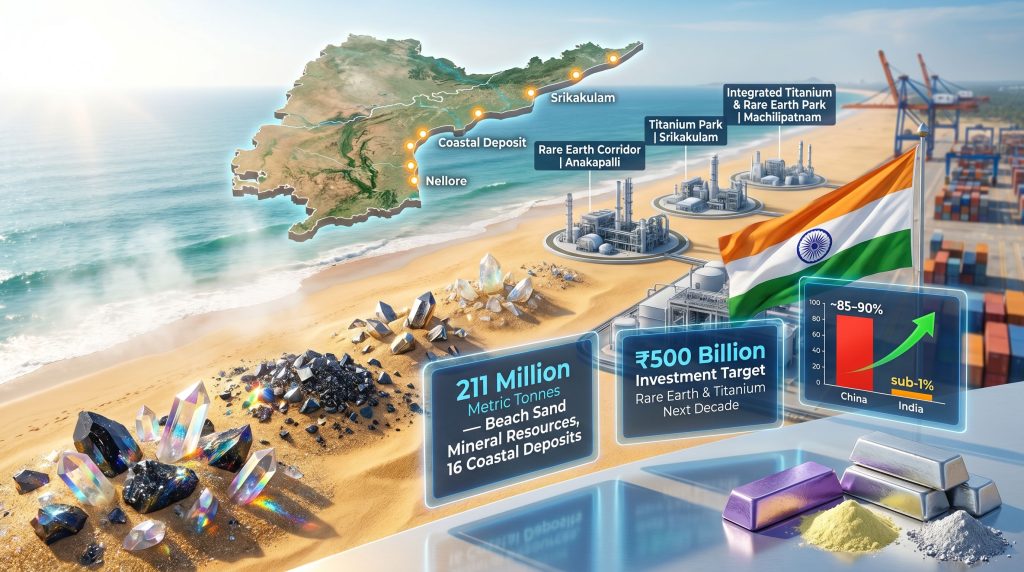
The physical geography of Andhra Pradesh's coastline is not incidental to its strategic importance. The Bay of Bengal has spent millennia concentrating heavy minerals through wave action, tidal movement, and sediment sorting, depositing economically significant accumulations of monazite, ilmenite, rutile, zircon, and garnet across approximately 974 kilometres of coastline stretching from Srikakulam in the north to Nellore in the south.
This belt encompasses multiple strategically positioned deposit locations including Bhimunipatnam, Kalingapatnam, Kakinada, Narsapur, Machilipatnam, Chirala, Vodarevu, Ramayapatnam, and Dugarajapatnam. Unlike inland hard rock rare earth deposits, which require extensive excavation, crushing, and grinding before any concentration of value can occur, beach sand mineral resources arrive pre-concentrated by natural geological processes. The heavy minerals have already been separated from lighter material over geological timescales, materially reducing the energy intensity and capital requirements of initial processing steps.
The coastal location itself confers compounding logistical advantages. Deep-water port access along this stretch of coastline enables efficient import of processing reagents and export of finished rare earth products, creating a supply chain architecture that landlocked deposit regions simply cannot replicate. This structural advantage becomes particularly important when considering the downstream export ambitions embedded in the corridor's design.
What the Numbers Actually Reveal
The scale of Andhra Pradesh's mineral endowment is significant by any measure. According to draft government documentation, the state holds 211 million metric tonnes of beach sand mineral resources across 16 identified coastal deposits. When placed against India's total rare earth ore resource base of 482.6 million tonnes as documented by the Geological Survey of India, Andhra Pradesh's coastal belt represents a dominant share of the country's accessible rare earth potential.
The mineral composition of this endowment elevates the corridor beyond a conventional mining story. Monazite, the primary rare earth carrier in these beach sand deposits, contains 55 to 60% rare earth oxides alongside 8 to 10% thorium. This dual composition means that every tonne of monazite processed simultaneously yields rare earth material for magnet manufacturing and thorium, a potential fuel for advanced nuclear reactor cycles. Very few mineral deposits anywhere on earth combine these two dimensions in a single resource.
Approximately 16,000 hectares along the corridor have been earmarked for critical mineral exploration activities, with 1,000 hectares already cleared for a private developer and a further 4,000 hectares under active review.
"The presence of thorium alongside rare earth oxides elevates the Andhra Pradesh corridor into the simultaneous domain of nuclear energy policy, advanced defence supply chains, and clean energy manufacturing. Few mineral development initiatives globally carry this degree of strategic layering."
How India's Rare Earth Corridor Policy Actually Works
The Federal Architecture Behind the Corridor Designation
Andhra Pradesh was formally identified as one of four states selected in India's February 2026 federal budget for rare earth corridor development. This designation is not simply a label. It represents a bundled policy commitment covering three integrated verticals: mining, processing, and magnet manufacturing. The decision to integrate all three stages within a single corridor framework directly addresses India's historical failure to advance beyond the extraction phase of mineral development.
The Union government's approval in November 2025 of a ₹73 billion (approximately $816 million) program to support domestic rare earth permanent magnet manufacturing provides the downstream demand anchor that corridor supply chains can align to. This sequencing matters: by establishing magnet manufacturing incentives before processing capacity exists, the policy creates a pull-through demand signal that reduces the commercial risk for investors in upstream separation and refining facilities.
The corridor framework also involves infrastructure co-investment and downstream incentive layering that distinguishes it from standard mineral lease frameworks, where a developer typically secures extraction rights but navigates infrastructure and downstream development independently.
Andhra Pradesh's State-Level Policy Mechanics
At the state level, the policy architecture is moving toward implementation. Cabinet approval for the Andhra Pradesh rare earth corridor policy was anticipated within approximately one month of June 2026, with tender issuance for rare earth processing facilities to follow upon sign-off. Furthermore, Andhra Pradesh's rare earth ambitions have drawn considerable attention from analysts tracking the state's push to emerge as a major hub for rare earth and critical minerals exploration.
The incentive structure has been deliberately calibrated to attract substantial, vertically integrated investments rather than fragmented small-scale operations. Projects committing ₹10 billion or more qualify for enhanced capital-linked benefits, effectively filtering the tender pool to well-capitalised participants with genuine processing ambitions. This threshold reflects policymakers' recognition that rare earth separation technology requires significant scale to achieve economic viability and global competitiveness.
The overarching investment attraction target for the corridor is ₹500 billion (approximately $5.2 billion) in rare earth and titanium investments over the coming decade. This figure sits within a broader context: Andhra Pradesh has already demonstrated its capacity to attract marquee investors, having secured commitments from Google and ArcelorMittal Nippon Steel as part of its ambition to reach $1 trillion in total investment commitments by 2029, a target disclosed by a state minister in November 2025.
The Integrated Industrial Cluster Model
The corridor's spatial design reflects deliberate planning to create synergies between related mineral processing activities across three distinct cluster nodes:
| Cluster Name | Location | Primary Focus |
|---|---|---|
| Rare Earth Corridor | Anakapalli | REE separation, refining, downstream processing |
| Titanium Park | Srikakulam | Titanium sponge and alloy production |
| Integrated Titanium & Rare Earth Park | Machilipatnam | Combined value-added manufacturing |
This distributed cluster model allows specialisation at each node while enabling logistical integration across the full value chain, from initial mineral separation through to alloy and magnet production.
What Raw Reserves Alone Cannot Deliver: India's Processing Gap Problem
The Structural Deficit Between Ore and Output
Resource endowment and processing capability are entirely different things. India's rare earth story has historically been defined by the gap between these two realities. The country holds substantial reserves, yet currently accounts for less than 1% of global rare earth processing output. Understanding why this gap exists requires examining where China's dominance is actually embedded.
China's control of the rare earth supply chain is not primarily a mining story. It is a processing story. The intricate hydrometallurgical separation techniques required to isolate individual rare earth elements from mixed concentrate have been refined in China over decades, with substantial state investment in the underlying chemistry, engineering, and workforce capabilities. Replicating this industrial knowledge base elsewhere takes time and capital that no policy announcement can shortcut. Indeed, the rare earth processing challenges facing nations attempting to build independent capacity are well-documented and significant.
India's specific challenge is compounded by the thorium content of its primary rare earth mineral, monazite. Under the Atomic Energy Act framework, thorium-bearing minerals fall under the jurisdiction of the Atomic Minerals Directorate, creating regulatory complexity that has historically restricted private sector access to monazite-based processing pathways. The regulatory evolution enabling greater private sector participation is underway but remains incomplete, representing one of the most consequential variables in the corridor's development timeline.
Comparing India's Processing Capacity Against Global Benchmarks
The following table illustrates the structural imbalance between reserve holdings and processing capacity that defines the global rare earth landscape:
| Country | Share of Global REE Mining | Share of Global REE Processing | Processing-to-Mining Ratio |
|---|---|---|---|
| China | ~60% | ~85-90% | Dominant |
| USA | ~15% | ~5% | Significant gap |
| Australia | ~8% | ~2% | Significant gap |
| India | ~1-2% | Less than 1% | Critical gap |
"India ranks among the world's top holders of rare earth reserves but processes less than 1% of global output. The Andhra Pradesh corridor is specifically architected to correct this structural imbalance by co-locating mining, separation, refining, and magnet manufacturing within a single policy and infrastructure framework."
The solvent extraction processes used in rare earth separation are capital-intensive, chemically complex, and require substantial engineering expertise. A single commercial-scale rare earth separation plant involves hundreds of individual extraction stages, each calibrated to isolate specific elements based on subtle differences in chemical affinity. This is not technology that can be purchased off the shelf and deployed immediately. It requires either deep domestic expertise or formal technology transfer from established operators.
Who Is Competing to Build India's Rare Earth Processing Infrastructure?
The Industrial Conglomerates Entering the Arena
The private sector response to Andhra Pradesh's corridor framework has been significant. Approximately 10 companies have formally expressed interest in establishing rare earth facilities in the state, according to sources cited by Reuters. Among those confirmed as interested parties are three of India's largest and most strategically diversified industrial groups: Reliance Industries, Vedanta, and Adani Enterprises.
The entry of these conglomerates into a sector historically dominated by the state-owned Indian Rare Earths Limited signals a fundamental shift in India's mineral development approach. Each of the three groups brings capabilities that translate meaningfully to the rare earth processing challenge:
| Company | Relevant Existing Capabilities | Strategic Fit for REE Corridor |
|---|---|---|
| Reliance Industries | Petrochemicals, refining, energy transition investments | High-purity chemical processing and separation expertise |
| Vedanta | Base metals mining, zinc smelting, aluminium refining | Metallurgical processing and hydrometallurgical separation |
| Adani Enterprises | Port infrastructure, logistics, green energy assets | Supply chain integration and export connectivity |
What Each Conglomerate Brings to the Table
Reliance's relevance extends beyond its financial scale. The company's petrochemical and refining operations involve complex chemical processing at industrial scale, including solvent management, chemical recovery systems, and high-purity separation processes that share engineering principles with rare earth hydrometallurgy. Its recent investments across clean energy and battery technology also create internal demand signals that make backward integration into rare earth processing strategically coherent.
Vedanta's base metals background is perhaps the most technically proximate to rare earth processing among the three. Zinc hydrometallurgy and aluminium refining involve comparable separation challenges to rare earth processing, and Vedanta's existing engineering workforce carries transferable skills. The company also has established relationships with international metals technology providers that could facilitate technology transfer agreements.
Adani's port infrastructure is arguably the corridor's most underappreciated strategic asset. The ability to move processed rare earth materials efficiently from production facilities to international customers is a genuine competitive advantage, particularly as allied-nation manufacturers seek alternative supply chains with reliable delivery schedules.
The Competitive Dynamics of Tender Participation
The ₹10 billion investment threshold for enhanced incentives effectively defines the competitive landscape. Smaller domestic players are unlikely to qualify, while the threshold is comfortable for the conglomerates named. However, the more significant competitive variable is access to processing technology.
None of India's domestic industrial groups currently possesses commercial-scale rare earth separation technology. This means technology partnerships are not optional enhancements to tender bids but prerequisites for viability. The most likely pathways involve partnerships with rare earth processing specialists from Japan, South Korea, or Australia — countries that have invested significantly in developing processing capabilities outside China and that carry their own strategic incentives to see India's corridor succeed.
Why This Corridor Matters Beyond India's Borders: The Geopolitical Dimension
China's Rare Earth Leverage and the Global Scramble to Respond
The 2025 to 2026 period has brought China's rare earth dominance from a strategic concern to an operational crisis for many global manufacturers. China's export restrictions on rare earth elements created immediate supply disruptions across electric vehicle, defence electronics, and advanced manufacturing sectors. The restrictions exposed the degree to which global manufacturers had accepted Chinese rare earth supply as a structural given rather than a manageable risk.
A US business group survey found that 47% of companies were actively searching for but had not yet found viable alternative supply sources, with some characterising the situation as certain critical minerals being nearly unobtainable outside of China. This demand signal from allied-nation manufacturers is precisely the commercial environment in which the India rare earth corridor in Andhra Pradesh has been designed to compete.
India as an Emerging Counterweight in the Global REE Supply Architecture
India's participation in the Quad framework alongside the United States, Japan, and Australia has elevated critical mineral supply chain cooperation from a peripheral diplomatic topic to a central strategic priority. The monazite-derived rare earths available from Andhra Pradesh's coastal deposits include the neodymium and praseodymium that form the core of NdFeB permanent magnets, the foundational technology in both electric vehicle motors and wind turbine generators.
India's port-connected coastal corridor offers a structural advantage over landlocked deposit regions when considering the timeline for reaching export-ready production. The combination of established port infrastructure, existing industrial workforce, and proximate deep-water access compresses the capital expenditure and construction timelines associated with getting processed material to allied-nation customers. Consequently, China's rare earth strategy of leveraging supply chain dominance has, paradoxically, accelerated investment interest in exactly the kind of alternative capacity that Andhra Pradesh now offers.
Applications Driving Demand for Andhra Pradesh's Rare Earth Output
The end-use demand landscape for the specific rare earth elements available from Andhra Pradesh's monazite deposits spans multiple high-growth sectors:
| End-Use Sector | Key Rare Earth Elements Required | Strategic Importance |
|---|---|---|
| Electric Vehicle Motors | Neodymium, Praseodymium, Dysprosium | Core EV transition technology |
| Wind Turbine Generators | Neodymium, Terbium | Renewable energy infrastructure |
| Defence Systems | Samarium, Dysprosium, Europium | Military-grade magnets and precision sensors |
| Consumer Electronics | Lanthanum, Cerium, Europium | Smartphones, displays, batteries |
| Nuclear Energy | Thorium (monazite co-product) | Advanced reactor fuel cycle potential |
In addition, the broader critical minerals demand surge underway globally means that corridor output is entering a market environment characterised by sustained structural demand rather than cyclical price speculation.
The next major ASX story will hit our subscribers first
What Does a Fully Operational Rare Earth Corridor Actually Look Like?
Scenario 1: Partial Build-Out (2026 to 2030)
Under this pathway, mining and mineral separation facilities achieve operational status while downstream magnet manufacturing remains nascent. India reduces its dependence on Chinese separated oxides by an estimated 20 to 30%, with the primary beneficiaries being domestic electric vehicle manufacturers and defence procurement agencies that gain access to domestically processed material. This scenario represents meaningful progress but falls short of the corridor's transformative potential.
Scenario 2: Full Value Chain Integration (2030 to 2035)
End-to-end corridor operations span from beach sand extraction through to rare earth permanent magnet production. Andhra Pradesh transitions from a mineral-exporting region to a processed materials exporter, with allied-nation supply chains incorporating Indian rare earth materials as a structural component. The ₹500 billion investment target is achieved, and the corridor contributes measurably to India's advanced manufacturing GDP.
Scenario 3: Corridor as a Regional Anchor for Indo-Pacific Supply Chains
In the most ambitious scenario, Andhra Pradesh's corridor becomes formally integrated into allied-nation critical mineral frameworks including the Quad, the Indo-Pacific Economic Framework, and bilateral agreements. Japanese and South Korean magnet manufacturers establish downstream processing partnerships within the corridor, capturing value from proximity to raw material supply. India achieves a meaningful share of the global rare earth magnet market. Andhra Pradesh's clean energy ambitions are closely intertwined with these industrial development goals, reinforcing the corridor's broader strategic rationale.
"The determining variable between these scenarios is not resource availability. India has the reserves. It is whether processing technology transfer, regulatory clarity, and private capital deployment can align within the same five-year window. That coordination challenge is the corridor's defining test."
Disclaimer: Scenario projections are illustrative frameworks based on current policy trajectories and investment signals. They do not constitute investment advice or guaranteed outcomes. Actual development timelines and investment volumes are subject to regulatory, technological, and macroeconomic variables.
What Are the Biggest Obstacles Facing the Andhra Pradesh Rare Earth Corridor?
Regulatory and Atomic Energy Act Constraints
The thorium content embedded in Andhra Pradesh's monazite deposits creates a regulatory dimension absent from most other mineral development pathways globally. Thorium-bearing minerals fall under the Atomic Minerals Directorate's jurisdiction, imposing statutory oversight frameworks designed for nuclear materials onto what would otherwise be a commercial mineral processing operation. This dual regulatory burden has historically been one of the primary barriers to private sector participation in Indian beach sand mineral development.
Recent policy amendments have begun carving out clearer pathways for private processing participation without requiring full deregulation of thorium-bearing minerals. However, the pace and completeness of this regulatory evolution will materially influence which companies can realistically participate in corridor tenders and at what processing scope.
Technology Transfer and Processing Capability Gaps
India does not currently possess commercial-scale rare earth separation technology. The solvent extraction and ion exchange processes required for high-purity separation of individual rare earth elements represent decades of accumulated industrial knowledge that must either be developed domestically or transferred from international partners. This is not a gap that capital alone can bridge. It requires sustained technical collaboration agreements with organisations that have genuine operational expertise.
The risk is that technology transfer negotiations become protracted, delaying facility commissioning beyond the policy window during which incentive structures are most favourable. Japan's experience in developing rare earth processing capability outside China following its own supply disruption episode in 2010 provides instructive context: even with strong government backing and substantial capital, building commercial processing capability took the better part of a decade.
Environmental and Coastal Zone Management Challenges
Beach sand mining operations in ecologically sensitive coastal zones introduce environmental management requirements that add both cost and complexity to the development pathway. India's Coastal Regulation Zone rules establish specific limitations on industrial activities in proximity to the shoreline, with mineral processing facilities potentially triggering detailed environmental impact assessment requirements.
Coastal communities along the 974-kilometre belt depend on fisheries, aquaculture, and agriculture for their livelihoods. Meaningful engagement with these communities, including transparent communication about potential environmental impacts and genuine consultation on development plans, is both a regulatory requirement and a practical necessity for maintaining operational social licence.
Capital Mobilisation at the Required Scale
The ₹500 billion investment target requires sustained private capital commitment across a decade-long horizon during which rare earth prices, global demand trajectories, and policy environments will inevitably shift. Key risk factors include:
- Uncertainty about long-term policy continuity across state and federal electoral cycles
- Potential technology cost overruns as processing facilities are commissioned for the first time at commercial scale
- Global rare earth price volatility, which has historically been significant enough to challenge processing economics
- Competition from other corridor states and international rare earth projects for the same pool of processing technology providers and specialist capital
How Does Andhra Pradesh's Rare Earth Strategy Compare to Other State and National Models?
India's Four Rare Earth Corridor States: A Comparative Overview
| State | Key Mineral Assets | Corridor Development Stage | Relative Advantage |
|---|---|---|---|
| Andhra Pradesh | Beach sand monazite, ilmenite, rutile | Policy framework imminent | Coastal access, port connectivity, large conglomerate interest |
| Odisha | Rare earth-bearing placer deposits | Early-stage | Existing mining infrastructure |
| Tamil Nadu | Beach sand minerals, coastal deposits | Moderate | Established industrial base |
| Kerala | Monazite-rich beach sands (Chavara) | Advanced (IREL-operated) | Longest operational history |
Global Corridor Models Worth Benchmarking
Three international models offer particularly relevant lessons for Andhra Pradesh's development pathway:
Australia's Lynas Rare Earths experience illustrates both the feasibility and the difficulty of building commercial rare earth processing capability outside China. Lynas established its separation facility in Malaysia rather than Australia partly due to regulatory complexity at home, a cautionary lesson for India about ensuring that processing-friendly regulatory environments are genuinely in place before tender processes begin.
MP Materials' mine-to-magnet strategy at Mountain Pass in the United States demonstrates that vertical integration from ore through to finished magnets is achievable outside China, but requires patient capital, technology partnerships, and a sustained policy commitment that extends across multiple administration cycles.
Japan's urban mining and recycling model points toward a complementary demand-side strategy that India has not yet fully explored. While the corridor focuses on supply-side development, building rare earth recovery and recycling infrastructure alongside primary processing creates a more resilient and circular critical mineral economy over the long term.
Frequently Asked Questions: India's Rare Earth Corridor in Andhra Pradesh
What is the India rare earth corridor in Andhra Pradesh?
The India rare earth corridor in Andhra Pradesh is a state-designated industrial development framework spanning approximately 974 kilometres of coastline, designed to integrate beach sand mineral mining, rare earth separation, refining, alloy production, and magnet manufacturing into a vertically connected value chain ecosystem anchored by three distinct industrial cluster nodes.
Which minerals are found in Andhra Pradesh's coastal belt?
The coastal mineral sands contain monazite, carrying 55 to 60% rare earth oxides and 8 to 10% thorium, alongside ilmenite, rutile, zircon, and garnet. These collectively constitute heavy mineral sand deposits with significant strategic and commercial value across clean energy, defence, and advanced manufacturing applications.
Why was Andhra Pradesh selected for rare earth corridor development?
The state combines large-scale beach sand mineral reserves totalling 211 million metric tonnes across 16 deposits, extensive coastal infrastructure, port connectivity enabling efficient export logistics, and a state government actively pursuing large-scale industrial investment with a track record of attracting major domestic and international capital.
What is the investment target for Andhra Pradesh's rare earth sector?
The state has set a target of attracting ₹500 billion (approximately $5.2 billion) in rare earth and titanium investments over the next decade, underpinned by capital-linked incentive structures and supported by the Union government's ₹73 billion national rare earth magnet manufacturing program. According to recent budget reporting, federal budget provisions have given the corridor additional financial momentum heading into the implementation phase.
How does the corridor reduce dependence on China?
By developing domestic mining, separation, and magnet manufacturing capacity within a single integrated policy framework, India aims to replace Chinese-sourced processed rare earth materials with domestically produced equivalents, reducing structural vulnerability to supply chain leverage.
What role do private companies play?
Approximately 10 companies have expressed interest in developing facilities within the corridor, with major industrial conglomerates including Reliance Industries, Vedanta, and Adani Enterprises among those being considered for tender participation once the state's rare earth corridor policy receives cabinet approval.
The Strategic Verdict: Structural Shift or Policy Aspiration?
Signals That Suggest Structural Momentum
Several converging factors indicate that the India rare earth corridor in Andhra Pradesh represents genuine industrial policy with durable foundations rather than a single-cycle initiative:
- The federal budget designation of four corridor states signals a multi-year political commitment that transcends any individual administration's priorities
- The ₹73 billion national magnet manufacturing program creates downstream demand that corridor supply chains can anchor to, reducing commercial risk for upstream investors
- The confirmed interest from Reliance, Vedanta, and Adani indicates that India's most sophisticated private capital assessors see genuine commercial viability, not simply policy-driven opportunity
- Andhra Pradesh's demonstrated capacity to attract marquee investors across multiple sectors provides institutional credibility for the ₹500 billion investment target
The Conditions That Will Determine Actual Outcomes
The corridor's ultimate impact will be shaped by a relatively small number of high-leverage variables:
- Speed of cabinet approval and tender issuance for rare earth processing facilities
- Resolution of Atomic Energy Act constraints on private sector processing of monazite-bearing minerals
- Quality of technology transfer agreements secured with international rare earth processing specialists
- Policy continuity across state and federal electoral cycles over the coming decade
- Depth and structure of allied-nation partnerships that create stable export demand for processed corridor output
"The Andhra Pradesh rare earth corridor represents one of the most consequential industrial policy bets in India's critical minerals history. The resource base is confirmed, the policy architecture is forming, and private sector appetite is validated. Whether it becomes a globally significant rare earth supply node or remains a well-resourced policy framework will be determined almost entirely by execution speed, regulatory resolution, and the technological partnerships secured within the next 24 to 36 months."
This article is for informational purposes only and does not constitute financial or investment advice. Projections, scenario analyses, and forward-looking statements involve inherent uncertainty and should not be relied upon as predictions of actual outcomes. Readers should conduct independent due diligence before making any investment decisions related to the critical minerals sector.
Want to Stay Ahead of the Next Major Mineral Discovery?
Discovery Alert's proprietary Discovery IQ model scans ASX announcements in real time, instantly identifying significant mineral discoveries across rare earths and critical minerals before the broader market reacts — explore historic discovery returns on Discovery Alert's discoveries page to understand the scale of opportunity, then begin your 14-day free trial at Discovery Alert to position yourself at the forefront of the critical minerals transformation.