August 5, 2026
The Geology Behind the Grade: Why Not All Rare Earth Deposits Are Created Equal
Across the global critical minerals landscape, few geological distinctions carry more commercial weight than the difference between a rare earth deposit that is merely abundant and one that is genuinely enriched in the elements that modern industry actually needs. The permanent magnet supply chain, which underpins everything from electric vehicle drivetrains to offshore wind turbines, depends not on rare earth tonnage in aggregate, but on a specific subset of elements that occur in elevated concentrations only in a handful of geological settings worldwide. Understanding this distinction is the starting point for evaluating why the Power Minerals Morro do Ferro rare earths project in Brazil's Poços de Caldas complex has attracted serious technical attention.
What Magnet Rare Earth Oxides Actually Are, and Why They Command a Premium
The rare earth element family contains seventeen metals, but from a commercial standpoint, they are not equally valuable. Total rare earth oxide content, commonly expressed as TREO, measures the aggregate concentration of all rare earth elements in a deposit. However, the subset that drives the highest economic returns is the magnet rare earth oxide fraction, referred to as MREO.
This fraction consists primarily of:
- Neodymium (Nd) and praseodymium (Pr) — the primary inputs for neodymium-iron-boron (NdFeB) permanent magnets used in EV motors and wind turbine generators
- Dysprosium (Dy) and terbium (Tb) — heavy rare earth elements added in small quantities to NdFeB magnets to preserve magnetic performance at high operating temperatures
- These four elements collectively define a deposit's relevance to the clean energy manufacturing chain
A deposit with high TREO but a low MREO fraction may contain predominantly cerium and lanthanum, which are abundant and command comparatively modest market prices. Deposits where MREO represents a substantial share of TREO are disproportionately more commercially valuable because they align with actual industrial demand rather than geological abundance alone. Furthermore, understanding rare earth supply chains helps clarify precisely why MREO-rich deposits attract such intense commercial scrutiny.
The Carbonatite Connection: Why Geological Setting Determines REE Quality
The concentration and speciation of rare earth elements in any given deposit is fundamentally a product of its geological origin. Two geological settings produce the world's most significant REE mineralisation: carbonatite intrusions and alkaline igneous complexes. Both settings share a common characteristic: they originate from mantle-derived magmatic systems that are unusually enriched in incompatible elements, a category that includes the rare earth elements.
Carbonatite-hosted REE deposits, such as Mount Weld in Western Australia and Mountain Pass in California, form when carbon-rich magmatic fluids crystallise and concentrate REEs through a combination of igneous fractionation and hydrothermal overprinting. Alkaline igneous complexes, which often host both carbonatite intrusions and surrounding alkaline rocks, can produce even more complex and mineralogically rich REE systems when weathering processes further concentrate elements through supergene enrichment.
Brazil's Poços de Caldas plateau in southern Minas Gerais state is a textbook example of this latter geological architecture. The complex is one of the world's largest alkaline igneous structures and has been recognised in geological literature as a world-class REE province precisely because of the combination of carbonatite intrusions, alkaline host rocks, and deep weathering profiles that have concentrated rare earth mineralisation over geological timescales.
When big ASX news breaks, our subscribers know first
What Makes a Rare Earth Grade "World Class"? Understanding the Benchmarks
Grade classification in the REE sector follows a broadly understood progression that separates economically marginal deposits from genuinely tier-one assets. The table below contextualises where Morro do Ferro's verification results sit relative to the broader global peer group:
| Grade Category | TREO Range | Representative Examples |
|---|---|---|
| Low Grade | Below 1% TREO | Many Southeast Asian laterite deposits |
| Moderate Grade | 1% to 5% TREO | Typical hard rock carbonatite projects |
| High Grade | 5% to 10% TREO | Upper-tier global REE development projects |
| Exceptional Grade | Above 10% TREO | Fewer than a handful confirmed globally |
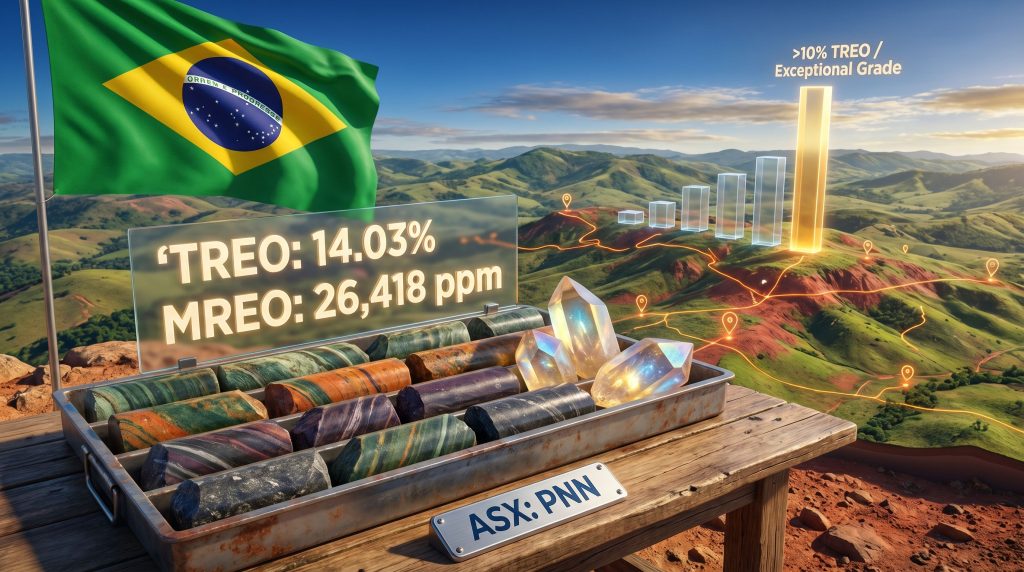
Verification sampling at the Morro do Ferro project returned TREO values reaching 14.03%, placing individual intercepts firmly in the exceptional category. Equally significant, MREO concentrations reached as high as 26,418 parts per million (ppm), a figure that reflects not just total rare earth abundance but a meaningful enrichment in the specific magnet-critical elements that industrial demand prioritises. Proactive Investors notes that these MREO grades are genuinely exceptional by global standards.
Grades above 10% TREO are statistically rare across global REE databases. When combined with MREO concentrations exceeding 20,000 ppm, a deposit transitions from a geological curiosity into a potentially commercially transformative asset, provided the mineralisation is confirmed to be consistent and amenable to processing.
An important distinction that investors often overlook is the difference between historical assay data and independently verified sampling results. Historical drillhole databases, particularly those compiled under earlier regulatory and technical standards, can carry data integrity risks that affect resource estimation reliability. Verification programs are specifically designed to test whether historical numbers hold up under modern laboratory protocols before a company commits capital to a full drilling campaign.
The Significance of Duplicate Sampling Across a Wide Grade Range
The verification program at Morro do Ferro comprised six duplicate samples drawn from three separate historical diamond drillholes. Critically, the samples were selected to span a deliberately broad range of previously reported grades and depths. This design philosophy matters because a verification program that only tests the highest-grade intervals provides limited statistical comfort.
Testing across the full grade distribution and at multiple depths stress-tests the internal consistency of the entire database rather than cherry-picking its best moments. When the new results correlated closely with the historical assays across this range and all duplicate pairs fell within acceptable laboratory tolerances, it validated the statistical integrity of the broader drillhole database that Power Minerals has inherited as the foundation for its future resource estimation work.
Power Minerals Morro do Ferro Rare Earths: The Technical Case for the Acquisition
Power Minerals (ASX: PNN), carrying a market capitalisation of approximately $40.71 million at the time of the announcement, structured its entry into Brazil's leading REE district through a definitive agreement with Mineração Terras Raras for the acquisition of the Morro do Ferro project. The execution of that definitive agreement was followed in short succession by the release of verification sampling results, creating a sequential de-risking narrative that speaks to the technical discipline of the due diligence process. Kalkine Media provides further context on what this acquisition means for investors evaluating the project's potential.
The project's CEO confirmed that the six verification samples were chosen precisely to represent the widest possible grade and depth range from the historical dataset, and that the correlation between historical and new results provided a strong technical foundation for the planned exploration program. Importantly, this confirmation de-risks what is typically the highest-uncertainty component of inheriting a historically drilled deposit: the reliability of the data that underpins any future JORC-compliant mineral resource estimate.
What the Drillhole Database Reveals About Deposit Geometry
Beyond grade confirmation, the spatial characteristics of the Morro do Ferro mineralisation offer additional upside indicators. The main deposit remains open at depth and along strike, meaning the known mineralised envelope has not been closed off by drilling at its lateral or vertical boundaries. This is a materially positive geological signal because it implies the deposit could be larger than what historical drilling has delineated.
Historical shallow auger drilling traverses at Morro do Ferro were spaced at intervals of 250 to 480 metres, a relatively wide spacing that leaves substantial ground between lines inadequately characterised. These untested margins represent primary targets for the aircore drilling component of the planned exploration program. In addition, rare earth exploration insights from comparable projects highlight that such wide traverse spacings frequently conceal significant additional mineralisation.
The Planned Drilling Program: Three Methods, One Objective
The exploration strategy that Power Minerals has outlined for Morro do Ferro employs three complementary drilling methodologies, each serving a distinct technical purpose:
- Deep diamond core drilling targeting approximately 200-metre depths on the main deposit to capture fresh rock geology, structural data, and oriented core for detailed geological interpretation
- Reverse circulation (RC) drilling as a cost-effective method for volumetric grade definition across the broader deposit footprint, allowing faster sample throughput at lower cost per metre than diamond core
- Aircore drilling targeting the wide, underexplored peripheral margins where historical traverse spacing has left significant ground untested
This three-pronged approach is methodologically well-suited to building a JORC-compliant maiden mineral resource estimate from a deposit that has historical drilling data but has not previously been taken through the systematic resource definition process required under current international reporting standards.
The combination of diamond core for structural and metallurgical data, RC for grade continuity, and aircore for boundary definition represents a resource definition strategy that minimises capital waste by using the most appropriate tool for each geological question being asked.
Brazil's Poços de Caldas Complex in a Global Context
To understand what makes the Poços de Caldas geological setting exceptional, it is useful to benchmark it against the world's other major REE producing and development districts:
| REE District | Country | Geological Setting | Notable Characteristic |
|---|---|---|---|
| Bayan Obo | China | Carbonatite-related | World's largest REE producer by volume |
| Mountain Pass | USA | Carbonatite | Primary US domestic REE producer |
| Mount Weld | Australia | Carbonatite | Among the highest-grade deposits mined globally |
| Poços de Caldas | Brazil | Alkaline igneous complex with carbonatite | Recognised world-class REE province, historically underexplored |
Brazil holds substantial rare earth reserves relative to global totals, yet its historical contribution to global REE production has been minimal compared to China. This structural underexploitation creates an opportunity dynamic that is distinct from more mature jurisdictions. The Minas Gerais state, where Poços de Caldas is located, has an established mining regulatory framework and infrastructure, though project-specific permitting timelines remain a project-level consideration that investors should evaluate independently.
The broader context of Western industrial policy driving demand for non-Chinese rare earth geopolitics adds a macro tailwind to Brazilian REE development in general. However, it is important to distinguish between this sector-wide dynamic and any project-specific regulatory support or designation, which has not been confirmed for the Morro do Ferro project at this stage.
The Demand Architecture Behind MREO-Rich Deposit Valuations
The commercial logic underpinning high-grade MREO deposits is rooted in the industrial demand structure for permanent magnets. NdFeB magnets are the dominant magnet technology in EV traction motors and direct-drive wind turbine generators, and they cannot be substituted without significant performance penalties in these applications.
Key demand vectors for MREO-rich feedstock include:
- Electric vehicle manufacturing, where each EV traction motor typically requires between one and two kilograms of NdFeB magnet material
- Wind turbine generators, particularly direct-drive offshore models, which use substantially larger magnet assemblies per unit of generating capacity
- Defence and aerospace applications, where high-coercivity magnets incorporating dysprosium and terbium are used in guidance systems, actuators, and communications hardware
- Consumer electronics and industrial motors, representing the largest volume demand category by unit count
The processing economics of high-grade vs. low-grade REE feedstock create a natural advantage for deposits like Morro do Ferro. Higher TREO grades reduce the volume of ore that must be mined, crushed, and processed to produce a given quantity of rare earth oxide concentrate, lowering unit operating costs and improving the project's economic resilience across commodity price cycles.
The next major ASX story will hit our subscribers first
Risk Factors That Informed Investors Must Evaluate
Verification sampling results of exceptional quality are a necessary but not sufficient condition for investment conviction in an early-stage REE project. Several layers of technical and commercial risk remain between the current exploration stage and any future production scenario.
| Milestone | Significance | Current Status at MDF |
|---|---|---|
| Maiden MRE completion | Converts exploration data to JORC resource | Drilling program being mobilised |
| Metallurgical test work | Confirms processing pathway viability | Not yet commenced |
| Scoping or PFS study | Preliminary economic framework | Pre-resource stage |
| Permitting advancement | Secures operational approvals | Early stage |
Metallurgical Complexity: The Challenge That Grade Alone Cannot Solve
One of the less frequently discussed challenges in rare earth project development is that exceptional ore grades do not automatically translate into straightforward processing. REE mineralogy is highly variable, and the specific mineral hosts for rare earth elements in a given deposit determine how amenable the ore is to physical concentration and chemical separation. Furthermore, the rare earth processing challenges encountered at comparable projects illustrate that each deposit requires entirely site-specific metallurgical work before processing economics can be reliably estimated.
Carbonatite-hosted REE deposits have historically been among the more amenable geological types, but each deposit requires site-specific metallurgical characterisation before processing economics can be reliably estimated. This is why metallurgical test work, which has not yet been conducted at Morro do Ferro, represents a critical future milestone that will significantly influence the project's economic trajectory. Investors should treat the current assay results as geological validation rather than economic confirmation.
Disclaimer: This article is intended for informational purposes only and does not constitute financial advice. Past exploration results and historical assay data are not guarantees of future resource definition outcomes. Readers should conduct independent due diligence and consult a licensed financial adviser before making any investment decisions. Forward-looking statements involve inherent uncertainty and actual results may differ materially from projections.
Frequently Asked Questions: Power Minerals Morro do Ferro Rare Earths
What is the Morro do Ferro project?
Morro do Ferro is a rare earth element project located in southern Minas Gerais state, Brazil, situated within the Poços de Caldas alkaline igneous and carbonatite complex. Power Minerals (ASX: PNN) is acquiring the project from Mineração Terras Raras under a definitive agreement and is advancing towards a maiden mineral resource estimate through a systematic diamond core, RC, and aircore drilling program.
What TREO grades were returned from the verification program?
The six-sample verification program returned TREO values reaching 14.03%, with MREO concentrations as high as 26,418 ppm. All duplicate samples correlated closely with historical assay results and fell within acceptable laboratory tolerances, validating the inherited drillhole database.
What is MREO and why does it matter?
Magnet rare earth oxides comprise the fraction of total rare earth oxide content that consists of neodymium, praseodymium, dysprosium, and terbium. These elements are the critical inputs for NdFeB permanent magnets used in EV motors and wind turbines, making them the highest-demand and most commercially valuable subset of the rare earth element family.
How does Morro do Ferro compare globally?
TREO grades above 10% are statistically rare across global REE deposit databases. The 14.03% TREO verification result at Morro do Ferro places individual intercepts among the highest grades documented anywhere in the world for a rare earth deposit, though a full JORC resource estimate is needed to determine overall deposit scale and grade consistency.
What are the next steps for Power Minerals?
The company is mobilising its planned drilling program, comprising deep diamond core drilling targeting around 200 metres depth, RC drilling for grade continuity, and aircore drilling to test underexplored margins. The combined dataset from this program will form the basis for a maiden JORC-compliant mineral resource estimate.
What risks apply to early-stage REE projects in Brazil?
Key risk factors include the gap between high-grade sampling and a certified resource estimate, metallurgical uncertainty regarding processing complexity, infrastructure and logistics considerations for Brazilian project locations, permitting timelines under Minas Gerais state regulations, and broader commodity price risk across REE markets. Investors should treat current results as exploration-stage data requiring significant further validation before economic conclusions can be drawn.
From Verification to Resource: What the Road Ahead Looks Like
The sequential milestones achieved at Morro do Ferro, from the execution of the definitive acquisition agreement to the release of independently verified, world-class assay results, represent a methodologically sound progression through the early stages of a major REE project's technical de-risking process. The verification sampling program has achieved its primary objectives: confirming the integrity of the historical drillhole database and establishing that the exceptional grades previously reported reflect genuine geological mineralisation rather than sampling artefacts.
What remains is a substantial body of work. The planned drilling program will need to systematically define the three-dimensional geometry of the Morro do Ferro mineralised system at depths and lateral extents that historical programs did not adequately test. The open-at-depth and open-along-strike characteristics of the known mineralisation provide genuine geological optionality, but translating that optionality into a certified resource requires disciplined execution of the planned program.
For context within the broader structural shift in critical minerals supply chain strategy, China's rare earth strategy continues to drive urgency among Western nations seeking alternative sources of MREO-rich feedstock. High-grade deposits located in politically stable, mining-friendly jurisdictions outside of China are consequently among the most sought-after development assets in the global resources sector. Whether the Power Minerals Morro do Ferro rare earths project ultimately fulfils its geological promise will depend on the outcomes of the metallurgical, drilling, and resource estimation work that lies ahead, but the verification results announced in April 2026 establish a compelling technical foundation from which that journey begins.
For ongoing coverage of ASX-listed materials and mining developments, including rare earth element projects, visit The Market Online's Materials section.
Want To Be First When the Next Major Rare Earth Discovery Hits the ASX?
Discovery Alert's proprietary Discovery IQ model scans ASX announcements in real time, instantly identifying significant mineral discoveries — including high-grade rare earth projects — and delivering actionable alerts directly to subscribers before the broader market has time to react. Explore historic discoveries and their exceptional returns, then start your 14-day free trial to position yourself ahead of the next major find.