
August 14, 2026
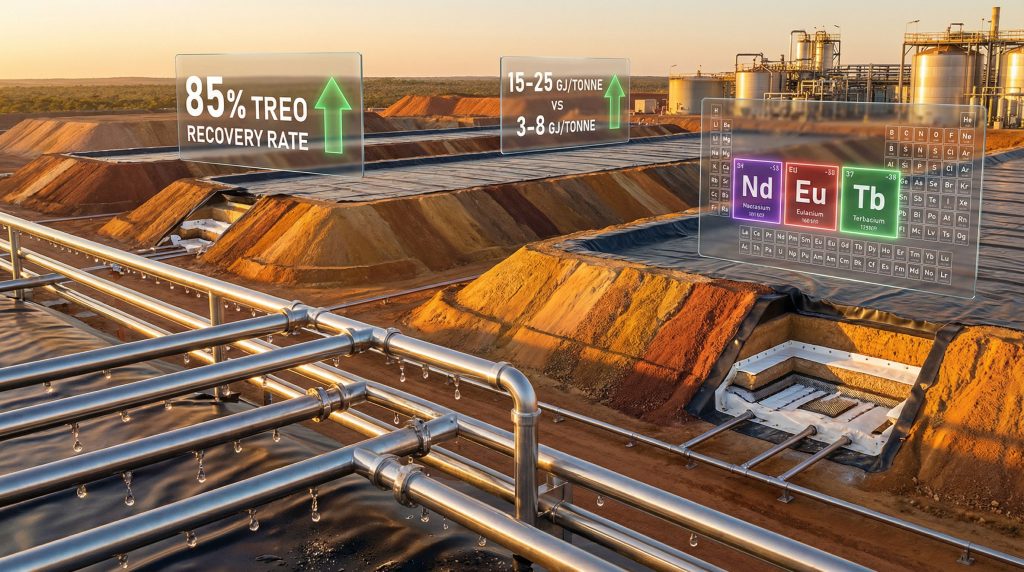
Understanding the Technical Mechanics of Rare Earth Element Recovery
Modern mineral processing faces mounting pressure to develop economically viable extraction methods for critical materials. Heap leaching rare earths represents a transformative approach that challenges conventional hydrometallurgical paradigms by utilising ambient temperature chemical dissolution processes on engineered ore stockpiles.
The fundamental mechanism operates through controlled percolation of lixiviant solutions through prepared ore masses, creating extended contact periods that facilitate selective metal dissolution. This contrasts sharply with energy-intensive tank leaching systems that require continuous agitation, elevated temperatures, and complex reactor configurations.
Column testwork conducted by the Australian Nuclear Science and Technology Organisation demonstrates the practical application of these principles, achieving 81% total rare earth extraction from ionic clay materials using mild ammonium sulfate solutions. These results indicate that heap leaching rare earths can deliver commercially viable recovery rates under ambient processing conditions.
When big ASX news breaks, our subscribers know first
Economic Drivers Behind Heap Leaching Adoption
Capital expenditure reduction forms the primary economic incentive for heap leaching rare earths implementation. Traditional rare earth processing demands substantial infrastructure investment in grinding circuits, high-temperature reactors, and complex solution handling systems. Heap operations eliminate many of these requirements while enabling processing of larger ore tonnages.
ABX Group's Deep Leads project exemplifies this economic positioning, with management characterising heap leaching as offering a compelling pathway to lower capital intensity. The project's progression from maiden rare earth carbonate production to column testwork within months demonstrates the accelerated development timeline possible with simplified processing approaches.
Key Economic Considerations:
- Processing Scale Flexibility: Heap operations scale through pad expansion rather than equipment multiplication
- Energy Profile: Ambient temperature processing eliminates heating costs associated with traditional methods
- Labour Requirements: Periodic monitoring versus continuous reactor supervision
- Infrastructure Complexity: Simplified reagent handling and solution management systems
The ionic clay deposit advantage becomes particularly pronounced in economic analysis. These materials contain rare earth elements as exchangeable ions readily mobilised by mild salt solutions, reducing preprocessing requirements and minimising reagent consumption compared to hard-rock deposits requiring aggressive dissolution chemistry.
Optimising Lixiviant Chemistry for Maximum Recovery
Lixiviant selection determines both extraction efficiency and downstream processing complexity. Recent column testwork results provide concrete evidence of ammonium-based system performance, with ammonium sulfate solutions at pH approximately 4.0 achieving exceptional heavy rare earth recoveries of 76% dysprosium and 79% terbium.
These results validate the effectiveness of mild acidic conditions for ionic clay processing whilst maintaining low impurity dissolution, particularly aluminium content that can complicate downstream separation processes. The selectivity achieved represents a critical advantage over more aggressive acid systems that co-dissolve gangue minerals.
Ammonium Sulfate System Characteristics:
- Operating pH range: 3.5-4.5 (mildly acidic conditions)
- Target ion exchange: REE mobilisation from clay mineral surfaces
- Impurity control: Minimal aluminium and iron dissolution
- Environmental profile: Lower toxicity compared to strong acid systems
Alternative lixiviant systems include hydrochloric acid formulations for refractory mineral phases, though these require more robust containment infrastructure and generate higher downstream processing costs. Furthermore, the selection ultimately depends on ore mineralogy, environmental constraints, and economic optimisation parameters specific to each project.
Engineering Requirements for Heap Infrastructure
Heap leach pad design incorporates multiple containment barriers to prevent environmental contamination whilst ensuring optimal solution distribution and collection. Modern installations utilise engineered liner systems combining synthetic membranes with natural clay barriers to achieve regulatory compliance standards.
The Deep Leads testwork utilised 2.4-metre column heights to evaluate percolation characteristics and residence time requirements. This pilot-scale approach provides essential data for scaling to production heap configurations whilst optimising solution application rates and collection efficiency.
Critical Design Elements:
| Component | Function | Specifications |
|---|---|---|
| Primary Liner | Containment barrier | HDPE geomembrane systems |
| Drainage Layer | Solution collection | Engineered gravel gradations |
| Irrigation Network | Uniform distribution | Controlled application rates |
| Monitoring Systems | Environmental protection | Leak detection protocols |
Solution distribution systems must maintain uniform lixiviant application across heap surfaces whilst accommodating ore permeability variations. Consequently, drip emitter networks or spray irrigation systems provide controlled application rates that optimise contact time without creating preferential flow paths that reduce extraction efficiency.
Processing Pregnant Solutions for Commercial Products
Pregnant leach solutions containing dissolved rare earth elements require sophisticated separation technologies to produce marketable concentrates. The complexity increases significantly when targeting individual rare earth separation due to similar chemical properties within the lanthanide series.
Precipitation represents the initial concentration step, producing mixed rare earth compounds that reduce solution volumes entering downstream processing circuits. For instance, ABX Group's production of maiden mixed rare earth carbonate demonstrates this approach, creating an intermediate product enriched in valuable heavy rare earth elements.
Separation Technology Options:
- Precipitation Systems: Mixed rare earth carbonates or oxalates
- Solvent Extraction: Multi-stage circuits for individual REE separation
- Ion Exchange: Selective concentration of heavy rare earth elements
- Crystallisation: High-purity individual rare earth compounds
The choice between separation technologies depends on target product specifications, market requirements, and economic optimisation. Many applications accept mixed rare earth products, particularly for magnet alloy manufacturing, reducing downstream processing complexity and associated costs.
Ore Type Compatibility and Performance Optimisation
Deposit geology fundamentally determines heap leaching viability, with ionic clay formations demonstrating superior amenability to ambient temperature extraction processes. These deposits, formed through prolonged weathering of igneous rocks, contain rare earth elements adsorbed onto clay mineral surfaces rather than incorporated within crystal lattices.
ABX Group's Deep Leads project represents Australia's emerging ionic clay rare earth sector, with testwork results validating the deposit's heap leaching potential. The project recently secured an expanded exploration licence, indicating confidence in the geological continuity and processing characteristics of the ore body.
Optimal Ore Characteristics:
- Ionic Clay Deposits: Exchangeable REE ions on mineral surfaces
- Weathered Profiles: Secondary mineral formation enhancing permeability
- Low Acid Consumption: Minimal neutralising minerals
- Heavy REE Enrichment: Higher-value element concentration
Moreover, secondary rare earth resources, including coal refuse and industrial waste materials, present additional heap leaching opportunities. These materials often contain dispersed rare earth elements accessible through controlled acid leaching, whilst simultaneously addressing environmental remediation objectives.
The next major ASX story will hit our subscribers first
Environmental Management and Regulatory Compliance
Environmental stewardship requirements drive heap leaching design parameters, particularly regarding solution containment and groundwater protection. Multi-layer monitoring systems provide early detection of potential seepage whilst automated data collection enables rapid response to operational deviations.
However, water management protocols emphasise closed-loop circulation to minimise freshwater consumption and prevent contaminated discharge. Solution recycling reduces reagent costs whilst maintaining tight control over chemical inventories and environmental exposure potential. Additionally, developing in-situ leaching benefits can further enhance environmental performance through reduced surface disturbance.
Environmental Control Systems:
- Groundwater Monitoring: Multi-depth observation well networks
- Air Quality Management: Dust suppression during ore handling
- Stormwater Diversion: Precipitation event protection measures
- Reagent Recovery: Closed-loop solution recycling systems
The mild chemistry utilised in ammonium-based systems reduces environmental risks compared to strong acid processes, whilst achieving comparable or superior extraction performance. Furthermore, comprehensive mining waste management solutions complement heap leaching operations by addressing all waste streams throughout the mining lifecycle.
Technical Limitations and Commercial Challenges
Despite promising pilot-scale results, several technical challenges constrain widespread commercial implementation of heap leaching rare earths. Extended processing timelines of 6-18 months require different working capital management compared to conventional processing that operates on daily cycles.
Heap structural integrity presents ongoing concerns during extended leaching campaigns. Fine particle migration and ore settlement can create preferential flow paths that reduce extraction efficiency whilst potentially compromising containment system performance. However, advanced mine reclamation innovation addresses these concerns through improved heap stability techniques.
Primary Technical Challenges:
- Processing Timeline: Extended leach cycles requiring patient capital
- Structural Stability: Long-term heap integrity maintenance
- Reagent Recovery: Economic lixiviant regeneration systems
- Heavy REE Selectivity: Preferential extraction of high-value elements
Achieving preferential heavy rare earth extraction remains technically challenging, with most systems extracting light and heavy elements proportionally. This limitation affects revenue optimisation for projects where heavy rare earth elements command significantly higher market prices than light rare earth commodities.
Comparative Analysis with Traditional Processing Methods
Heap leaching rare earths operates on fundamentally different principles compared to conventional tank leaching systems, creating distinct operational and economic trade-offs. Traditional processing achieves higher individual rare earth purities but requires substantially greater capital investment and energy consumption.
Processing Method Comparison:
| Parameter | Heap Leaching | Tank Leaching |
|---|---|---|
| Processing Timeline | 6-18 months | Days to weeks |
| Capital Requirements | Moderate infrastructure | High equipment costs |
| Energy Consumption | Ambient temperature | Elevated temperature/agitation |
| Product Purity | Mixed REE concentrates | Individual REE compounds |
| Operational Flexibility | Variable ore grades | Consistent feed requirements |
The extended processing timeline characteristic of heap operations enables processing larger ore tonnages with smaller equipment footprints, potentially offsetting the time disadvantage through scale economies. Consequently, this approach proves particularly attractive for lower-grade deposits that cannot support intensive processing infrastructure.
Operational flexibility represents a significant heap leaching advantage, accommodating variable ore grades and types without requiring extensive feed preparation or blending protocols. Nevertheless, conventional plants demand consistent feedstock specifications to maintain optimal performance parameters.
Future Technology Development and Innovation Pathways
Emerging technologies promise to address current limitations whilst expanding the range of deposits suitable for heap leaching applications. In-situ leaching development could eliminate ore handling requirements entirely for suitable geological formations, minimising surface disturbance whilst accessing deeper ore bodies.
Biotechnology integration offers potential for enhanced extraction selectivity through engineered microorganisms producing specific rare earth-binding compounds. These biological systems could operate under ambient conditions whilst achieving superior metal selectivity compared to conventional chemical systems.
Innovation Opportunities:
- In-Situ Processing: Direct ore body leaching without excavation
- Biological Enhancement: Microbial rare earth mobilisation systems
- Smart Materials: Self-healing liner systems with embedded sensors
- Process Intensification: Accelerated extraction kinetics through novel chemistry
Furthermore, advanced materials development focuses on next-generation containment systems incorporating self-healing polymers and embedded monitoring capabilities. These smart materials could provide real-time leak detection and automatic repair functions, enhancing operational reliability whilst reducing maintenance requirements.
The progression of ABX Group's heap leach breakthrough for rare earths in Tasmania, with final column leach results scheduled for January 2026, represents a critical milestone for Australian rare earth development. Success could validate heap leaching rare earths as a commercially viable processing route whilst strengthening Australia's position in global critical minerals supply chains.
In addition, broader mining innovation trends suggest that technological advancement will continue to drive efficiency improvements and environmental performance enhancements across all extraction methodologies.
Global Distribution and Strategic Importance
The development of heap leaching technologies becomes increasingly important when considering global rare earth reserves distribution and supply chain security. However, current concentration of production in specific geographic regions creates vulnerability for technology-dependent nations.
Consequently, alternative processing technologies like heap leaching could enable more distributed production from previously uneconomic deposits. This geographic diversification aligns with national security objectives whilst reducing dependence on traditional rare earth suppliers.
Moreover, heap leaching for rare earth recovery research continues to advance technical understanding and commercial viability of these systems through academic and industrial collaboration.
Disclaimer: This analysis is based on publicly available information and preliminary testwork results. Commercial viability depends on comprehensive feasibility studies, environmental approvals, and market conditions. Investment decisions should consider all risk factors and seek professional financial advice. Rare earth market conditions and extraction technologies continue to evolve rapidly, potentially affecting project economics and technical viability.
Ready to Invest in the Next Major Rare Earth Discovery?
Discovery Alert instantly alerts investors to significant ASX mineral discoveries using its proprietary Discovery IQ model, turning complex mineral data into actionable insights. Understand why historic discoveries can generate substantial returns by visiting Discovery Alert's dedicated discoveries page, showcasing historic examples of exceptional outcomes, and begin your 30-day free trial today to position yourself ahead of the market.