July 11, 2026
The global appetite for strategic mineral independence has intensified dramatically as geopolitical tensions reshape supply chain priorities. Within this context, rare earth elements have emerged as the critical bottleneck constraining everything from electric vehicle expansion to renewable energy infrastructure. The dynamics driving this transformation extend far beyond traditional mining economics, encompassing national security considerations, technological sovereignty, and the fundamental architecture of critical minerals energy security. Furthermore, recent developments in critical minerals policy have accelerated the urgency for supply chain diversification.
Critical Resource Characteristics Defining Longonjo's Strategic Value
Advanced Geological Assessment and Resource Quality
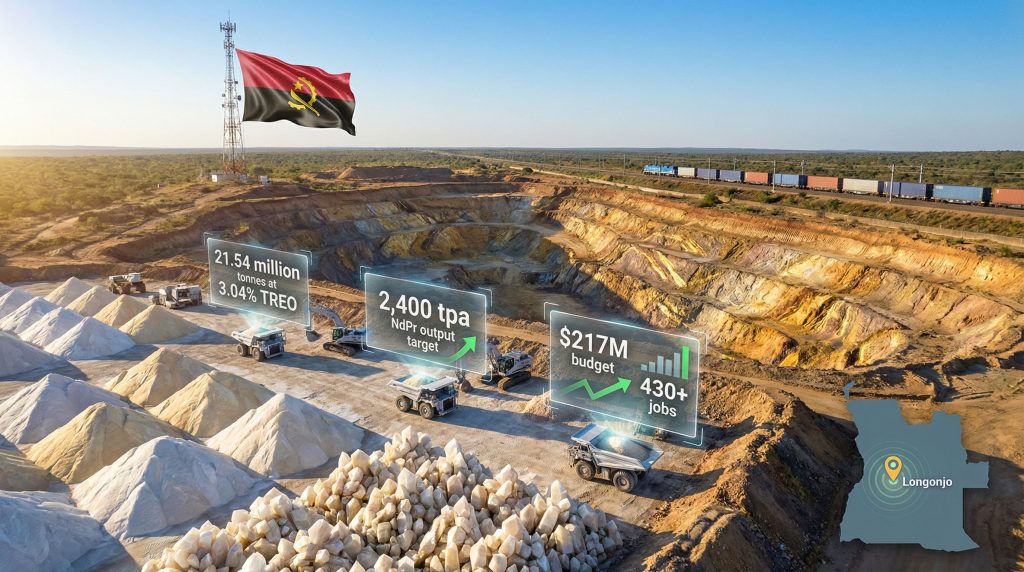
The Pensana Longonjo rare earth project represents one of Africa's most comprehensively evaluated rare earth deposits, with a JORC-compliant resource base exceeding 22 million tonnes at 3.04% Total Rare Earth Oxide (TREO) equivalent. This classification places the deposit within the economically viable range for modern rare earth extraction, particularly given the shallow weathered carbonatite formation that facilitates cost-effective open-pit mining methodologies.
The deposit's 139,457 tonnes of combined neodymium-praseodymium oxide (NdPr) content represents the most economically valuable fraction of the resource base. These magnet-critical elements typically command premium pricing, often ranging from $45-85 per kilogram depending on market conditions and oxide purity specifications. Consequently, the concentration of these elements within Longonjo's resource envelope positions the project to capture the highest-margin segment of the rare earth value chain.
Key Geological Advantages:
- Shallow weathered zone extending 20-30 meters from surface
- Carbonatite host rock amenable to conventional processing
- Monazite and bastnaesite mineral assemblage requiring minimal beneficiation
- Free-dig conditions eliminating hard rock mining complexity
- Projected mine life exceeding 20 years based on current reserves
Mineral Composition and Processing Compatibility
The carbonatite-hosted mineralization at Longonjo presents distinct advantages over alternative rare earth deposit types. Moreover, weathered carbonatite formations naturally concentrate rare earth elements in oxidized, leachable forms that integrate seamlessly with established hydrometallurgical processing circuits. This geological configuration eliminates many of the technical challenges associated with hard-rock pegmatite or placer deposits.
The dominant mineral phases, monazite and bastnaesite, respond favorably to:
- Direct sulfuric acid leaching without complex pre-concentration
- Conventional solvent extraction separation techniques
- Standard precipitation and crystallization pathways
- Production of mixed rare earth carbonate (MREC) intermediate products
The shallow oxide zone represents a fundamental cost advantage, potentially reducing initial capital requirements by 30-40% compared to hard-rock rare earth projects requiring extensive crushing and grinding infrastructure.
Comparative Resource Analysis
When benchmarked against global rare earth deposits, Longonjo occupies a favorable position within the mid-tier grade range. While premium deposits like Mountain Pass (USA) and Bayan Obo (China) demonstrate superior grade characteristics, Longonjo's 3.04% TREO places it well above the 2% economic threshold typically required for viable rare earth operations.
Global Rare Earth Deposit Comparison:
| Deposit | Location | TREO Grade | Development Status | Key Advantages |
|---|---|---|---|---|
| Bayan Obo | China | 6.0% | Operating | Established infrastructure |
| Mountain Pass | USA | 8.9% | Operating | High-grade, domestic US |
| Longonjo | Angola | 3.04% | Development | Shallow, Africa access |
| Kvanefjeld | Greenland | 1.06% | Suspended | Environmental challenges |
When big ASX news breaks, our subscribers know first
Production Framework and Global Supply Integration
Phased Development Strategy and Output Projections
The Pensana Longonjo rare earth project employs a carefully structured development approach designed to minimize initial capital exposure while establishing meaningful market presence. In addition, Phase 1 operations target 20,000 tonnes per annum of mixed rare earth carbonate production, translating to approximately 2,400 tonnes annually of neodymium-praseodymium oxide equivalent.
This initial production scale positions Longonjo to capture roughly 5% of global magnet feedstock supply, representing material significance within the non-Chinese rare earth supply base. The project timeline targets commercial production by 2027, providing a 24-month construction and commissioning horizon from the December 2025 funding announcements.
Phase Development Metrics:
- Phase 1: 20,000 tpa MREC (2027 target)
- Phase 2: 40,000 tpa MREC (expansion timeline TBD)
- Full-scale market share: ~10% of global magnet-capable feedstock
- Revenue potential: $400-600M annually at Phase 2 scale
Market Positioning Within Supply Chain Context
The global rare earth supply landscape remains heavily concentrated, with Chinese producers controlling approximately 70% of total capacity. This concentration creates strategic vulnerabilities for consuming economies, particularly as electric vehicle production scales and wind energy deployment accelerates. However, ongoing US‑China trade tensions have intensified the urgency for alternative supply sources, making Longonjo's entry into this market particularly strategic for addressing critical supply gaps.
Current global magnet feedstock production approximates 400,000 tonnes TREO equivalent annually, with demand growth projecting 8-12% annually through 2035. Furthermore, the electric vehicle sector alone requires approximately 200-300 grams of NdPr per vehicle, creating substantial incremental demand as EV production targets expand globally.
Supply-Demand Dynamics:
- Current global deficit: 15,000-25,000 tpa magnet feedstock
- Projected 2030 deficit: 40,000-60,000 tpa
- Longonjo contribution at full scale: 40,000 tpa (addresses material portion)
- Non-Chinese supply necessity: Strategic imperative for consuming nations
Production Ramp and Operational Considerations
Rare earth operations typically experience graduated production ramps, achieving 60-80% of nameplate capacity during the first operational year before reaching optimal throughput rates. For instance, the technical complexity of maintaining consistent MREC purity specifications requires careful process optimization during this initial period.
The processing circuit design for carbonatite-hosted deposits follows established metallurgical pathways, reducing technical risk compared to novel extraction methodologies. However, achieving magnet-grade specifications requires precise control of:
- Leaching efficiency and rare earth recovery rates
- Impurity rejection, particularly thorium and uranium
- Precipitation and crystallization parameters
- Final product moisture and particle size distribution
Strategic Infrastructure Positioning and Export Capabilities
Lobito Corridor Transportation Advantages
The Pensana Longonjo rare earth project benefits from exceptional infrastructure positioning through direct rail access to Lobito Port via a 273-kilometer connection. This transportation link provides material cost advantages compared to landlocked African mining projects that require overland transport exceeding 2,000 kilometers to reach deep-water ports.
For high-value, low-volume products like rare earth carbonate, transportation costs typically represent 3-5% of product value. Consequently, Longonjo's proximity to Lobito Port substantially reduces this burden, improving project economics and supply chain reliability for international customers.
Transportation Infrastructure Details:
- Rail distance: 273 km to Lobito Port
- Rail gauge: Standard gauge (1,435mm) for regional compatibility
- Annual throughput requirement: ~800 rail cars for Phase 1 production
- Port modernization: Completion targeted for 2025-2026
- Container capacity: 5-8 million tonnes per annum general cargo
Regional Development and Clustering Potential
The broader Huambo Province region demonstrates significant geological prospectivity for rare earth mineralization, with the nearby Coola and Sulima West discoveries indicating a coherent metallogenic province. As a result, this regional clustering creates opportunities for:
- Shared infrastructure utilization and cost distribution
- Consolidated processing facilities serving multiple deposits
- Enhanced logistics efficiency through coordinated production scheduling
- Regional supply chain concentration similar to China's Baotou complex
Regional Proximity Factors:
- Distance to Huambo: ~60 kilometers from provincial center
- Local workforce availability: Population base for mining operations
- Power supply options: National grid plus renewable integration potential
- Government support: Provincial development priorities aligned
Renewable Energy Integration Framework
Angola possesses exceptional renewable energy resources that align with Longonjo's operational requirements. Furthermore, the project's estimated 15-25 MW power demand for Phase 1 operations can be supplied through multiple pathways:
Hydroelectric Options:
- Connection to Angola's national grid system
- Inga II hydroelectric development (4,800 MW planned capacity)
- Regional hydroelectric resources within transmission distance
Solar Energy Potential:
- Angola solar irradiation: 5.5-6.5 kWh/m²/day
- On-site solar installation potential for operational independence
- Reduced grid dependency and long-term cost stability
- Environmental benefits for ESG-focused investors
Capital Structure and Financial Engineering Strategy
Multi-Source Funding Architecture
The Pensana Longonjo rare earth project employs sophisticated capital structuring designed to balance development risk, political alignment, and international market access. In addition, the December 2025 funding announcements demonstrate successful engagement across sovereign, institutional, and development finance channels.
Confirmed Funding Sources:
| Funding Source | Amount | Structure | Strategic Purpose |
|---|---|---|---|
| FSDEA (Angola Sovereign) | $15M conversion | Staged equity conversion | Political stability, local partnership |
| M&G Investments | £5M commitment | Equity investment | Institutional validation |
| Development Finance | Various | Grant/loan combination | Risk mitigation, feasibility |
Ownership Structure and Governance Framework
The current ownership configuration balances operational control with strategic partnerships across multiple jurisdictions. Following the staged conversion of the FSDEA bridging loan, the Angolan Sovereign Wealth Fund subsidiary (ASF Yova Mining Holding Limited) will hold approximately 29.2% of issued share capital.
This ownership structure provides several advantages:
- Pensana operational control: Majority stake ensures management autonomy
- Angolan government alignment: Significant local ownership reduces political risk
- International investor access: Remaining equity available for institutional participation
- Nasdaq listing preparation: Ownership structure compatible with US market requirements
Capital Deployment Timeline and Requirements
Total project capital requirements for Phase 1 development approximate $217 million, encompassing mine development, processing plant construction, and initial working capital. Consequently, the phased funding approach manages capital deployment risk while maintaining development momentum.
Capital Allocation Framework:
- Mine development: 35-40% of total capex
- Processing plant: 45-50% of total capex
- Infrastructure and utilities: 10-15% of total capex
- Working capital and contingency: 5-10% of total capex
Risk Assessment and Execution Challenges
Technical and Operational Risk Factors
Despite favorable geological conditions, the Pensana Longonjo rare earth project faces several execution risks that could impact development timeline and economics. For instance, construction project management in Angola requires specialized expertise and may encounter infrastructure, permitting, or logistics constraints. This is particularly relevant as the broader mining industry evolution continues to present new technological and operational challenges.
Primary Technical Risks:
- Processing circuit optimization and MREC quality consistency
- Construction timeline adherence within approved budget parameters
- Skilled workforce development and retention in regional context
- Equipment procurement and maintenance logistics for specialized processing equipment
Market and Commercial Risk Variables
Rare earth markets demonstrate significant price volatility, with NdPr pricing fluctuating based on Chinese supply policies, global demand patterns, and geopolitical tensions. Furthermore, project economics remain sensitive to sustained pricing below $40-45 per kilogram for NdPr oxide.
Commercial Risk Factors:
- Rare earth price volatility and market cycles
- Competition from established Chinese and Myanmar suppliers
- US offtake agreement negotiations and contract terms
- Downstream integration execution in target markets
Market analysis suggests that rare earth pricing volatility has increased 40-60% since 2020, driven primarily by supply chain disruptions and geopolitical tensions affecting Chinese export policies.
Regulatory and Political Considerations
Operating within Angola's regulatory framework requires navigation of mining codes, environmental permitting, and export licensing procedures. While the Angolan government demonstrates support through FSDEA participation, regulatory processes may introduce timeline uncertainty.
Regulatory Risk Areas:
- Environmental impact assessment completion and approval
- Mining license conditions and renewal requirements
- Export permit procedures for rare earth products
- Currency exchange and repatriation regulations
Western Supply Chain Integration and Strategic Impact
Geopolitical Supply Security Implications
The Pensana Longonjo rare earth project addresses critical supply chain vulnerabilities identified by Western governments and defense establishments. Current dependency on Chinese rare earth sources creates strategic risks for electric vehicle production, renewable energy deployment, and defense applications requiring permanent magnets. Notably, developments such as the European CRM facility demonstrate the increasing focus on supply chain resilience.
Longonjo's development aligns with multiple strategic initiatives:
- US Defense Production Act rare earth supply diversification
- European Union Critical Raw Materials Act import substitution targets
- Allied nation cooperation frameworks for critical mineral security
- Indo-Pacific supply chain resilience building efforts
Clean Energy Transition Integration
The project's timing coincides with accelerating clean energy deployment across Western economies. Electric vehicle production requires approximately 200-300 grams of NdPr per vehicle, while wind turbines consume 150-600 kilograms per megawatt of installed capacity, depending on generator design.
Demand Growth Projections:
- Global EV production: 30 million units by 2030 (requiring ~7,500 tpa NdPr)
- Wind energy capacity: 200+ GW annual additions (requiring ~25,000 tpa NdPr)
- Industrial motors and automation: Steady 5-7% annual growth
- Total projected demand growth: 8-12% annually through 2035
Environmental and Social Governance Positioning
The project emphasises sustainable mining practices and community development initiatives designed to meet international ESG standards. Key commitments include:
Environmental Framework:
- Renewable energy integration reducing carbon footprint
- Water management and conservation protocols
- Biodiversity protection and habitat restoration
- Waste minimisation and circular economy principles
Social Development Commitments:
- Local employment creation targeting 430+ direct jobs
- Youth training and skills development programs
- Community infrastructure and healthcare investments
- Supplier development and local procurement initiatives
The next major ASX story will hit our subscribers first
Investment Analysis and Valuation Framework
Financial Projections and Economic Modeling
Project economics for the Pensana Longonjo rare earth project depend on sustained rare earth pricing, operational efficiency achievement, and successful market penetration. Conservative modelling assumes NdPr pricing of $50-60 per kilogram for base case scenarios.
Phase 1 Economics (20,000 tpa MREC):
- Projected annual revenue: $200-300M (depending on pricing and product mix)
- Operating costs: $150-200M annually (including mining, processing, logistics)
- EBITDA margin: 25-35% at normalised pricing levels
- Payback period: 6-8 years from commercial production
Capital Allocation and Return Analysis
The staged development approach allows for capital efficiency optimisation and risk management. Phase 1 capital deployment of $217 million provides platform for Phase 2 expansion requiring estimated additional $200-300 million investment.
Return Metrics:
- Internal Rate of Return (IRR): 18-24% base case
- Net Present Value (NPV): $400-600M at 8% discount rate
- Capital intensity: $10,000-11,000 per annual tonne MREC capacity
- Operating leverage: High sensitivity to pricing and volume
Risk-Adjusted Investment Considerations
Investment in rare earth development projects requires careful assessment of technical, market, and political risk factors. Moreover, Longonjo's risk profile benefits from:
Risk Mitigation Factors:
- Proven geological resource with extensive drilling
- Established processing technology for carbonatite deposits
- Strong government and sovereign wealth fund alignment
- Strategic importance for Western supply security
Remaining Risk Variables:
- Construction execution in developing market context
- Rare earth market volatility and Chinese competition
- Regulatory and permitting timeline uncertainty
- Currency and political stability considerations
Frequently Asked Questions About Longonjo Development
When will Longonjo begin commercial production?
Current project scheduling targets commercial production by 2027, providing approximately 24 months for construction and commissioning activities. This timeline depends on successful completion of detailed engineering, procurement of long-lead processing equipment, and construction execution without material delays.
The production ramp typically extends over 12-18 months, with nameplate capacity achievement expected by late 2028 or early 2029. However, regulatory approvals, financing completion, and equipment delivery represent the primary scheduling risk factors.
How does Longonjo compare to other African rare earth projects?
Longonjo demonstrates several competitive advantages compared to peer developments across Africa:
Infrastructure Position: The 273-kilometer rail connection to Lobito Port provides superior logistics compared to landlocked deposits requiring overland transport exceeding 2,000 kilometers.
Resource Quality: The 3.04% TREO grade sits within the economic viability range, while the shallow weathered zone reduces mining complexity compared to hard-rock deposits.
Development Stage: Advanced feasibility studies and secured funding position Longonjo ahead of conceptual-stage projects across the continent.
What makes Angola attractive for rare earth mining?
Angola offers several structural advantages for rare earth development:
Geological Endowment: The country hosts multiple carbonatite bodies with confirmed rare earth mineralization, indicating broader regional potential beyond Longonjo.
Government Support: Sovereign wealth fund participation demonstrates political alignment and policy stability for mining development.
Infrastructure Development: Ongoing investment in rail, port, and power infrastructure improves operational feasibility for resource projects.
Regional Stability: Compared to some African jurisdictions, Angola maintains relatively stable political and security conditions conducive to international investment.
Long-term Sector Development and Strategic Outlook
Regional Resource Development Potential
The Pensana Longonjo rare earth project represents the initial development within what appears to be a significant regional rare earth province. Furthermore, exploration activities have identified target resources exceeding 1,000 million tonnes across the broader area, suggesting potential for multiple mining operations over the coming decades.
This resource endowment positions Angola to become a material rare earth producing jurisdiction, potentially ranking among the top five global producers within 15-20 years. In addition, the development of regional processing capabilities, transportation infrastructure, and technical expertise creates positive spillover effects for additional projects.
Regional Development Scenarios:
- Conservative: 2-3 additional deposits reach development stage by 2035
- Base case: 4-5 deposits operational, creating regional rare earth cluster
- Optimistic: Angola becomes top-3 global rare earth producer by 2040
Technology Integration and Value Addition
Future development phases may incorporate advanced processing technologies and downstream integration capabilities. For instance, potential value-addition opportunities include:
Processing Technology Advancement:
- Direct oxide production eliminating carbonate intermediate steps
- High-purity individual rare earth element separation
- Specialised alloy and magnet powder manufacturing
- Recycling and urban mining integration
Downstream Integration Potential:
- Magnet manufacturing facilities serving regional markets
- Electric motor and generator production capabilities
- Technology transfer and skills development programs
- Research and development center establishment
Global Supply Chain Transformation Impact
Longonjo's successful development contributes to fundamental restructuring of global rare earth supply chains. The project's strategic significance extends beyond its direct production contribution, influencing:
Market Structure Evolution:
- Reduced Chinese market concentration and pricing power
- Enhanced supply security for Western manufacturers
- Competitive pressure driving innovation and efficiency improvements
- Regional supply chain development in Africa and allied nations
Geopolitical Implications:
- Strengthened resource diplomacy between Angola and consuming nations
- Enhanced bargaining position for African mineral-rich countries
- Accelerated investment in alternative supply sources globally
- Reduced strategic vulnerability for critical technology supply chains
Industry analysis suggests that successful development of 3-4 major non-Chinese rare earth projects, including Longonjo, could fundamentally alter global market dynamics within the next decade.
The Pensana Longonjo rare earth project represents more than a single mining development; it embodies a strategic shift toward supply chain diversification and resource security that will influence global clean energy transition pathways for decades to come. As construction advances toward the 2027 production target, the project's execution will provide critical insights into the viability of establishing competitive rare earth production capabilities outside traditional Chinese dominance. Furthermore, the Pensana website provides additional technical details about the project's development progress, whilst the Institute of Materials, Minerals and Mining offers independent analysis of the project's strategic importance to global magnet metals supply security.
Disclaimer: This analysis contains forward-looking statements and projections based on current information and industry assumptions. Rare earth markets demonstrate significant volatility, and project development involves substantial technical, financial, and regulatory risks. Investment decisions should be based on comprehensive due diligence and professional financial advice.
Ready to Invest in the Next Major Mineral Discovery?
Discovery Alert instantly alerts investors to significant ASX mineral discoveries using its proprietary Discovery IQ model, turning complex mineral data into actionable insights. Understand why major mineral discoveries can lead to significant market returns by exploring Discovery Alert's dedicated discoveries page, showcasing historic examples of exceptional outcomes, then begin your 30-day free trial today to position yourself ahead of the market.