May 14, 2026
India's rare earth exploration initiatives have emerged as pivotal to global supply chain diversification, with the nation leveraging its substantial geological endowments to challenge established market dynamics. These seventeen chemically similar metals, ranging from commonly discussed neodymium to lesser-known dysprosium, function as essential building blocks for advanced manufacturing across defense systems, renewable energy infrastructure, and consumer electronics. Unlike traditional commodities, rare earth elements cannot be easily substituted, creating supply chain dependencies that extend far beyond typical resource economics.
Furthermore, India's position within this global framework reflects both opportunity and structural challenge. The nation controls approximately 6.3 million tonnes of rare earth oxide equivalent reserves, representing the world's fifth-largest endowment according to U.S. Geological Survey assessments. However, reserve ownership differs substantially from production capability, processing expertise, and manufacturing integration. India currently produces less than 3% of global rare earth output despite holding nearly 6% of known reserves, illustrating the complexity of transforming geological assets into economic value.
In addition, the economic multiplier effects of successful rare earth development extend well beyond mining revenues. Each tonne of rare earth element production typically generates 8-12 tonnes of downstream manufacturing output when integrated with magnet production and electronics assembly. This value multiplication explains why nations prioritise processing capabilities over raw material extraction, with Japan capturing approximately 70% of permanent magnet manufacturing value despite complete import dependency on rare earth feedstock.
India's Geological Survey Expansion and Market Transformation
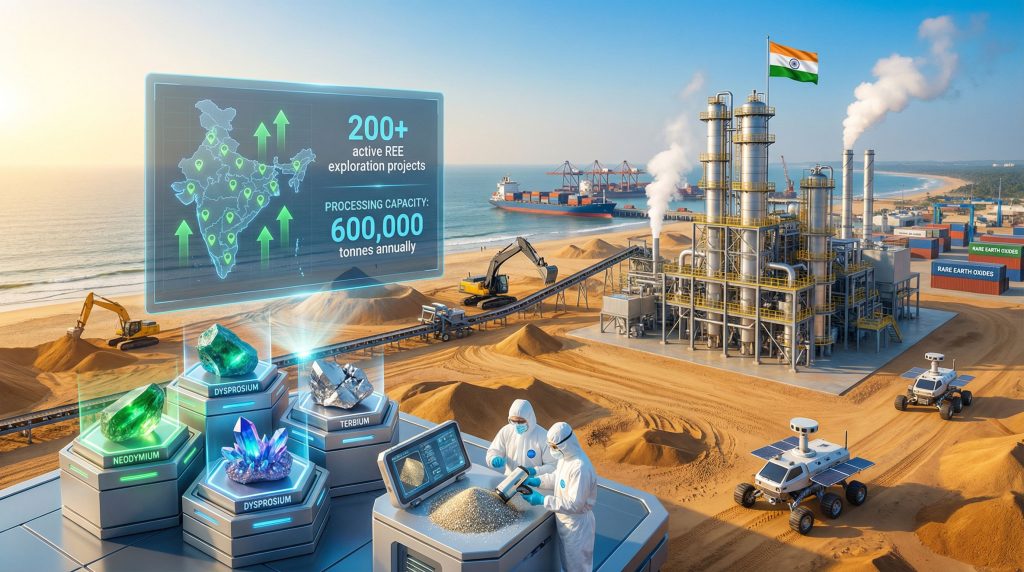
The Geological Survey of India has initiated nearly 200 rare earth exploration projects since 2021, representing the most comprehensive mineral assessment programme in the nation's history. These projects span approximately 5,000 square kilometres across thirteen states, with capital allocation reaching INR 450-500 crores (USD 54-60 million) over three years. The scale reflects governmental recognition that geological knowledge represents foundational infrastructure for future manufacturing competitiveness.
Moreover, geographic distribution concentrates heavily in coastal regions, with Odisha, Andhra Pradesh, Tamil Nadu, and Kerala accounting for approximately 70-75% of active projects. This concentration stems from both geological advantages and practical considerations. Beach sand deposits containing monazite require substantially lower capital investment than hard rock formations, while coastal infrastructure provides existing transportation and processing facility access.
Current Exploration Distribution:
• Odisha: 25-30% of projects (beach sand monazite focus)
• Andhra Pradesh: 20-25% of projects (mixed hard rock and coastal)
• Tamil Nadu: 15-18% of projects (coastal formations)
• Kerala: 10-12% of projects (established beach sand operations)
• Other states: 20% distributed across inland formations
The exploration methodology employs advanced techniques including airborne radiometric surveys using helicopter-mounted gamma-ray spectrometers to identify thorium and uranium-bearing formations that typically correlate with rare earth concentrations. Approximately 80% of current projects incorporate this technology, with follow-up diamond drilling and ICP-MS analysis providing precise elemental characterisation.
However, modern exploration programmes require substantial investment, with average drill programmes costing USD 50,000-100,000 per target area and comprehensive beneficiation testing requiring 12-18 months at USD 200,000-500,000 per project. These costs reflect the technical complexity of rare earth geology, where economic viability depends not only on total rare earth content but also on specific element distribution and processing characteristics.
When big ASX news breaks, our subscribers know first
Beach Sand Mining Versus Hard Rock Development Economics
India's rare earth resources divide into two distinct categories with fundamentally different economic profiles. Beach sand deposits, primarily containing monazite, offer lower capital requirements but limited heavy rare earth content. Consequently, hard rock deposits, including xenotime and apatite-hosted formations, require substantially higher investment but can access heavy rare earth elements unavailable in coastal operations.
Production Cost Comparison:
| Deposit Type | Capital Investment | Processing Cost/Tonne | REE Oxide Content | Development Timeline |
|---|---|---|---|---|
| Beach Sand | USD 50-100M | USD 150-200 | 22-26% | 2-3 years |
| Hard Rock | USD 150-300M | USD 400-600 | 0.3-0.5% | 4-6 years |
The Odisha coast historically produces approximately 95% of India's monazite, with established operations demonstrating viable production economics. Beach sand mining achieves concentrate grades of 22-26% rare earth oxides by weight, substantially higher than hard rock formations requiring processing of ore containing 0.3-0.5% total rare earth content.
Nevertheless, beach sand deposits typically contain light rare earth elements with limited heavy rare earth concentrations. Heavy rare earth elements, particularly dysprosium and terbium, command premium pricing (USD 300-700 per kilogram for dysprosium oxide versus USD 40-80 per kilogram for neodymium oxide) due to their essential role in high-performance permanent magnets.
Economic feasibility calculations for hard rock deposits require significantly higher rare earth prices or substantial scale advantages to justify the 2-3x higher capital requirements. Most hard rock projects require minimum production scales of 10,000-15,000 tonnes annually of rare earth oxides to achieve acceptable returns, compared to 2,000-5,000 tonnes for beach sand operations.
Processing Infrastructure Bottlenecks and Capacity Constraints
IREL operates India's primary rare earth processing infrastructure through facilities in Odisha and Kerala, with reported capacity of 600,000 tonnes annually. This figure refers to heavy mineral processing capacity rather than rare earth oxide production, representing a critical distinction often overlooked in policy discussions. Heavy mineral processing yields approximately 5-8% rare earth oxides, implying actual production capacity of 30,000-48,000 tonnes of rare earth oxides annually.
Furthermore, current capacity utilisation remains substantially below potential, with actual production estimated at 20,000-25,000 tonnes of processed rare earth-bearing materials. This utilisation gap reflects both feedstock limitations and processing technology constraints, particularly in separation chemistry where India lacks advanced solvent extraction capabilities for individual rare earth element isolation.
Processing Value Chain Analysis:
• Mining Stage: 5-8% gross margin on raw monazite
• Separation: 15-25% margin on rare earth oxides
• Alloy Production: 30-45% margin on refined metals
• Magnet Manufacturing: 40-60% margin on finished magnets
The value multiplication demonstrates why China maintains dominant market position through vertical integration rather than raw material control alone. Chinese companies capture value across all processing stages, while India currently operates primarily in the lowest-margin mining and basic separation segments.
Additionally, separation chemistry represents the most critical technology gap, requiring specialised knowledge of solvent extraction processes, precipitation chemistry, and radioactive byproduct management. Individual rare earth elements possess nearly identical chemical properties, making separation extremely challenging without proprietary process technology typically controlled by established producers.
Construction of modern separation facilities requires capital investment of USD 300-500 million for 50,000-tonne annual capacity, with development timelines of 4-5 years including technology licensing, equipment procurement, and regulatory approval processes. These requirements explain why processing capability development presents greater challenges than mining expansion.
Regulatory Framework Complexities and Investment Implications
India's rare earth sector operates under unique regulatory constraints stemming from thorium content in monazite deposits. The Department of Atomic Energy oversees IREL operations due to uranium and thorium-bearing mineral streams, creating approval processes substantially more complex than conventional mining projects.
Moreover, private sector participation faces significant limitations due to radioactive material handling requirements and security considerations. While exploration permits can be obtained through standard mining lease procedures, processing and refining operations require additional atomic energy regulatory approval, creating multi-agency coordination requirements that extend project development timelines.
Regulatory Approval Timeline Comparison:
| Project Type | Environmental Clearance | Mining Permit | Atomic Energy Approval | Total Timeline |
|---|---|---|---|---|
| Beach Sand (Private) | 12-18 months | 6-12 months | 18-24 months | 36-54 months |
| Hard Rock (Private) | 18-24 months | 12-18 months | 24-36 months | 54-78 months |
| IREL Operations | 6-12 months | Expedited | Pre-approved | 12-24 months |
Environmental compliance costs add substantial expense, particularly for radioactive byproduct management and coastal ecosystem protection. Processing facilities must incorporate specialised waste treatment systems for thorium separation and long-term storage, with ongoing monitoring requirements that increase operational expenses by approximately 15-20% compared to conventional mineral processing.
The regulatory framework effectively creates dual-track development, with IREL enjoying streamlined approval processes while private companies face extended timelines and additional compliance costs. This structure may require modification to achieve the scale of development necessary for global competitiveness.
International Collaboration Models and Technology Transfer
India's rare earth exploration strategy increasingly emphasises international partnerships to access technology and market channels unavailable through domestic development alone. The U.S.-India Strategic Partnership on Critical Minerals, announced in 2023, provides framework for technology sharing and joint venture development, particularly in processing and downstream manufacturing.
Furthermore, Japanese companies bring specialised expertise in magnet manufacturing and separation chemistry, with potential joint ventures focusing on high-value applications rather than bulk commodity production. Additionally, European CRM facility supply chain diversification initiatives offer market access opportunities for Indian producers meeting quality and environmental standards.
Foreign Investment Structure Analysis:
| Partnership Model | Technology Access | Market Guarantee | Capital Contribution | Risk Sharing |
|---|---|---|---|---|
| Joint Venture | High | Medium | 30-70% | Balanced |
| Technology License | Medium | Low | 10-20% | Indian-weighted |
| Supply Agreement | Low | High | 0-10% | Customer-weighted |
Technology licensing arrangements typically require upfront payments of USD 20-50 million plus ongoing royalties of 3-8% of production value. Joint venture structures provide greater technology access but require shared operational control and profit distribution, creating potential conflicts in strategic decision-making.
In addition, international collaboration becomes particularly valuable in magnet manufacturing, where proprietary alloy compositions and processing techniques represent closely guarded intellectual property. Japanese and South Korean companies control approximately 75% of global permanent magnet production technology, making partnership essential for Indian market entry.
China's Export Policy Impact and Competitive Positioning
China export controls on rare earth elements have fundamentally altered global supply chain calculations, creating both opportunities and challenges for alternative producers like India. Chinese export restrictions on gallium, germanium, and antimony have demonstrated willingness to use critical minerals as geopolitical tools, raising concerns about rare earth supply security.
Consequently, price volatility resulting from Chinese policy changes creates planning uncertainty for downstream manufacturers while potentially improving economics for alternative suppliers. Neodymium oxide prices fluctuated between USD 40-80 per kilogram over the past five years, with policy announcements creating short-term price spikes that benefit existing producers but complicate long-term investment planning.
However, Indian cost structures currently cannot compete with Chinese production efficiency, which benefits from decades of process optimisation and integrated supply chains. Chinese producers achieve production costs of approximately USD 8-12 per kilogram for mixed rare earth oxides, compared to estimated Indian costs of USD 15-25 per kilogram for equivalent products.
Nevertheless, geopolitical supply chain diversification creates market opportunities beyond pure cost competition. Technology companies increasingly prioritise supply source diversification over marginal cost savings, creating premium pricing opportunities for non-Chinese suppliers meeting quality and reliability requirements.
Market Share Redistribution Analysis:
• Defense applications: 60% actively seeking non-Chinese suppliers
• Automotive permanent magnets: 30% evaluating supply diversification
• Consumer electronics: 15% considering alternative sources
• Wind turbines: 45% targeting supply chain redundancy
This market segmentation suggests that India's competitive positioning should focus on high-reliability applications rather than cost-sensitive commodity markets, emphasising quality assurance and supply chain security over volume production.
The next major ASX story will hit our subscribers first
Infrastructure Development Requirements and Investment Priorities
Successful rare earth development requires substantial infrastructure investment beyond mining and processing facilities. Transportation networks must accommodate radioactive material handling requirements, while power and water supply systems need capacity for energy-intensive separation processes.
Furthermore, processing facilities require dedicated electrical supply of 150-200 MW for 50,000-tonne annual production capacity, with consistent power quality essential for precise chemical control systems. Water requirements reach 5-8 cubic metres per tonne of rare earth oxide production, necessitating reliable industrial water supply or expensive recycling systems.
Infrastructure Capital Requirements:
| Infrastructure Component | Capital Cost (USD) | Development Timeline | Capacity Requirements |
|---|---|---|---|
| Processing Facility | 300-500M | 4-5 years | 50,000 tonnes/year |
| Power Infrastructure | 50-100M | 2-3 years | 200 MW dedicated |
| Transportation | 25-50M | 2-3 years | Rail/port access |
| Water Treatment | 30-60M | 18-24 months | 400,000 m³/year |
| Waste Management | 40-80M | 2-3 years | Radioactive storage |
Waste management represents a particularly complex requirement, with thorium separation and long-term storage requiring specialised facilities meeting atomic energy regulatory standards. These facilities typically cost USD 40-80 million for commercial-scale operations and require ongoing monitoring expenses of USD 2-5 million annually.
Moreover, transportation infrastructure must accommodate container shipping of finished products while meeting safety requirements for radioactive material movement. Rail connections to major ports become essential for export market access, with dedicated handling facilities required at shipping terminals.
Market Demand Projections and Revenue Models
Global rare earth demand continues expanding driven by electric vehicle adoption, renewable energy infrastructure development, and defence modernisation programmes. Electric vehicle motors require approximately 1-2 kilograms of rare earth permanent magnets per vehicle, with global EV production targeting 30-40 million units annually by 2030.
Additionally, wind turbine installations consume approximately 200-600 kilograms of rare earth magnets per MW of generation capacity, depending on turbine design and efficiency requirements. Global wind capacity additions of 100-150 GW annually translate to substantial rare earth demand growth.
Demand Growth by Sector (2024-2030):
• Electric vehicles: 8-12% annual growth
• Wind turbines: 6-10% annual growth
• Consumer electronics: 3-5% annual growth
• Defence critical minerals: 5-8% annual growth
• Industrial motors: 4-6% annual growth
Price forecasting remains challenging due to supply concentration and geopolitical factors, but long-term contracts increasingly provide revenue stability for new producers. Automotive manufacturers offer 3-7 year supply agreements with pricing mechanisms tied to production cost indices rather than spot market volatility.
However, revenue models must account for the extended development timeline from exploration through production, with cash flow beginning 5-8 years after initial investment. Financing structures typically require government support or strategic partner backing due to capital intensity and extended payback periods.
Timeline Challenges and Market Entry Strategy
Rare earth project development follows predictable timelines that constrain market entry strategy and competitive positioning. Exploration phases require 2-4 years for resource definition, followed by 2-3 years for feasibility studies and engineering design, and 3-5 years for construction and commissioning.
Critical Path Analysis for Integrated Operations:
- Exploration Phase (Years 1-3): Geological survey, drilling, resource estimation
- Feasibility Phase (Years 4-5): Engineering studies, environmental assessment, financing
- Construction Phase (Years 6-8): Facility construction, equipment installation, commissioning
- Ramp-up Phase (Years 9-10): Production optimisation, customer qualification, market penetration
Customer qualification represents a frequently underestimated timeline component, with automotive and aerospace applications requiring 12-24 months of material testing and supplier certification. Defence applications may require additional security clearances and domestic content verification extending qualification periods to 2-3 years.
Furthermore, working capital requirements during ramp-up periods typically equal 6-12 months of operating expenses, as production must reach steady-state while inventory builds and customer payments establish regular cash flow. This period often requires additional financing beyond construction capital.
Phased capacity expansion provides risk management benefits but may sacrifice economies of scale essential for competitive positioning. Market entry strategies must balance development speed against operational flexibility, particularly given uncertainty about Chinese competitive responses.
Strategic Policy Framework and Global Implications
Recent geopolitical developments have transformed rare earth exploration from purely economic considerations into strategic imperative. Trump's critical minerals order highlighted the importance of supply chain diversification, while global events have demonstrated the vulnerability of concentrated rare earth production.
Consequently, the parliamentary Standing Committee on Coal, Mines, and Steel recommendation for targeted budgetary support reflects recognition that critical minerals energy security requires sustained government commitment rather than purely market-driven investment. According to a recent analysis by the Observer Research Foundation, "India's shift from mining to processing represents a fundamental change in its mineral strategy, moving beyond extraction to value-added manufacturing".
Moreover, international experiences demonstrate successful rare earth development requires coordinated policy frameworks. Australia's experience with rare earth processing indicates that strategic partnerships between government and industry can accelerate development timelines while managing technical risks.
Long-term Strategic Economic Impact (2028-2035):
• Supply chain independence: Targeting 70-80% reduction in critical mineral imports
• Global market share: Projecting 8-12% of processed rare earth production
• Economic multiplier effects: Estimated 15,000-25,000 direct jobs across the value chain
• Export potential: USD 2-4 billion annually in rare earth products and magnets
The economic transformation timeline extends beyond immediate rare earth production to encompass broader manufacturing ecosystem development. Success creates foundation for advanced materials manufacturing, precision component production, and technology hardware assembly that multiplies initial rare earth investment returns.
India's rare earth exploration represents a critical juncture where geological endowment meets manufacturing ambition. The 200 exploration projects initiated by the Geological Survey represent necessary groundwork, but commercial success depends on processing technology development, regulatory framework optimisation, and international partnership execution. The parliamentary recommendation signals governmental recognition that rare earth development requires sustained commitment rather than incremental policy adjustment.
Market participants should view India's rare earth development as a long-term structural shift rather than immediate supply alternative, with meaningful production capability emerging over 8-12 year investment cycles. The economic transformation potential justifies sustained attention, but timeline realism remains essential for investment and strategic planning purposes.
Ready to Invest in the Next Major Mineral Discovery?
Discovery Alert's proprietary Discovery IQ model delivers real-time alerts on significant ASX mineral discoveries, instantly empowering subscribers to identify actionable opportunities ahead of the broader market. Understand why historic discoveries can generate substantial returns by visiting Discovery Alert's dedicated discoveries page, showcasing exceptional outcomes from companies like De Grey Mining and WA1 Resources, then begin your 30-day free trial today to position yourself ahead of the market.