May 20, 2026
Understanding the Environmental Challenges of Rare Earth Magnet Manufacturing
The metallurgical transformation of lanthanide elements into high-performance permanent magnets represents one of modern industry's most chemically complex manufacturing processes. Unlike conventional metal extraction, environmental performance in rare earth magnet production involves navigating the unique challenges posed by the lanthanide contraction phenomenon, where 15 different elements exhibit nearly identical chemical behaviour despite their distinct magnetic properties. Furthermore, the industry innovation trends continue to shape how manufacturers approach these environmental challenges.
The Complex Chemistry Behind Sustainable Production
The fundamental chemistry driving rare earth element separation creates inherent environmental challenges that extend far beyond traditional mining operations. Lanthanide separation processes require thousands of individual solvent extraction stages due to the minimal differences in ionic radii between adjacent elements. This chemical reality means that separating neodymium from praseodymium, or isolating heavy rare earth elements like dysprosium and terbium, demands extensive cascading systems.
Water consumption intensifies dramatically during the refining phases compared to initial extraction operations. Processing facilities consume approximately 75 cubic metres of water per ton of rare earth oxide produced, with much of this volume contaminated by residual organic solvents, mineral acids, and dissolved salt compounds. The separation cascades require continuous aqueous and organic phase contact, making water management a critical environmental control point.
Chemical reagent intensity reaches its peak during solvent extraction operations, where facilities utilise sulfuric, hydrochloric, and hydrofluoric acids alongside specialised organic extractants. The repeated cycling of these chemicals through multi-stage separation systems creates substantial reagent consumption rates and corresponding waste management solutions.
Quantifying Resource Intensity Across Production Stages
Land use disruption occurs at significantly higher ratios than conventional metal mining due to the dispersed nature of rare earth deposits. Most economically viable deposits require substantial overburden removal to access ore-bearing formations, particularly in open-pit bastnäsite and monazite operations.
Energy consumption patterns vary dramatically across the three primary production stages:
• Extraction and concentration: Mechanical crushing and grinding operations
• Chemical separation: Energy-intensive solvent extraction cascade systems
• Metallurgical processing: High-temperature electrolysis and sintering alignment
The sintering and magnetic alignment phases demand sustained high-temperature operations, typically requiring 40-60 MWh per ton of finished magnet material. Electrolysis processes for converting rare earth oxides to metallic form operate at temperatures exceeding 1,000°C, contributing substantially to the overall energy footprint.
Radioactive byproduct management presents unique challenges, particularly for monazite-based operations. These deposits naturally contain thorium and uranium concentrations that require specialised containment systems utilising high-density polyethylene liners and multi-barrier engineering controls.
When big ASX news breaks, our subscribers know first
What Are the Primary Environmental Impact Vectors in Magnet Production?
Environmental impact assessment in rare earth magnet manufacturing must account for the integrated nature of the supply chain, where upstream mining decisions directly influence downstream processing efficiency and waste generation patterns. Moreover, environmental impacts of rare earth production extend beyond immediate operational footprints.
Mining and Extraction Environmental Footprint
Overburden removal requirements vary significantly across the three primary ore types used in commercial rare earth production. Bastnäsite deposits typically require lower overburden ratios compared to ion-adsorption clay operations, though specific removal volumes depend heavily on geological formation characteristics and deposit geometry.
Dust generation occurs throughout the crushing and grinding operations, with particular intensity during dry processing of carboniferous ores. Airborne particulate emissions require sophisticated dust collection systems and atmospheric monitoring to maintain air quality standards in surrounding communities.
Ecosystem disruption patterns in open-pit operations extend beyond the immediate mining footprint through groundwater drawdown, surface water diversion, and habitat fragmentation. Biodiversity impact assessments increasingly focus on endemic species protection and mine reclamation innovations.
Chemical Processing Environmental Burden
Wastewater streams from separation facilities contain complex mixtures of organic solvents, mineral acids, and dissolved rare earth salts. Advanced treatment systems now employ membrane filtration and ion-exchange technologies to enable water recycling and reduce external discharge volumes.
Acid consumption in separation processes creates corresponding neutralisation requirements and salt precipitation challenges. Sulfuric acid usage in roasting operations and hydrochloric acid applications in leaching stages generate substantial quantities of neutralised waste requiring appropriate disposal or beneficial reuse pathways.
Air quality impacts extend beyond particulate matter to include volatile organic compounds from solvent extraction operations and potential acid vapour emissions from various processing stages. Modern facilities implement scrubber systems and enclosed processing environments to minimise atmospheric releases.
Manufacturing Stage Environmental Costs
High-temperature sintering operations represent the most energy-intensive phase of magnet production, requiring sustained temperatures above 1,000°C for proper grain alignment and magnetic domain optimisation. These thermal processes often account for 60-70% of total manufacturing energy consumption.
Magnetic field alignment procedures during sintering require substantial electrical power for generating the intense magnetic fields necessary to orient crystalline domains. Power consumption for magnetic field generation systems can exceed 15-20% of total facility electrical demand during production cycles.
Heat treatment carbon footprint analysis reveals significant variation based on regional electrical grid composition. Facilities located in renewable energy regions demonstrate substantially lower carbon intensity compared to those dependent on fossil fuel-powered electrical grids.
How Do Regional Production Hubs Compare in Environmental Performance?
Global rare earth magnet production concentrates in distinct regional hubs, each characterised by different ore types, processing technologies, and environmental regulatory frameworks. Environmental performance in rare earth magnet production varies substantially across these regions due to geological, technological, and regulatory factors.
China's Dominant Production Centres
China controls approximately 85-90% of global rare earth processing capacity through integrated operations spanning from mining to finished magnet production. The Bayan Obo complex in Inner Mongolia processes bastnäsite ore through large-scale operations that have undergone significant environmental improvements since 2010 regulatory reforms.
| Production Hub | Primary Ore Type | Processing Method | Environmental Focus |
|---|---|---|---|
| Bayan Obo | Bastnäsite | Sulfuric acid roasting | Tailings consolidation |
| Southern Ion-Clay | Ion-adsorption clays | In-situ leaching | Groundwater protection |
| Shandong Province | Mixed concentrates | Solvent extraction | Air quality management |
Southern China ion-adsorption operations utilise in-situ leaching techniques that reduce surface disruption but require careful groundwater management. These operations produce the majority of global heavy rare earth supply, including dysprosium and terbium essential for high-performance permanent magnets.
Recent environmental reforms in China have emphasised dry-stacking tailings management and closed-loop water systems. The transition from conventional wet tailings ponds to engineered dry-stack facilities has improved geotechnical stability and reduced long-term environmental liability.
Western Production Facility Standards
Mount Weld in Western Australia and Kuantan processing in Malaysia represent the primary non-Chinese integrated rare earth operation through Lynas Rare Earths. This vertically integrated supply chain separates mining from processing across international boundaries, creating unique logistical and environmental oversight challenges.
The Mountain Pass facility in California has implemented advanced environmental management systems following its 2017 restart under MP Materials ownership. Recent sustainability reporting indicates substantial improvements in water recycling rates and waste minimisation compared to historical operations.
European Union regulatory frameworks emphasise life cycle assessment and circular economy principles for critical mineral supply chains. The EU's Critical Raw Materials Act establishes environmental performance benchmarks that influence sourcing decisions for European magnet manufacturers.
Emerging Production Centres and Best Practices
Advanced containment systems in newer facilities incorporate multiple environmental protection layers, including synthetic liner systems, real-time monitoring networks, and automated leak detection technologies. These systems represent substantial capital investments but provide enhanced environmental security.
In addition, renewable energy solutions vary by region and facility design. Solar-powered processing facilities in high-insolation regions demonstrate the feasibility of reducing carbon intensity in energy-intensive rare earth refining operations.
Closed-loop water management implementations have achieved water recycling rates exceeding 85-90% in modern facilities through advanced membrane filtration and selective ion-exchange systems. These technologies significantly reduce freshwater consumption and external discharge requirements.
Which Advanced Technologies Are Reducing Environmental Impact?
Technological innovation in rare earth processing focuses on reducing chemical consumption, minimising energy requirements, and improving separation selectivity to decrease overall environmental impact while maintaining production efficiency.
Bio-Hydrometallurgy Innovations
Bacterial and fungal leaching systems offer potential alternatives to conventional acid leaching by utilising specialised microorganisms capable of dissolving rare earth elements from ore matrices. Bio-leaching processes using bacteria such as Acidithiobacillus species have demonstrated the ability to reduce chemical reagent consumption significantly compared to traditional mineral acid applications.
Specialised microorganism applications target specific rare earth elements through engineered biological systems. Research developments focus on organisms capable of selective rare earth uptake and concentration, potentially enabling more targeted extraction processes.
Temperature reduction benefits in biological processing systems eliminate many high-temperature roasting and calcination requirements, substantially decreasing energy consumption and thermal emissions. Bio-hydrometallurgy typically operates at ambient temperatures, offering significant energy advantages.
Ionic Liquid Separation Technologies
Room-temperature ionic liquid applications for rare earth separation represent a paradigm shift from conventional organic solvent systems. These liquid salts remain stable at ambient temperatures while providing highly selective separation capabilities for individual lanthanide elements.
Selective dysprosium and terbium extraction becomes increasingly important for electric vehicle motor applications where these heavy rare earth elements provide essential high-temperature magnetic stability. Ionic liquid systems demonstrate superior selectivity for heavy rare earth separation compared to conventional solvent extraction processes.
Reduced hazardous chemical dependency results from ionic liquid implementations that eliminate many traditional organic solvents and mineral acids. The lower volatility and improved selectivity of ionic liquids contribute to safer working environments and reduced atmospheric emissions.
Membrane Filtration and Ion-Exchange Systems
Advanced water treatment technologies enable comprehensive water recycling through multi-stage filtration and selective ion removal systems. Membrane technologies including reverse osmosis, nanofiltration, and selective ion-exchange provide targeted treatment capabilities for complex rare earth processing wastewaters.
Multi-barrier containment systems for radioactive materials utilise engineered combinations of synthetic liners, compacted clay barriers, and geochemical stabilisation systems. High-density polyethylene liner effectiveness provides primary containment while clay barriers offer long-term geochemical attenuation.
Process automation and data-driven operations enable precise control of chemical addition rates, temperature profiles, and separation efficiency parameters. Digital process optimisation reduces reagent overconsumption and minimises waste generation through improved operational control.
What Role Does Circular Economy Play in Sustainable Magnet Production?
Circular economy principles in rare earth magnet production focus on maximising material utilisation efficiency, extending product lifecycles, and recovering valuable elements from end-of-life applications to reduce dependence on primary mining operations.
Magnet-to-Magnet Recycling Pathways
Recycling methodology selection depends on product specifications, contamination levels, and economic considerations across different recovery pathways:
| Recovery Method | REE Recovery Rate | Energy Reduction | Implementation Complexity |
|---|---|---|---|
| Short-loop Mechanical | 85-90% | 40% reduction | Low complexity |
| Long-loop Chemical | 95%+ recovery | 35% reduction | High complexity |
| Hybrid Processing | 92-95% recovery | 38% reduction | Medium complexity |
Short-loop recycling processes mechanically process end-of-life magnets into powder form suitable for direct reintegration into new magnet production. This approach bypasses chemical separation stages, significantly reducing processing complexity and chemical consumption.
Long-loop chemical recycling achieves maximum rare earth recovery through complete dissolution and re-separation of individual elements. While more complex, this approach enables purification and removal of contaminants that accumulate during magnet service life.
Urban Mining and End-of-Life Recovery
Electric vehicle magnet recovery potential represents a substantial future secondary source as first-generation EVs approach end-of-life status. Industry projections suggest significant rare earth availability from automotive applications beginning in the 2030-2040 timeframe.
Wind turbine decommissioning creates concentrated sources of large-scale permanent magnets containing substantial quantities of neodymium and dysprosium. Early wind turbine installations from the 2000-2010 period are approaching 20-year service life expectations, creating emerging secondary supply streams.
E-waste rare earth content optimisation focuses on efficient collection and processing of consumer electronics containing small but concentrated rare earth magnet applications. Collection efficiency improvements through specialised e-waste processing facilities increase recovery rates from distributed consumer applications.
Secondary Sourcing Integration
Industrial scrap reprocessing capabilities enable recovery of rare earth materials from manufacturing waste streams, including grinding swarf, reject materials, and off-specification products. These materials often contain higher rare earth concentrations than primary ores.
Manufacturing waste stream utilisation requires close integration between primary production and recycling operations to maintain material traceability and quality specifications. Quality assurance protocols ensure recycled materials meet magnet performance requirements.
Contamination management in recycled rare earth streams addresses accumulation of elements such as oxygen, carbon, and transition metals that can degrade magnetic properties. Advanced purification techniques maintain product quality while maximising recycled content utilisation.
How Are Supply Chain Transparency and Traceability Improving?
Enhanced transparency in rare earth magnet supply chains addresses growing stakeholder demands for environmental accountability, ethical sourcing verification, and compliance with emerging regulatory frameworks governing critical mineral supply chains.
Blockchain-Enabled Environmental Tracking
Digital product passport implementations create comprehensive records of environmental impacts, processing locations, and material composition throughout the supply chain. Blockchain technology provides tamper-resistant documentation of environmental performance metrics from extraction through final product delivery.
Real-time environmental footprint monitoring integrates sensor data, processing parameters, and energy consumption metrics into unified tracking systems. Automated data collection eliminates manual reporting inconsistencies while providing continuous environmental performance visibility.
Supply chain verification protocols enable downstream manufacturers and end users to verify environmental performance claims through independently auditable digital records. These systems support compliance with emerging environmental disclosure regulations.
International Certification Standards
OECD Due Diligence Guidelines provide frameworks for responsible supply chain management covering environmental performance, social impacts, and governance standards. Compliance requires systematic risk assessment and mitigation planning across all supply chain tiers.
Initiative for Responsible Mining Assurance (IRMA) frameworks establish comprehensive environmental and social performance standards for mining operations. IRMA certification provides third-party verification of environmental management systems and operational practices.
ISO 14001 environmental management integration ensures systematic environmental performance improvement through established management system frameworks. Integration with quality management systems creates comprehensive operational oversight.
Stakeholder Reporting and Accountability
ESG metrics standardisation across the rare earth value chain enables consistent environmental performance comparison and benchmarking. Standardised reporting frameworks facilitate investor evaluation and supply chain decision-making processes.
Third-party environmental auditing requirements provide independent verification of environmental performance claims and compliance with applicable regulations. Independent verification enhances stakeholder confidence in reported environmental data.
Investor-grade sustainability reporting addresses growing financial sector focus on environmental risk assessment and climate-related disclosure requirements. Comprehensive environmental performance data supports investment decision-making and risk management processes.
The next major ASX story will hit our subscribers first
What Are the Future Prospects for Sustainable Rare Earth Magnet Production?
Future sustainability in rare earth magnet production requires balancing unprecedented demand growth with finite environmental capacity constraints while advancing technological solutions that fundamentally improve production efficiency and environmental performance.
Demand Growth vs. Environmental Capacity
Projected demand increases for neodymium, dysprosium, and terbium substantially exceed current production capacity as electric vehicle adoption accelerates and renewable energy deployment expands globally. Industry analysis suggests potential 20-30 fold increases in rare earth demand by 2040-2050 across clean technology applications.
Production capacity expansion faces significant environmental constraints including water availability, energy infrastructure, and waste management capacity. Environmental bottlenecks may limit production growth rates regardless of economic incentives or technological capabilities.
Technology scaling challenges require simultaneous advancement in processing efficiency, environmental performance, and production capacity. Innovation integration must address multiple performance parameters without compromising environmental sustainability objectives.
Renewable Energy Integration Strategies
Solar-powered refining facility developments demonstrate feasibility of renewable energy integration in energy-intensive rare earth processing. Dedicated solar installations can provide substantial portions of facility power requirements while reducing carbon footprint.
Hydroelectric-integrated processing centres leverage renewable energy availability to power high-consumption electrolysis and thermal processing operations. Geographic co-location of processing facilities with renewable energy resources improves overall sustainability profiles.
Grid decarbonisation impacts on production carbon footprint vary significantly by region and electrical grid composition. Regional variations in renewable energy availability influence facility location decisions and environmental performance outcomes.
Policy and Regulatory Evolution
Environmental reform impacts following China's post-2010 regulatory changes demonstrate the influence of policy frameworks on production practices and environmental performance. Continued policy evolution drives technological advancement and operational improvements.
International environmental cost internalisation through carbon pricing, pollution taxes, and regulatory requirements creates economic incentives for environmental performance improvement. Policy mechanisms increasingly favour lower-impact production methods and technologies.
Carbon pricing effects on production economics may reshape competitive dynamics between different production regions and processing technologies. Environmental externality pricing influences investment decisions and operational strategies.
Measuring and Benchmarking Environmental Performance
Comprehensive environmental performance assessment requires standardised methodologies, consistent metrics, and transparent reporting frameworks that enable meaningful comparison across different production routes and facilities.
Life Cycle Assessment Methodologies
Cradle-to-gate environmental impact quantification provides comprehensive assessment of environmental burdens from mining through finished magnet production. LCA methodologies enable identification of environmental hotspots and optimisation opportunities across the complete production process.
Hotspot identification consistently points to separation and refining stages as the primary contributors to environmental impact due to chemical intensity, energy consumption, and waste generation characteristics. Process improvements in these stages offer the greatest potential for environmental performance enhancement.
Comparative analysis frameworks enable evaluation of different production routes, technologies, and facility designs based on standardised environmental impact categories. These frameworks support decision-making for process selection and facility development.
Key Performance Indicators for Sustainability
Environmental performance metrics require standardisation across the industry to enable meaningful benchmarking and continuous improvement tracking:
| Performance Category | Key Indicator | Current Industry Range | Best Practice Target |
|---|---|---|---|
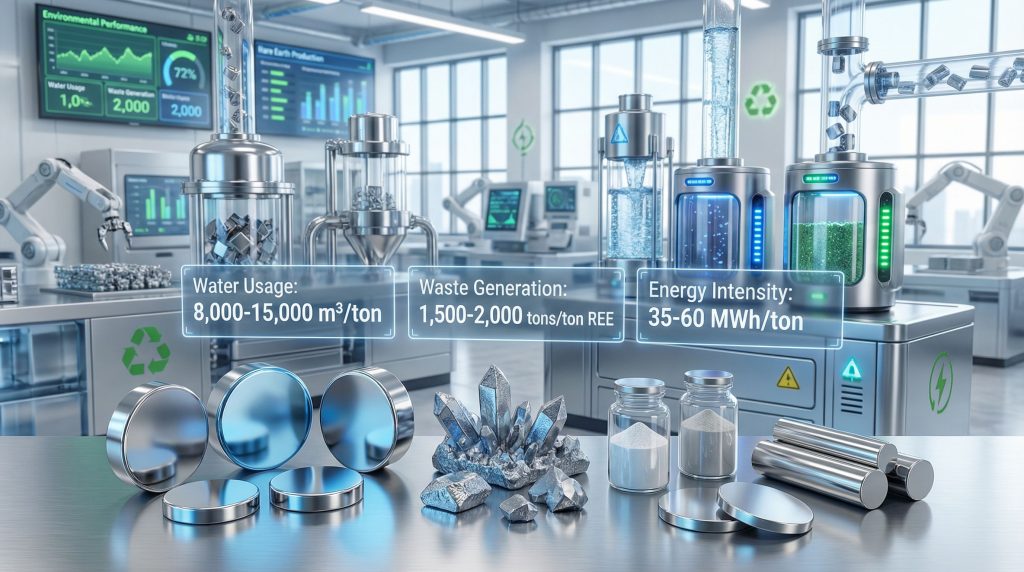
| Water Efficiency | Cubic metres per ton REE | 8,000-18,000 m³/ton | <6,000 m³/ton |
| Waste Minimisation | Tailings generation ratio | 1,200-2,000:1 | <1,000:1 |
| Energy Intensity | Energy per ton magnet | 35-60 MWh/ton | <30 MWh/ton |
| Recycled Content | Secondary material utilisation | 10-25% | >40% |
Water efficiency improvements through closed-loop systems and advanced treatment technologies demonstrate feasibility of substantial water consumption reduction while maintaining production quality and capacity.
Waste generation ratios vary significantly based on ore type, processing route, and facility design. Best practice facilities achieve substantially lower waste generation through process optimisation and byproduct utilisation.
Continuous Improvement Frameworks
Process optimisation opportunities in existing facilities focus on chemical consumption reduction, energy efficiency improvement, and waste stream minimisation through operational parameter adjustment and equipment upgrades.
Technology upgrade pathways for legacy operations require systematic assessment of retrofit feasibility, capital requirements, and expected environmental performance improvements. Modernisation strategies balance economic considerations with environmental objectives.
Environmental management system integration ensures systematic identification of improvement opportunities and implementation of performance enhancement measures. Continuous improvement frameworks provide structured approaches to environmental performance in rare earth magnet production optimisation.
However, the path forward requires navigating complex relationships between increasing demand and environmental constraints. Research indicates that bottlenecks and sustainable pathways present significant challenges for scaling production while maintaining environmental standards.
Disclaimer: This analysis presents industry trends and technological developments in rare earth magnet production based on available information as of early 2026. Environmental performance data and technological capabilities continue to evolve rapidly. Specific environmental metrics may vary significantly across different facilities, production routes, and regulatory jurisdictions. Readers should verify current operational data and regulatory requirements for specific applications or investment decisions.
What Role Could Discovery Alert Play in Your Mining Investment Strategy?
Discovery Alert's proprietary Discovery IQ model delivers real-time notifications on significant ASX mineral discoveries, transforming complex geological data into actionable investment insights that could position you ahead of market movements. Explore historic examples of how major mineral discoveries have generated substantial returns and begin your 30-day free trial today to gain immediate access to the latest discovery opportunities powered by advanced AI technology.