July 10, 2026
Understanding Rare Earth Magnet Recycling Technology and Its Growing Industrial Impact
Complex electronic systems require specialised materials to function reliably under demanding operational conditions. Modern manufacturing increasingly depends on permanent magnet technologies that deliver exceptional magnetic performance across temperature extremes and mechanical stress cycles. These materials represent critical infrastructure components for industries spanning renewable energy generation, electric transportation, medical imaging, and precision manufacturing equipment.
The specialised magnetic properties required for high-performance applications create unique challenges for materials recovery and reuse. Unlike conventional metals that can be processed through established recycling pathways, rare earth magnet recycling requires sophisticated extraction and processing technologies to maintain their functional characteristics during recovery operations.
When big ASX news breaks, our subscribers know first
What Is Rare Earth Magnet Recycling and Why Does It Matter?
The Critical Materials Crisis Behind Modern Technology
Rare earth magnet recycling addresses fundamental vulnerabilities in global technology supply chains through recovery and reprocessing of permanent magnet materials from end-of-life products. This process targets neodymium-iron-boron (NdFeB) magnets, which contain strategically important elements including neodymium, praseodymium, dysprosium, and terbium.
Current global supply patterns demonstrate significant geographic concentration risks. China controls approximately 70% of global rare earth element processing capacity as of 2024, according to the U.S. Geological Survey's Mineral Commodity Summaries. This concentration creates downstream dependencies for economies lacking domestic processing infrastructure, particularly affecting industries requiring reliable access to high-performance magnetic materials.
The U.S. Department of Energy identifies rare earth permanent magnets amongst the most constrained links in global critical mineral supply chains. Manufacturing capacity remains geographically concentrated, leaving many downstream economies dependent on imports for technologies essential to renewable energy deployment, electric vehicle production, and advanced manufacturing capabilities. Furthermore, these rare earth reserves insights highlight the critical importance of diversifying supply sources.
Understanding Rare Earth Permanent Magnets and Their Applications
Rare earth permanent magnets function through aligned magnetic domains created via rare earth elements, maintaining magnetic field strength at elevated temperatures essential for demanding applications. These materials enable compact designs with superior magnetic properties compared to ferrite alternatives, making them irreplaceable for high-performance systems requiring strong magnetic fields within space-constrained environments.
Key Application Sectors:
• Electric vehicle motors (0.5–1.5 kg of magnets per vehicle)
• Wind turbine generators (200–600 kg per MW capacity)
• Medical imaging equipment (MRI scanner magnet assemblies)
• Industrial automation systems (robotic actuators and precision positioning)
• Consumer electronics (hard drive actuators, motor assemblies)
The global rare earth permanent magnet market reached approximately $14.8 billion in 2023 and projects 8.4% compound annual growth through 2030, driven by electric vehicle adoption and renewable energy expansion. With over 14 million EVs sold globally in 2024 and modern wind turbines requiring substantial magnet content, demand pressures continue intensifying across multiple sectors simultaneously. Additionally, EVs transforming mining operations further demonstrates the expanding market demand.
Current Global Recycling Rates: Less Than 1% Recovery
Global rare earth magnet recycling currently recovers less than 1% of magnets from end-of-life products, representing one of the lowest recovery rates amongst technology minerals. This minimal recovery occurs despite approximately 500,000–700,000 metric tons of rare earth magnets embedded in products currently in use globally, with roughly 50,000–80,000 metric tons reaching end-of-life annually.
Recovery Challenges by Product Category:
| Product Type | Magnet Content | Recovery Difficulty | Current Recovery Rate |
|---|---|---|---|
| Hard Disk Drives | 1-3g per unit | Low | <5% |
| EV Motors | 0.5-1.5kg per vehicle | High | <1% |
| Wind Turbines | 200-600kg per MW | Very High | <1% |
| Consumer Electronics | Variable | Medium | <2% |
The extremely low recycling rates reflect systemic infrastructure barriers rather than technical impossibilities. Traditional recycling systems were designed for high-volume commodity metals like aluminium, copper, and steel rather than speciality materials requiring selective extraction protocols. Most discarded electronics containing rare earth magnets undergo conventional e-waste processing that fails to identify or separate magnet-bearing components.
How Do Traditional Rare Earth Magnet Recovery Methods Work?
Conventional Acid-Based Extraction Processes
Traditional rare earth magnet recycling relies primarily on acid-based dissolution methods developed since the 1990s. These processes employ sulphuric acid or hydrochloric acid to dissolve magnet-bearing scrap, achieving rare earth element dissolution rates of 85–95% under controlled conditions.
The acid leaching process dissolves the iron-boron matrix while maintaining rare earth elements in solution, requiring subsequent precipitation and separation steps to isolate individual elements or mixed rare earth oxides. Conventional methods typically consume 2–4 kg of acid per kilogram of magnet scrap processed, generating significant waste streams requiring neutralisation before discharge.
Process Limitations:
• High reagent costs for corrosive acids
• Extensive waste acid neutralisation requirements
• Environmental compliance complexity
• Limited scalability due to waste management constraints
While economically viable at small scales due to low capital equipment requirements, acid-based methods face increasing operational complexity from environmental compliance burdens and waste treatment expenses that limit broader implementation.
Mechanical Separation Challenges in Electronic Waste Streams
Mechanical recovery of rare earth magnets from complex electronic assemblies presents unique material handling challenges. Hard disk drives contain 1–3 grams of rare earth permanent magnets per unit in actuator assemblies. With approximately 400 million hard drives reaching end-of-life annually, this represents 400–1,200 metric tons of potentially recoverable rare earth magnets.
However, existing e-waste recycling processes recover less than 5% of embedded rare earth magnets. The fragmented nature of magnets within complex electronic assemblies creates separation difficulties that conventional shredding and magnetic separation systems cannot address effectively.
Technical Separation Issues:
• Mixed metal fragments containing magnet material interspersed with copper, aluminium, and plastics
• Iron content within NdFeB magnets complicates selective extraction
• Traditional magnetic separation equipment designed for ferrous metals, not speciality magnets
• Labour-intensive manual disassembly requirements for selective recovery
Mechanical shredding produces heterogeneous material streams where rare earth permanent magnets require different separation protocols than conventional iron-based materials, necessitating specialised identification and extraction technologies.
Environmental and Safety Concerns with Legacy Technologies
Traditional acid-based magnet recycling generates substantial environmental burdens through chemical waste production and occupational health risks. Conventional processing produces 3–6 kg of acid waste per kilogram of magnets processed, primarily neutralised residue requiring specialised disposal or treatment.
Environmental Impact Metrics:
| Impact Category | Conventional Acid Method | Regulatory Requirements |
|---|---|---|
| Acid Waste Generation | 3-6 kg per kg processed | Hazardous waste protocols |
| CO₂ Emissions | 4-8 metric tons per metric ton | Lifecycle assessment reporting |
| Chemical Exposure | SO₂, acid mists | OSHA monitoring required |
| Waste Residue | Calcium/sodium sulphates | Stabilisation for landfill |
Sulphuric and hydrochloric acid leaching produces iron sulphate or chloride solutions requiring neutralisation with calcium hydroxide or sodium hydroxide, generating bulky calcium sulphate sludges or sodium sulphate residues. These materials require stabilisation and specialised disposal pathways, increasing operational costs and environmental compliance complexity.
The corrosive nature of process solutions necessitates acid-resistant equipment construction using titanium or specialised coatings, substantially increasing capital equipment costs compared to conventional metal recycling operations.
What Are the Most Promising New Recycling Technologies?
Hydrogen Processing of Magnet Scrap (HPMS) Technology
Hydrogen Processing of Magnet Scrap represents a breakthrough approach to rare earth magnet recycling, utilising hydrogen as a reducing agent and processing medium rather than corrosive acids. Developed at the University of Birmingham's Magnetic Materials Group, HPMS technology has progressed from pilot-scale processing to commercial implementation.
The technology enables direct recovery of rare earth magnets from end-of-life products without requiring complete mechanical disassembly. This approach converts discarded magnet-bearing materials into feedstock suitable for producing new metals, alloys, and sintered magnets whilst avoiding the chemical waste streams associated with acid-based methods. Moreover, this represents a significant battery recycling breakthrough in sustainable materials recovery.
Commercial Scale Implementation:
The Tyseley Energy Park facility launched in January 2026 demonstrates commercial viability with processing capacity exceeding 400 kilograms of rare earth alloy per batch. The facility supports annual output of approximately 100 metric tons of sintered magnets on single-shift operation, expanding to over 300 metric tons under multi-shift scheduling.
Performance Advantages:
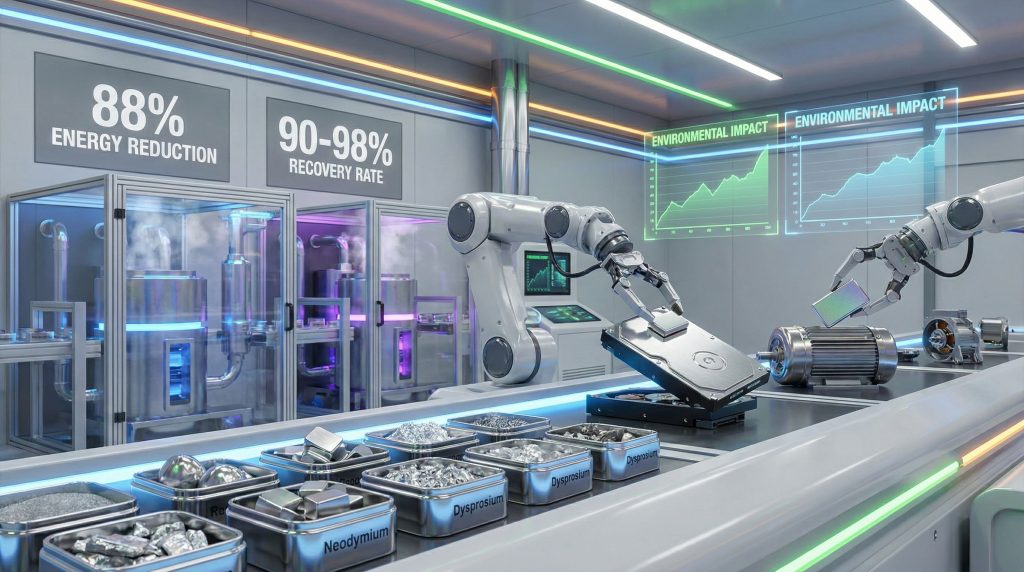
• 90-98% recovery efficiency for valuable rare earth elements
• 90% carbon dioxide reduction compared to primary material production
• Elimination of acid waste streams
• Direct processing without complete product disassembly
HPMS technology delivers transformational benefits for rare earth supply chains by combining cost advantages with minimal carbon footprint compared to conventional recovery methods.
Acid-Free Copper Salt Leaching Systems
Alternative leaching technologies employ copper salt solutions to dissolve rare earth magnet materials without generating the corrosive waste streams associated with mineral acids. These systems utilise copper sulphate or copper chloride solutions operating at controlled pH levels to selectively extract rare earth elements whilst minimising environmental impact.
Copper salt leaching offers several operational advantages including reduced equipment corrosion requirements, simplified waste treatment protocols, and potential for copper recovery as a valuable byproduct. The process generates less hazardous waste whilst maintaining recovery efficiency comparable to acid-based methods.
Process Benefits:
• Lower equipment corrosion rates
• Reduced hazardous waste classification
• Copper recovery as process byproduct
• Simplified neutralisation requirements
Direct Recycling and Remagnetisation Approaches
Direct recycling methods focus on restoring magnetic properties to recovered magnet materials without complete chemical dissolution. These approaches employ controlled heating cycles, hydrogen treatment, or magnetic field exposure to realign magnetic domains in processed scrap materials.
Remagnetisation processes can restore 80-95% of original magnetic performance in properly processed materials, enabling direct reuse in applications with compatible performance requirements. This approach minimises chemical processing whilst maintaining material functionality for specific end-use applications. This technology complements European CRM facility developments across the continent.
Which Industries Generate the Most Recyclable Rare Earth Magnets?
Hard Disk Drive Recovery: The Low-Hanging Fruit
Hard disk drives represent the most accessible source of recoverable rare earth magnets due to standardised designs and concentrated magnet placement in actuator assemblies. Each drive contains 1–3 grams of high-grade neodymium-iron-boron magnets in easily identifiable locations.
With approximately 400 million drives reaching end-of-life annually, hard disk recycling offers immediate access to 400–1,200 metric tons of rare earth magnet material. The standardised actuator design enables automated disassembly protocols, making hard drives an ideal feedstock for recycling operations.
Recovery Advantages:
• Predictable magnet location and composition
• Standardised disassembly procedures
• High magnet concentration per unit weight
• Established collection infrastructure through e-waste streams
Electric Vehicle Motor Recycling Potential
Electric vehicle motors contain substantially more rare earth magnet material than consumer electronics, with 0.5–1.5 kg of permanent magnets per vehicle. As EV adoption accelerates, with over 14 million vehicles sold globally in 2024, the accumulated magnet inventory represents significant long-term recovery potential.
However, EV motor recycling presents greater technical challenges due to magnet integration within complex motor assemblies and thermal management systems. Motors require specialised disassembly protocols to access embedded magnets without contamination from other materials.
Projected Recovery Volumes:
| Year | Global EV Sales (Million) | Magnet Content (Metric Tons) | Cumulative Inventory |
|---|---|---|---|
| 2024 | 14.0 | 14,000-21,000 | 35,000-52,500 |
| 2030 | 25.0 (projected) | 25,000-37,500 | 140,000-210,000 |
| 2040 | 40.0 (projected) | 40,000-60,000 | 450,000-675,000 |
Wind Turbine End-of-Life Magnet Recovery
Wind turbine generators represent the largest concentration of rare earth magnets in individual units, with modern direct-drive turbines containing 200–600 kg of permanent magnets per MW of capacity. As first-generation wind farms approach end-of-life, turbine recycling will provide access to substantial magnet inventories.
However, wind turbine recycling faces logistical challenges due to remote installation sites and specialised handling requirements for large generator assemblies. The concentrated nature of magnet deposits in wind turbines makes selective recovery economically attractive despite handling complexity.
Wind Turbine Recycling Timeline:
• 2025-2030: Early wind farms reach 20-year service life
• 2030-2035: Accelerating turbine retirement rates
• 2035-2040: Peak turbine recycling volumes
How Do Automated Recovery Systems Improve Efficiency?
Robotic Identification and Extraction Technologies
Advanced recycling facilities integrate robotic systems with machine vision capabilities to identify and extract rare earth magnets from complex waste streams. These systems employ artificial intelligence algorithms trained to recognise magnet-bearing components across diverse product categories.
Robotic extraction eliminates manual handling risks whilst improving recovery consistency and processing throughput. Automated systems can process thousands of units per hour compared to manual disassembly rates measured in tens of units, dramatically improving operational efficiency.
Automation Benefits:
• 10-50x throughput improvement over manual processing
• Consistent identification accuracy across product variations
• Reduced worker exposure to hazardous materials
• 24/7 operational capability
Magnetic Field Sensor Integration
Sophisticated magnetic field sensors enable precise identification of rare earth permanent magnets within complex assemblies before physical disassembly. These sensors distinguish between different magnet types and accurately locate magnet positions within electronic products.
Magnetic field mapping allows optimisation of disassembly procedures by identifying optimal access points and magnet removal sequences. This technology reduces processing time whilst maximising recovery rates through targeted extraction protocols. Furthermore, these advances support broader mining decarbonisation trends across the industry.
Pre-Shredding Separation Protocols
Advanced separation systems employ multiple detection technologies before mechanical shredding to identify and remove magnet-bearing components. This approach prevents magnet contamination with other materials whilst preserving magnet integrity for subsequent processing.
Pre-separation protocols utilise:
• X-ray fluorescence (XRF) scanning for elemental identification
• Eddy current separation for conductive material sorting
• Optical recognition systems for component classification
• Magnetic field gradient detection for magnet location
The next major ASX story will hit our subscribers first
What Are the Economic Drivers Behind Recycling Investment?
Supply Chain Vulnerability and Import Dependence
Rare earth magnet recycling addresses critical supply chain vulnerabilities for nations dependent on imported materials. With China controlling approximately 70% of global rare earth processing capacity, supply disruptions pose significant risks to industries requiring reliable magnet supply.
Import dependence creates price volatility and availability uncertainty for manufacturers across multiple sectors. Domestic recycling capacity provides supply chain resilience whilst reducing exposure to international trade restrictions or market manipulation.
Economic Risk Factors:
• Price volatility from supply concentration
• Trade policy impacts on material availability
• Currency fluctuation effects on import costs
• Long-term supply security concerns
Cost Comparison: Recycled vs. Primary Material Production
Recycled rare earth magnet production demonstrates substantial cost advantages compared to primary material extraction and processing. HPMS technology achieves 90% carbon dioxide reduction whilst maintaining competitive production costs through reduced energy consumption and simplified processing requirements.
Cost Advantage Analysis:
| Cost Component | Primary Production | Recycled Material | Savings |
|---|---|---|---|
| Energy Consumption | 100% baseline | 12% of baseline | 88% reduction |
| Raw Material Costs | Mining + Transport | Collection + Processing | 40-60% reduction |
| Environmental Compliance | High | Moderate | 30-50% reduction |
| Capital Equipment | Complex processing | Simplified systems | 20-40% reduction |
Advanced recycling methods can reduce energy consumption by up to 88% compared to primary rare earth mining and processing operations whilst achieving 90-98% material recovery rates.
Carbon Footprint Reduction Benefits
Rare earth magnet recycling provides substantial environmental benefits through carbon emission reductions compared to primary production pathways. HPMS technology delivers 90% carbon dioxide savings compared to producing magnets from newly mined material, addressing corporate sustainability goals and regulatory requirements.
Carbon footprint reduction benefits include:
• Elimination of mining-related emissions
• Reduced transportation requirements
• Lower energy consumption in processing
• Avoided waste disposal emissions
Which Countries Are Leading Recycling Infrastructure Development?
European Union Circular Economy Initiatives
The European Union has implemented comprehensive circular economy policies promoting rare earth magnet recycling through regulatory frameworks and financial incentives. The EU Waste Framework Directive establishes recycling targets whilst providing funding for recycling technology development.
European initiatives focus on domestic supply chain development to reduce import dependence whilst meeting climate commitments. The European Commission's Critical Raw Materials Act designates rare earth magnets as strategic materials requiring domestic recycling capacity development.
EU Policy Framework:
• Mandatory recycling targets for electronic waste
• Extended producer responsibility requirements
• Research funding for recycling technology development
• Trade policies supporting domestic capacity building
United States Critical Materials Strategy Implementation
The United States has designated rare earth elements as critical materials requiring supply chain security measures. The Department of Defense and Department of Energy provide funding for domestic recycling technology development through various grant programmes and strategic initiatives.
American investment focuses on reducing import dependence whilst supporting domestic manufacturing capability for defence and energy applications. Federal programmes prioritise technologies enabling cost-competitive domestic production of recycled rare earth materials.
Asian Market Recycling Capacity Expansion
Asian markets are developing substantial recycling capacity to capture value from regional electronic waste streams whilst reducing raw material costs. Japan and South Korea have implemented advanced recycling technologies for domestic rare earth recovery from consumer electronics and automotive applications.
These markets benefit from proximity to major electronics manufacturing centres, providing access to substantial magnet-bearing waste streams. Regional cooperation initiatives facilitate technology sharing and feedstock exchange between countries with complementary capabilities.
How Can Manufacturers Integrate Recycled Materials?
Quality Standards for Recycled Rare Earth Elements
Recycled rare earth magnet materials must meet stringent quality specifications to ensure performance equivalency with primary materials. Advanced processing technologies achieve 90-98% recovery of valuable elements whilst maintaining magnetic properties suitable for demanding applications.
Quality control protocols include:
• Chemical composition verification through elemental analysis
• Magnetic property testing for performance validation
• Microstructural analysis for material integrity assessment
• Contamination screening for impurity control
Recycled materials meeting primary material specifications enable direct substitution in existing manufacturing processes without product redesign or performance compromisation.
Supply Chain Integration Challenges and Solutions
Manufacturers face integration challenges when incorporating recycled materials due to supply consistency requirements and quality verification protocols. Recycled material supply chains require different logistics and quality assurance procedures compared to primary material sourcing.
Integration Solutions:
• Long-term supply contracts with recycling facilities
• Blended feedstock combining recycled and primary materials
• Inventory buffer strategies for supply continuity
• Quality certification programmes for recycled materials
Design for Disassembly Principles
Product design optimisation can significantly improve rare earth magnet recovery rates by facilitating selective disassembly of magnet-bearing components. Design for disassembly principles include accessible magnet locations, standardised fastener systems, and material identification marking.
Design Optimisation Strategies:
• Modular designs enabling component separation
• Magnetic shielding to prevent interference during disassembly
• Material marking systems for automated identification
• Standardised fastener types for robotic handling
What Are the Technical Barriers to Scale-Up?
Feedstock Collection and Sorting Infrastructure
Large-scale rare earth magnet recycling requires sophisticated collection and sorting infrastructure to aggregate sufficient feedstock volumes from diverse waste streams. Current e-waste collection systems lack the specialisation necessary for selective magnet-bearing product identification and segregation.
Infrastructure development challenges include:
• Regional collection network establishment
• Specialised handling equipment requirements
• Product identification and sorting protocols
• Transportation logistics for concentrated materials
Successful scaling requires integration with existing waste management systems whilst adding specialised capabilities for magnet-bearing product handling and preprocessing.
Processing Equipment Capital Requirements
Commercial-scale recycling facilities require substantial capital investment in specialised processing equipment capable of handling diverse feedstock streams whilst maintaining high recovery rates. The Tyseley Energy Park facility represents a £4.5 million investment supported by government funding programmes.
Capital Investment Categories:
| Equipment Type | Investment Range | Critical Requirements |
|---|---|---|
| Processing Systems | £2-5 million | Automated handling capability |
| Quality Control | £0.5-1 million | Analytical instrumentation |
| Environmental Systems | £1-2 million | Emission control equipment |
| Safety Infrastructure | £0.5-1 million | Hazard mitigation systems |
Regulatory Compliance and Certification Standards
Rare earth magnet recycling facilities must navigate complex regulatory frameworks addressing environmental protection, occupational health, and product quality standards. Compliance requirements vary significantly between jurisdictions, complicating international technology transfer and facility development.
Regulatory Considerations:
• Environmental permits for chemical processing operations
• Occupational health standards for worker protection
• Product certification requirements for recycled materials
• International trade regulations for critical materials
Standardised regulatory frameworks would facilitate technology deployment whilst ensuring appropriate environmental and safety protections across different markets.
Future Outlook: Market Projections and Technology Development
Projected Growth in Recycling Capacity Through 2030
Global rare earth magnet recycling capacity is projected to expand dramatically through 2030 as governments implement critical materials strategies and private investment responds to supply chain security concerns. Current capacity of less than 10,000 metric tons annually could expand to over 100,000 metric tons by 2030.
Capacity Expansion Projections:
| Region | Current Capacity (2026) | 2030 Projection | Growth Rate |
|---|---|---|---|
| Europe | 2,000 MT | 25,000 MT | 1,150% |
| North America | 1,500 MT | 20,000 MT | 1,233% |
| Asia-Pacific | 5,000 MT | 60,000 MT | 1,100% |
| Global Total | 8,500 MT | 105,000 MT | 1,135% |
Emerging Technologies in Development
Research and development efforts focus on improving recovery rates whilst reducing processing costs through technological innovation. Emerging technologies include advanced separation methods, automated disassembly systems, and direct remanufacturing approaches.
Technology Development Areas:
• Artificial intelligence for product identification and sorting
• Advanced materials processing for improved recovery rates
• Direct remanufacturing of magnet components
• Integrated processing systems combining multiple recovery methods
For instance, HyproMag's innovative recycling approach demonstrates cutting-edge applications of sustainable recycling technologies. Similarly, McKinsey's analysis of circular rare earth elements provides comprehensive insights into industry transformation.
Policy Support and Investment Trends
Government policies increasingly prioritise domestic recycling capacity development through funding programmes, regulatory incentives, and strategic material designations. The UK's £4.5 million investment in the Tyseley Energy Park facility demonstrates public sector commitment to recycling infrastructure development.
Investment trends indicate substantial private sector interest in recycling technologies as supply chain security concerns drive demand for domestic material sources. Venture capital and strategic investment in recycling technology companies has increased significantly since 2020.
Investment Indicators:
• Government funding programmes expanding globally
• Corporate strategic investments in recycling technology
• Venture capital interest in speciality materials recycling
• International cooperation agreements for technology sharing
The convergence of supply chain security concerns, environmental sustainability requirements, and technological capability advancement positions rare earth magnet recycling for substantial growth through 2030 and beyond. Advanced processing technologies like HPMS demonstrate commercial viability whilst providing environmental benefits necessary to support sustainable manufacturing practices across critical technology sectors.
Disclaimer: This article contains forward-looking projections and market analysis based on current trends and available data. Actual market developments may differ from projections due to technological, economic, regulatory, or geopolitical factors. Investment and business decisions should be made based on comprehensive due diligence and professional consultation.
Looking to Capitalise on Critical Materials Recovery Innovations?
Discovery Alert delivers instant alerts on significant ASX mineral discoveries, including rare earth and critical materials developments, using its proprietary Discovery IQ model to identify actionable investment opportunities before they reach mainstream attention. With rare earth recycling technologies attracting substantial investment and companies developing breakthrough processing capabilities, begin your 30-day free trial today to position yourself ahead of this rapidly evolving sector.