July 8, 2026
The Industrial Gap That Defines a Generation of Supply Chain Risk
Across the past three decades, Western industrial economies made a quiet but consequential trade: they outsourced the most technically demanding stages of rare earth processing to China in exchange for cheaper inputs and leaner supply chains. That decision, repeated across administrations and boardrooms alike, produced a structural dependency that now sits at the heart of some of the most urgent national security debates in modern history. Permanent magnets, specifically neodymium-iron-boron (NdFeB) variants, are the physical embodiment of that dependency. They are not commodity components.
They are precision-engineered materials embedded inside electric vehicle drivetrains, fighter jet actuators, robotics joints, wind turbine generators, and AI data centre cooling systems. Without them, entire technology categories stall.
The REalloys JS Link rare earth magnet manufacturing platform, announced via a non-binding letter of intent on July 7, 2026, is one of the more ambitious attempts yet to close that gap from the inside out, building integration vertically rather than patching isolated midstream bottlenecks.
When big ASX news breaks, our subscribers know first
Why Non-Chinese Rare Earth Magnet Supply Chains Barely Exist
The Mine-to-Magnet Gap in Western Industrial Architecture
Producing a finished NdFeB permanent magnet requires at least four distinct industrial stages: mining and concentrating rare earth ore, separating individual rare earth oxides, converting those oxides into metals and alloys, and finally sintering those alloys into shaped magnets. China controls the majority of global capacity at every one of those stages simultaneously.
According to the International Energy Agency, China accounts for roughly 60% of rare earth mining output and over 85% of global rare earth processing capacity, with its dominance in magnet manufacturing estimated to exceed 90% of global sintered NdFeB production. The rare earth supply chain dependency that Western nations have accumulated over decades is now deeply structural.
Western nations have invested heavily in mining and early-stage processing over the past decade, but the midstream and downstream stages, specifically metal production and magnet manufacturing, remain almost entirely absent outside Asia. This is the mine-to-magnet gap: the industrial no-man's land where raw feedstock fails to connect with finished strategic components.
How China Built Structural Control Over Every Link
China's dominance was not accidental. Beginning in the 1980s, state-directed industrial policy systematically cultivated each stage of the rare earth value chain, subsidising processing capacity, enabling vertical integration, and developing domestic magnet manufacturers at scale. By the time Western governments recognised the strategic implications, Chinese producers had achieved cost structures and technical experience that would take decades to replicate.
The economic cost of this dependency is measurable. The strategic cost is harder to quantify but arguably more severe. Furthermore, China's rare earth restrictions on heavy rare earths such as dysprosium and terbium — essential for heat-resistant high-performance magnets used in defence systems and EV traction motors — are sourced almost entirely from Chinese-controlled supply. Any disruption, whether through export restrictions, quota changes, or geopolitical escalation, would cascade rapidly through Western defence procurement and advanced manufacturing.
What Makes NdFeB Magnets So Strategically Irreplaceable
The Physics Behind the Performance
NdFeB magnets hold the highest energy density of any known permanent magnet material. Their magnetic field strength per unit volume makes them physically irreplaceable in applications demanding compact, lightweight, and powerful magnetic sources. Substitutes exist in theory but not in commercial practice at the performance thresholds required by modern defence and transportation systems.
The rare earth elements involved are not interchangeable. Each performs a distinct metallurgical function within the final magnet:
| Rare Earth Element | Function in NdFeB | Key Application Demand |
|---|---|---|
| Neodymium (Nd) | Core magnetic phase material | EVs, wind turbines, robotics |
| Praseodymium (Pr) | Blended with Nd to increase strength | Defence motors, industrial drives |
| Dysprosium (Dy) | Enhances coercivity at elevated temperatures | EV traction motors, aerospace |
| Terbium (Tb) | Maintains coercivity under extreme heat | Advanced defence, AI hardware cooling |
Light vs. Heavy Rare Earths: A Distinction With Serious Implications
The rare earth supply chain is frequently discussed as a single category, but the distinction between light rare earths (LREEs) such as neodymium and praseodymium, and heavy rare earths (HREEs) such as dysprosium and terbium, is critical. HREEs are rarer, geologically more constrained, and significantly harder to refine. They are also disproportionately important for the most demanding magnet applications.
A magnet designed for ambient-temperature robotics may contain minimal or no HREE addition. A magnet destined for a fighter jet actuator or high-temperature EV motor requires dysprosium or terbium grain-boundary diffusion to maintain coercivity at operating temperatures that would otherwise cause demagnetisation. This technical requirement makes HREE supply one of the most sensitive chokepoints in the entire advanced manufacturing supply chain.
Critical Insight: Many analysts focus on neodymium supply when discussing rare earth risk. The more acute vulnerability sits with dysprosium and terbium, where Chinese processing dominance is near-total and Western alternatives remain embryonic.
How REalloys Constructed Its North American Platform Before the Magnet Deal
Upstream Feedstock and the Hoidas Lake Anchor
REalloys' platform architecture begins at the source. The Hoidas Lake rare earth project in Saskatchewan provides a domestic Canadian feedstock anchor, complemented by a growing portfolio of global feedstock agreements that reduce single-source dependency. This upstream position is strategically important because it insulates downstream processing from the price and availability volatility that affects buyers who source feedstock entirely from third parties.
The Saskatchewan Research Council Alliance and HREE Refining
REalloys secured rights to 80% of output from a heavy rare earth processing facility developed through its partnership with the Saskatchewan Research Council, with operations targeted for early 2027. This partnership provides access to rare earth refining and metalmaking capacity, including high-purity neodymium-praseodymium metal production, at a scale relevant to commercial magnet manufacturing inputs.
PMT Critical Metals and Commercial-Scale Metallization
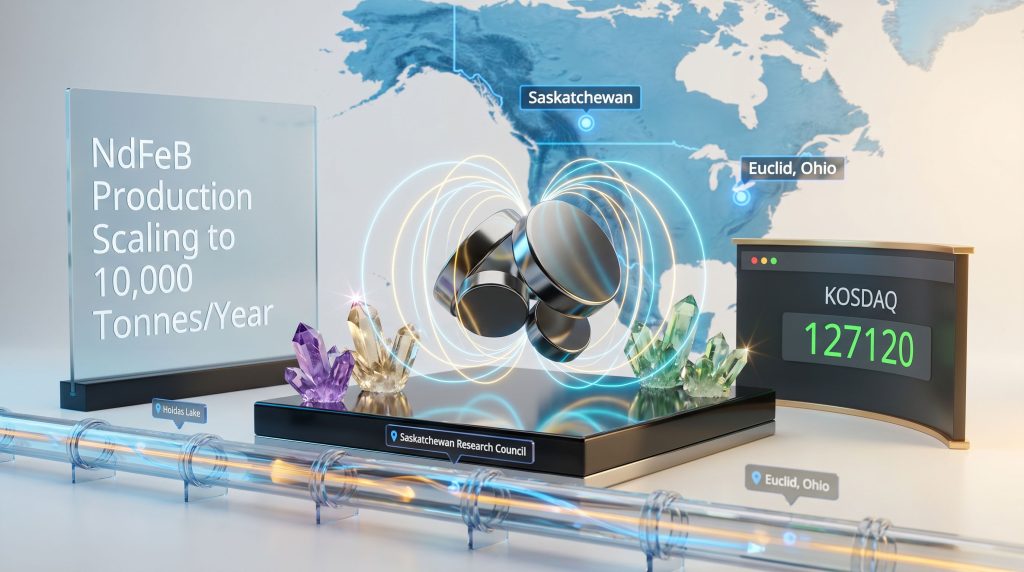
Through the acquisition of PMT Critical Metals, REalloys developed commercial-scale heavy rare earth metallization capabilities in Euclid, Ohio. The Euclid facility represents the midstream bridge between refined oxides and the metal alloys that magnet manufacturers actually require as inputs. Current production capacity is targeted to scale from an initial 3,000 tonnes per year toward 10,000 tonnes per year, a trajectory that, if achieved, would represent significant non-Chinese metallization capacity.
The HF-Free Metallization Process: A Technical Edge Worth Understanding
One of the less widely discussed differentiators in REalloys' platform is its proprietary metallization process that eliminates the use of hydrofluoric acid (HF). Traditional rare earth metallization relies on HF at certain process stages, creating substantial regulatory, environmental, and workplace safety challenges. HF is one of the most hazardous industrial chemicals in common use, and its presence in a processing flow significantly complicates facility permitting, insurance, community acceptance, and operational risk management.
An HF-free process does not merely reduce costs. It fundamentally changes the regulatory landscape for where and how a metallization facility can be built and operated, particularly within U.S. industrial zones subject to EPA and OSHA oversight. This technical attribute could prove decisive when competing for long-term supply contracts with defence primes and automotive OEMs that apply rigorous supply chain auditing standards.
Breaking Down the REalloys JS Link LOI: What the Agreement Actually Contains
What Each Party Contributes to the Integrated Model
The letter of intent signed July 7, 2026, is explicitly non-binding but articulates a shared intent to evaluate full vertical integration from feedstock through to finished permanent magnets. The complementary nature of the two companies' capabilities is the structural logic behind the partnership:
| Capability Dimension | REalloys | JS Link |
|---|---|---|
| Feedstock Supply | Hoidas Lake + global feedstock agreements | None specified |
| Separation and Refining | Saskatchewan Research Council partnership | None specified |
| Metallization | Euclid, Ohio facility (3,000-10,000 tpa target) | None specified |
| Magnet Manufacturing | None specified | Commercial operations in Korea, planned expansion |
| Defense Relationships | U.S. Army Strategic Capital Initiatives program | None specified |
| Capital Markets | $100M private placement completed | KOSDAQ-listed (127120) |
| Geographic Expansion | North American platform | Malaysia and U.S. expansion planned |
The Non-Binding Status: What It Means for Investors
Letters of intent in complex industrial partnerships carry a well-documented conversion risk. The gap between LOI and definitive agreement is where most partnerships in the mining and materials sector encounter delays or collapse entirely. Factors that typically determine conversion success include alignment on valuation, resolution of regulatory and permitting pathways, confirmation of government financing availability, and the technical integration work required to validate process compatibility between both parties' operations.
Investor Note: The LOI stage represents an expression of intent, not a commitment of capital or a guarantee of operational outcomes. Investors should monitor progress toward definitive agreements, project financing confirmations, and regulatory clearances as the key milestones that will determine whether this platform moves from concept to commercial reality.
JS Link: Who Is REalloys Partnering With?
A KOSDAQ-Listed Manufacturer With Global Expansion Ambitions
JS Link (KOSDAQ: 127120) is a South Korean permanent magnet manufacturer with established commercial operations in Korea and active expansion planning into Malaysia and the United States. The company's target end markets span automotive, industrial motors, electronics, energy, aerospace, and defence sectors, directly overlapping with the defence and aerospace relationships REalloys has developed through its U.S. Army engagement.
The decision by a Korean manufacturer to pursue North American production capacity reflects broader industry trends. Multiple Asian magnet producers have identified North American and European localisation as both a commercial necessity and a strategic hedge, as Western OEMs increasingly require supply chain traceability and non-Chinese origin certification for sensitive applications.
JS Link's stated strategic intent is to build globally competitive permanent magnet manufacturing outside China. REalloys' upstream and midstream platform in North America provides precisely the feedstock and processing infrastructure that a downstream magnet manufacturer requires to credibly claim non-Chinese origin status across the full value chain.
The next major ASX story will hit our subscribers first
The U.S. Defence Dimension: Why Government Relationships Matter
Army Strategic Capital Initiatives and Tooele Army Depot
REalloys' engagement with the U.S. Army under the Strategic Capital Initiatives program established a framework to evaluate development and operation of a rare earth processing facility at Tooele Army Depot in Utah. This relationship is significant not because it guarantees funding or contract awards, but because it positions REalloys inside a defence procurement and qualification ecosystem that civilian suppliers rarely access.
Defence qualification for rare earth materials is a lengthy, technically demanding process. Beginning that qualification early, in parallel with platform development rather than after commercial operations commence, provides a time advantage that could prove decisive in capturing long-term defence supply contracts.
Is the 2027 Timeline Realistic for Domestic HREE Supply?
U.S. defence planning documents have identified the establishment of domestic heavy rare earth supply as a near-term priority. Indeed, the critical minerals demand surge has made REalloys' Saskatchewan Research Council facility targeting early 2027 operations directly intersect with this procurement urgency. Whether that alignment translates into formal procurement support remains to be confirmed, but the operational timeline is not coincidental.
Competitive Landscape: How This Platform Compares
Other Western Mine-to-Magnet Efforts Underway
The REalloys JS Link rare earth magnet manufacturing platform is not operating in isolation. Several other significant initiatives are advancing simultaneously:
| Initiative | Current Stage | Key Differentiator |
|---|---|---|
| REalloys + JS Link | LOI / Platform Assembly | Full vertical integration from feedstock to finished magnet |
| USA Rare Earth ($1.6B federal funding) | Processing and magnet scale-up | Significant federal capital deployment |
| Energy Fuels + VAC ($1.9B acquisition) | Midstream plus European magnet alloy | Uranium-to-REE diversification model |
| ReElement + POSCO JV | U.S. magnet joint venture | Korean steel giant's North American expansion push |
What distinguishes the REalloys and JS Link model conceptually is the intent to connect every stage from raw feedstock through to finished magnets within a single integrated structure. Partial integration approaches, which link two or three stages but not all four, remain dependent on external parties for the missing links, reintroducing the concentration risk they are designed to eliminate. In addition, America's rare earth supply chain efforts highlight just how rare truly integrated Western platforms remain.
Toward a Publicly Traded North American Magnet Platform
The Capital Markets Vision Beyond the LOI
Both parties have indicated intent to evaluate U.S. government financing programs, strategic industrial partnerships, and future public capital markets initiatives as part of the collaboration framework. The language used in the announcement suggests the proposed platform is being architected with a public listing or spin-out structure in mind, rather than purely as a private industrial operation.
A publicly traded, vertically integrated North American magnet company would be structurally novel. There is currently no listed Western company that credibly spans feedstock, separation, metallization, and magnet manufacturing within a single corporate structure. If the REalloys JS Link platform achieves that integration and reaches public markets, it would represent a genuinely new investable asset class within the critical minerals sector. The broader critical minerals coalition forming across government and industry further reinforces the policy tailwinds supporting this type of venture.
The $100 million private placement REalloys completed strengthens the balance sheet available to pursue this vision, though the capital requirements of full vertical integration at commercial scale will substantially exceed that figure.
Frequently Asked Questions: REalloys JS Link Rare Earth Magnet Platform
What is the REalloys and JS Link partnership?
It is a non-binding letter of intent, signed July 7, 2026, under which REalloys Inc. and JS Link Inc. agreed to evaluate the development of a fully integrated North American rare earth magnet manufacturing platform spanning feedstock supply, separation, metallization, and permanent magnet production.
What rare earth materials are used in NdFeB permanent magnets?
The core materials are neodymium and praseodymium (light rare earths). Dysprosium and terbium (heavy rare earths) are added in smaller quantities for applications requiring heat-resistant, high-coercivity performance, such as EV traction motors and defence systems.
Is the REalloys JS Link agreement legally binding?
No. The letter of intent is explicitly non-binding. Both parties must negotiate and execute definitive agreements before any formal obligations are created.
What is the planned production capacity for the integrated platform?
REalloys' Euclid, Ohio metallization facility is targeting a scaling pathway from approximately 3,000 tonnes per year toward 10,000 tonnes per year of NdFeB-relevant rare earth metal production, subject to investment, regulatory approvals, and demand confirmation.
How does the REalloys platform differ from other North American rare earth projects?
Its distinguishing characteristic is the intent to integrate every stage of the value chain, from domestic feedstock through to finished magnets, within a single platform. Most competing initiatives address two or three stages but leave critical gaps that maintain dependency on external, often non-Western, suppliers.
What role does the U.S. military play in REalloys' development strategy?
REalloys is engaged with the U.S. Army under the Strategic Capital Initiatives program at Tooele Army Depot in Utah, providing a framework to evaluate rare earth processing facility development and beginning qualification of heavy rare earth materials for defence-grade applications.
When could the integrated magnet manufacturing platform become operational?
The Saskatchewan Research Council partnership targets early 2027 operations. The broader integrated platform timeline depends on the conversion of the current LOI into definitive agreements and the subsequent capital deployment and construction cycle.
What markets will the REalloys JS Link platform serve?
The stated target markets include defence, aerospace, automotive, robotics, artificial intelligence infrastructure, energy, and other advanced manufacturing sectors where non-Chinese permanent magnet supply is increasingly required.
Key Takeaways: What This Platform Signals for Western Rare Earth Strategy
The REalloys JS Link rare earth magnet manufacturing platform represents more than a bilateral corporate agreement. It reflects a broader strategic recognition that closing the mine-to-magnet gap requires deliberate, stage-by-stage assembly of capabilities that the market alone has failed to create.
Three developments make this moment structurally different from earlier attempts at Western rare earth self-sufficiency:
-
Defence urgency has become explicit. U.S. military procurement timelines and qualification programs are now actively pulling rare earth supply chain development rather than passively waiting for commercial markets to deliver solutions.
-
Capital is moving at scale. The combination of private placements, federal financing programs, and strategic industrial investment represents a materially different funding environment than existed five years ago.
-
Downstream integration is finally being attempted. The critical missing link in Western rare earth strategy has always been magnet manufacturing. Agreements like the REalloys and JS Link LOI represent the first serious attempts to address that gap through genuine vertical integration rather than import substitution at isolated stages.
Whether the LOI converts to a definitive agreement, and whether the platform reaches commercial scale within its stated timelines, remains to be demonstrated. What is already clear is that the structural imperative driving this initiative is not going away. The dependency is real, the cost is rising, and the window for building credible alternatives is narrowing.
Further Exploration: Readers interested in the broader context of North American rare earth supply chain development can explore related industry coverage at Metal Tech News, which tracks critical mineral policy, rare earth processing, and advanced manufacturing developments across North America and globally.
Want to Stay Ahead of the Next Major Rare Earth Discovery on the ASX?
Discovery Alert's proprietary Discovery IQ model delivers real-time alerts the moment significant mineral discoveries — including rare earths and critical minerals — are announced on the ASX, turning complex data into actionable investment insights. Explore historic discoveries and their exceptional market returns, then begin your 14-day free trial to position yourself ahead of the broader market.