August 11, 2026
The Complex Landscape of Manufacturing Efficiency in Rare Earth Permanent Magnets
The rare earth permanent magnets supply chain represents one of modern industry's most complex technical challenges. The transformation of mineral concentrates into precision-engineered magnetic components requires sophisticated processing infrastructure, stringent quality controls, and specialised metallurgical expertise that few nations have successfully developed outside of China's integrated ecosystem.
What Makes Rare Earth Permanent Magnets Essential to Modern Industry?
The Foundation of High-Performance Applications
Advanced permanent magnet technology enables the miniaturisation and efficiency gains that define contemporary electronics, transportation, and energy systems. Neodymium-iron-boron (NdFeB) magnets deliver magnetic flux densities exceeding 1.2 Tesla, compared to ferrite alternatives achieving only 0.38-0.42 Tesla. This performance differential translates directly into torque density advantages of 85-90% for electric motor applications, enabling automotive manufacturers to reduce motor weight while increasing power output.
The magnetic energy product (BHmax) of rare earth permanent magnets reaches 40-52 megaGauss-Oersteds (MGOe), versus 3.5-4.0 MGOe for ferrite magnets. This specification determines the volume of magnetic material required for specific applications. A Tesla Model 3 electric motor achieves 95% efficiency using approximately 1.2 kg of NdFeB magnets, while equivalent performance using ferrite technology would require 8-12 kg of magnetic material plus redesigned motor architecture.
Wind energy applications demonstrate the irreplaceable nature of rare earth permanent magnets in direct-drive generator systems. Siemens 15 MW offshore wind turbines integrate 850 kg of permanent magnet material, eliminating gearbox complexity and reducing maintenance requirements in harsh marine environments. The magnetic stability and coercivity of rare earth magnets enable generator operation across temperature ranges from -40°C to +60°C without demagnetisation.
Economic Impact Across Sectors
Global permanent magnet market valuation reached USD 15.3 billion in 2023, with projections indicating growth to USD 28.5 billion by 2032 representing a 7.2% compound annual growth rate. NdFeB permanent magnets specifically account for approximately 70% of global permanent magnet volume and over 80% of market value, reflecting the premium pricing structure for performance-critical applications.
Electric vehicle adoption drives the most significant demand growth vector. Each battery electric vehicle requires 1-1.5 kg of permanent magnet material for traction motor applications, with hybrid vehicles consuming 0.3-0.8 kg depending on motor configuration. Global EV production of 10.5 million units in 2022 consumed approximately 8,000-12,000 metric tons of magnet-grade rare earth elements.
Industrial automation and robotics represent emerging consumption categories with 15-20% annual growth rates. Furthermore, precision servo motors, actuators, and sensors require miniaturised permanent magnets with exceptional temperature stability and dimensional precision. Medical imaging systems utilising magnetic resonance technology demand permanent magnets capable of generating 1.5-3.0 Tesla magnetic fields with long-term stability specifications.
Manufacturing cost economics reveal that permanent magnets represent 15-25% of total electric motor production costs but enable 30-40% improvements in power-to-weight ratios compared to electromagnet alternatives.
When big ASX news breaks, our subscribers know first
Which Raw Materials Drive Permanent Magnet Production?
Primary Rare Earth Elements
The rare earth permanent magnets supply chain depends on a narrow subset of the 17 rare earth elements, with neodymium and praseodymium forming the magnetic foundation of NdFeB alloys. Neodymium constitutes 28-32% of magnet composition by weight, while praseodymium additions of 1-3% provide grain boundary enhancement and thermal stability improvements.
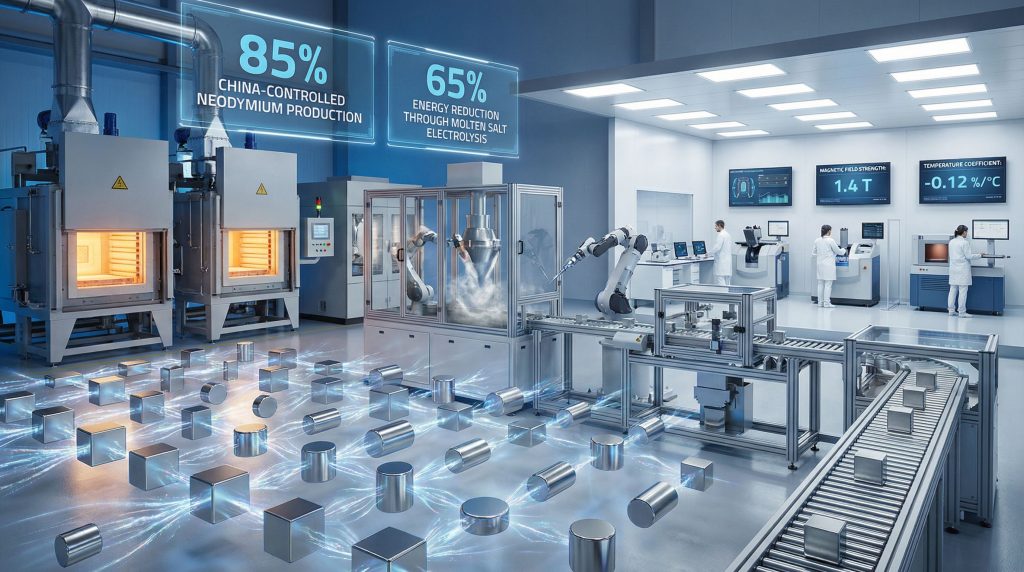
China produced 70,000 metric tons of neodymium oxide equivalent in 2023, representing 85% of global production capacity. Myanmar serves as the primary secondary source, contributing 8,000-9,000 metric tons annually through concentrated mining operations in Kachin State. This geographic concentration creates supply vulnerability for industries dependent on uninterrupted magnet feedstock availability.
Dysprosium and terbium represent the most strategically critical elements for high-performance magnet applications. These heavy rare earth elements enable magnet operation at elevated temperatures exceeding 150°C, essential for automotive under-hood environments and aerospace applications. Global dysprosium production reaches only 700-800 metric tons annually, with China controlling 95% of separation and purification capacity.
Mining and Concentration Patterns
In addition, rare earth reserves analysis reveals that extraction occurs through three primary deposit types, each presenting distinct processing challenges and environmental considerations. Bastnasite ores, dominant in California's Mountain Pass and China's Bayan Obo deposits, contain 8-10% rare earth oxides with light rare earth enrichment favouring neodymium and praseodymium production.
Ion-absorption clays in southern China provide the primary source of heavy rare earth elements including dysprosium and terbium. These deposits require minimal crushing and grinding but involve extensive acid leaching processes to extract rare earth ions from clay mineral structures. Consequently, environmental regulations have constrained production from these sources, contributing to heavy rare earth price volatility.
Monazite beach sands in Australia, India, and Brazil contain 50-65% rare earth oxides but also include thorium, requiring specialised handling procedures and nuclear material licensing. Processing complexity and regulatory requirements have limited development of monazite-based rare earth production despite substantial reserves.
Supply Concentration Analysis
| Element | Primary Sources | Global Production Share | Strategic Risk Level |
|---|---|---|---|
| Neodymium | China, Myanmar | 85% China-controlled | High |
| Dysprosium | China, Myanmar | 95% China-controlled | Critical |
| Praseodymium | China, Australia | 80% China-controlled | High |
| Terbium | China | 95% China-controlled | Critical |
| Samarium | China, India | 70% China-controlled | Moderate |
The strategic vulnerability extends beyond mining to separation and purification infrastructure. China operates 85% of global rare earth separation capacity, processing not only domestic ore but also concentrates from Myanmar, Australia, and the United States. This processing monopoly creates dependencies that persist even when alternative mining sources are developed.
How Do Separation and Refining Processes Create Value?
Chemical Separation Technologies
Rare earth separation represents the most technically complex and capital-intensive stage in the supply chain, transforming mixed rare earth concentrates into individual elements with 99.5-99.9% purity specifications. Solvent extraction processes utilise specialised organic compounds including 2-ethylhexylphosphonic acid mono-2-ethylhexyl ester (HEH/EHP) to selectively extract rare earth cations from aqueous solutions.
The separation cascade requires 8-15 extraction stages for complete neodymium-praseodymium fractionation, with each stage involving precise pH control, temperature management, and organic-to-aqueous phase ratio optimisation. Industrial facilities process 50-200 tons of rare earth chloride solution per day, generating substantial volumes of acidic wastewater requiring neutralisation and treatment.
Ion exchange technology provides an alternative separation pathway utilising specialised resins that selectively adsorb specific rare earth elements based on ionic radius and charge density. This approach achieves comparable purity levels while reducing organic solvent consumption, though at slower processing rates limiting commercial scalability.
Metallisation and Alloying Operations
Conversion from rare earth oxides to metallic forms requires electrolytic reduction in molten salt baths operating at 850-1,000°C. Traditional calcium reduction processes consume 25-35 kWh per kilogram of rare earth metal, while advanced molten salt electrolysis reduces energy requirements to 12-15 kWh/kg representing 50-55% efficiency improvements.
Vacuum melting and casting operations combine rare earth metals with iron and boron to produce magnet-grade alloys with precisely controlled composition. Induction melting under argon atmosphere prevents oxidation while achieving homogeneous element distribution essential for consistent magnetic properties. Strip casting techniques enable rapid solidification rates of 10³-10⁶ K/s, producing fine-grained microstructures optimised for powder metallurgy processing.
Quality control during alloying requires real-time chemical analysis using X-ray fluorescence spectroscopy and optical emission spectroscopy to verify composition within ±0.1% tolerance limits. Deviation beyond these specifications results in magnetic property degradation and potential rejection of entire production batches.
Process Innovation Trends
Closed-loop recycling integration within separation facilities achieves 98-99% recovery of rare earth elements from production scrap and rejected components. This approach reduces raw material consumption while minimising waste generation, addressing both economic and environmental objectives in rare earth processing.
AI mining innovations incorporating automation advances optimise extraction parameters based on real-time chemical analysis and process monitoring. Machine learning algorithms adjust solvent flow rates, pH levels, and temperature profiles to maximise yield while maintaining purity specifications. These systems reduce operator exposure to hazardous chemicals while improving process consistency.
Membrane separation technologies under development promise to reduce energy consumption and chemical usage in rare earth purification. Selective ion transport through engineered polymer membranes could replace portions of conventional solvent extraction, though commercial deployment remains in pilot-scale testing phases.
What Are the Critical Steps in Magnet Manufacturing?
Powder Metallurgy Foundation
Permanent magnet production begins with controlled comminution of rare earth alloys into powder particles sized 3-7 micrometers. Hydrogen decrepitation exposes alloy ingots to hydrogen gas at 200-300°C, causing lattice expansion and spontaneous fracture into coarse powder. This hydrogen-induced embrittlement provides initial size reduction while maintaining chemical composition uniformity.
Jet milling operations utilise high-velocity nitrogen or argon gas streams to achieve final particle size distribution with tight tolerances. Powder particles must remain within narrow size ranges to ensure uniform sintering behaviour and optimal magnetic properties. Contamination control during milling requires inert atmosphere handling and stainless steel equipment to prevent oxidation and foreign material introduction.
Particle surface passivation using controlled oxidation creates thin oxide layers that prevent spontaneous combustion while maintaining powder flowability. Rare earth powders exhibit pyrophoric behaviour in air, necessitating specialised storage and handling procedures including humidity control and fire suppression systems.
Forming and Consolidation Techniques
Magnetic field alignment during powder compaction orients crystallographic easy axes parallel to the intended magnetisation direction. Die pressing operations apply 200-400 MPa pressure while exposing powder to 1.0-1.5 Tesla magnetic fields generated by electromagnets or permanent magnet assemblies. Proper alignment achieves 85-90% of theoretical magnetic performance.
Isostatic pressing provides uniform density distribution for complex geometries including curved surfaces and internal features. Cold isostatic pressing at 200-400 MPa creates green bodies with 60-65% of theoretical density while maintaining dimensional precision within ±0.1 mm tolerances. Rubber mould design accommodates various shapes while ensuring consistent pressure application.
Green body handling requires careful material flow control to prevent demagnetisation or mechanical damage prior to sintering. Automated systems transport pressed components using non-magnetic materials and controlled acceleration profiles that avoid shock loading or vibration exposure.
Sintering and Heat Treatment
Vacuum sintering operations at 1,050-1,100°C transform powder compacts into dense, mechanically robust permanent magnets. Liquid phase sintering mechanisms involve neodymium-rich grain boundary phases that enhance densification while maintaining magnetic domain structure. Sintering shrinkage of 15-20% requires precise dimensional compensation in tooling design.
Atmosphere control during sintering prevents oxidation and decarburisation that would degrade magnetic properties. Vacuum levels below 10⁻³ Torr combined with hydrogen atmosphere treatment remove oxygen and carbon contamination while promoting optimal microstructure development. Temperature ramping rates of 3-5°C/minute ensure uniform heating and minimise thermal stress.
Post-sinter annealing at 500-600°C optimises coercivity through precipitation of secondary phases and grain boundary chemistry modification. Two-stage heat treatment sequences first dissolve undesirable phases at high temperature, then precipitate optimised grain boundary compositions during controlled cooling. This thermal processing requires precise temperature control within ±5°C to achieve target magnetic properties.
Finishing Operations
Precision machining using polycrystalline diamond (PCD) tooling achieves dimensional tolerances of ±0.05 mm on critical surfaces. Wire electrical discharge machining (EDM) enables complex geometries including slots, holes, and curved profiles without mechanical stress that could cause cracking. Grinding operations require specialised wheels and coolant systems to manage heat generation and prevent thermal damage.
Surface coating applications provide corrosion protection essential for long-term performance in humid environments. Nickel-copper-nickel (NiCuNi) electroplating achieves 10-25 micrometer coating thickness with excellent adhesion and environmental resistance. Alternative coatings include zinc, epoxy, and aluminium for specific environmental requirements or cost optimisation.
Magnetisation procedures utilise pulsed magnetic fields exceeding 3-5 Tesla to achieve saturation magnetisation and establish magnetic pole orientation. Capacitor discharge systems generate brief high-intensity pulses without excessive heating that could damage temperature-sensitive assemblies. Quality verification confirms magnetic flux density and pole orientation meet specification requirements.
Manufacturing precision demands microstructural control where grain sizes of 5-10 micrometers and grain boundary chemistry variations of 0.1% can determine whether magnets meet automotive qualification standards.
Where Are the Geographic Bottlenecks in Production?
Regional Manufacturing Clusters
China's vertically integrated rare earth permanent magnet ecosystem spans from mining operations in Inner Mongolia through separation facilities in Jiangxi Province to magnet manufacturing concentrated in Shanxi and Shandong regions. This geographic consolidation enables supply chain optimisation, technical expertise concentration, and cost efficiencies that competitors struggle to replicate.
Emerging production capacity in Southeast Asia focuses primarily on assembly and finishing operations using Chinese-supplied sintered magnet blanks. Vietnam, Thailand, and Malaysia host facilities performing machining, coating, and magnetisation services for multinational electronics manufacturers seeking supply chain diversification without complete independence from Chinese feedstock.
Western attempts at supply chain reconstruction face fundamental infrastructure deficits including separation capacity, metallurgical expertise, and qualified supplier networks. The United States operates limited rare earth processing through MP Materials' Mountain Pass facility, while European initiatives remain largely in planning phases with uncertain commercial viability timelines.
Infrastructure Requirements Analysis
New magnet production facilities require capital investments of USD 200-500 million depending on capacity and integration level. Sintering furnaces, vacuum systems, and specialised metallurgy equipment must be sourced from limited supplier networks, creating lead times of 18-36 months for critical manufacturing equipment. Environmental permitting adds additional timeline complexity in developed economies.
Skilled workforce development represents an often-overlooked constraint in supply chain diversification efforts. Powder metallurgy expertise, vacuum technology operation, and magnetic measurement capabilities require years of training and experience accumulation. China's magnet industry benefits from decades of accumulated human capital that competitors cannot rapidly replicate.
For instance, utility infrastructure demands include high-capacity electrical service for induction melting and vacuum systems, industrial water treatment for cooling and cleaning operations, and waste management systems for chemical by-products. Rural locations often lack adequate infrastructure, while urban sites face zoning restrictions and environmental opposition.
Qualification and Certification Barriers
Automotive industry qualification processes following TS 16949 standards require 18-36 months of testing, documentation, and performance verification before suppliers achieve approved vendor status. Production part approval processes (PPAP) demand statistical validation of manufacturing capability including dimensional measurement, chemical analysis, and performance testing across multiple production lots.
Aerospace and defence applications require AS9100 certification and compliance with DFARS (Defence Federal Acquisition Regulation Supplement) requirements for domestic content. These specifications often mandate U.S.-based production and exclude foreign-controlled suppliers, creating market access barriers for non-domestic manufacturers.
Quality management system implementation requires documentation of all manufacturing processes, supplier qualifications, and corrective action procedures. Audit requirements by major customers involve on-site inspections, process capability studies, and long-term performance monitoring that new entrants must complete before achieving full qualification status.
How Do Quality Control Systems Ensure Performance Standards?
Testing and Measurement Protocols
Magnetic property verification utilises vibrating sample magnetometers (VSM) and hysteresisgraphs to measure remanence (Br), coercivity (Hc), and energy product (BHmax) with accuracy of ±1%. Testing protocols require representative sampling from each production lot with statistical analysis confirming normal distribution and capability indices (Cpk) exceeding 1.33 for critical parameters.
Thermal stability assessment subjects magnets to accelerated aging at elevated temperatures up to 200°C for 1,000-hour exposure periods. Magnetic flux measurements before and after thermal cycling quantify irreversible losses that must remain below 2-5% depending on application requirements. Automotive specifications particularly emphasise performance retention at 180°C reflecting under-hood operating conditions.
Mechanical property testing includes tensile strength measurement exceeding 75 MPa, compressive strength above 800 MPa, and fracture toughness assessment using controlled crack propagation. These properties determine assembly feasibility and service life under mechanical loading conditions common in motor and generator applications.
Traceability and Documentation Requirements
Batch tracking systems maintain complete genealogy from raw material sourcing through final assembly, enabling rapid identification of affected products during quality issues or supplier problems. Radio frequency identification (RFID) tags and database integration provide real-time inventory visibility and automated data collection throughout manufacturing processes.
Certificate of compliance documentation includes chemical composition analysis, magnetic property verification, dimensional inspection results, and environmental test summaries. Regulatory requirements for conflict mineral reporting mandate supplier disclosure of raw material sourcing including country of origin and chain of custody documentation.
Supply chain transparency initiatives increasingly demand visibility into rare earth element sourcing, environmental impact assessment, and labour practice verification. Blockchain-based systems under development promise immutable record-keeping for provenance tracking and authenticity verification throughout global supply networks.
Continuous Improvement Methodologies
Statistical process control implementation monitors key variables including sintering temperature profiles, powder composition uniformity, and magnetic property distribution using control charts and capability studies. Real-time data collection enables immediate process adjustment when parameters drift outside control limits, preventing defective product generation.
Six Sigma methodologies applied to magnet manufacturing focus on variation reduction in critical characteristics affecting customer satisfaction. Design of experiments (DOE) techniques optimise process parameters while failure mode and effects analysis (FMEA) identifies potential quality risks and preventive measures.
However, predictive maintenance programmes utilise vibration analysis, thermal imaging, and oil analysis to monitor equipment condition and prevent unscheduled downtime. Machine learning algorithms analyse sensor data patterns to predict maintenance needs before failures occur, improving equipment availability and product quality consistency.
The next major ASX story will hit our subscribers first
What Role Does Recycling Play in Supply Chain Resilience?
End-of-Life Magnet Recovery
Electric vehicle battery and motor recycling represents the largest emerging source of rare earth permanent magnet recovery. Vehicle teardown facilities increasingly incorporate magnet extraction procedures to capture 200-1,500 grams of rare earth content per vehicle depending on motor configuration and auxiliary system design. Recovery rates of 85-95% are achievable with proper disassembly techniques.
Wind turbine decommissioning provides substantial rare earth recovery opportunities as first-generation installations reach 20-25 year service life limits. Direct-drive generators contain 600-1,000 kg of permanent magnet material per turbine, representing significant concentrated sources for recycling operations. Logistics challenges include remote site access and heavy component transportation requirements.
Consumer electronics and hard disk drives contribute smaller individual quantities but large aggregate volumes of rare earth magnets. Automated disassembly systems under development can process thousands of units per hour while selectively recovering magnets for reprocessing. Economic viability depends on achieving sufficient processing volume and material purity standards.
Secondary Material Processing
Demagnetisation procedures using elevated temperature exposure or alternating magnetic fields prepare recovered magnets for reprocessing. Hydrogen decrepitation breaks sintered magnets into powder form suitable for conventional powder metallurgy processing, though composition adjustment may be required to compensate for element segregation during service.
Chemical recovery methods dissolve used magnets in acid solutions followed by selective precipitation and purification to produce recycled rare earth oxides. Solvent extraction techniques similar to primary processing achieve 98-99% recovery efficiency while removing contaminants including aluminium, copper, and steel from disassembly operations.
Alloy adjustment procedures incorporate recycled rare earth metals with virgin materials to achieve target compositions for new magnet production. Dilution ratios typically range from 10-30% recycled content to maintain consistent magnetic properties while utilising secondary materials. Quality control requirements remain identical regardless of recycled content percentage.
Circular Economy Integration
Design for disassembly principles promote product architecture that facilitates magnet recovery at end of life. Automotive manufacturers increasingly specify removable motor housings and accessible magnet mounting systems that reduce disassembly time and improve recovery economics. Industry collaboration on standardised designs could enhance recycling efficiency across multiple vehicle platforms.
Urban mining potential from accumulated electronic waste represents substantial rare earth resources in developed economies. Studies indicate that urban concentrations of rare earth elements in some cities exceed natural ore grades, making systematic collection and processing economically attractive with appropriate infrastructure investment.
Policy frameworks supporting recycling infrastructure include extended producer responsibility programmes requiring manufacturers to fund collection and processing systems. Tax incentives for recycling operations and critical minerals security stockpile purchases from domestic recycling sources could improve economic viability of circular economy initiatives in strategic materials.
How Do Geopolitical Factors Influence Supply Chain Strategy?
Trade Policy and Export Controls
Licensing requirements for rare earth element exports enable producing countries to control supply availability without formal embargos or trade restrictions. China's export licensing system can effectively ration material availability through administrative delays and quota allocations that create uncertainty for downstream manufacturers and encourage domestic processing investment.
Technology transfer restrictions affecting rare earth separation equipment and magnet manufacturing technology limit the ability of consuming countries to develop independent production capabilities. Equipment export controls on specialised furnaces, separation systems, and testing instrumentation create dependencies that persist beyond raw material sourcing relationships.
Furthermore, US‑China trade impacts demonstrate how tariff structures significantly influence cost competitiveness between domestic and imported magnet supplies. Differential tariff rates on rare earth oxides versus finished magnets can encourage or discourage downstream processing investment depending on the magnitude of protection provided to domestic manufacturers.
Strategic Stockpiling Initiatives
Government reserve programmes for critical materials provide supply security during geopolitical or natural disruptions but require substantial capital investment and inventory management expertise. The United States National Defence Stockpile includes rare earth materials but at quantities insufficient for extended supply interruptions affecting civilian consumption.
Private sector inventory management strategies increasingly incorporate rare earth price volatility and supply risk assessment into procurement planning. Automotive manufacturers report increasing safety stock levels for rare earth magnets despite inventory carrying costs, reflecting risk management priorities over cost optimisation.
Emergency allocation protocols during supply disruptions prioritise defence and critical infrastructure applications over commercial consumption. Industry associations develop frameworks for voluntary allocation agreements that could be implemented during severe shortages to ensure continued operation of essential services.
International Cooperation Frameworks
Bilateral agreements between allied nations establish preferred supplier relationships and technology sharing arrangements that enhance supply security while maintaining competitive market dynamics. The U.S.-Australia Critical Minerals Partnership exemplifies strategic cooperation combining resource development with processing capability enhancement.
Multilateral initiatives including the Minerals Security Partnership promote supply chain diversification through coordinated investment in alternative sources and processing capabilities. However, implementation requires sustained political commitment and substantial financial resources across multiple election cycles and changing government priorities.
Technology sharing partnerships between allied nations focus on developing alternative rare earth processing technologies and magnet chemistries that reduce dependence on incumbent suppliers. Joint research and development programmes distribute costs and risks while accelerating technology maturation timelines.
What Are the Emerging Technologies Reshaping Production?
Alternative Magnet Chemistries
Iron nitride research offers potential for rare earth-free permanent magnets with theoretical energy products exceeding NdFeB performance. Laboratory demonstrations achieve promising magnetic properties, but synthesis challenges including nitrogen stabilisation and oxidation resistance prevent commercial implementation. Manufacturing scalability remains unproven despite decades of research investment.
Manganese-based alloy development focuses on MnAl and MnBi compounds that utilise abundant elements while achieving moderate permanent magnet performance. These materials offer cost advantages and supply security benefits but with magnetic properties 40-60% lower than rare earth magnets, limiting application scope to less demanding uses.
Nanocomposite approaches combine hard magnetic phases with soft magnetic materials to optimise energy product through exchange coupling mechanisms. While theoretically promising, manufacturing challenges including phase separation and microstructure control prevent practical implementation in commercial magnet production systems.
Manufacturing Process Innovations
Additive manufacturing techniques enable complex magnet geometries including integrated cooling channels, varying magnetic orientations, and functionally graded compositions impossible with conventional sintering processes. However, powder feedstock requirements and layer bonding quality issues currently limit applications to prototyping and specialised low-volume production.
Grain boundary engineering improves coercivity without heavy rare earth additions through controlled precipitation of non-magnetic phases that pin magnetic domain walls. This approach reduces dysprosium consumption by 30-50% while maintaining high-temperature performance, though it requires precise composition control and specialised heat treatment procedures.
For instance, mining innovation trends show that artificial intelligence optimisation of sintering parameters utilises machine learning algorithms to predict optimal temperature profiles, atmosphere composition, and cooling rates based on powder characteristics and target properties. Early implementations demonstrate 5-10% improvements in magnetic property consistency while reducing energy consumption and processing time.
Digital Supply Chain Management
Blockchain technology provides immutable records of material provenance and processing history, enabling verification of conflict-free sourcing and quality compliance throughout complex global supply chains. Pilot programmes demonstrate technical feasibility while revealing implementation challenges including system integration costs and industry-wide adoption requirements.
Internet of Things sensors monitor material conditions including temperature, humidity, and magnetic field exposure during transportation and storage. Real-time data collection enables predictive quality management and rapid identification of handling problems that could affect magnet performance or shelf life.
Predictive analytics for demand forecasting utilise economic indicators, production schedules, and market intelligence to optimise inventory levels and production planning. These systems help balance supply chain efficiency with resilience by identifying potential disruption scenarios and recommended mitigation actions.
How Should Companies Evaluate Supply Chain Risk?
Risk Assessment Framework
Supplier concentration analysis quantifies dependency levels by measuring the percentage of critical materials sourced from single suppliers, countries, or regions. Comprehensive mapping includes not only direct suppliers but also second and third-tier sources of raw materials and components that could create indirect dependencies and vulnerability points.
Geopolitical stability scoring incorporates multiple indicators including political risk assessments, trade relationship stability, and historical patterns of export restrictions or supply interruptions. Quantitative models assign risk scores that enable comparison between alternative sourcing options and guide diversification investment priorities.
Financial health evaluation of critical suppliers examines balance sheet strength, cash flow stability, and debt service capabilities that could affect continuous supply availability. Credit rating changes and financial stress indicators provide early warning signs of potential supplier disruption requiring contingency planning activation.
Mitigation Strategy Development
Dual sourcing arrangements require qualification of geographically diverse suppliers capable of meeting quality and delivery requirements. Implementation challenges include the cost of maintaining relationships with multiple suppliers and ensuring adequate capacity allocation during normal operations to maintain supplier viability.
Strategic inventory positioning based on lead time variability and supply risk assessment determines optimal safety stock levels for different materials and components. Economic modelling balances inventory carrying costs against supply interruption costs to identify cost-effective risk mitigation levels for different risk scenarios.
Force majeure planning includes alternative material qualification, emergency supplier identification, and allocation procedures for limited supplies during crisis situations. Regular testing through tabletop exercises and supplier audits ensures plans remain current and implementable when needed.
Performance Monitoring Systems
Key performance indicators for supply chain resilience include supplier diversity metrics, inventory turnover rates, and supply interruption frequency and duration measurements. Dashboard reporting enables management visibility into risk exposure trends and mitigation strategy effectiveness over time.
Early warning systems integrate multiple data sources including supplier performance metrics, geopolitical intelligence, and market price signals to identify emerging risks before they affect operations. Automated alerting systems trigger predefined response procedures when risk thresholds are exceeded.
Continuous supplier relationship management protocols include regular performance reviews, capability assessments, and strategic planning discussions that strengthen partnerships and identify potential issues before they become critical problems. Collaborative approach builds mutual understanding and commitment to supply continuity.
What Does the Future Hold for Magnet Supply Chains?
Demand Growth Projections
Electric vehicle adoption acceleration drives the most significant demand growth for rare earth permanent magnets, with global EV production projected to reach 30-40 million units annually by 2030. Each vehicle requiring 1-1.5 kg of magnet material translates to 30,000-60,000 metric tons of annual magnet consumption for automotive applications alone.
Offshore wind expansion represents another major demand driver with installed capacity targets of 250-300 GW globally by 2030 requiring approximately 600,000-750,000 metric tons of permanent magnet material. Direct-drive generator technology adoption increases magnet intensity per MW while improving reliability and reducing maintenance requirements.
Industrial automation and robotics markets demonstrate sustained growth with precision servo motors, actuators, and sensors requiring miniaturised high-performance magnets. Factory automation expansion in developing economies and advanced manufacturing technology adoption support 15-20% annual growth in magnet demand from industrial applications.
Supply Response Capabilities
New mining and processing capacity additions require 7-12 year development timelines from discovery through commercial production, creating inherent lags between demand recognition and supply response. Lynas Rare Earths' Kalgoorlie processing expansion and MP Materials' planned separation facility represent significant but insufficient capacity additions relative to projected demand growth.
Investment requirements for achieving supply-demand balance exceed USD 20-30 billion globally across mining, separation, and magnet manufacturing infrastructure. Financial returns depend on sustained rare earth price levels and political support for supply chain diversification initiatives that may not align with traditional market-driven investment criteria.
Technology maturation curves for alternative materials and recycling systems indicate potential contribution of 10-15% of total supply by 2030, providing modest relief but insufficient to eliminate rare earth dependence for high-performance applications. Continued research investment and pilot-scale demonstration remain necessary for breakthrough technologies.
Strategic Recommendations
Portfolio diversification across multiple supply sources requires systematic supplier development and qualification programmes that may span 5-7 years for full implementation. Companies should begin qualification processes immediately for alternative suppliers even if current arrangements appear secure, given the extended timelines for establishing new relationships.
Vertical integration considerations include selective investment in separation, alloying, or magnet manufacturing capabilities for companies with sufficient scale and technical expertise. Partial integration can provide supply security and cost advantages while maintaining flexibility to source from external suppliers when beneficial.
Collaborative industry initiatives including joint ventures, technology sharing agreements, and collective purchasing arrangements can distribute risks and costs while accelerating capability development. Industry associations should facilitate coordination between competitors on pre-competitive aspects of supply chain development and risk management.
According to Eurasiareview's analysis, the rare earth permanent magnets supply chain requires unprecedented coordination between India and Australia to establish viable alternatives to Chinese dominance. Additionally, the U.S. Department of Energy's neodymium magnet supply chain report emphasises the critical importance of domestic processing capabilities for national security applications.
Disclaimer: Projections for future demand growth and supply capacity involve uncertainties including policy changes, technology developments, and economic conditions that could materially affect actual outcomes. Investment decisions should incorporate comprehensive risk assessment and professional consultation.
The evolution of the rare earth permanent magnets supply chain will ultimately depend on balancing economic efficiency with strategic resilience. While market forces naturally drive cost optimisation and concentration, geopolitical realities increasingly demand supply diversification and redundancy that may come at premium costs. Success in managing this transition requires coordinated action across industry, government, and international partners to build sustainable alternatives to current concentrated supply systems.
Are You Exploring Opportunities in Critical Minerals and Rare Earth Companies?
Discovery Alert's proprietary Discovery IQ model delivers real-time alerts on significant critical minerals discoveries across the ASX, instantly empowering subscribers to identify actionable opportunities ahead of the broader market. With the rare earth permanent magnets supply chain becoming increasingly strategic for global manufacturing, understanding major mineral discoveries and their potential market returns has never been more crucial for informed investment decisions.