June 17, 2026
The Bottleneck Between Ground and Gadget: Understanding America's Rare Earth Processing Crisis
The story of modern warfare and advanced technology has always been a story of materials. From the steel that built battleships to the silicon that powers semiconductors, controlling the physical inputs of industrial civilisation confers enormous strategic leverage. Today, that leverage belongs overwhelmingly to China, not because it holds a monopoly on rare earth ore in the ground, but because it built, over decades of deliberate industrial policy, an unmatched capacity to transform that ore into usable metals. Pentagon backing Phoenix Tailings' rare earth processing push is Washington's most significant direct response yet to that structural imbalance. The United States, for all its mining heritage and defence spending, allowed that processing infrastructure gap to widen, and now, with a January 2027 regulatory deadline closing in, serious capital is finally being deployed to close it.
When big ASX news breaks, our subscribers know first
The Processing Gap That Actually Defines the Crisis
Mining Is Not the Problem
A common misconception in public coverage of rare earth supply chains is that the United States lacks rare earth resources. It does not. Deposits exist across multiple states, and domestic mining operations have been expanding in recent years. The actual vulnerability, however, sits one step further downstream, at the point where mined concentrate must be chemically separated into individual elements, then reduced into refined metals through metallisation processes that require specialised equipment, trained chemists, and years of accumulated process knowledge.
This distinction between extraction and metallisation is fundamental to understanding why Pentagon backing Phoenix Tailings' rare earth processing push carries such strategic weight. A mine without a processing partner is, commercially and militarily, nearly useless. Ore must travel somewhere for refining, and for most of the past two decades, that somewhere has been China.
China's Structural Advantage in Midstream Processing
China's dominance over rare earth midstream processing did not emerge accidentally. Beginning in the 1980s and accelerating through the 1990s and 2000s, Chinese industrial policy directed investment toward separation chemistry, solvent extraction technology, and metallothermal reduction infrastructure at a scale no Western nation matched. Furthermore, China's rare earth export restrictions have demonstrated precisely how that dominance can be weaponised. By the 2020s, China was responsible for the overwhelming majority of global rare earth separation and metal production, even for material originally mined in Australia, the United States, or Myanmar.
The 17 rare earth elements, which span the lanthanide series plus scandium and yttrium, underpin everything from the permanent magnets in F-35 fighter jet actuators to the drive motors of electric vehicles and the resonators inside smartphones. The most defence-critical of these are neodymium, praseodymium, dysprosium, and terbium, all of which feed into neodymium-iron-boron (NdFeB) permanent magnets. Without a domestic source of refined NdFeB-grade metals, no amount of mining activity translates into a functioning domestic magnet supply chain.
When Geopolitical Tensions Become Supply Chain Emergencies
The theoretical vulnerability became an acute operational concern in April 2025, when China implemented export controls on a range of rare earth materials and magnets. These restrictions, introduced in response to U.S. semiconductor export curbs, sent a clear signal that midstream processing dependency could be weaponised at any moment. The effect was to collapse the assumption, long held by defence procurement planners, that market mechanisms would always ensure access to critical materials regardless of geopolitical friction.
Simultaneously, the Defense Federal Acquisition Regulation Supplement, known in procurement circles as DFARS, introduced a hard deadline of January 2027 after which covered defence systems cannot incorporate rare earth magnets of Chinese origin. That regulatory clock is now running, and the gap between where domestic processing capacity stands today and where it needs to be by that deadline is precisely the gap Washington is attempting to fund its way through.
The Office of Strategic Capital and How This Financing Works
What the OSC Actually Does
The Pentagon's Office of Strategic Capital, established to deploy long-term debt financing into defence-critical industrial sectors, operates differently from traditional government grant programmes. Rather than transferring funds outright, the OSC structures conditional loan commitments designed to crowd in private capital and de-risk projects that are strategically necessary but commercially challenging to finance at scale. The distinction matters because it aligns federal support with commercial accountability rather than functioning as a straightforward subsidy.
David Lorch, Director of the Office of Strategic Capital, has described domestic rare earth midstream processing capabilities as key shortage areas requiring rapid resolution, framing Phoenix Tailings' processing expertise as directly responsive to identified defence industrial gaps.
The Structure of the Pentagon's Commitment to Phoenix Tailings
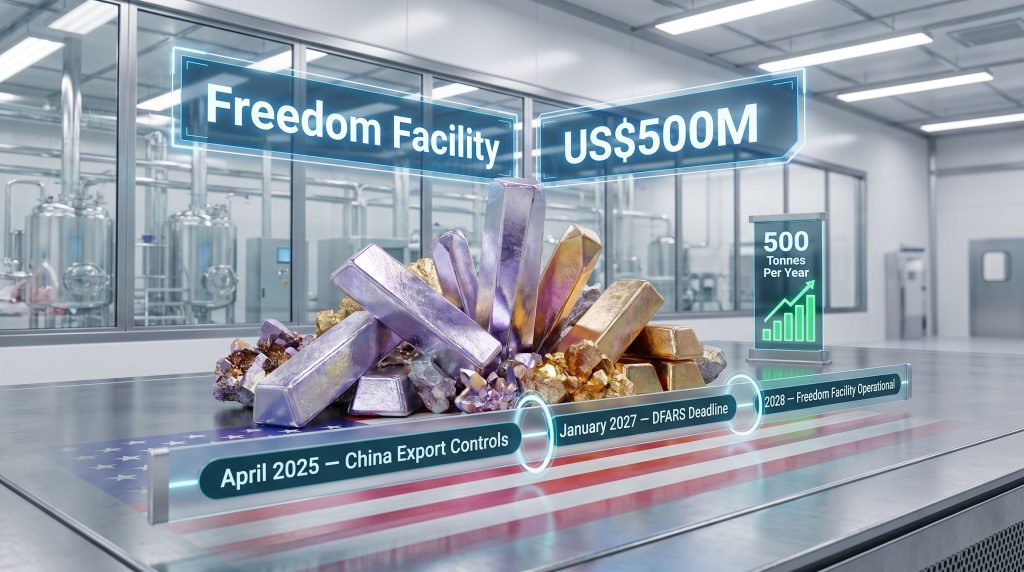
The financial architecture surrounding the Freedom Facility reflects both the scale of the ambition and the conditionality that remains in place. According to reporting on the Pentagon's $500M loan commitment, the structure is as follows:
| Financing Detail | Specifics |
|---|---|
| Committing Agency | U.S. Department of Defense, Office of Strategic Capital |
| Conditional Commitment Value | US$500 million |
| Total Initiative Scale | Approximately US$1 billion |
| Project Name | Freedom Facility |
| Target Operational Date | 2028 |
| Due Diligence Status | Financial, legal, and technical review ongoing |
The loan has not yet been finalised. It remains conditional on the completion of financial, legal, and technical due diligence, meaning Phoenix Tailings still needs to satisfy rigorous scrutiny before capital flows. This is not an unusual structure for large defence-industrial financing, but it does mean the project carries execution risk that investors and supply chain planners should not discount.
Phoenix Tailings: What the Company Does and Why It Was Selected
A Processing-First Business Model Built Around America's Waste Streams
Phoenix Tailings occupies an unusual position in the critical minerals landscape. Rather than pursuing the vertically integrated model of mining its own ore, the company was founded on the insight that rare earth processing expertise, not geological ownership, is the true scarcity. Its core technology focuses on extracting rare earth metals from unconventional feedstocks, including tailings, recycled scrap, and secondary sources that would otherwise require export for processing.
The company's existing operational footprint spans two facilities: one in Burlington, Massachusetts and a metallisation facility in Exeter, New Hampshire. Together, these currently process approximately 500 tonnes of rare earth metals per year, a volume Phoenix Tailings equates to the entire annual consumption requirement of the U.S. defence industrial base. That figure is striking less for its absolute size than for what it reveals about the defence sector's current rare earth demand profile, and how exposed that demand remains if the single company meeting it encounters operational disruptions.
The Metals That Matter Most
Phoenix Tailings' processing operations focus on the alloys most critical to permanent magnet production:
- Neodymium-praseodymium (NdPr): The primary driver of magnetic performance in NdFeB magnets, essential to both defence and clean energy applications
- Dysprosium: A heavy rare earth element added to NdFeB magnets to improve coercivity at elevated temperatures, critical for fighter jet actuators and missile guidance systems
- Additional heavy rare earths: Processing capabilities extending toward terbium and other elements where Chinese dominance is most concentrated
The investor base backing Phoenix Tailings reflects both the commercial and strategic dimensions of the project. BMW, whose electric vehicle programmes depend on NdFeB magnet supply, and Sumitomo, a Japanese trading and materials conglomerate with deep rare earth experience, provide commercial validation alongside the Pentagon's strategic interest.
What the Freedom Facility Will Actually Build
Feedstock Strategy: Diversity as a Risk Management Tool
The Freedom Facility's design incorporates a deliberate feedstock diversification strategy. Rather than depending exclusively on a single mine or source, the facility is being structured to accept mined concentrates, recycled magnet scrap, and secondary processing streams. This approach serves two purposes simultaneously: it provides supply resilience against disruption at any single input source, and it creates a commercial anchor for emerging domestic miners and recyclers who would otherwise struggle to find viable offtake markets.
Anthony Balladon, Chief Commercial Officer and Co-Founder of Phoenix Tailings, has articulated this positioning directly, noting that the facility will serve as a commercial bridge ensuring that mines and recyclers coming online in the United States can find buyers for their output without routing material through foreign processors. This is a subtle but important point: the Freedom Facility is not just a processing plant but a market-making mechanism for the broader domestic rare earth ecosystem.
The 2028 Timeline and What Must Happen First
Reaching operational status by 2028 requires executing several parallel workstreams:
- Completion of financial, legal, and technical due diligence to finalise the OSC loan commitment
- Site selection, permitting, and environmental review for the Freedom Facility itself
- Equipment procurement and construction across a facility capable of handling significantly higher throughput than current Burlington and Exeter operations
- Workforce development and process scale-up from existing 500 tonne per year baseline
- Feedstock supply agreement negotiation with mines, recyclers, and secondary processors
Each of these steps carries its own timeline risk. The 2028 target is ambitious relative to the DFARS January 2027 deadline, meaning there will be a period during which domestic processing capacity is ramping but the regulatory requirement is already in force. That gap underscores why Phoenix Tailings' existing 500 tonne per year capacity is not merely a baseline but an active defence supply asset in the interim.
The Rare Earth Supply Chain: A Technical Stage-by-Stage View
Understanding Why Each Stage Creates Its Own Bottleneck
To appreciate where the Freedom Facility fits, it helps to map the full supply chain from geology to operational military hardware. The rare earth processing challenges at each stage reveal why a single facility, however well funded, cannot resolve the entire problem:
| Supply Chain Stage | U.S. Capability Status | Key Gap |
|---|---|---|
| Mining and Concentration | Moderate and improving | Limited number of operating mines |
| Separation and Metallisation | Critical shortage being addressed | Phoenix Tailings, ReElement under review |
| Alloy Production | Largely absent | No scaled domestic capacity exists |
| Sintering and Magnet Manufacturing | Minimal | Dependent on allied and foreign producers |
| Heavy Rare Earth Refining | Unresolved | Dysprosium and terbium processing gaps remain |
The Freedom Facility directly targets Stage 2, separation and metallisation. However, Stages 3 and 4, alloy production and magnet sintering, remain largely unaddressed by any currently funded programme. This is a critical nuance that is often lost in coverage of the Pentagon's commitment: processing metals is necessary but not sufficient to produce finished magnets. The chain from refined dysprosium metal to a sintered NdFeB magnet ready for installation in an F-35 actuator requires additional manufacturing steps that the U.S. still largely lacks.
Technical Note: NdFeB magnet production involves blending refined rare earth metals with iron and boron in precise ratios, melting and strip casting the alloy, hydrogen decrepitation into powder, jet milling, magnetic alignment pressing, and sintering at high temperature under controlled atmospheres. Each step requires specialised capital equipment and process expertise. The U.S. has capability gaps at multiple points in this sequence, not just at the upstream refining stage.
The next major ASX story will hit our subscribers first
The Pentagon's Multi-Company Strategy
Why the U.S. Is Not Betting on a Single Facility
The commitment to Phoenix Tailings is one node in a broader, distributed investment strategy across the rare earth supply chain. In addition to this, America's rare earth supply chain is being bolstered through parallel investments in multiple companies simultaneously:
- ReElement Technologies: A separate conditional loan to a competing rare earth refiner, though Pentagon officials have publicly raised concerns about the company's scale-up trajectory
- Hertha Metals: A Houston-based startup targeting high-purity iron production, addressing the iron feedstock gap in NdFeB magnet manufacturing that is separate from the rare earth element challenge
- Defense Logistics Agency contract (March 2026): An award specifically advancing metallothermal production of samarium and gadolinium, two rare earth metals used in advanced weapons systems including samarium-cobalt magnets that outperform NdFeB at extreme temperatures
This distributed approach reflects a clear-eyed acknowledgement that no single company or facility can close the entire midstream processing gap before regulatory deadlines take effect. The strategic logic is to fund across multiple supply chain nodes simultaneously, accepting that some investments will underperform while ensuring that at least some capacity comes online within the critical window.
The Regulatory and Geopolitical Pressure Timeline
| Date | Event | Strategic Impact |
|---|---|---|
| April 2025 | China imposes rare earth export controls | Accelerated urgency for domestic alternatives |
| March 2026 | DLA awards samarium and gadolinium production contract | Expands metallothermal processing capability |
| June 2026 | Pentagon conditionally commits US$500M to Phoenix Tailings | Anchors midstream processing expansion |
| January 2027 | DFARS deadline banning Chinese-origin magnets from defence systems | Compliance cliff for defence contractors |
| 2028 (Target) | Freedom Facility operational | Domestic processing capacity at meaningful scale |
Remaining Gaps the Freedom Facility Does Not Resolve
Heavy Rare Earths: The Harder Problem
Dysprosium and terbium present a distinct challenge within the rare earth supply chain. Both are classified as heavy rare earth elements, a subset of the lanthanide series that occurs at lower concentrations in most ore bodies and requires different separation chemistry than the more abundant light rare earths like neodymium and praseodymium. China's dominance in heavy rare earth processing is even more pronounced than its already commanding position in light rare earths.
While Phoenix Tailings processes dysprosium at its existing facilities, the question of whether the Freedom Facility will achieve the throughput scale needed to meaningfully reduce heavy rare earth dependency remains open. Terbium refining at commercial scale in the United States, furthermore, remains an unresolved challenge that no currently funded programme fully addresses.
The Alloying and Sintering Gap
Even with refined NdPr and dysprosium metals available domestically, the absence of scaled NdFeB alloy production and magnet sintering capacity means the supply chain remains incomplete. A rare earth metal refined in New Hampshire still needs to travel to a facility capable of converting it into a magnet, and those facilities are predominantly located in Japan, China, and, to a lesser extent, Germany. Building domestic alloying and sintering capacity requires separate capital commitments, different expertise, and a commercial customer base willing to pay for domestically produced magnets at a cost premium over Chinese alternatives.
Feedstock Sufficiency
The Freedom Facility's feedstock diversification strategy, drawing from mines, recyclers, and secondary sources, is sound in concept but depends on those upstream suppliers actually coming online at sufficient scale. Several planned U.S. rare earth mines are at various stages of permitting and development, but mining timelines regularly extend beyond initial projections. Consequently, if the Freedom Facility is ready to process material in 2028 but domestic feedstock supply remains insufficient, the facility would be forced to either operate below capacity or source internationally, partially defeating the strategic purpose of the investment.
Comparing the Investment to the Scale of the Problem
What US$1 Billion Can and Cannot Do
China's rare earth processing infrastructure represents decades of investment estimated in the tens of billions of dollars, supported by state financing, captive domestic demand, and a workforce trained across generations. The US$1 billion initiative anchored by the Phoenix Tailings commitment is a meaningful start, but it is not remotely sufficient to replicate that infrastructure from scratch. The more realistic framing is that it establishes a domestic processing nucleus around which additional private and public investment can accumulate over time.
Investor Perspective: Capital deployed into rare earth processing faces longer payback periods than conventional mining investment, because processing plants require continuous feedstock, technical workforces, and customer relationships that take years to mature. The Pentagon's conditional debt structure, rather than equity, means that Phoenix Tailings will carry debt obligations that require revenue generation to service, adding financial discipline but also financial risk to the project's execution.
The Recycling Dimension as a Long-Term Structural Shift
One underappreciated dimension of Phoenix Tailings' model is its emphasis on recycled rare earth feedstock. End-of-life NdFeB magnets from scrapped electronics, vehicles, and industrial equipment represent a growing secondary supply source that is, by definition, already present inside the United States. The development of rare earth recycling infrastructure not only reduces dependence on primary mining but creates a circular supply chain that is geopolitically insulated from source-country disruptions.
A broader critical minerals strategy at the national level will ultimately be necessary to make recycling commercially viable at scale. At current recycling rates, the volume is modest, but as the installed base of rare earth-intensive products grows and recycling technology matures, this stream could become increasingly significant to facilities like the Freedom Facility.
Frequently Asked Questions: Pentagon Backing and Phoenix Tailings' Rare Earth Processing Push
What is Phoenix Tailings and what does it produce?
Phoenix Tailings is a U.S.-based rare earth processing company operating facilities in Burlington, Massachusetts and Exeter, New Hampshire. It specialises in separating and metallising rare earth elements, including neodymium-praseodymium and dysprosium, from mined concentrates, recycled scrap, and other secondary sources for use in permanent magnet production and defence applications.
Why is the Pentagon funding a private rare earth company?
The U.S. defence industrial base depends on NdFeB permanent magnets for critical hardware including the F-35 fighter jet. The midstream processing capacity needed to produce those magnets domestically is currently inadequate. The Pentagon's Office of Strategic Capital is deploying conditional debt financing to accelerate the build-out of that processing capacity before regulatory and geopolitical constraints force a supply crisis.
What is the Freedom Facility and when will it be operational?
The Freedom Facility is a planned rare earth midstream processing complex to be developed by Phoenix Tailings with Pentagon backing. It will process mined concentrates and recycled scrap into light and heavy rare earth metals. The target operational date is 2028, subject to due diligence completion, permitting, and construction.
What rare earth metals are most critical to U.S. defence systems?
Neodymium, praseodymium, dysprosium, and terbium are the most defence-critical rare earth elements, all feeding into NdFeB permanent magnets used in actuators, guidance systems, motors, and electronic warfare equipment across multiple weapons platforms.
What is the DFARS 2027 deadline and how does it affect defence contractors?
The Defense Federal Acquisition Regulation Supplement deadline of January 2027 prohibits covered defence systems from incorporating rare earth magnets of Chinese origin. Defence contractors must source magnets from non-Chinese supply chains by that date or face compliance failures affecting their ability to fulfil government contracts.
Is the US$500 million loan confirmed or still conditional?
The commitment remains conditional as of June 2026. It is subject to ongoing financial, legal, and technical due diligence by the Pentagon's Office of Strategic Capital. According to analysis of the broader US defense rare earth expansion, the loan has not yet been formally executed or disbursed, and completion of the review process remains the critical near-term milestone.
How does Phoenix Tailings source its raw materials?
The company sources from mined rare earth concentrates, recycled magnet scrap, and secondary processing streams. The Freedom Facility is designed to expand that feedstock base by creating commercial offtake relationships with domestic mines and recyclers.
What is the difference between rare earth mining and rare earth processing?
Mining involves extracting rare earth-bearing ore from the ground and concentrating it into a form suitable for further refining. Processing, or midstream metallisation, involves chemically separating individual rare earth elements from those concentrates and reducing them into purified metals. Processing requires entirely different infrastructure, chemistry expertise, and capital than mining, and it is the processing stage where the United States faces its most acute supply chain vulnerability. Pentagon backing Phoenix Tailings' rare earth processing push is, consequently, targeted precisely at this stage of the chain.
Key Takeaways
- The U.S. Department of Defense has conditionally committed US$500 million to Phoenix Tailings through its Office of Strategic Capital, as part of a broader US$1 billion initiative to build the Freedom Facility
- The investment targets the midstream processing gap, specifically rare earth separation and metallisation, which remains overwhelmingly concentrated in China
- Phoenix Tailings currently operates at 500 tonnes per year across two U.S. facilities, a volume the company equates to the entire annual demand of the U.S. defence industrial base
- The January 2027 DFARS deadline banning Chinese-origin magnets from covered defence systems is the primary compliance driver accelerating federal investment timelines
- Critical supply chain gaps including alloy production, magnet sintering, and heavy rare earth refining of dysprosium and terbium remain unresolved by this commitment alone
- The Pentagon is simultaneously funding multiple companies across different supply chain stages, reflecting a distributed rather than centralised build-out strategy that distributes both risk and potential capability
- China's April 2025 rare earth export controls transformed a latent vulnerability into an active supply chain emergency, providing the immediate geopolitical catalyst behind the Pentagon's accelerated financing activity
Disclaimer: This article contains forward-looking statements, timeline projections, and analysis of conditional financial commitments that have not yet been formally executed. All loan commitments described are subject to due diligence and may not proceed as currently structured. This content is for informational purposes only and does not constitute financial or investment advice. Readers should conduct their own due diligence before making any investment decisions.
Want to Capitalise on the Next Major Critical Minerals Discovery Before the Market Does?
Discovery Alert's proprietary Discovery IQ model delivers real-time alerts on significant ASX mineral discoveries — including critical minerals driving defence and clean energy supply chains — turning complex geological data into actionable investment insights for both short-term traders and long-term investors. Explore why historic mineral discoveries have generated substantial returns and begin your 14-day free trial at Discovery Alert to position yourself ahead of the market.