June 24, 2026
Critical mineral supply chains face unprecedented disruption as traditional processing monopolies encounter sustained challenges from emerging Western production capabilities. The global rare earth elements market, historically concentrated in East Asian processing facilities, now confronts diversification pressures driven by supply security concerns and strategic manufacturing requirements. This restructuring creates opportunities for companies positioned to bridge the gap between raw material availability and domestic processing capacity across multiple jurisdictions.
The convergence of uranium market dynamics with rare earth element production represents a unique industrial positioning that leverages existing infrastructure for expanded commodity exposure. Energy Fuels rare earth elements production exemplifies this strategic evolution, transforming conventional uranium processing facilities into multi-commodity platforms capable of addressing critical raw materials supply chain vulnerabilities.
Breaking China's Processing Monopoly Through Domestic Infrastructure
Western rare earth element processing capabilities remain severely constrained relative to global demand requirements, with current production capacity concentrated primarily in Chinese facilities that control approximately 85% of global rare earth oxide separation. This processing bottleneck creates strategic vulnerabilities for manufacturers requiring consistent supplies of magnetic rare earth elements, particularly neodymium-praseodymium compounds essential for permanent magnet applications.
Energy Fuels' White Mesa Mill in Utah operates as the sole conventional uranium processing facility in the United States with licensed capacity exceeding 8 million pounds of U3O8 annually. More significantly for rare earth market dynamics, this facility represents the only US-based infrastructure capable of processing monazite concentrates into separated rare earth oxides at commercial scale. This unique positioning addresses a critical gap in North American mineral processing capabilities.
Furthermore, the strategic importance of neodymium-praseodymium production extends beyond commercial applications into defense manufacturing requirements. Military systems increasingly depend on high-performance permanent magnets for guidance systems, advanced propulsion technologies, and electronic warfare capabilities. Domestic production of NdPr oxides reduces dependence on potentially unreliable international supply chains for these critical defense applications.
Monazite Processing Advantages Over Alternative Feedstocks
Monazite mineral concentrates contain 50-60% total rare earth oxides, with significantly higher concentrations of valuable neodymium, praseodymium, and heavy rare earth elements compared to bastnaesite or other primary rare earth sources. This composition provides processing advantages through higher recovery rates and reduced separation complexity for high-value magnetic rare earths.
The economic advantages of importing monazite concentrates versus developing primary rare earth mining operations extend beyond capital requirements to operational timelines. Processing imported concentrates eliminates the extended development periods required for mine permitting, construction, and commissioning, enabling faster market entry with lower initial investment.
In addition, Energy Fuels' approach of adapting existing uranium infrastructure for rare earth separation demonstrates capital efficiency unavailable to greenfield processing facilities. The White Mesa Mill's established regulatory approvals, waste management systems, and technical expertise create operational advantages that reduce both development risk and time-to-production for rare earth oxide manufacturing.
When big ASX news breaks, our subscribers know first
Production Scale and Revenue Potential Analysis
Current Energy Fuels rare earth elements production operates at Phase 1A capacity, processing up to 10,000 tonnes annually of monazite concentrate to produce approximately 1,000 tonnes of separated NdPr oxide. This production level represents significant market entry scale, with commercial validation achieved through qualification by major manufacturers including POSCO for permanent magnet production applications.
| Production Metric | Current Capacity | Phase 2 Target | Revenue Potential |
|---|---|---|---|
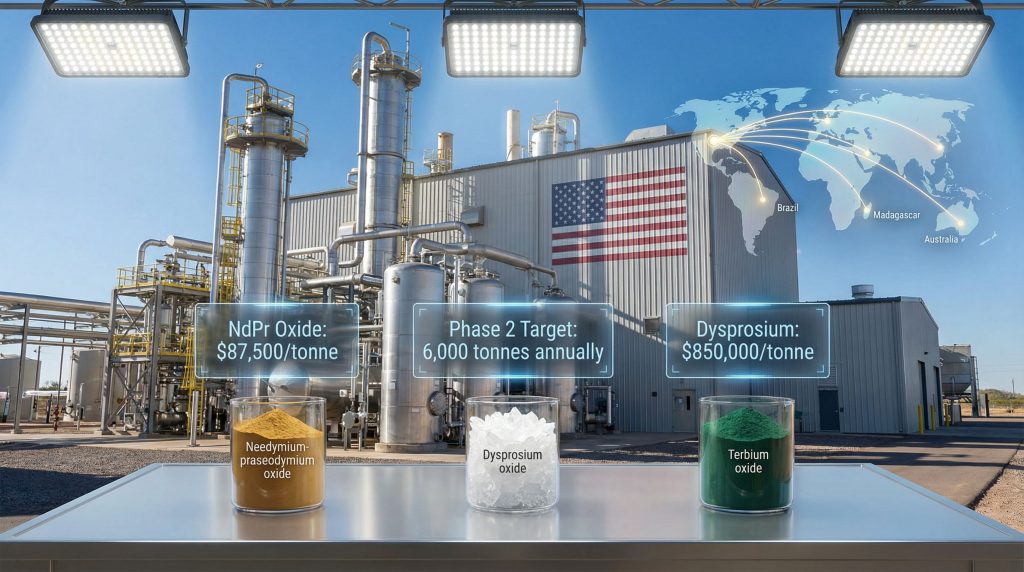
| NdPr Oxide | 1,000 tonnes annually | 6,000 tonnes annually | $525 million at $87,500/tonne |
| Dysprosium Oxide | 29kg pilot production | 275 tonnes annually | $234 million at $850,000/tonne |
| Terbium Oxide | 1kg expected December 2025 | 80 tonnes annually | $288 million at $3.6 million/tonne |
Heavy rare earth element production represents the highest value component of Energy Fuels' strategy, with dysprosium and terbium oxides commanding substantial price premiums reflecting their scarcity and specialized applications. These elements enhance permanent magnet performance at elevated temperatures, making them essential for electric vehicle motors, wind turbine generators, and aerospace applications.
Consequently, the company has achieved 99.9% purity specifications for dysprosium oxide at pilot scale, with commercial production targeted for Q4 2026. This timeline positions Energy Fuels among the first Western producers of separated heavy rare earth oxides, potentially capturing first-mover advantages in supply agreements with major manufacturing customers.
Market Validation Through Customer Qualification
POSCO's qualification of Energy Fuels' NdPr oxide for commercial permanent magnet production represents critical market validation, confirming that domestically produced rare earth oxides meet stringent specifications required for high-performance applications. This qualification process typically requires extensive testing and validation periods, indicating established product quality and consistency.
Third-party validation extends beyond light rare earth products to include heavy rare earth oxides, with dysprosium oxide samples undergoing qualification testing for magnet applications. Successfully completing these qualification processes establishes Energy Fuels as a qualified supplier for manufacturers seeking supply chain diversification away from Chinese sources.
Moreover, the development of a complete US mine-to-magnet supply chain represents significant strategic value for defense and critical infrastructure applications. Energy Fuels' domestic processing capability, combined with qualification achievements, positions the company as a key component in reducing Western dependence on concentrated rare earth supply chains.
Heavy Mineral Sands Strategy for Feedstock Security
Energy Fuels' rare earth production strategy relies fundamentally on securing consistent monazite concentrate supplies from heavy mineral sands mining operations globally. This approach leverages monazite as a byproduct stream from titanium and zirconium production, accessing rare earth feedstock without developing dedicated rare earth mining operations.
The Donald Project in Australia represents the most advanced feedstock source, where Energy Fuels is earning up to a 49% joint venture interest with Astron Corporation while securing 100% offtake rights for monazite production. Export Finance Australia has provided conditional support of A$80 million toward the A$520 million total project development cost, with final investment decision expected in Q1 2026.
Donald Project monazite contains exceptional levels of heavy rare earth elements, including significant dysprosium, terbium, and samarium concentrations. This feedstock composition aligns directly with Energy Fuels' heavy rare earth production strategy, potentially supplying sufficient raw materials for commercial-scale heavy REE oxide production beginning in late 2027.
Madagascar and Brazil Feedstock Development
The Toliara Project in Madagascar represents one of the world's largest undeveloped heavy mineral sands resources, featuring a 38-year mine life with substantial expansion potential. Recent political developments in Madagascar require monitoring, though the project's exceptional rare earth monazite content maintains its strategic importance for long-term feedstock security.
Energy Fuels expects to release an updated feasibility study for Toliara before year-end 2025, providing detailed development timelines and production specifications. The project's scale could potentially supply decades of monazite concentrate to the White Mesa Mill, supporting sustained rare earth oxide production well beyond Phase 2 expansion capacity.
Similarly, the company's third heavy mineral sands project in Brazil, Bahia, is 100%-owned with sonic drilling programs underway and resource estimates expected in 2025. Preliminary assessments suggest potential annual monazite production of 3,000-5,000 tonnes, translating to approximately 300-500 tonnes of NdPr oxide production annually for multiple decades.
Financial Strength Supporting Expansion Strategy
Energy Fuels completed a $700 million convertible senior notes offering in October 2025, oversubscribed by more than 7x, demonstrating exceptional institutional investor interest in the company's rare earth development strategy. The offering featured favorable terms including a 0.75% annual coupon rate, 32.5% conversion premium at $20.34 per share, and effective pre-tax yield of just 2.1%.
The convertible structure includes capped call features that effectively increase the conversion price to $30.70 per share, minimising potential dilution while providing substantial development capital. Net proceeds of approximately $625 million are specifically earmarked for White Mesa Mill Phase 2 expansion and Donald Project development funding.
Furthermore, working capital of $298.5 million as of September 30, 2025, combined with convertible notes proceeds, provides total liquidity exceeding $900 million. This financial position eliminates near-term funding constraints for major development initiatives while maintaining operational flexibility through multiple commodity price cycles.
Inventory Valuation and Revenue Pipeline
Energy Fuels maintains substantial finished product inventory valued at approximately $45.3 million at current commodity prices, including 37,000 kilograms of finished separated NdPr oxide and 9,000 kilograms of high-purity mixed rare earth elements. This inventory represents significant embedded value that increases with rare earth price appreciation.
Current uranium inventory includes 485,000 pounds of finished U3O8 and 1.62 million pounds in various processing stages, providing near-term cash generation to support rare earth expansion activities. Uranium sales of 240,000 pounds at $72.38 per pound during Q3 2025 demonstrate consistent revenue generation from the core uranium business.
Therefore, the combination of rare earth and uranium production creates revenue diversification that reduces single-commodity exposure while capturing multiple thematic investment trends simultaneously. This dual-commodity approach provides cash flow stability during development phases and enhanced revenue potential as both markets reach full production scale.
Development Timeline and Production Milestones
Energy Fuels expects to release the Phase 2 feasibility study before year-end 2025, detailing engineering specifications and cost estimates for expanding rare earth processing capacity to 6,000 tonnes annually of NdPr oxide plus 275 tonnes of dysprosium oxide and 80 tonnes of terbium oxide. This feasibility study represents the critical next step toward securing development approvals and finalising construction planning.
| Timeline | Development Milestone | Production Impact |
|---|---|---|
| End 2025 | Phase 2 feasibility study release | Detailed capacity and cost planning |
| 2026-2027 | Permitting and construction phases | Infrastructure development |
| 2028 | Phase 2 commissioning | 6,000 tpa NdPr capacity online |
| Q4 2026 | Heavy REE commercial production | 275 tpa Dy, 80 tpa Tb production |
Heavy rare earth oxide commercial production timelines target Q4 2026 for dysprosium and terbium, positioning Energy Fuels ahead of most Western competitors in reaching commercial heavy REE production. This timeline advantage could secure preferential supply agreements with manufacturers seeking reliable heavy rare earth sources.
Consequently, Donald Project development follows a parallel timeline, with final investment decision expected Q1 2026 and first monazite deliveries to White Mesa Mill anticipated by late 2027. This timing aligns closely with Phase 2 commissioning, ensuring adequate feedstock availability to support expanded processing capacity.
Technology Transfer and Commercial Validation Progress
Ongoing qualification processes with additional major manufacturers beyond POSCO create multiple potential offtake pathways for expanding rare earth oxide production. These qualification activities typically extend over 12-18 months, establishing technical specifications and supply terms for long-term commercial relationships.
The US production executive order initiatives supporting domestic mine-to-magnet supply chain development align directly with Energy Fuels' production capabilities and timeline. Department of Defense supply chain security priorities increasingly favour domestic rare earth sources for critical applications, potentially creating offtake opportunities at premium pricing.
Moreover, the company's unique position as the only US facility capable of commercial rare earth oxide separation provides substantial competitive advantages in government procurement processes and supply agreements requiring domestic content certifications.
Geopolitical Drivers Supporting Domestic Production
Current US government critical minerals policy strongly emphasises supply chain security for rare earth elements, with specific focus on reducing dependence on concentrated international sources. The defense minerals strategy has identified rare earth elements as critical materials requiring domestic supply capability for national security applications.
Inflation Reduction Act provisions include significant incentives for domestic critical mineral production, creating potential tax advantages and production credits for US-based rare earth oxide manufacturing. These policy incentives improve project economics while reducing development risk for domestic producers.
Similarly, Export Finance Australia's conditional $80 million commitment to the Donald Project demonstrates international government support for securing Western rare earth supply chains. This financing support reduces project development risk while confirming government-level recognition of strategic importance.
How Does China's Dominance Impact Supply Chain Security?
Chinese rare earth export restrictions periodically create supply disruptions and price volatility for international manufacturers, highlighting the strategic vulnerability of concentrated supply chains. Recent policy changes affecting rare earth processing technology exports further emphasise supply security concerns for Western manufacturers.
Strategic stockpiling initiatives by major consuming nations indicate growing recognition of rare earth supply risks and potential for sustained supply disruptions. These stockpiling programmes create additional demand sources while confirming government-level concern regarding supply chain vulnerabilities.
Furthermore, Energy Fuels' domestic processing capability directly addresses these supply security concerns, providing manufacturers with Western-sourced rare earth oxides that eliminate exposure to potential Chinese export restrictions or trade disruptions.
The next major ASX story will hit our subscribers first
Competitive Positioning in Global Rare Earth Markets
Energy Fuels' competitive position differs significantly from other Western rare earth producers through its focus on processing imported concentrates rather than developing primary mining operations. This approach enables faster production timelines and lower capital requirements compared to integrated mine-to-mill operations.
| Company | Geographic Focus | Primary Strategy | Processing Status |
|---|---|---|---|
| Energy Fuels | North America | Monazite processing | Operating commercial separation |
| MP Materials | North America | Bastnaesite processing | Separating in China (Phase 1) |
| Lynas Rare Earths | Australia/Malaysia | Integrated mining-processing | Operating separation in Malaysia |
The White Mesa Mill's 40+ years of uranium processing experience provides operational advantages through established regulatory approvals, trained workforce, and proven processing capabilities. This operational history reduces execution risk for rare earth expansion compared to greenfield processing facilities.
Consequently, Energy Fuels' timeline for commercial heavy rare earth production appears to lead most Western competitors, potentially securing first-mover advantages in supply agreements and customer relationships. Heavy rare earth scarcity creates particular opportunities for early production capabilities.
Technology and Infrastructure Competitive Advantages
Licensed processing capacity exceeding 8 million pounds U3O8 annually demonstrates the White Mesa Mill's substantial throughput capabilities, providing significant scaling potential for rare earth operations beyond current Phase 1A capacity. This infrastructure scalability supports future expansion beyond Phase 2 targets.
Established monazite cracking and rare earth separation technologies at commercial scale represent significant technological advantages over theoretical processing capabilities. Proven operations reduce technical risk and provide immediate production capacity unavailable to development-stage competitors.
In addition, the facility's unique capability to process both uranium and rare earth feedstocks simultaneously creates operational efficiencies and revenue diversification unavailable to single-commodity processing facilities. This flexibility provides additional competitive advantages during commodity price cycles.
Investment Risk Factors and Strategic Opportunities
Phase 2 expansion permitting represents the primary near-term execution risk, requiring environmental approvals and regulatory clearances for expanded processing capacity. While Energy Fuels has initiated permitting processes, approval timelines remain subject to regulatory review periods and potential delays.
Monazite feedstock supply chain dependencies create operational risks if heavy mineral sands projects experience development delays or operational challenges. The company's multiple feedstock sources partially mitigate this risk, though Donald Project timing remains critical for Phase 2 feedstock requirements.
However, rare earth price volatility presents both opportunities and risks for revenue projections, with heavy rare earth prices particularly susceptible to supply-demand imbalances. Current pricing assumptions for dysprosium and terbium oxides reflect substantial premiums that may not persist through full production ramp.
Market Opportunities and Strategic Positioning
Government offtake agreements for defense applications represent significant strategic opportunities, potentially providing long-term revenue security at premium pricing for domestically produced rare earth oxides. Department of Defense supply chain initiatives increasingly favour domestic sources for critical materials.
Vertical integration opportunities in permanent magnet manufacturing could capture additional value-added processing margins while securing end-market demand for rare earth oxide production. Several US manufacturers are developing domestic magnet production capabilities requiring reliable rare earth supplies.
Furthermore, international partnership development for additional feedstock sources provides opportunities to expand processing throughput beyond current project pipelines. Energy Fuels' proven processing capabilities create attractive partnership opportunities with global heavy mineral sands developers.
Technology and Process Innovation in Rare Earth Separation
Energy Fuels' monazite processing methodology leverages specialised cracking and leaching techniques adapted from decades of uranium processing experience. The company utilises acid digestion processes to break down monazite structure, followed by solvent extraction circuits to separate individual rare earth elements into high-purity oxide products.
The facility's ability to achieve 99.9% purity specifications for heavy rare earth oxides demonstrates advanced separation capabilities essential for high-performance permanent magnet applications. This purity level meets stringent requirements for aerospace, defense, and electric vehicle motor applications.
Moreover, pilot-scale production of 29 kilograms of dysprosium oxide provides critical operational data for scaling to commercial production levels. This pilot experience validates processing parameters and recovery rates necessary for accurate feasibility study projections and customer qualification programmes.
Process Optimisation and Efficiency Improvements
Energy Fuels continues optimising rare earth separation processes through operational experience and customer feedback, with particular focus on heavy rare earth recovery rates and product specifications. These improvements enhance both production efficiency and product quality for expanding customer base.
The company's integrated approach to processing both uranium and rare earth materials creates operational synergies through shared infrastructure, utilities, and technical expertise. This integration reduces unit costs for rare earth production while maximising facility utilisation rates.
Therefore, waste management systems developed for uranium processing adapt effectively to rare earth separation requirements, minimising additional environmental compliance costs and regulatory complexity for expanded operations.
Market Demand Dynamics and Supply-Demand Balance
Global demand for neodymium-praseodymium oxides continues growing driven by electric vehicle motor requirements, wind turbine generator expansion, and industrial automation applications. Market analysts project sustained demand growth exceeding 7% annually through 2030 for magnetic rare earth applications, as outlined in recent REE market analysis.
Heavy rare earth demand growth rates exceed light rare earth trends due to specialised applications in high-performance permanent magnets. Dysprosium and terbium elements enhance magnet performance at elevated temperatures, making them essential for advanced electric vehicle motors and aerospace applications.
Consequently, supply-demand imbalances for heavy rare earth elements remain particularly acute, with limited global production capacity outside Chinese operations. This supply constraint creates sustained pricing support and strategic value for Western heavy rare earth production capabilities, similar to Australia's strategic minerals reserve initiatives.
Defense and Critical Infrastructure Applications
Military applications for rare earth elements continue expanding across guidance systems, electronic warfare capabilities, and advanced propulsion technologies. These applications typically require domestic supply sources due to security clearance and supply chain integrity requirements.
Critical infrastructure applications including power grid modernisation, renewable energy systems, and advanced manufacturing technologies increasingly depend on high-performance rare earth permanent magnets. These applications create sustained demand independent of consumer electronics cycles.
Furthermore, Energy Fuels' domestic processing capability positions the company favourably for defense contractor supply agreements requiring US-sourced critical materials. These applications often command premium pricing reflecting strategic value and supply security requirements.
Investment Considerations for Energy Fuels Rare Earth Elements Production
The combination of established processing infrastructure, secured feedstock sources, and favourable geopolitical trends creates a compelling investment framework for Energy Fuels rare earth elements production. The company's unique position as the only operating commercial rare earth separation facility in North America provides significant competitive advantages during Western supply chain diversification.
Revenue diversification across uranium and rare earth production reduces commodity exposure risks while capturing multiple strategic mineral themes simultaneously. This dual-commodity approach provides operational flexibility and enhanced revenue potential as both markets reach maturity.
However, investors must consider execution risks including permitting timelines, feedstock supply security, and rare earth price volatility when evaluating investment merits. The company's substantial financial resources and proven operational capabilities partially mitigate these risks while supporting sustained development programmes through multiple market cycles.
The strategic alignment of Energy Fuels' production timeline with government priorities for domestic critical mineral supply creates potential for preferential offtake agreements and pricing premiums. This positioning enhances investment attractiveness while supporting long-term revenue visibility for expanding rare earth operations.
Investment Considerations: This analysis contains forward-looking statements regarding production timelines, capacity expansions, and market projections that involve significant risks and uncertainties. Rare earth element prices are subject to substantial volatility, and actual production results may differ materially from management projections. Investors should conduct independent due diligence and consider consulting qualified investment professionals before making investment decisions.
Looking to Capitalise on the Next Wave of Critical Mineral Opportunities?
Discovery Alert's proprietary Discovery IQ model delivers real-time alerts on significant ASX critical mineral discoveries, instantly empowering subscribers to identify actionable opportunities ahead of the broader market. Understand why major mineral discoveries can lead to substantial market returns by exploring Discovery Alert's dedicated discoveries page, showcasing historic examples of exceptional outcomes, and begin your 30-day free trial today to position yourself ahead of the market.