August 25, 2026
The global critical minerals landscape operates under fundamental constraints that extend far beyond geological availability. While mining operations capture headlines and policy attention, the true strategic vulnerability lies within a narrow technical chokepoint: the specialised industrial processes required to transform raw rare earth concentrates into the high-purity materials essential for modern technology manufacturing. Furthermore, these energy transition challenges continue to intensify as nations seek greater supply chain independence.
Unlike conventional commodity processing, rare earth elements present unique challenges rooted in their atomic structure and chemical behaviour. The lanthanide contraction phenomenon creates nearly identical ionic radii across the 17-element group, making separation exponentially more complex than traditional metal refining. This technical reality has concentrated global processing capacity in a handful of facilities, with China commanding approximately 85-90% of worldwide separation capabilities through decades of sustained investment and operational refinement.
Understanding Rare Earth Midstream Processing Architecture
Midstream processing in rare earths encompasses the critical transformation stage between raw concentrates and finished products, involving separation, purification, refining, and metallisation operations. This technical bridge converts mixed rare earth concentrates containing multiple elements into individual high-purity oxides suitable for downstream applications in permanent magnets, catalysts, and advanced materials.
The separation process exploits minute differences in chemical properties across rare earth elements, requiring sophisticated cascade systems operating under precise temperature, pH, and concentration parameters. Commercial facilities typically employ solvent extraction methodologies for light rare earth elements, with more complex ion exchange protocols reserved for heavy rare earth isolation where chemical similarities become most pronounced.
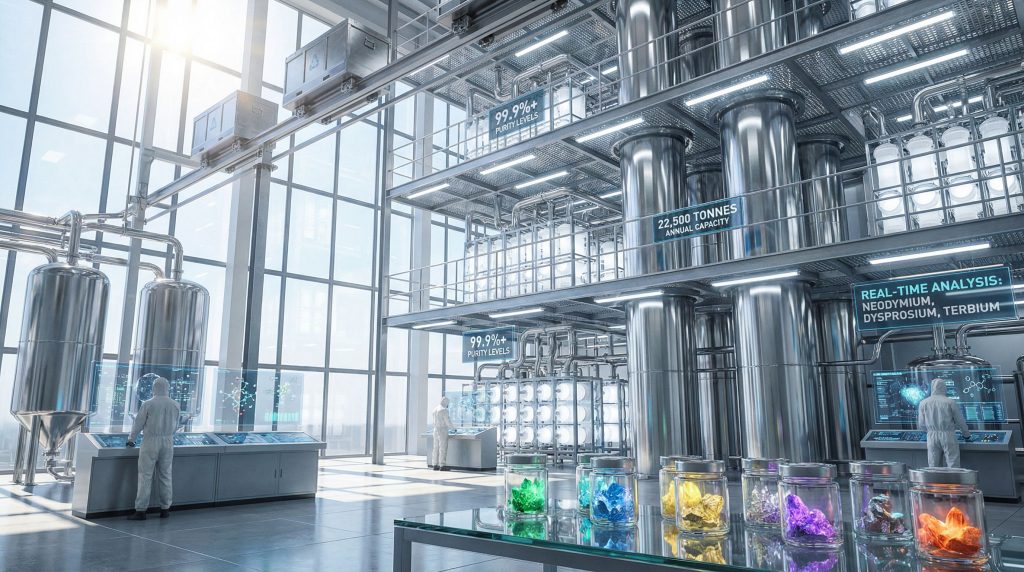
Technical requirements for achieving 99.9% purity levels demand multiple processing stages, with light rare earth separation typically requiring 6-8 distinct phases while heavy rare earth elements like dysprosium and terbium necessitate 12-15 separation stages. This exponential complexity increase reflects the fundamental challenge of distinguishing between chemically similar elements using conventional hydrometallurgical approaches.
Core Separation Technologies and Economic Implications
Three primary methodologies dominate commercial rare earth separation: solvent extraction, ion exchange chromatography, and selective precipitation techniques. Each approach presents distinct operational characteristics, cost structures, and performance parameters that influence facility economics and competitive positioning. However, advances in AI optimization in mining are beginning to enhance process efficiency across these technologies.
Solvent Extraction Cascade Systems
| Technology | Efficiency Rate | Cost Level | Primary Application | Processing Duration |
|---|---|---|---|---|
| Solvent Extraction | 95-99% | High | Light REEs | 30-60 days |
| Ion Exchange | 99%+ | Very High | Heavy REEs | 60-120 days |
| Precipitation | 85-95% | Medium | Bulk Separation | 7-14 days |
Solvent extraction represents the cornerstone technology for commercial rare earth processing, utilising organic solvents to selectively extract target elements from aqueous solutions. The methodology achieves 95-99% recovery efficiency across multiple cascade stages, with operational cycles requiring 30-60 days for complete processing. Capital intensity remains substantial due to equipment complexity, chemical consumption, and extended processing timeframes.
Ion exchange chromatography delivers superior purity levels exceeding 99% but incurs significantly elevated operational costs and processing durations extending 60-120 days. This methodology proves essential for heavy rare earth isolation where chemical similarity reaches its most challenging levels, particularly for dysprosium and terbium separation from yttrium-rich concentrates.
Precipitation techniques provide moderate efficiency levels between 85-95% while operating under compressed timeframes of 7-14 days. These approaches suit bulk separation applications where moderate purity suffices for downstream refining, offering cost advantages for initial concentration stages preceding higher-purity processing.
Economic Barriers to Processing Infrastructure Development
Capital expenditure requirements for commercial-scale midstream processing facilities range between $200-500 million, reflecting the technical complexity, environmental compliance systems, and specialised equipment necessary for rare earth separation. Minimum viable scale economics dictate annual processing capacity between 3,000-5,000 tonnes to achieve competitive unit costs against established Chinese producers.
Profitability thresholds require sustained neodymium-praseodymium oxide pricing above $150 per kilogram, establishing the baseline economics for Western facilities operating under elevated environmental compliance costs and labour expenses. This pricing sensitivity creates vulnerability to market volatility and competitive pressure from subsidised Chinese production.
Environmental compliance represents 15-25% of total operating costs in developed markets, compared to 3-5% in jurisdictions with less stringent oversight. This regulatory differential creates substantial competitive disadvantages for Western facilities, compounding capital intensity challenges with ongoing operational cost burdens. Moreover, decarbonisation in mining adds another layer of complexity to these economic calculations.
Environmental compliance can represent a quarter of total operating costs in developed markets, creating fundamental competitive challenges for facilities outside China's regulatory framework.
Water Consumption and Waste Management Challenges
Processing operations generate approximately 75 cubic metres of wastewater per tonne of rare earth oxides produced, requiring extensive treatment systems and regulatory compliance monitoring. Water consumption intensity reaches extreme levels, with yttrium production requiring up to 29,902 kilograms of water per kilogram of final product, constraining facility location to water-abundant regions.
Radioactive waste management from thorium co-extraction presents additional regulatory challenges, particularly in Western jurisdictions with stringent nuclear materials oversight. Thorium occurs naturally alongside rare earth deposits, requiring specialised handling, storage, and disposal protocols that increase operational complexity and compliance costs.
When big ASX news breaks, our subscribers know first
Global Processing Capacity Distribution and Strategic Implications
China's dominance of rare earth midstream processing stems from decades of coordinated industrial development, vertical integration, and state support for capacity expansion. This concentration creates strategic vulnerabilities for countries dependent on Chinese processing capacity for critical technology supply chains, particularly in defence, renewable energy, and advanced manufacturing sectors.
Non-Chinese Processing Infrastructure Development
Current non-Chinese processing capacity remains limited to a handful of operational and planned facilities, with significant lead times constraining rapid capacity expansion. In addition, the broader mining industry innovation landscape continues to evolve rapidly.
Existing and Planned Processing Facilities
| Facility Operator | Location | Current Capacity | Target Capacity | Development Timeline |
|---|---|---|---|---|
| Lynas Rare Earths | Malaysia | 22,500 t/yr | 25,000 t/yr | Currently Operating |
| MP Materials | California | 0 t/yr | 50,000 t/yr | 2025-2026 Target |
| Iluka Resources | Australia | 0 t/yr | 17,500 t/yr | 2025-2027 Target |
Lynas Rare Earths operates the only credible commercial-scale, non-Chinese processing facility today, with established production of separated rare earth oxides from its Malaysian separation plant. The company's operational experience provides critical insights into non-Chinese processing economics, technical challenges, and market positioning against Chinese competitors.
MP Materials' Mountain Pass facility represents the most significant Western capacity addition under development, targeting 50,000 tonnes annual production by 2025-2026. This timeline faces uncertainty due to regulatory approvals, construction delays, and technical commissioning challenges inherent in complex chemical processing operations.
Iluka Resources' Australian development plans contribute additional capacity diversity through a different geographic and regulatory framework. However, the 2025-2027 timeline remains subject to permitting approvals, construction execution, and workforce development in specialised processing technologies.
Technology Transfer Restrictions and Competitive Dynamics
China maintains technological advantages through intellectual property controls, restricted technology transfer, and limited access to operational expertise developed over decades of commercial processing experience. These barriers prevent straightforward replication of Chinese processing methodologies in Western facilities, requiring independent technology development or licensing arrangements.
State subsidisation effects on global pricing dynamics create additional competitive challenges for Western producers. Direct subsidies, preferential financing, energy cost supports, and regulatory cost advantages enable Chinese facilities to maintain pricing below Western production costs, constraining profitability for non-Chinese capacity.
Vertical integration advantages from mining through magnet production provide Chinese companies with supply chain coordination, cost optimisation, and market responsiveness unavailable to non-integrated competitors. This structural advantage extends beyond processing into downstream manufacturing, amplifying China's leverage across the entire rare earth value chain. Consequently, understanding the broader critical minerals supply chain becomes essential for strategic planning.
Innovation Pathways and Processing Technology Evolution
Emerging technologies offer potential pathways for improving separation economics, reducing environmental impacts, and enhancing processing efficiency. Artificial intelligence optimisation of extraction cascades provides opportunities for real-time process control, yield improvement, and reagent consumption reduction through predictive modelling and automated parameter adjustment.
Membrane separation technology development represents an alternative approach to conventional solvent extraction, potentially reducing chemical consumption, processing times, and waste generation. However, commercial viability remains unproven at industrial scale, particularly for achieving the high purity levels required for magnet-grade rare earth oxides.
Continuous processing methodologies offer advantages over traditional batch operations through improved efficiency, reduced capital intensity, and enhanced quality control. Automated reagent recovery and recycling systems address cost and environmental concerns by minimising chemical consumption and waste generation.
Environmental Footprint Reduction Initiatives
Closed-loop water recycling implementations reduce consumption intensity and regulatory burden through advanced treatment and recovery systems. Alternative reagent development programmes seek to replace conventional chemicals with more environmentally benign options, though technical performance and cost considerations limit adoption speed.
Waste minimisation through process optimisation targets reduction of radioactive waste streams, chemical consumption, and energy intensity through improved separation efficiency and recovery rates. Integration with renewable energy sources addresses carbon footprint concerns while potentially reducing operational costs in regions with abundant clean energy resources.
Strategic Investment Requirements and Market Outlook
Global investment requirements for achieving supply chain diversification in rare earth processing exceed $100 billion by 2035, based on projected demand growth from electric vehicles, wind turbines, and advanced technology applications. Current committed capital totals approximately $5 billion across active projects, indicating substantial financing gaps for comprehensive capacity development.
Government incentive programmes provide partial support for facility development through grants, loan guarantees, and tax incentives. However, private sector investment remains constrained by long payback periods, technical risks, and competitive pressure from subsidised Chinese production.
Processing capacity cannot be developed independently from mining operations, downstream manufacturing, and workforce capabilities, requiring coordinated industrial ecosystem development rather than isolated facility construction. Multi-year lead times for facility construction and commissioning extend from initial planning through commercial production, typically requiring 5-7 years for complex chemical processing operations. Furthermore, implementing effective green transition strategies requires careful coordination across these timelines.
Demand Growth Scenarios and Supply-Demand Dynamics
Electric vehicle adoption rates drive neodymium and praseodymium demand growth, with permanent magnet motors requiring approximately 200-400 grams of rare earth content per vehicle. Wind turbine installations similarly consume dysprosium and neodymium for high-efficiency generators, with offshore installations requiring larger generators and higher rare earth content.
Supply-demand balance projections indicate potential shortfalls in processing capacity by 2030 absent accelerated facility development, particularly for heavy rare earth elements where alternatives remain limited. Geopolitical factors influence capacity development through trade policies, investment restrictions, and national security considerations affecting facility financing and technology access. Additionally, rare earth processing hubs are becoming increasingly important for strategic planning.
Recycling Integration and Circular Economy Potential
End-of-life magnet processing represents an emerging source of rare earth materials, particularly for high-value heavy rare earth elements concentrated in permanent magnets. Urban mining economics improve as primary material prices increase and recycling technologies advance, though scale limitations constrain current contribution to total supply.
Integration with primary processing facilities offers operational synergies through shared infrastructure, technical expertise, and market access. However, recycling feedstock requires different processing protocols due to altered chemical composition and contamination from use applications.
Circular economy implications extend beyond recycling to include design for disassembly, material substitution, and efficiency improvements reducing total rare earth consumption per unit of economic output. These approaches complement supply expansion through demand management and resource optimisation.
The next major ASX story will hit our subscribers first
Processing Economics and Competitive Positioning
Understanding rare earth midstream processing requires recognition that technical complexity, environmental constraints, and scale economics create natural barriers to market entry and capacity expansion. These factors explain China's sustained dominance and the challenges facing Western capacity development initiatives.
Investment in processing infrastructure must account for long-term strategic value beyond immediate financial returns, given the critical role of rare earth materials in defence, energy transition, and advanced technology applications. Midstream processing in rare earths represents national security infrastructure rather than conventional commercial investment, requiring policy support and strategic patience.
This analysis is based on publicly available information and industry sources current as of December 2025. Rare earth markets remain subject to significant volatility, regulatory changes, and geopolitical developments that may affect processing economics and capacity development timelines. Investors should conduct independent research and consult qualified professionals before making investment decisions in rare earth processing facilities or related securities.
Ready to Capitalise on Critical Minerals Investment Opportunities?
Discovery Alert's proprietary Discovery IQ model delivers real-time alerts on significant ASX mineral discoveries, instantly empowering subscribers to identify actionable opportunities in critical minerals and rare earth companies ahead of the broader market. Understand why historic discoveries can generate substantial returns by visiting Discovery Alert's dedicated discoveries page, showcasing exceptional outcomes, and begin your 30-day free trial today to position yourself ahead of the market.