August 14, 2026
The global technology landscape operates on hidden vulnerabilities that extend far beyond silicon semiconductors and software algorithms. While nations compete for dominance in artificial intelligence and quantum computing, the real strategic advantage lies buried within industrial processes that transform raw earth materials into the magnetic components powering modern civilisation. The rare earth processing infrastructure China has developed represents perhaps the most critical yet underappreciated foundation of technological supremacy.
This transformation requires sophisticated chemical separation technologies, decades of accumulated technical expertise, and massive capital investments that cannot be replicated through policy announcements or emergency funding. The infrastructure controlling these processes represents perhaps the most durable competitive moat in contemporary geopolitics.
What Makes China's Rare Earth Processing Infrastructure Unbreakable?
The Four-Decade Foundation That Competitors Cannot Replicate
China's rare earth processing infrastructure China represents the culmination of systematic industrial development spanning over four decades. Beginning in the 1980s, state-directed investment patterns created an integrated ecosystem encompassing mining operations, chemical processing facilities, and downstream manufacturing capabilities under unified strategic control.
This approach differed fundamentally from Western market-driven strategies that relied on private capital allocation and profit-maximising decisions. While Western companies focused on quarterly returns and shareholder value, Chinese entities absorbed sustained losses during the infrastructure-building phase, subsidised by government policy objectives that prioritised long-term strategic positioning over immediate profitability.
The integration of mining, processing, and manufacturing under unified control created synergies impossible to achieve through market coordination alone. Transportation costs decreased, quality control improved, and technical innovations could be rapidly deployed across the entire supply chain without complex licensing negotiations or competitive constraints.
Technical Superiority Through Patent Accumulation and Innovation
China's dominance in rare earth processing extends beyond raw capacity to encompass fundamental technological advantages accumulated through decades of focused research and development. Chinese entities have systematically filed thousands of patents covering critical aspects of solvent extraction methodology, chemical separation processes, and environmental management techniques.
These patents create technical barriers that competitors cannot circumvent without either licensing Chinese technology or investing years in alternative research pathways. The solvent extraction methods used to separate individual rare earth elements from mixed concentrates represent particularly sophisticated chemistry that requires precise control of pH levels, temperature gradients, and chemical reagent concentrations.
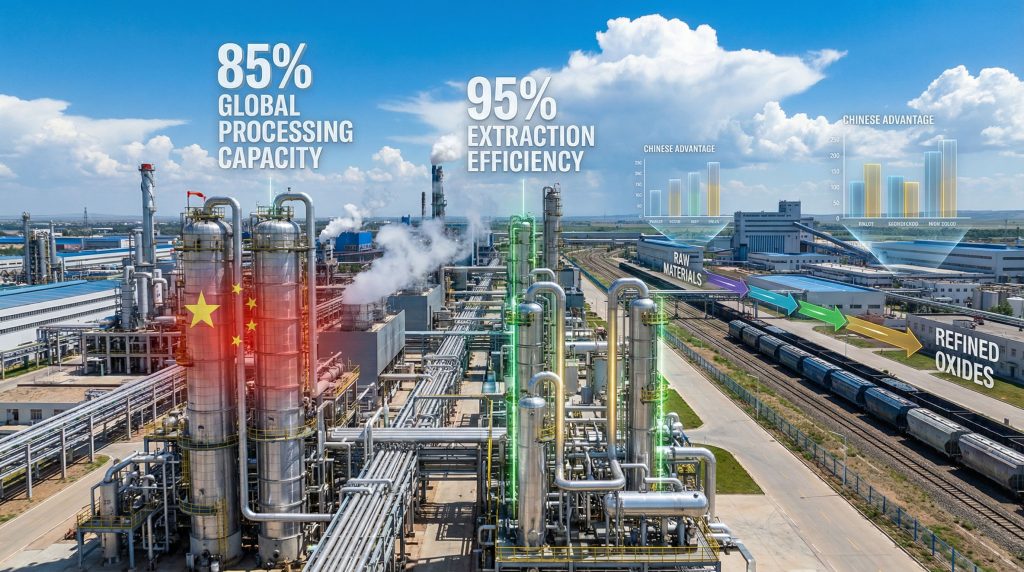
Chinese facilities have refined these processes to achieve separation efficiency rates significantly higher than global averages. While typical international operations struggle to maintain consistent purity levels above 95%, leading Chinese processors routinely achieve 99.9% purity ratings for critical elements like neodymium and dysprosium.
The gap becomes even more pronounced when examining recovery rates from processing operations. Chinese facilities have optimised their operations to recover over 90% of valuable elements from raw feedstock, compared to global averages ranging between 65-80%. This efficiency advantage translates directly into cost competitiveness and environmental performance.
When big ASX news breaks, our subscribers know first
Where Does China Process 85% of Global Rare Earth Elements?
Northern Processing Hub: Inner Mongolia's Industrial Complex
The Bayan Obo mine in Inner Mongolia represents the world's largest rare earth deposit by proven reserves, containing approximately 70 million tonnes of rare earth oxide equivalent. This geological advantage provided the foundation for China's most significant processing hub, centred around the Baotou Steel Rare-Earth Hi-Tech operations.
Baotou's facilities specialise in light rare earth element processing, particularly neodymium and praseodymium, which constitute the primary ingredients for permanent magnets used in electric vehicles and wind turbines. The integration between mining operations and processing facilities eliminates transportation bottlenecks and reduces processing costs through direct feedstock delivery systems.
The northern hub benefits from established transportation infrastructure connecting to China's major manufacturing centres. Rail networks transport both raw materials inward and finished products outward, while supporting infrastructure includes specialised storage facilities, chemical supply chains, and technical workforce housing.
Furthermore, environmental management systems have been upgraded significantly since 2016, incorporating advanced wastewater treatment capabilities and emission control technologies that meet increasingly stringent regulatory requirements while maintaining operational efficiency.
Southern Processing Corridor: Jiangxi Province Operations
Jiangxi Province emerged as China's second major rare earth processing corridor, specialising in heavy rare earth element extraction from ionic clay deposits. The cities of Ganzhou and Longnan host multiple processing facilities that employ advanced leaching techniques to extract valuable elements like dysprosium and terbium from clay-based ore bodies.
Heavy rare earth elements command significantly higher prices than their light counterparts due to supply constraints and critical applications in high-performance magnetic systems. Jiangxi's ionic clay deposits represent one of the world's few economically viable sources for these materials, creating strategic value beyond simple processing capacity.
The southern corridor has undergone substantial environmental remediation and facility modernisation programmes. Legacy pollution from earlier processing operations has been addressed through comprehensive cleanup initiatives, while new facilities incorporate closed-loop processing systems that minimise waste generation and environmental impact.
Modern processing facilities in Jiangxi employ electrokinetic mining industry innovation developed by Chinese research institutions, achieving dramatic reductions in ammonia emissions compared to conventional leaching methods. These technological advances maintain China's cost advantages while addressing environmental concerns that historically plagued the industry.
Coastal Refinement Centres: Export-Ready Processing
Xiamen Tungsten Company Limited operates strategic coastal processing facilities that serve as the final refinement stage before export to international markets. Located in Fujian Province, these facilities specialise in producing export-grade rare earth materials that meet international quality standards and certification requirements.
The coastal positioning provides logistical advantages for serving global markets while maintaining integration with domestic value-added manufacturing operations. Additionally, Xiamen's facilities can rapidly adjust production mix between export markets and domestic consumption based on pricing dynamics and policy directives.
Quality control systems at coastal facilities achieve international certifications including ISO standards that enable direct sales to demanding end-users in automotive, aerospace, and electronics industries. This capability eliminates the need for additional processing stages in destination countries, maintaining China's value capture throughout the supply chain.
How Do Chinese Solvent Extraction Technologies Outperform Global Competitors?
Advanced Chemical Separation Methodologies
Chinese rare earth processing facilities have developed proprietary solvent extraction methodologies that significantly outperform international competitors across multiple efficiency metrics. These technological advantages represent decades of accumulated research and development investment combined with large-scale operational optimisation.
The primary extraction stage, where rare earth elements are initially separated from ore concentrates, demonstrates the most dramatic efficiency differences. Chinese facilities achieve consistency levels that international operations struggle to match, particularly when processing lower-grade feedstock materials that require more sophisticated separation techniques.
| Processing Stage | Chinese Facility Performance | International Average | Efficiency Gap |
|---|---|---|---|
| Initial Concentration | 94-96% recovery | 60-75% recovery | 19-36% advantage |
| Chemical Purification | 99.5-99.9% purity | 95-98% purity | 1.5-4.9% advantage |
| Final Recovery | 88-92% yield | 65-80% yield | 8-27% advantage |
Note: Performance metrics vary by facility age, feedstock quality, and specific element being processed. Data represents industry estimates and may not reflect all operational variations.
Purification processes represent another area of significant Chinese advantage. The ability to achieve 99.9% purity levels consistently enables direct sales to high-specification end markets without additional refining stages. International facilities often require multiple processing cycles to achieve comparable purity, increasing costs and reducing throughput capacity.
Electrokinetic Mining Innovation and Environmental Integration
Chinese research institutions have pioneered electrokinetic mining technologies that address both economic and environmental challenges in rare earth processing. These innovations employ electrical fields to enhance ion mobility during leaching operations, dramatically improving extraction efficiency while reducing chemical consumption.
The Guangzhou Institute of Geochemistry, operating under the Chinese Academy of Sciences, has developed breakthrough methodologies that achieve substantial reductions in ammonia emissions compared to conventional processing techniques. In addition, these environmental improvements maintain economic competitiveness while addressing regulatory pressures and public health concerns.
Electrokinetic methods enable processing of lower-grade ore bodies that were previously considered economically unviable. This capability expands available feedstock resources and provides operational flexibility during periods of raw material constraints or pricing volatility.
Cost efficiency improvements from these technological advances compound over time, as facilities can process larger volumes of material with reduced chemical inputs and lower environmental compliance costs. The combination creates sustainable competitive advantages that become more pronounced as global environmental standards tighten.
Industrial-Scale Processing Economics and Cost Structure
Chinese rare earth processing achieves unit cost advantages through multiple factors including labour costs, energy pricing, regulatory environment, and scale economies from integrated supply chain management. These structural advantages prove difficult for international competitors to overcome without fundamental changes to their operating environments.
Scale economies become particularly important in chemical processing operations where fixed costs for specialised equipment, environmental management systems, and technical expertise must be distributed across production volumes. Chinese facilities operate at scales that enable full utilisation of capital-intensive separation equipment throughout production cycles.
Labour cost advantages persist despite rising wages in China's industrial regions. The combination of lower absolute wage levels and higher productivity from experienced workforces creates sustained cost competitiveness. Additionally, the availability of specialised technical expertise reduces training costs and operational disruptions common in newer facilities.
Energy costs benefit from government industrial policies that provide preferential pricing for strategic industries. While these subsidies face international trade scrutiny, they create immediate operational advantages that accumulate over multi-year production cycles.
Which State-Owned Enterprises Control China's Processing Capacity?
China Rare-Earths Group: The Consolidated Market Leader
The 2021 formation of China Rare-Earths Group Company Limited through mega-merger consolidation strategy created a dominant entity controlling substantial portions of China's processing capacity. This consolidation combined multiple previously independent state-owned enterprises under unified management, enabling coordinated production planning and strategic resource allocation.
The mega-merger integrated operations from China Minmetals Corporation and Aluminum Corporation of China subsidiaries, along with other state-controlled entities involved in rare earth extraction and processing. This vertical integration spans from mining operations through magnet manufacturing, creating a complete supply chain under single organisational control.
Market concentration through state-directed consolidation enables coordinated responses to international demand fluctuations, trade policy changes, and competitive pressures from emerging alternative suppliers. The unified structure can cross-subsidise operations during market downturns while maximising revenue during periods of strong demand.
Production coordination capabilities extend beyond individual facility optimisation to encompass strategic stockpiling, export quota management, and technology development priorities aligned with national industrial policy objectives rather than purely commercial considerations.
Regional Processing Specialists and Market Segmentation
Baotou Steel Rare-Earth Hi-Tech Co., Ltd. operates as the dominant processor in China's northern rare earth hub, specialising in light rare earth elements extracted from Inner Mongolia's Bayan Obo deposit. The company's integrated operations span from ore processing through magnetic material manufacturing, capturing value throughout the supply chain.
As a publicly traded entity on the Shanghai Stock Exchange, Baotou Steel provides greater operational transparency than privately held competitors. Annual financial reports reveal production volumes, cost structures, and capital investment patterns that demonstrate the scale advantages of integrated operations.
China Southern Rare Earth Group Co., Ltd. controls substantial processing capacity focused on heavy rare earth elements extracted from ionic clay deposits in Jiangxi Province and surrounding regions. Heavy rare earth specialisation commands premium pricing due to supply constraints and critical applications in advanced magnetic systems.
| Company | Primary Location | Specialisation | Market Position |
|---|---|---|---|
| Baotou Steel Rare-Earth | Inner Mongolia | Light REE Processing | Northern Hub Leader |
| China Southern Rare Earth | Jiangxi Province | Heavy REE Extraction | Southern Corridor |
| Xiamen Tungsten | Fujian Province | Export Processing | Coastal Refinement |
Xiamen Tungsten Company Limited operates coastal processing facilities that serve both export markets and domestic value-added manufacturing operations. The company's strategic positioning enables rapid response to international demand changes while maintaining integration with China's domestic supply chains.
Technology Transfer Restrictions and Export Control Implementation
Chinese authorities have implemented comprehensive restrictions on technology transfer and foreign investment in rare earth processing facilities. These policies protect accumulated technological advantages while limiting international competitors' access to Chinese processing innovations and operational expertise.
Recent China export controls target processing equipment, chemical reagents, and technical documentation related to solvent extraction methodologies. While raw rare earth materials continue flowing to international markets under quota systems, the technology required to establish competing processing facilities faces increasing restrictions.
Foreign investment limitations in separation facilities prevent international companies from acquiring Chinese processing assets or establishing joint ventures that could facilitate technology transfer. These restrictions extend beyond direct ownership to encompass licensing agreements, technical partnerships, and equipment sales.
Dual-use technology classifications cover processing equipment that could support both civilian and military applications. This designation enables export restrictions based on national security considerations rather than purely commercial trade policy, providing additional regulatory tools for controlling technology dissemination.
What Environmental Challenges Shape China's Processing Infrastructure?
Legacy Pollution Remediation and Infrastructure Modernisation
China's rare earth processing infrastructure China inherited substantial environmental liabilities from decades of rapid industrial development prioritising production volumes over environmental protection. Legacy pollution remediation programmes now address contaminated soil, groundwater systems, and accumulated waste materials at processing sites throughout major production regions.
Jiangxi Province has invested heavily in wastewater treatment infrastructure capable of processing tens of thousands of metric tonnes daily from regional processing facilities. These systems employ advanced treatment technologies that remove ammoniacal nitrogen contamination and other processing byproducts before discharge into local water systems.
Illegal operation shutdowns and environmental compliance enforcement campaigns have eliminated numerous small-scale processors that lacked proper environmental controls. This consolidation improved overall industry environmental performance while concentrating production in larger facilities with better pollution control systems.
Ammoniacal nitrogen contamination cleanup initiatives target the specific pollutants generated by ionic clay rare earth extraction using ammonia-based leaching solutions. These specialised remediation programmes address both active contamination and legacy pollution from historical processing operations.
Modern Environmental Standards Integration and Compliance Systems
Industrial park consolidation has enabled upgraded processing facilities incorporating comprehensive environmental management systems that meet increasingly stringent regulatory requirements. Modern facilities employ closed-loop processing systems that minimise waste generation while maximising resource recovery.
Erosion control systems and waste management protocols address the environmental challenges specific to rare earth processing operations. These systems manage both liquid effluents and solid waste streams while preventing contamination of surrounding soil and groundwater resources.
Environmental monitoring systems provide real-time tracking of emission levels, water quality parameters, and waste generation rates. This data supports both regulatory compliance reporting and operational optimisation to minimise environmental impact while maintaining production efficiency.
The 2016 regulatory framework established comprehensive standards for rare earth processing operations including specific limits for ammonia emissions, wastewater discharge parameters, and solid waste management requirements. Furthermore, compliance with these standards requires substantial capital investment in environmental control technology.
However, mine reclamation innovation continues to evolve as companies recognise the importance of environmental stewardship in maintaining social licence to operate.
How Does China's Processing Monopoly Impact Global Supply Chains?
Strategic Export Management and Market Control Mechanisms
China employs sophisticated export quota management systems that create measured market friction rather than complete supply cutoffs. This calibrated approach enables Beijing to influence global pricing and supply dynamics while avoiding the economic and political costs of comprehensive export bans.
Licensing systems provide administrative tools for controlling export volumes, timing, and destination markets without requiring formal trade restrictions that might trigger international retaliation. These mechanisms create uncertainty that influences global supply chain planning and investment decisions.
Market friction creation through regulatory complexity, documentation requirements, and approval delays imposes costs on international buyers while preserving plausible deniability regarding deliberate trade restriction. This approach proves more sustainable than overt export controls that attract international attention and diplomatic pressure.
Price ceiling establishment occurs through the interaction between Chinese domestic pricing and export availability. When export quotas tighten, international prices rise until they reach levels that trigger demand destruction or substitution behaviours, effectively capping the economic benefits of restricting supply.
According to the International Energy Agency, "supply concentration risks have now become reality as new export controls create structural changes in global critical mineral markets."
Downstream Manufacturing Integration and Value Chain Control
Chinese rare earth processing facilities demonstrate extensive co-location with magnet production and advanced manufacturing operations. This integration enables immediate consumption of processed materials within China's domestic supply chains while reducing transportation costs and inventory requirements.
Electric vehicle and wind turbine supply chain control extends from rare earth processing through component manufacturing to final assembly operations. This vertical integration provides Chinese manufacturers with cost advantages and supply security impossible for international competitors to replicate without establishing comparable processing capacity.
Defense industry applications and strategic material reserves create additional layers of supply chain control beyond purely commercial considerations. Military end-uses for rare earth materials enable national security justifications for export restrictions and technology transfer limitations.
The combination of processing capacity concentration and downstream integration creates compound advantages that strengthen over time as global demand increases and alternative suppliers struggle to achieve comparable scale and efficiency. This is particularly concerning for critical minerals energy security planning in Western nations.
The next major ASX story will hit our subscribers first
Can Alternative Processing Infrastructure Challenge China's Dominance?
India's Processing Development Potential and Infrastructure Challenges
India possesses significant monazite sand deposits along its coastal regions that contain economically recoverable rare earth concentrations. These resources provide the geological foundation for potential processing industry development, supported by technical workforce capabilities and government policy interest in reducing import dependence.
However, infrastructure investment requirements for establishing competitive processing facilities exceed current budgetary allocations and private sector capabilities. The capital requirements for modern solvent extraction facilities, environmental control systems, and supporting infrastructure demand sustained commitment over multi-year development periods.
Geopolitical support from Western nations seeking supply chain diversification provides potential funding sources and technology transfer opportunities. Yet this support must translate into concrete investment programmes that can overcome technical challenges and regulatory obstacles within realistic timeframes.
The execution gap between policy announcements and operational processing capacity reflects the complexity of establishing chemical processing operations that meet both economic and environmental requirements. Technical expertise, regulatory frameworks, and supply chain integration require development across multiple sectors simultaneously.
Western Processing Revival Challenges and Investment Requirements
Environmental permitting processes in Western nations create substantial delays and uncertainty for new rare earth processing facilities. Public opposition to chemical processing operations, combined with complex regulatory approval procedures, extends project development timelines far beyond Chinese alternatives.
| Challenge Category | Development Timeline | Capital Requirements | Success Probability |
|---|---|---|---|
| Environmental Permits | 5-10 years | $50-100 million | Moderate |
| Technical Expertise | 10-15 years | $200-500 million | Low-Moderate |
| Scale Economics | 15-25 years | $1-3 billion | Low |
Technical expertise development requires rebuilding institutional knowledge that was lost when Western rare earth processing operations ceased in previous decades. Training programmes, research partnerships, and operational experience accumulation demand extended timeframes that cannot be compressed through increased funding alone.
Scale economics present perhaps the greatest challenge, as new Western processing facilities must compete against established Chinese operations benefiting from decades of optimisation and integration. Achieving cost competitiveness requires either technological breakthroughs or sustained subsidisation during market development phases.
Substitution Technology Development and Alternative Strategies
Rare-earth-free motor design advancement represents a potential long-term solution to supply chain dependency concerns. Research programmes targeting alternative magnetic systems, improved efficiency designs, and novel materials combinations could reduce rare earth consumption in critical applications.
Alternative magnet chemistry research explores options including ferrite magnets, electromagnetic systems, and hybrid approaches that reduce rare earth content while maintaining performance characteristics. These technological pathways require substantial research investment and extended development timelines before commercial viability.
Cost-performance trade-offs in substitution strategies often involve accepting reduced efficiency or increased system complexity in exchange for supply chain security. These compromises may prove acceptable for certain applications while remaining inadequate for others requiring maximum performance density.
The timeline for meaningful substitution technology deployment extends beyond current policy planning horizons, making alternative processing capacity development a more realistic near-term strategy for addressing supply chain vulnerabilities. This is particularly relevant for countries developing their critical minerals strategy.
What Does China's Processing Infrastructure Mean for Investors?
Market Bifurcation and Pricing Dynamics Evolution
China's processing dominance creates increasingly distinct pricing environments between Chinese domestic markets and international supply chains. This bifurcation generates arbitrage opportunities for entities capable of accessing both market segments while creating planning challenges for international manufacturers.
Government-backed offtake agreements and price floor mechanisms provide stability for Chinese processing operations while creating additional uncertainty for international competitors. These support systems enable Chinese facilities to maintain operations during market downturns that might force international facilities to curtail production.
Regional supply chain development investment opportunities emerge as governments and corporations seek alternatives to Chinese processing capacity. These investments carry substantial risk due to technical challenges and uncertain demand dynamics, but offer potentially significant returns if successful.
Investment strategies must account for the extended timeframes required for processing infrastructure development and the competitive response capabilities of established Chinese operations. Patient capital and government support prove essential for viable alternative processing projects.
Technology Transfer and Licensing Implications for Market Development
Processing equipment export restrictions impact the capital costs and technical feasibility of establishing alternative processing capacity outside China. International projects may require development of domestically manufactured equipment or acceptance of older, less efficient technologies.
Joint venture limitations and technology sharing constraints prevent international companies from accessing Chinese processing innovations through conventional partnership arrangements. Alternative approaches including independent research programmes and technology licensing from non-Chinese sources require higher investment and longer development timelines.
Alternative supply chain development funding requirements exceed the capabilities of private sector entities alone, necessitating government participation through direct investment, loan guarantees, or other support mechanisms. The scale of required investment and extended payback periods demand patient capital sources aligned with strategic rather than purely financial objectives.
Research by the Center for Strategic and International Studies indicates that "developing alternative rare earth processing hubs requires coordinated analytical approaches combining technical feasibility, economic viability, and strategic considerations across multiple jurisdictions."
Investment Disclaimer: The analysis presented involves projections and assumptions about complex supply chain dynamics, government policies, and technology development timelines. Actual market conditions, policy changes, and technological developments may differ materially from these assessments. Investors should conduct independent due diligence and consider consulting qualified professionals before making investment decisions related to critical minerals supply chains or processing infrastructure development projects.
Looking for Mining Investment Opportunities in Critical Minerals?
Discovery Alert's proprietary Discovery IQ model delivers real-time alerts on significant ASX mineral discoveries, instantly empowering subscribers to identify actionable opportunities ahead of the broader market. Understand why historic discoveries can generate substantial returns by visiting Discovery Alert's dedicated discoveries page, showcasing exceptional examples of major mineral finds.