June 27, 2026
Global supply chain vulnerabilities have exposed critical dependencies that threaten industrial competitiveness and national security. As manufacturing economies seek alternatives to concentrated rare earth sources, new regional hubs emerge from geological advantage combined with strategic policy intervention. This dynamic reshapes traditional commodity flows and creates opportunities for jurisdictions with both resource endowment and processing ambition, particularly as global trade tensions continue to intensify.
Minas Gerais represents a compelling case study in this transformation, where substantial rare earth deposits intersect with established mining infrastructure and deliberate government strategy. The state's geological inheritance positions it uniquely within global supply chain diversification efforts, yet translating mineral wealth into processing capability requires overcoming formidable technical and capital barriers. Furthermore, the development of rare earth processing in Minas Gerais aligns with broader trends in mining industry evolution towards value-added production.
Geological Foundation and Project Development Landscape
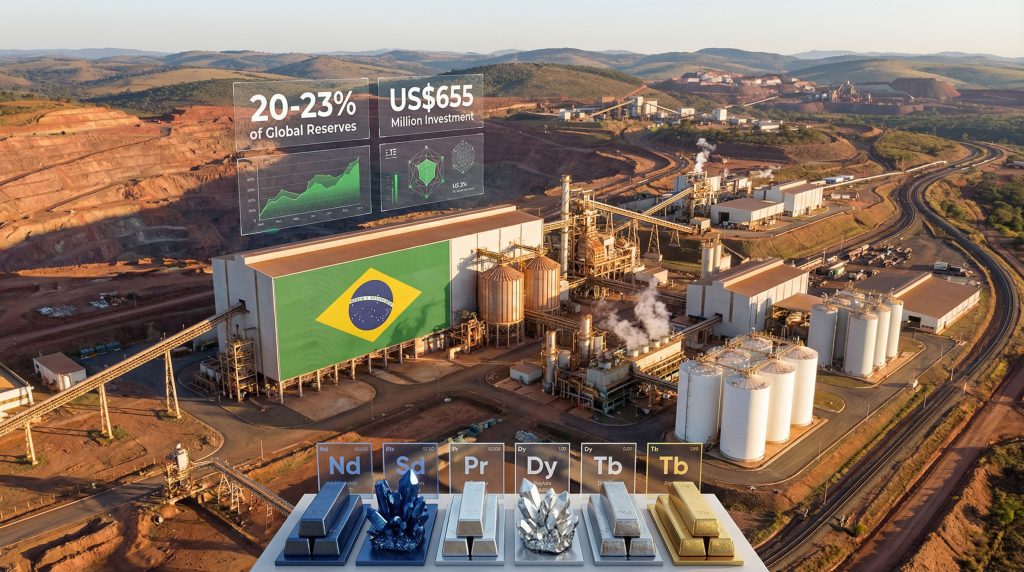
The rare earth potential of Minas Gerais stems from exceptional geological endowment concentrated in proven mineralised districts. Brazil controls approximately 20-23% of global rare earth reserves, with significant concentrations located within the state's established mining corridors. The Poços de Caldas region has emerged as the primary focus, hosting carbonatite and alkaline igneous complexes that typically contain mixed rare earth oxide assemblages.
Current development activity centres on two major projects representing substantial capital commitments. Companies such as Meteoric Resources are advancing the Caldeira project, which demonstrates the international interest in the region's potential.
| Project | Company | Estimated CapEx | Development Phase |
|---|---|---|---|
| Colossus | Viridis Mining | ~$300 million | Exploration to Early Development |
| Caldeira | Meteoric Resources | ~$350 million | Exploration to Early Development |
These initiatives collectively represent approximately $655 million in proposed capital expenditures, demonstrating serious investor interest in the region's potential. However, both projects remain in early development phases, requiring extensive drilling programmes, metallurgical testing, and feasibility studies before advancing to production decisions.
Reserve Classification and Development Timelines
The progression from geological potential to commercial production follows established industry protocols that typically span 5-8 years for complex rare earth projects. Current reserve estimates in Minas Gerais require classification advancement through:
- Inferred Resources: Initial geological modelling and limited sampling
- Indicated Resources: Systematic drilling and grade continuity confirmation
- Measured Resources: Detailed geological knowledge suitable for mine planning
- Proven and Probable Reserves: Economic viability demonstration under current market conditions
Most Minas Gerais projects currently report inferred resources, necessitating substantial additional investment in exploration and engineering before reserve conversion becomes possible. This timeline constraint affects both project financing and production scheduling across the district.
Metallurgical Complexity Factors
Rare earth deposits in the Poços de Caldas region contain mixed lanthanide assemblages requiring sophisticated separation processes. Unlike simpler mineral commodities, rare earth processing demands:
- Solvent extraction circuits for individual element separation
- Multi-stage purification systems to achieve commercial-grade oxides
- Waste management infrastructure for radioactive and acidic byproducts
- Environmental controls meeting Brazilian and international standards
The geological characteristics of local deposits will determine processing complexity and capital requirements, factors that remain under investigation across active projects. Moreover, developing effective waste management solutions represents a critical component of sustainable rare earth processing operations.
When big ASX news breaks, our subscribers know first
State Policy Architecture and Public Sector Engagement
Minas Gerais has adopted an interventionist approach to rare earth development, leveraging state-controlled entities to de-risk private investment and accelerate project timelines. This strategy draws directly from the state's successful niobium sector development, where public-private partnerships enabled Brazil to capture global market leadership in specialised metallurgical applications.
Institutional Framework and Risk Sharing
The state's rare earth strategy operates through several key mechanisms:
- Codemig/Codemge involvement in early-stage exploration and project structuring
- Risk-sharing partnerships between state entities and private developers
- Infrastructure coordination linking mining projects to processing facilities
- Regulatory streamlining to reduce permitting bottlenecks and timeline uncertainty
This institutional approach mirrors successful models deployed in other critical mineral sectors, where government participation reduces capital costs and accelerates development timelines. However, rare earth processing presents technical challenges not encountered in traditional Minas Gerais commodities, requiring new forms of public-private collaboration.
Integration Strategy Beyond Extraction
Unlike conventional mining development focused solely on ore production, the Minas Gerais strategy explicitly targets downstream processing capabilities. This value-chain integration approach reflects understanding that commodity export dependence limits economic leverage and strategic autonomy.
State policy emphasises:
- Processing facility development capable of producing refined rare earth oxides
- Technology transfer partnerships with international separation process developers
- Workforce training programmes for specialised metallurgical operations
- Export infrastructure linking processing facilities to global markets
The transition from raw material export to processed product manufacturing represents a fundamental shift in economic strategy, requiring sustained investment and technical capability development over multiple business cycles.
Technical Infrastructure Requirements and Processing Challenges
The path from rare earth ore to separated oxides involves some of the most technically demanding processes in modern metallurgy. Establishing commercial-scale rare earth processing in Minas Gerais requires overcoming barriers that have constrained development in numerous other jurisdictions attempting similar transitions.
Capital Intensity and Technology Transfer
Integrated rare earth processing facilities typically require $2-5 billion in capital investment, depending on throughput capacity and product specifications. This investment encompasses:
- Solvent extraction plants using specialised organic extractants and hydrocarbon solvents
- Environmental management systems for waste neutralisation and disposal
- Quality control laboratories ensuring product specifications meet end-user requirements
- Utility infrastructure providing reliable power, water, and chemical supply chains
Technology transfer represents the most critical constraint for Brazilian rare earth ambitions. Established producers guard separation process intellectual property, leaving new entrants with three primary pathways:
- Licensed technology acquisition from existing process developers (subject to geopolitical constraints)
- Independent process development requiring extensive R&D investment and validation
- Strategic acquisition of companies possessing proven separation technologies
Each approach involves distinct risk profiles, capital requirements, and timeline implications that affect project viability assessments.
Environmental Management and Regulatory Compliance
Rare earth processing generates substantial waste streams requiring sophisticated management systems. Environmental considerations include:
- Acidic waste neutralisation consuming limestone or lime in continuous operations
- Radioactive material handling for naturally occurring thorium and uranium
- Solvent recovery systems preventing organic compound releases
- Solid waste stabilisation ensuring long-term disposal safety
These environmental systems typically represent 15-25% of total project capital costs while adding operational complexity that requires specialised expertise. Brazilian environmental licensing processes for processing facilities involve multi-stage approvals potentially extending 18-36 months, affecting project development schedules.
Workforce Development and Technical Expertise
Commercial rare earth separation requires specialised personnel across multiple technical disciplines:
- Process metallurgists understanding solvent extraction chemistry and equipment operation
- Environmental engineers managing complex waste streams and regulatory compliance
- Quality control specialists ensuring product specifications and customer requirements
- Maintenance technicians capable of servicing specialised processing equipment
Brazil's substantial mining workforce provides foundational skills, but rare earth-specific expertise remains extremely limited. Training programmes through academic institutions or industrial partnerships require 2-3 years minimum to develop competent personnel, representing an additional constraint on rapid capacity development.
Global Competitive Positioning and Supply Chain Context
The emergence of rare earth processing in Minas Gerais occurs within evolving global supply chain dynamics driven by strategic competition and diversification imperatives. Understanding competitive positioning requires analysis of how Brazilian capabilities compare against established producers and alternative development initiatives worldwide.
Reserve Distribution and Processing Maturity Comparison
| Region | Reserve Share | Processing Capability | Government Role | Market Position |
|---|---|---|---|---|
| Minas Gerais | 20-23% | Early Development | Public-Private Partnership | Emerging Alternative |
| China | ~37% | Dominant Global Leader | State-Led Integration | Market Controller |
| Myanmar | ~15% | Limited Processing | Military-Controlled | Constrained Development |
| Australia | ~8% | Established (Lynas) | Private Sector Led | Proven Alternative |
This comparison reveals both opportunity and challenge for Brazilian development. While reserve endowment provides geological foundation, processing maturity gaps require substantial investment and technology development to achieve competitive positioning. Consequently, initiatives like the Australian critical minerals strategy offer valuable lessons for Brazil's approach.
Supply Chain Diversification Drivers
Western economies have implemented comprehensive strategies to reduce rare earth import dependence, creating market opportunities for non-Chinese suppliers. Key policy frameworks include:
- EU Critical Raw Materials Act: Targets 10% of annual rare earth consumption from European or allied sources by 2030
- US CHIPS and Science Act: Provides funding for domestic and allied critical mineral capacity development
- Japan-Australia Strategic Partnership: Emphasises secure rare earth supply chain development
- Indo-Pacific Mineral Security Partnership: Coordinates allied nation capacity building initiatives
These frameworks create potential market access for Brazilian rare earth products, provided processing capabilities can achieve commercial scale and quality specifications. Additionally, the development of a European CRM facility demonstrates the commitment to supply chain diversification.
Technological Competitive Factors
Success in global rare earth markets depends on several technical and economic factors where Minas Gerais faces both advantages and constraints:
Advantages:
- Established mining infrastructure and geological expertise
- Stable political and regulatory environment compared to alternative jurisdictions
- Strategic location providing access to both Atlantic and Pacific markets
- Existing metallurgical industry base in aluminium, steel, and specialty metals
Constraints:
- Limited rare earth separation experience and technology access
- Capital market depth for multi-billion dollar processing investments
- Competition from established producers with proven operational track records
- Technical workforce development requirements for specialised operations
Strategic Implications for Supply Chain Independence
The development of integrated rare earth processing in Minas Gerais carries implications extending beyond Brazilian economic development to global supply chain security and strategic competition dynamics. Success or failure will influence broader patterns of critical mineral independence efforts worldwide.
Alignment with Western Diversification Goals
Brazilian rare earth capacity development aligns with diversification strategies pursued by the United States, European Union, and allied nations seeking alternatives to Chinese supply dominance. Key strategic benefits include:
- Geographic diversity reducing single-point-of-failure risks in global supply chains
- Political stability providing reliable supply access during geopolitical tensions
- Processing capability enabling value-chain control beyond raw material extraction
- Market competition potentially moderating rare earth price volatility through increased supply
However, realising these benefits requires sustained capital commitment and technical execution across multiple complex projects simultaneously.
Capital Flow Dynamics and Investment Risk
Financing multi-billion dollar rare earth processing infrastructure involves several risk categories affecting investor decision-making:
Technical Execution Risks:
- Metallurgical process scaling from laboratory to commercial operations
- Environmental system performance under continuous operating conditions
- Product quality consistency meeting end-user specifications
- Operational cost competitiveness against established producers
Market and Commercial Risks:
- Rare earth price volatility affecting project economics
- Competition from Chinese producers with lower cost structures
- Technology access limitations constraining process optimisation
- Long-term supply contract negotiation with end-users
Regulatory and Political Risks:
- Environmental permitting delays or requirement changes
- Brazilian mining policy modifications affecting project economics
- International trade policy shifts influencing market access
- Currency fluctuation impacts on dollar-denominated capital costs
Timeline Realism and Execution Milestones
Realistic assessment of development timelines suggests that meaningful rare earth processing in Minas Gerais requires sustained effort across multiple business cycles. According to Minas Gerais' strategy for rare earth projects, key milestones include:
2025-2027: Foundation Phase
- Environmental permitting completion for major projects
- Technology transfer agreements or independent process development
- Initial pilot-scale separation facility construction and testing
- Workforce training programme implementation
2027-2030: Construction Phase
- Commercial-scale processing facility construction
- Utility infrastructure development and commissioning
- Environmental management system installation and testing
- Market development and customer qualification processes
2030-2035: Operations Phase
- Commercial production ramp-up and process optimisation
- Product quality certification and market penetration
- Potential capacity expansion based on market demand
- Regional supply chain integration and logistics optimisation
This timeline assumes successful navigation of technical, financial, and regulatory challenges that have constrained similar initiatives in other jurisdictions.
Risk Assessment and Uncertainty Factors
The ambitious scope of developing integrated rare earth processing in Minas Gerais involves multiple categories of execution risk that could significantly impact project outcomes and investment returns. Comprehensive risk assessment enables more informed decision-making by both public and private stakeholders.
Technology and Process Development Risks
Rare earth separation technology presents unique challenges that have historically caused project delays and cost overruns:
- Metallurgical complexity: Individual rare earth elements require specific separation conditions, with heavy rare earth elements (HREEs) particularly difficult to process
- Environmental waste management: Processing generates 1-3 tons of waste per ton of product, requiring sophisticated treatment systems
- Quality control precision: End-users demand 99.9%+ purity levels requiring extensive analytical capabilities
- Solvent recovery efficiency: Economic viability depends on >95% organic solvent recovery rates
Historical precedents illustrate execution challenges. Molycorp's Mountain Pass expansion (2010-2015) involved $1.2 billion in capital investment but experienced significant operational difficulties leading to bankruptcy. These examples highlight the gap between feasibility study projections and commercial reality in rare earth processing.
Regulatory and Permitting Uncertainties
Brazilian environmental and mining regulations present both opportunities and risks for large-scale processing development:
Permitting Requirements:
- Environmental licensing (LP, LI, LO) requiring multi-stage approval processes
- Mining permits from Agência Nacional de Mineração (ANM)
- State-level environmental approvals coordinated with municipal authorities
- Community consultation and social licence development
Timeline Variability:
- Standard environmental licensing: 18-36 months minimum
- Community resistance or environmental concerns: potential multi-year delays
- Regulatory requirement changes during development: scope and cost implications
- Inter-agency coordination challenges: procedural delays and uncertainty
The December 2025 licensing decisions mentioned for key projects represent critical gates, but regulatory approval does not guarantee subsequent operational success or market viability.
Market Dynamics and Commercial Viability
Rare earth markets exhibit characteristics that create both opportunities and risks for new producers:
Price Volatility Factors:
- Chinese production policy changes significantly impact global prices
- End-user inventory management affects short-term demand patterns
- Geopolitical tensions create both supply constraints and demand surges
- Technology substitution efforts influence long-term demand trajectories
Customer Development Challenges:
- End-users prefer qualified suppliers with proven delivery track records
- Product certification processes require 12-24 months minimum
- Long-term supply agreements essential for project financing but difficult to secure pre-production
- Competition from established suppliers with existing customer relationships
Market success for new rare earth producers requires not only technical capability but also sustained relationship building with end-users who prioritise supply security over price optimisation.
Financing and Capital Market Considerations
Multi-billion dollar rare earth processing infrastructure requires sophisticated financing structures that may challenge traditional project finance approaches:
Capital Intensity Implications:
- Processing facilities require 60-70% of total project capital before revenue generation
- Long construction timelines increase financing costs and market risk exposure
- Technology licensing fees and know-how transfer costs add 10-15% to capital requirements
- Working capital requirements substantial due to long customer qualification cycles
Public Sector Role and Limitations:
- State participation can reduce private sector risk but may constrain operational flexibility
- Government budget constraints limit sustained support during development challenges
- Political changes could affect public sector commitment and policy continuity
- International financing restrictions may limit technology transfer partnerships
The next major ASX story will hit our subscribers first
Future Outlook and Strategic Positioning
The development of rare earth processing in Minas Gerais represents a critical test of whether emerging jurisdictions can successfully challenge established supply chain patterns through deliberate policy intervention and sustained investment. Success would demonstrate a replicable model for critical mineral independence, while failure would reinforce existing concentration dynamics.
Scenario Analysis and Probability Assessments
Optimistic Scenario (30% probability):
Successful technology transfer, efficient permitting processes, and sustained capital availability enable commercial-scale rare earth processing by 2030. Brazil becomes a significant non-Chinese supplier serving Western demand diversification, generating substantial economic returns and strategic influence.
Base Case Scenario (50% probability):
Mixed execution across projects, with some facilities achieving commercial operation while others experience delays or technical difficulties. Brazil develops meaningful but limited rare earth processing capability, contributing to global supply diversity without achieving transformational impact.
Pessimistic Scenario (20% probability):
Technology transfer constraints, capital shortfalls, or regulatory delays prevent large-scale processing development. Projects remain focused on ore extraction with limited value-chain integration, replicating traditional commodity export patterns.
Strategic Success Factors
Achieving optimistic outcomes requires alignment across multiple critical factors:
Technical Execution Excellence:
- Successful pilot-scale process validation before commercial-scale investment
- Technology partner selection balancing capability with knowledge transfer willingness
- Environmental management system design preventing operational disruptions
- Quality control system development ensuring customer specification compliance
Policy Coordination and Continuity:
- Sustained state support across electoral cycles and budget pressures
- Regulatory streamlining without compromising environmental or safety standards
- Infrastructure development coordination linking projects to export facilities
- Workforce development programmes aligned with industry timeline requirements
Market Development and Customer Relations:
- Early engagement with potential end-users during facility development
- Product certification processes initiated before commercial production
- Long-term supply agreement negotiation providing revenue certainty for financing
- Market intelligence systems tracking demand trends and competitive developments
Broader Implications for Critical Mineral Strategy
The Minas Gerais experience will influence broader patterns of critical mineral development worldwide. Success would encourage similar initiatives in other resource-rich jurisdictions, while failure might reinforce existing supply concentration and discourage alternative development efforts.
Key learnings from the Brazilian experience will inform:
- Technology transfer mechanisms enabling emerging producers to access separation processes
- Public-private partnership models balancing risk sharing with operational efficiency
- Environmental management approaches addressing rare earth processing waste streams
- Market development strategies connecting new producers with end-user demand
The stakes extend beyond economic returns to encompass strategic autonomy, supply chain security, and technological independence for both Brazil and its potential customers in diversified supply chains.
Disclaimer: This analysis involves forward-looking assessments based on available information as of December 2025. Rare earth project development involves substantial technical, commercial, and regulatory risks that could significantly impact outcomes. Investment decisions should incorporate comprehensive due diligence and professional consultation appropriate to specific circumstances.
Could You Benefit From Real-Time Mining Discovery Alerts?
Discovery Alert's proprietary Discovery IQ model delivers instant notifications when significant ASX mineral discoveries are announced, helping investors identify opportunities like the rare earth developments emerging in global markets. Take advantage of immediate market insights and begin your 30-day free trial to position yourself ahead of major mineral discoveries before they move the market.