June 8, 2026
The Invisible Weapon That Kept Western Rare Earth Industries Permanently Grounded
There is a category of strategic competition that never makes the front pages of defence journals or trade law reviews, yet shapes the technological capacity of entire nations for generations. It operates not through sanctions, military posturing, or diplomatic pressure, but through the quiet manipulation of commodity pricing indices and the selective transfer of industrial knowledge. Understanding how China built and defended its rare earth processing monopoly requires examining this less visible form of economic warfare — one that has shaped how Western governments are now responding.
The phrase how China killed every rare earth competitor before it could get started is not hyperbole. It is an accurate description of a repeating pattern that has dismantled commercial project after commercial project, from California to Canada to Australia, every time geopolitical anxiety pushed rare earth prices high enough to attract serious capital investment.
When big ASX news breaks, our subscribers know first
Why Rare Earth Processing Is Unlike Any Other Industrial Challenge
Rare earth elements occupy a peculiar position in the global materials economy. China holds approximately 35 to 40 percent of global rare earth reserves by volume, yet commands more than 85 percent of global processing capacity. That gap between geological endowment and industrial control is not an accident. It reflects decades of deliberate capability building in the technically demanding stages that transform raw ore into usable metals and magnets.
Is Processing Complexity the Real Barrier?
Processing complexity is the key variable that separates rare earths from other critical minerals. Unlike lithium or cobalt, where the refining pathway is relatively well understood and globally distributed, rare earth processing challenges require solvent extraction techniques that are chemically intensive, yield-sensitive, and enormously difficult to optimise without operational experience accumulated over years.
The purity standards required for defence and advanced technology applications are demanding, and small variations in feedstock composition can require entirely different chemical processing approaches.
The table below illustrates the distribution of rare earth elements across strategic industries, highlighting why the processing gap creates leverage that extends into defence, clean energy, and advanced technology simultaneously:
| Rare Earth Element | Primary Application | Strategic Sector |
|---|---|---|
| Neodymium (Nd) | Permanent magnets | Defence, EVs, Wind Turbines |
| Dysprosium (Dy) | High-temperature magnets | Aerospace, Guided Munitions |
| Terbium (Tb) | Magnet performance enhancement | Defence Electronics |
| Praseodymium (Pr) | Alloys and magnets | EV Motors, Robotics |
| Cerium (Ce) | Catalytic converters, polishing | Automotive, Optics |
| Lanthanum (La) | Battery electrodes | Hybrid Vehicles, Refining |
Critical Insight: The processing complexity of rare earth separation is not merely technical. It is a structural barrier that requires years of operational learning to master, which means a country that achieves early dominance in processing accumulates an experiential advantage that cannot be replicated simply by acquiring equipment or funding new facilities.
How the Asian Metal Index Became the Most Effective Non-Military Weapon in Modern Industrial Policy
The Asian Metal Index, known as the AMI, is a China-based pricing benchmark that has functioned for decades as the primary global reference point for rare earth material pricing. The critical structural feature of this arrangement is that China controls both the supply volumes and the index itself, meaning that price signals in the global rare earth market have historically reflected strategic calculation as much as genuine supply and demand dynamics.
The mechanism through which this pricing control functioned as a competitive weapon was straightforward but devastating in its effects. When a Western mining or processing project reached a stage of development that represented a genuine threat to Chinese market dominance, the response was to suppress prices through coordinated oversupply, making the investment case for the competitor economically unviable.
Because Western projects were financed through commercial capital markets, their viability depended on sustained price levels that justified the capital expenditure required to build processing infrastructure. A state actor with the capacity to absorb short-term losses in exchange for long-term strategic dominance held an asymmetric advantage that private capital structures could not withstand. As one industry analysis notes, this approach has proven remarkably effective across multiple decades and investment cycles.
Three Price Suppression Cycles and Their Industrial Consequences
The pattern has repeated with remarkable consistency across three documented cycles:
| Period | Market Trigger | Price Impact | Western Industry Outcome |
|---|---|---|---|
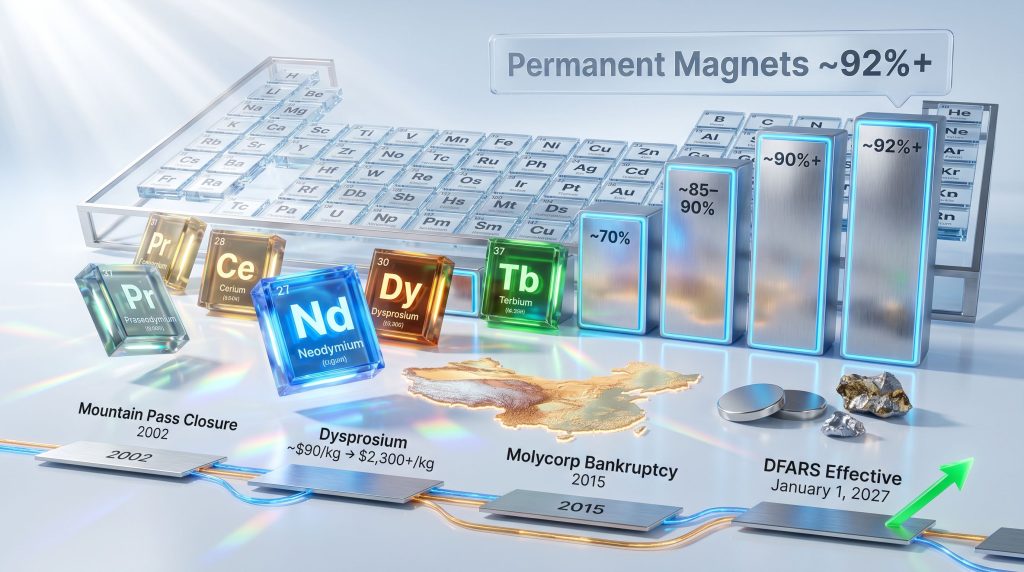
| Early 2000s | Chinese production scale-up | Sustained low pricing environment | Mountain Pass mine closure (2002); U.S. capacity falls to near zero |
| 2010 to 2012 | Export quota crisis and territorial embargo | Dysprosium oxide: ~$90/kg to $2,300+/kg | Surge of Western investment across North America and Australia |
| 2013 to 2016 | Chinese supply flood following price peak | Dysprosium oxide collapses below $200/kg | Molycorp bankruptcy (2015); widespread project abandonment globally |
Each cycle followed the same logic. Higher prices attracted Western capital. Western capital formation represented a future threat to Chinese dominance. The response was to flood the market with supply, crash prices faster than competitors could adjust their cost structures, and wait for commercial financing structures to fail. The strategy worked every time.
The 2010 Territorial Dispute and the First Open Weaponisation of Supply
In September 2010, a territorial standoff between China and Japan over the Senkaku Islands triggered what analysts now regard as the clearest demonstration of rare earth supply as a geopolitical instrument. The broader context of rare earth geopolitics had been building for years, however this episode brought it into sharp focus. China informally halted rare earth shipments to Japan, and within months the consequences for global pricing were severe.
Dysprosium oxide alone moved from approximately $90 per kilogram in early 2009 to more than $2,300 per kilogram by mid-2011, representing a price appreciation in excess of 2,400 percent according to industry pricing data reviewed at the time by outlets including Industrial Info Resources.
Historical Benchmark: The 2010 Japan episode established a precedent that has shaped every subsequent Western policy discussion on critical mineral supply chains. A state actor willing to accept short-term economic costs imposed disproportionate strategic pain on a technologically dependent adversary without deploying a single military asset.
What followed the price spike was a genuine investment surge. Projects across Canada, the United States, and Australia attracted serious capital for the first time in years. Mountain Pass, which had closed in 2002, was revived under Molycorp with significant investor backing. For a period, it appeared that Western supply chain diversification might finally become commercially viable.
The subsequent price collapse demolished that possibility. As China eased restrictions and released suppressed supply, the market moved faster than any commercial operator could respond. Dysprosium oxide fell back below $200 per kilogram by 2016, Molycorp filed for bankruptcy protection in 2015, and the cycle of Western investment followed by strategic price suppression completed itself once again.
Technology Dependency: The Dimension That Amplified Every Price Disadvantage
What made China's pricing strategy so durable was not just the price mechanism itself, but the way it interacted with a deeper technology dependency that most Western analysis overlooked. Rare earth processing requires not only the physical equipment for chemical separation and metallisation, but also the operational knowledge to run those systems at acceptable yield rates and purity levels. That knowledge is not transferable through equipment acquisition alone.
Industry observers with direct experience in rare earth processing have noted that any reliance on Chinese-supplied processing systems, even partial reliance, can create a structural vulnerability that compromises operational independence entirely. This dynamic — sometimes described in industry circles as the problem where minimal reliance effectively becomes total reliance — meant that Western companies facing price pressures also lacked the technical self-sufficiency to adapt their operations without Chinese input.
The hidden technology transfer playbook that enabled this dependency operated across multiple dimensions:
- Processing hardware was exported while full operational documentation and process optimisation knowledge was retained by the supplier.
- Strategic acquisitions of Western magnet technology companies gave Chinese entities access to intellectual property developed outside China.
- Access to chemical inputs and reagents required for rare earth separation remained concentrated in suppliers with limited willingness to extend service to non-Chinese operators independently.
- Technical personnel with expertise in rare earth metallisation had limited mobility outside China's processing sector, constraining the global diffusion of operational knowledge.
Analytical Point: The 1995 transfer of Magnequench technology represents a frequently cited inflection point in the rare earth processing capability story. The loss of that magnet technology manufacturing base from Western control contributed to a sustained capability gap in the downstream stages of the rare earth value chain — the conversion of metals into finished magnets — that persists to varying degrees today.
China's Grip on Every Stage of the Value Chain
The concentration of Chinese control is not uniform across the rare earth supply chain. It intensifies significantly at each successive stage of processing, creating a situation where even countries with meaningful mining capacity remain dependent on Chinese infrastructure for the stages that actually determine the commercial value of the material.
| Supply Chain Stage | China's Estimated Global Share |
|---|---|
| Mining and ore extraction | ~70% |
| Separation and refining | ~85 to 90% |
| Rare earth metal production | ~90%+ |
| Permanent magnet manufacturing | ~92%+ |
Data references: U.S. Geological Survey Mineral Commodity Summaries; Congressional Research Service critical minerals analysis; International Energy Agency technology supply chain reporting.
The gap between the 70 percent share at the mining stage and the 92 percent share at the magnet manufacturing stage illustrates where the strategic leverage actually resides. A country can produce rare earth ore without having meaningful independence at the stages that matter most to defence and technology supply chains. Furthermore, understanding the full complexity of rare earth supply chains helps explain why downstream processing capability is the decisive variable.
The next major ASX story will hit our subscribers first
The Policy Failure That Sustained the Problem for Two Decades
Western governments were not unaware of rare earth dependency as a strategic risk. The 2010 embargo triggered policy reviews across the United States, European Union, and Japan. WTO complaints were filed against Chinese export quota mechanisms. The U.S. issued executive orders directing attention to critical mineral supply chain vulnerabilities. Advisory bodies produced detailed analyses of the problem.
None of these responses addressed the fundamental structural issue: without procurement mandates or price floors that insulated non-Chinese projects from market manipulation, commercial financing structures remained exposed to the same pricing dynamics that had destroyed every previous investment cycle.
The timeline of Western policy responses illustrates the gap between acknowledging the problem and implementing binding solutions:
| Year | Policy Action | Jurisdiction | Effectiveness Assessment |
|---|---|---|---|
| 2010 | WTO complaint against Chinese export quotas | U.S., EU, Japan | Quotas eventually removed in 2015; structural processing dependency unchanged |
| 2017 | Executive order on critical mineral supply chains | United States | Advisory framework only; no procurement mandate |
| 2020 to 2022 | Defence Production Act funding allocations | United States | Incremental support; no complete supply chain established |
| 2025 | DFARS rule finalised; China's export restrictions on 12 heavy rare earth elements | United States | First binding demand-side procurement mandate created |
| 2027 (effective) | Full DFARS compliance required across defence industrial base | United States | Structural demand floor established for non-Chinese producers |
Policy Gap Analysis: The consistent failure of voluntary frameworks to sustain Western rare earth investment reflects a structural mismatch. Identifying a supply chain risk is categorically different from removing the market conditions that perpetuate it. Two decades of advisory responses to a structural problem produced two decades of structural vulnerability.
The DFARS Deadline and Why 2027 Changes the Investment Calculus
The updated Defence Federal Acquisition Regulation Supplement rules, effective January 1, 2027, represent the first genuinely structural policy response to the rare earth dependency problem. These rules prohibit the use of Chinese-origin rare earth materials in American weapons systems, transforming demand from a price-sensitive commercial variable into a compliance-driven procurement requirement.
The significance of this shift cannot be overstated. China's historical pricing strategy depended on one core assumption: that Western demand for rare earth materials was responsive to market pricing, and that sufficiently low prices would eliminate the commercial rationale for non-Chinese supply chains. The DFARS mandate breaks that assumption entirely. Defence contractors subject to these rules cannot substitute Chinese-origin material regardless of price differential.
China's own 2025 export controls on twelve heavy rare earth elements, including dysprosium, terbium, and gadolinium, have simultaneously accelerated the urgency of non-Chinese supply chain development across allied nations. The decision to restrict these elements imposed costs on Western defence and technology sectors but also demonstrated, perhaps more clearly than any prior event, that dependency on Chinese rare earth processing is a direct strategic vulnerability.
Demand Growth That China Can No Longer Absorb Through Price Suppression
A structural shift in China's own rare earth consumption patterns further limits the effectiveness of the historical price suppression playbook. China currently consumes an estimated 60 percent of its own rare earth production for domestic manufacturing, including rapidly expanding electric vehicle production, wind energy deployment, and industrial robotics sectors. This internal absorption of output constrains the surplus available for strategic export flooding.
Simultaneously, demand growth from outside China is accelerating across multiple converging sectors:
- Defence and aerospace: Precision-guided munitions, radar arrays, next-generation aircraft platforms, and submarine acoustic systems all depend on rare earth permanent magnets for core functionality.
- Electric vehicle manufacturing: Traction motors in battery electric vehicles require neodymium-praseodymium-dysprosium magnet alloys, with demand for these elements scaling directly with EV adoption rates.
- AI infrastructure and data centres: Advanced cooling systems, power conversion electronics, and high-efficiency electric motors embedded throughout data centre infrastructure rely on rare earth magnet technology.
- Wind energy: Direct-drive turbine designs, which offer efficiency advantages at utility scale, require large-format rare earth permanent magnets in volumes that scale with installed capacity.
- Industrial automation: Servo motors and precision actuators across manufacturing and logistics robotics embed rare earth magnets as a fundamental component.
Morgan Stanley has projected rare earth magnet demand growing three to five times over the coming decade, driven by the convergence of these sectors. That trajectory, combined with China's constrained export capacity and the DFARS procurement mandate, represents a demand environment that bears little resemblance to the conditions that enabled previous price suppression cycles.
What Genuine Supply Chain Independence Actually Requires
The most underappreciated aspect of the Western rare earth challenge is that mining alone is deeply insufficient. America's rare earth strategy has increasingly recognised this, with policymakers acknowledging that a complete rare earth supply chain must encompass at minimum five distinct stages, each presenting its own technical and capital requirements:
| Stage | Technical Complexity | Historical Western Capability Gap |
|---|---|---|
| Mining and ore extraction | Moderate | Partially addressed by Mountain Pass and Lynas |
| Physical separation | High | Largely absent outside Chinese facilities |
| Chemical refining | Very high | Near-total dependency on Chinese capacity |
| Metallisation | Very high | Extremely limited Western capacity at scale |
| Magnet manufacturing | High | Minimal non-Chinese production at commercial scale |
Recent developments in AI-driven separation and metallisation processes have demonstrated that it is technically feasible to achieve high-purity outputs with significantly reduced labour requirements compared to conventional processing models. Emerging processing approaches developed at institutions such as the Saskatchewan Research Council have shown that systems engineered from the ground up, without Chinese equipment, reagents, or operational knowledge, can produce higher-purity outputs with fewer personnel than comparable Chinese facilities.
However, as researchers examining China's structural advantages have noted, technical feasibility and commercial viability at scale remain distinct challenges that Western policymakers must address simultaneously.
The attributes required for a genuinely viable non-Chinese rare earth platform include:
- End-to-end supply chain coverage spanning from upstream feedstock sourcing through to downstream magnet production.
- Processing technology independence, meaning systems developed without Chinese equipment, consumables, or operational knowledge at any stage.
- Institutional financing structures, backed by export credit agencies or sovereign-aligned bodies rather than purely commercial capital markets exposed to price volatility.
- Regulatory compliance designed to meet DFARS and allied procurement standards from inception rather than retrofitted to meet requirements.
- Diversified feedstock agreements across multiple geopolitically stable jurisdictions to avoid upstream concentration risk.
- An operational track record delivering to government and defence customers prior to full-scale production ramp-up.
Strategic Assessment: The rare earth supply chain challenge is ultimately a policy design and institutional financing problem, not a geological or technical one. The deposits exist outside China. The processing science is understood. What has been absent for two decades is a regulatory and institutional framework that insulates non-Chinese projects from the market manipulation that has historically destroyed them.
Frequently Asked Questions: China's Rare Earth Dominance and Western Supply Chain Strategy
Why Does China Control So Much of the Global Rare Earth Supply Chain?
China's dominance reflects four decades of deliberate state industrial policy combining subsidised production, the strategic acquisition of Western magnet technology, regulatory cost advantages relative to Western environmental compliance requirements, and the use of pricing mechanisms to suppress foreign competition at critical moments of emerging investment. China holds approximately 35 to 40 percent of global rare earth reserves yet controls over 85 percent of processing capacity — a gap that reflects capability investment rather than resource endowment.
What Is the Asian Metal Index and Why Has It Mattered Strategically?
The Asian Metal Index is a China-based pricing benchmark that has served as the global reference price for rare earth materials. Because China controls both supply volumes and the index itself, it has historically functioned as an instrument for strategic price management rather than a neutral reflection of global market conditions. Its role as a competitive weapon is most visible in periods when prices collapsed precisely as Western investment programmes reached stages that represented genuine threats to Chinese processing dominance.
Why Did Mountain Pass Fail Despite Being the Largest Rare Earth Deposit Outside China at the Time?
Mountain Pass under Molycorp was commercially viable only at sustained elevated rare earth prices. When Chinese supply flooded the global market following the 2010 to 2012 price spike, prices collapsed faster than Molycorp could reduce its operational cost base. The company filed for bankruptcy in 2015, illustrating how commercial financing structures, without policy-level price floors or procurement mandates, cannot withstand state-directed pricing strategies applied by an actor unconstrained by commercial return requirements.
What Changes After the 2027 DFARS Deadline?
From January 1, 2027, U.S. defence procurement rules prohibit the use of Chinese-origin rare earth materials in American weapons systems. This creates a compliance-driven demand floor for non-Chinese rare earth producers that exists independently of global market pricing, effectively removing China's capacity to suppress demand for Western alternatives through price manipulation in the defence procurement segment.
Is It Technically Possible to Build a Rare Earth Supply Chain Without Any Chinese Inputs?
Yes, though it requires deliberate engineering from the outset. Processing systems must be designed using non-Chinese equipment, reagents, and operational knowledge. Developments in AI-driven separation and metallisation have demonstrated that it is possible to achieve equivalent or superior purity outputs with significantly reduced labour requirements compared to conventional Chinese processing models, without relying on Chinese technology at any stage of the operation.
How Does China's Domestic Consumption Growth Affect Its Ability to Suppress Global Prices?
As China's own manufacturing sectors — particularly electric vehicles, wind energy, and industrial automation — consume a growing share of domestic rare earth production, estimated at approximately 60 percent of total output, the surplus available for strategic export flooding diminishes substantially. This structural constraint reduces Beijing's capacity to deploy the price suppression playbook that dismantled Western competitors in previous cycles, representing a meaningful shift in the underlying dynamics of global rare earth competition.
This article is intended for informational and educational purposes only and does not constitute investment advice. All forward-looking statements, projections, and market forecasts discussed herein involve material risks and uncertainties. Readers should conduct their own due diligence and consult a qualified financial adviser before making any investment decisions. Past market patterns do not guarantee future outcomes.
Want To Capitalise on the Next Major Mineral Discovery Before the Broader Market?
Discovery Alert's proprietary Discovery IQ model delivers real-time alerts on significant ASX mineral discoveries — transforming complex mineral data into actionable insights for both short-term traders and long-term investors. Explore Discovery Alert's dedicated discoveries page to understand how historic discoveries have generated substantial returns, and begin your 14-day free trial today to position yourself ahead of the market.