August 3, 2026
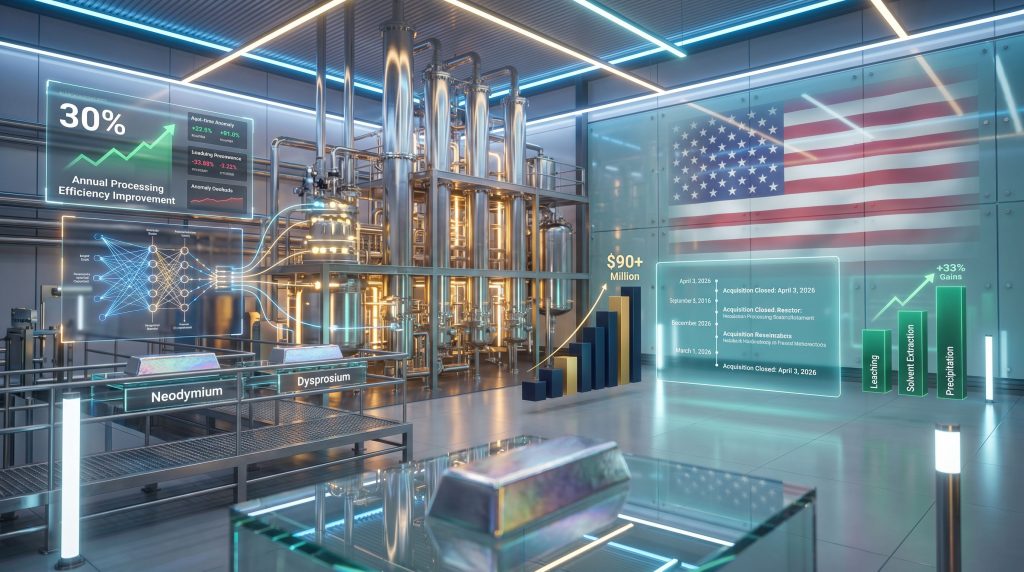
The Hidden Bottleneck Holding Back US Rare Earth Independence
For decades, the central narrative around rare earth supply chain vulnerability has focused almost exclusively on mining. Exploration acreage, ore grades, resource estimates, and drilling results have dominated the conversation. Yet the more strategically sensitive constraint has always resided downstream, in the processing and refining stage where mined ore is transformed into the functional materials that power electric motors, defence systems, and advanced electronics.
Rare earth refining is not a straightforward industrial process. The 17 lanthanide elements share remarkably similar chemical properties, making their separation extraordinarily difficult. Conventional hydrometallurgical separation methods, which rely on solvent extraction circuits operating across dozens of interdependent chemical variables, have historically demanded intensive human oversight. A pH shift of a fraction of a unit, a temperature fluctuation during calcination, or an undetected pump degradation in a solvent extraction circuit can corrupt an entire batch of intermediate product, sometimes irreversibly.
This chemical sensitivity is precisely why the processing stage has resisted the kind of broad automation that transformed other heavy industries over the past two decades. Furthermore, as critical minerals processing experts have long argued, downstream capacity often matters more than mining when it comes to genuine supply chain independence.
It is this bottleneck that makes the decision by Phoenix Tailings buys Machinery Partner one of the more consequential moves in the emerging US rare earth sector.
When big ASX news breaks, our subscribers know first
Why Rare Earth Processing Is Structurally Different From Other Minerals Industries
Understanding why Phoenix Tailings buys Machinery Partner matters requires first appreciating what makes rare earth processing uniquely resistant to industrial standardisation.
In conventional minerals processing, such as copper heap leaching or gold cyanidation, the target element behaves predictably across a relatively narrow range of operating conditions. Process engineers can establish robust control parameters and automate responses to deviation. Rare earth separation circuits do not offer this luxury. The elements being separated — neodymium from praseodymium, dysprosium from terbium, lanthanum from cerium — are chemically almost identical. Their separation relies on exploiting minute differences in ionic radius and electron configuration across many sequential extraction stages.
This creates several compounding challenges for automation:
- Each extraction stage amplifies small upstream deviations, meaning early process drift compounds into significant downstream purity problems
- Cross-contamination between adjacent rare earth elements degrades product specifications, which in turn affects pricing and customer acceptance
- Equipment failure during active separation stages is not merely a downtime event but a product loss event, potentially requiring complete circuit flushing and restart
- The rare earth composition of feedstock varies batch to batch, requiring dynamic process adjustment rather than fixed parameter operation
These characteristics explain why China's rare earth processing dominance has proven so durable. Decades of accumulated institutional knowledge, embedded in the tacit expertise of experienced process operators, created a capability moat that is difficult to replicate quickly. The US rare earth processing industry, which contracted sharply through the 1990s and 2000s as Chinese production scaled to supply the global market at prices domestic processors could not match, effectively lost this knowledge base over two generations.
Rebuilding that expertise through traditional workforce development alone would take years. Encoding it into an AI system that learns from operational data across hundreds of industrial deployments represents an entirely different pathway — and a much faster one. In addition, the strategic importance of heavy rare earths such as dysprosium and terbium makes accelerating this capability-building all the more urgent.
Phoenix Tailings: Processing Innovation as the Core Value Proposition
Phoenix Tailings occupies a distinctive position within the US critical minerals landscape. Unlike miners focused on resource extraction, or downstream manufacturers focused on finished magnet or alloy production, Phoenix operates in the processing middle ground where feedstock becomes refined rare earth material.
The company was founded on the premise that commercially viable rare earth metals could be recovered from mining tailings — the waste streams generated by existing and historical mining operations. This feedstock strategy offers several structural advantages:
- Tailings are already mined and surface-available, eliminating the years-long permitting and capital expenditure timeline of greenfield mining
- Feedstock procurement costs are generally lower than purchasing ore from active mining operations
- Processing tailings carries environmental rehabilitation benefits, which differentiate Phoenix from conventional processors in terms of ESG positioning
- The approach is scalable to multiple tailings sources without geographic constraint to a single mine asset
The company is backed by BMW and Sumitomo, two corporations with significant and growing rare earth consumption requirements driven by electric vehicle drivetrain production and industrial manufacturing respectively. BMW i Ventures' investment in Phoenix Tailings was announced to expand and stabilise rare earth element processing in the US, reflecting offtake interest from end users who need reliable domestic supply chains for neodymium-iron-boron (NdFeB) permanent magnets. These are central to EV traction motors and wind turbine generators, as explored in analysis of NdFeB magnets and their role in the global critical minerals race.
Phoenix's cumulative funding has surpassed $90 million, with a $40.2 million raise drawing participation from Traxys, Eni Next, and Geodesic Alliance. In February 2026, Traxys North America formalised a preferred trading relationship with Phoenix, providing feedstock supply, offtake infrastructure, and logistics support. This capital and commercial architecture reflects a company transitioning from technology validation to operational scaling.
The Machinery Partner Acquisition: Deal Architecture and Strategic Logic
The acquisition of Machinery Partner closed on April 3, 2026, with the transaction publicly announced on May 7, 2026 through Reuters reporting. Financial terms were not disclosed.
What the deal transfers to Phoenix is not simply a software licence or a technology partnership. It is a proven AI platform with an established deployment footprint across hundreds of US industrial facilities, a pre-trained model base derived from real-world operational data, and the leadership continuity of Clement Cazalot, who transitions from CEO of Machinery Partner to Chief Operating Officer of Phoenix Tailings.
Why the Cazalot Appointment Matters
The Cazalot appointment deserves particular analytical attention. His tenure on Phoenix's board of directors dates to 2019, meaning the two organisations maintained a seven-year strategic relationship before the acquisition was executed. This timeline strongly suggests the deal was deliberate capability-building rather than opportunistic dealmaking.
From an integration risk perspective, this is significant. Acquisitions that fail frequently do so because the acquired team lacks cultural alignment with the acquirer, or because the technology requires extensive adaptation to the acquiring company's processes. Neither risk applies in the same way here.
The seven-year board relationship between Cazalot and Phoenix prior to the acquisition suggests this was a deliberate, long-horizon capability-building strategy. The technology may have already been informally aligned with Phoenix's specific processing chemistry before the formal transaction was executed.
Machinery Partner's core capabilities centre on two functions:
-
Predictive equipment failure detection: The AI system monitors operational signatures across processing equipment, identifying anomalous patterns that precede physical failure before the failure actually occurs. This enables pre-emptive maintenance scheduling that prevents unplanned downtime.
-
Real-time process optimisation: The platform continuously adjusts operational parameters — flow rates, temperatures, pressures, and chemical dosing — to maximise throughput and yield within defined quality specifications.
In the context of rare earth processing, where the cost of an unplanned equipment failure extends beyond replacement parts and labour to potential batch contamination and circuit restart, predictive maintenance carries outsized economic value relative to conventional industrial applications.
Unpacking the 30% Efficiency Improvement Projection
The projected 30% annual improvement in minerals processing efficiency cited in connection with Machinery Partner's technology is a striking figure that warrants careful interpretation. The Reuters report confirming the acquisition states that this improvement is expected to be delivered in part through anticipating equipment failure, but does not decompose the metric further.
A 30% efficiency gain can manifest across multiple dimensions simultaneously, each with distinct economic implications:
| Efficiency Dimension | Mechanism | Economic Impact |
|---|---|---|
| Throughput increase | More feedstock processed per unit time | Higher revenue per capital asset |
| Yield improvement | Greater recovery of target REEs per tonne of input | Lower effective feedstock cost per kg of product |
| Downtime reduction | Fewer unplanned circuit interruptions | Lower fixed cost per unit of production |
| Energy optimisation | AI-adjusted process parameters reducing kWh per tonne | Directly reduced operating costs |
| Quality consistency | Tighter purity tolerances enabling premium pricing | Higher realised revenue per kg |
For an emerging domestic rare earth processor scaling toward commercial volumes, compressing costs across multiple dimensions simultaneously represents a qualitatively different competitive position than improving any single metric. The combination of lower unit costs and higher product quality can alter the calculus of competing with Chinese-refined rare earth materials, which have historically been priced at levels that made Western processing economically marginal.
One dimension that deserves emphasis is the quality consistency benefit. Rare earth customers, particularly in defence procurement and advanced magnet manufacturing, impose stringent purity specifications. A processor that can demonstrate consistent rare earth oxide purity above threshold levels commands premium pricing and earns long-term supply relationships that provide revenue visibility. An AI system that tightens purity variance by optimising separation parameters in real time is therefore a pricing tool as much as a cost reduction tool.
The Exeter Facility: Where AI Meets Operational Reality
Phoenix Tailings' rare earth processing facility in Exeter, New Hampshire will serve as the initial deployment site for Machinery Partner's AI platform. This facility represents the proving ground where the efficiency projections will be tested against operational reality.
The significance of New Hampshire as a processing location extends beyond logistics. The northeastern US has an established industrial workforce, proximity to defence and technology customers on the eastern seaboard, and access to academic institutions engaged in materials science research. It also places Phoenix within reasonable logistics distance of potential feedstock sources from historical mining operations across the Appalachian region.
Full automation of rare earth processing operations — the long-term objective Phoenix has stated for the Machinery Partner technology — would represent a structural shift in how domestic rare earth refining is conceptualised. Conventional processing facilities are designed around human operator intervention as a core feature. Fully automated facilities are designed around software-driven process control with human oversight reserved for system management rather than active process manipulation. The operational cost structure of these two models differs fundamentally, with automated facilities carrying lower variable labour costs and more predictable maintenance scheduling.
The next major ASX story will hit our subscribers first
Competitive Landscape: Where Phoenix Sits Within the US Rare Earth Sector
The US rare earth processing sector is in a formative stage, with several distinct approaches competing for investor attention and commercial traction simultaneously.
How MP Materials Compares
MP Materials, the operator of the Mountain Pass mine in California, remains the most capitalised and operationally advanced publicly traded US rare earth company. Its Q1 2026 adjusted profits were bolstered by $42.3 million in price protection income received from the US government under contractual arrangements, reflecting the strategic importance assigned to maintaining viable domestic rare earth production capacity. MP Materials controls both mining and processing at Mountain Pass, giving it vertical integration but also concentrated single-site exposure.
The NYSE Newcomer
Rare Earths Americas debuted on the NYSE in May 2026, targeting heavy rare earth discovery potential in the Shiloh exploration district in Georgia. The company's proposition centres on the potential for heavy rare earth mineralisation in the southeastern US, a geologically understudied region for rare earth prospectivity. Heavy rare earths, including dysprosium and terbium, command significantly higher prices than light rare earths due to their critical role in high-performance permanent magnets and their more constrained global supply base.
Phoenix Tailings occupies a differentiated position within this landscape. It is not a miner competing for resource discovery acreage, nor a conventional processor dependent on a single mine's ore supply. Its competitive differentiation lies entirely in processing technology, feedstock flexibility, and cost efficiency. The Phoenix Tailings buys Machinery Partner acquisition directly strengthens the dimensions on which Phoenix's competitive position depends.
Three Scenarios for Phoenix's Technology Platform
The strategic trajectory of the Machinery Partner acquisition is not deterministic. However, several plausible scenarios could unfold as the technology is deployed and performance data accumulates.
Scenario One: Phoenix Becomes the Low-Cost Domestic Rare Earth Processor
If the 30% efficiency improvement materialises as projected, Phoenix could achieve unit processing costs competitive with Chinese-refined rare earth materials at commercial production volumes. This would fundamentally change the economics of US supply chain independence, removing the need for ongoing price support mechanisms to sustain domestic processing viability.
Scenario Two: The AI Platform Becomes a Separately Licensable Asset
Machinery Partner's prior deployment across hundreds of US industrial sites demonstrates that the technology has applicability beyond rare earth processing. If Phoenix's deployment validates performance in the chemically demanding rare earth context, the platform could be licensed to other critical minerals processors, creating a secondary revenue stream and positioning Phoenix as a technology company alongside its processing business.
Scenario Three: The Integrated Capability Attracts Larger Strategic Interest
A proven, automated rare earth processing capability backed by BMW and Sumitomo, with a demonstrated technology platform and a growing contract revenue base, presents an attractive acquisition or partnership target for larger industrial entities. Defence contractors, automotive OEMs, and industrial conglomerates operating in rare-earth-dependent sectors all have strategic motivations to control or partner with domestic rare earth processors.
What Investors and Industry Observers Should Monitor
This section contains forward-looking analysis and projections. All scenarios described involve uncertainty and should not be interpreted as financial advice or guaranteed outcomes.
Several operational and commercial milestones will serve as meaningful indicators of whether the acquisition delivers its projected value:
- Exeter facility commissioning timeline: The pace of facility buildout and the date of first commercial production will determine when efficiency data from the AI deployment becomes available
- Post-integration efficiency metrics: Whether Phoenix discloses quantitative performance data following AI deployment will indicate management's confidence in the 30% projection
- Further strategic investment rounds: Additional capital raises at higher valuations would signal investor confidence in the integrated technology-processing model
- Offtake agreement announcements: New supply agreements with defence or automotive customers would validate commercial demand for Phoenix's output
- Expansion of AI applications: Any announcement extending Machinery Partner's technology to additional processing stages or feedstock types would indicate the platform is performing beyond initial deployment parameters
The rare earth processing sector is at an early inflection point in its domestic US revival. The combination of processing innovation, AI-driven operational intelligence, and strategic investor backing that Phoenix Tailings buys Machinery Partner has assembled represents one of the more complete capability stacks in this emerging industry. Whether that stack translates into commercially competitive rare earth production at scale is a question the Exeter facility will begin to answer.
Want to Track the Next Major ASX Mineral Discovery Before the Market Does?
Discovery Alert's proprietary Discovery IQ model scans ASX announcements in real time, instantly identifying significant mineral discoveries across more than 30 commodities — from rare earths to critical minerals — and delivering actionable alerts to subscribers ahead of the broader market. Explore how historic discoveries have generated substantial returns on Discovery Alert's dedicated discoveries page, and begin your 14-day free trial today to position yourself at the forefront of the next major find.