May 21, 2026
Why Rare Earth Recycling Has Become Europe's Most Urgent Industrial Priority
The global clean energy transition runs on permanent magnets. Every electric vehicle motor, every wind turbine generator, and an expanding range of precision defence systems depends on neodymium-iron-boron (NdFeB) alloys to function. These are not interchangeable components. The magnetic performance characteristics of NdFeB materials, specifically their exceptionally high energy density relative to physical size, make them effectively irreplaceable in compact drivetrain and power generation applications. Yet the rare earth supply chain importance that underpins these materials remains one of the most geographically concentrated in industrial history.
China currently controls approximately 85 to 90 percent of global rare earth processing capacity, according to the U.S. Geological Survey's Mineral Commodity Summaries. While China does not hold a comparable monopoly over raw rare earth mineral deposits, its dominance over the processing and separation stages means that Western manufacturers remain structurally exposed to a single-point supply risk. The International Energy Agency has documented this exposure in detail, noting that Europe's critical minerals supply chain holds minimal domestic rare earth processing infrastructure and sources the majority of its processed rare earth inputs through import channels.
This structural vulnerability has become a policy priority. The European Union's Critical Raw Materials Act (Regulation EU 2024/1378), adopted in May 2024, establishes binding targets including a 25 percent recycling rate for strategic materials by 2030. The regulation formally classifies rare earth elements within this strategic category, creating a regulatory framework that directly incentivises domestic recycling infrastructure investment across EU member states.
Against this backdrop, the HyProMag German plant opening in Pforzheim on April 28, 2026, represents more than a single facility commissioning event. It marks the activation of a commercially scaled, chemistry-free rare earth magnet recycling process on European soil, at a moment when the policy environment, feedstock availability, and geopolitical urgency are converging simultaneously.
When big ASX news breaks, our subscribers know first
HPMS Technology: How Hydrogen Transforms Magnet Recycling Economics
The Chemistry-Free Breakthrough
Conventional rare earth recycling follows a hydrometallurgical pathway. Magnet scrap is dissolved in acid solutions, rare earth elements are separated through solvent extraction, and the output is rare earth oxide powder that must then be re-processed through multiple downstream stages before it can be manufactured back into usable magnets. This pathway is energy-intensive, generates chemical waste streams, and requires substantial capital infrastructure for each processing stage. Furthermore, the rare earth processing bottlenecks associated with these conventional methods have long frustrated efforts to build resilient Western supply chains.
Hydrogen Processing of Magnet Scrap, or HPMS, bypasses this entire sequence. The process exploits a fundamental property of rare earth iron alloys: when exposed to hydrogen gas, the material undergoes rapid absorption and internal decrepitation, becoming brittle and breaking apart into fine particles along grain boundaries. Crucially, this hydrogen-driven fragmentation also removes the magnetic orientation of the material, effectively demagnetising it without any chemical inputs.
The output is a magnet-grade NdFeB alloy powder that can be directly re-sintered into new permanent magnets, bypassing the oxide production and chemical separation stages entirely. This is what practitioners describe as a short-loop recycling pathway: the material moves from end-of-life magnet to new magnet with minimal intermediate processing.
According to HyProMag, this approach delivers:
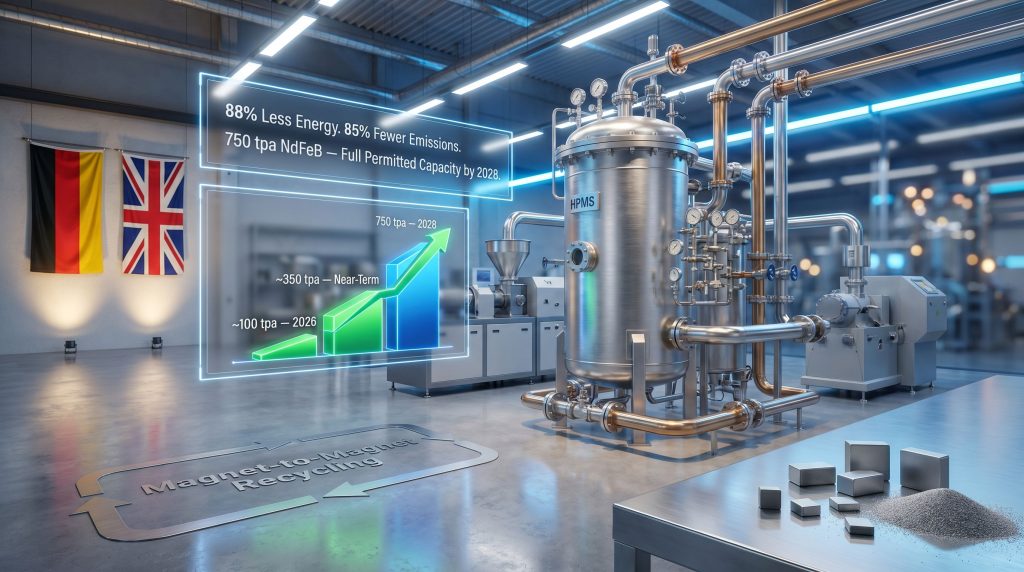
- 88% reduction in energy consumption compared to conventional rare earth processing methods
- 85% reduction in carbon emissions relative to baseline conventional processing
- Zero chemical processing requirement at any stage of the recovery cycle
- Minimal chemical waste generation, compared to the significant waste streams associated with solvent extraction routes
These performance figures originate from HyProMag company statements and would benefit from independent lifecycle assessment validation for full third-party verification. They have not yet been confirmed through widely published peer-reviewed studies as of available sources.
Feedstock Versatility as a Commercial Advantage
One of the less-discussed advantages of HPMS over competing recycling approaches is its tolerance for diverse input streams. Many recycling processes are optimised for a narrow feedstock type, which creates concentration risk in both supply and economics. HPMS, by contrast, is designed to process a broad range of magnet-bearing materials:
- End-of-life electric vehicle drive motors
- Decommissioned data centre hard disk drives and cooling equipment
- Industrial machinery containing embedded permanent magnets
- Consumer electronics including headphones, speakers, and compact motors
- Manufacturing offcuts and production scrap from magnet fabricators
This feedstock flexibility carries a strategic implication that is not immediately obvious. As European EV fleet penetration grows, the volume of end-of-life EV motors entering the waste stream will increase predictably over time. The IEA's Global EV Outlook 2024 reported that global EV sales exceeded 14 million vehicles in 2023, with European cumulative EV stock surpassing 8 million vehicles by 2024. Each of those vehicles contains permanent magnet motors with recoverable NdFeB content. As those vehicles age and enter decommissioning cycles over the next decade, the feedstock reservoir for HPMS facilities will expand organically.
The University of Birmingham's Two-Decade Development Path
HPMS technology was developed at the University of Birmingham over approximately two decades, with cumulative research and development investment exceeding US$100 million. The intellectual property generated through this research programme is licensed exclusively to HyProMag Ltd, which serves as the technology commercialisation vehicle. What distinguishes this development trajectory is the translation from laboratory-scale hydrogen decrepitation experiments into a process architecture that can operate continuously at industrial throughput, accept heterogeneous feedstocks with varying compositions, and produce magnet-grade alloy powder meeting commercial specifications.
| Process Stage | Conventional Hydrometallurgical Method | HPMS Approach |
|---|---|---|
| Feedstock preparation | Acid dissolution | Hydrogen absorption and decrepitation |
| Separation method | Solvent extraction | Hydrogen-driven grain boundary separation |
| Energy intensity | High (baseline) | ~88% lower than conventional |
| Carbon emissions | Baseline | ~85% reduction |
| Chemical waste generation | Significant | Minimal to none |
| Primary output form | Rare earth oxides | Magnet-grade NdFeB alloy powder |
| Downstream processing required | Yes (oxide to alloy conversion) | Minimal (direct re-sintering pathway) |
The Pforzheim Facility: Specifications, Commissioning Progress, and Capacity Trajectory
Facility Profile and Current Status
The HyProMag GmbH plant is located in Pforzheim, Baden-Württemberg, in southwestern Germany. The region carries historical significance as a precision manufacturing centre, with deep industrial heritage in jewellery, watchmaking, and high-tolerance metalworking. This background in precision materials processing creates relevant infrastructure and skills alignment with high-specification magnet production.
As of the official opening on April 28, 2026, the facility's commissioning status was as follows:
- HPMS hydrogen processing vessel runs had been completed
- Jet mill installation was ongoing
- Magnet manufacturing equipment installation was in progress
- Full regulatory permits had already been secured for production up to 750 metric tons per annum of NdFeB magnets and alloys
The distinction between commissioning completion and production commencement is worth noting. The facility is not yet in full commercial production; it is in an active equipment installation and process qualification phase. This is standard practice for new process manufacturing sites, where gradual ramp-up allows operators to optimise throughput, validate product specifications, and qualify output with potential customers before scaling.
Capacity Roadmap: From Commissioning to Full Output
| Phase | Annual Output Target | Indicative Timeline |
|---|---|---|
| Initial commissioning phase | ~100 metric tons NdFeB | 2026 |
| Mid-scale operational expansion | ~350 metric tons NdFeB | Near-term post-commissioning |
| Full permitted production capacity | 750 metric tons NdFeB | Targeted by approximately 2028 |
The three-year scale-up trajectory to 750 tpa reflects both the regulatory framework already in place and the operational learning curve expected as the facility progresses through successive production phases.
Birmingham vs. Pforzheim: A Comparative View
The Pforzheim facility is HyProMag's second commercial-scale plant. The first, located at Tyseley Energy Park in Birmingham, UK, was inaugurated in early 2026 at an identical 100 tpa initial capacity and carries the same tripling potential. Operating two geographically distinct facilities simultaneously creates compounding operational benefits:
- Cross-facility process data accelerates optimisation at both sites
- Product verification from two independent plants strengthens customer qualification conversations
- Redundancy in production geography reduces supply concentration risk for downstream buyers
- Technical expertise developed across both facilities directly informs the engineering and investment case for the proposed US facility
Corporate Architecture: The Multi-Jurisdictional Structure Behind HyProMag
Understanding the Ownership Layers
HyProMag's corporate structure reflects the complexity of commercialising university-developed intellectual property across multiple jurisdictions simultaneously. The key entities and their relationships are as follows:
- University of Birmingham: Original developer of HPMS technology through a multi-decade research programme; licensor of the core intellectual property
- HyProMag Ltd (Birmingham, UK): Exclusive licensee of HPMS technology; operating entity for the Birmingham plant; majority-controlled by Mkango Resources with CoTec Holdings Corp. as co-controller
- Mkango Resources: Dual-listed on the London Stock Exchange and Toronto Stock Exchange; primary control entity of HyProMag Ltd
- CoTec Holdings Corp.: Canadian resources and technology company; co-controls HyProMag Ltd alongside Mkango Resources
- HyProMag GmbH: German operating subsidiary responsible for the Pforzheim facility
- HyProMag USA: North American joint venture owned equally by CoTec Holdings Corp. and HyProMag Ltd; proponent of the proposed Texas facility
This structure creates a deliberate geographic distribution of operational exposure. The University of Birmingham retains licensing economics through HyProMag Ltd. Mkango Resources and CoTec Holdings each carry exposure to both the European and North American deployment paths. Meanwhile, HyProMag USA's 50/50 ownership allows both parent entities to share the capital burden of what is projected to be a significantly larger investment than either European facility.
The Texas Plant: Scale, Capital Requirements, and Market Targets
The proposed HyProMag USA facility in Texas represents a substantial step up in both capital commitment and market ambition. Key parameters:
- Estimated capital requirement: Approximately US$140 million
- Target market penetration: 10% of US domestic permanent magnet supply within five years of commissioning
- Strategic designation: Selected by the US Department of State as a Minerals Security Partnership (MSP) project
- Funding pathway: HyProMag USA is exploring a US public listing to fund the Texas construction programme
The MSP designation reflects the US government's broader objective of building allied-nation supply chains for critical minerals. The programme connects governments and private sector entities across partner nations to coordinate investment in strategic mineral production and processing outside of China's supply chain influence.
What is less widely appreciated is the operational function that the German plant plays in de-risking this US investment. Every metric ton of NdFeB alloy produced in Pforzheim generates process data, quality benchmarks, and customer qualification evidence that reduces technical uncertainty for potential investors evaluating the Texas facility. The Birmingham and Pforzheim plants are not merely standalone operations; they are also proof-of-concept infrastructure for a larger North American build-out.
CoTec CEO Julian Treger has described the Pforzheim opening as a major milestone following two decades of HPMS technology development at the University of Birmingham. He has also characterised the cross-facility collaboration between HyProMag operations as a long-term mechanism for securing domestic supply chain resilience and fostering partnership between allied nations. (Source: Mining Beacon, April 28, 2026)
Germany as a Strategic Location: Industrial Logic and Policy Alignment
Why Pforzheim Makes Industrial Sense
Germany's position as Europe's largest automotive manufacturing economy creates a direct structural rationale for locating a rare earth magnet recycling facility on German soil. German OEMs are among the most NdFeB-exposed manufacturers in the world, with electric vehicle production scaling rapidly across the country's major automotive groups. A domestic recycling facility positions HyProMag GmbH to serve these manufacturers with locally sourced, verifiably low-carbon magnet material that satisfies both supply security and ESG reporting objectives simultaneously.
Baden-Württemberg specifically is home to a dense cluster of automotive suppliers, precision manufacturers, and engineering firms. This proximity to both potential feedstock sources and potential magnet customers shortens the supply chain at both ends. In addition, the European critical raw materials supply framework increasingly incentivises exactly this kind of regionally embedded processing capability.
The Hannover Messe Context
The official opening was announced at Hannover Messe 2026, Europe's largest industrial trade fair. Parliamentary State Secretary Stefan Rouenhoff of Germany's Federal Ministry for Economic Affairs and Energy presided over the opening, noting at the event that innovation and international cooperation had become increasingly decisive factors in Germany's industrial evolution and new industrial investment. The choice of Hannover Messe as the announcement platform was deliberate, positioning HPMS-based recycling within Germany's broader narrative of industrial reinvestment and technology leadership.
Parliamentary-level attendance at an industrial facility opening is not routine. It signals sectoral priority and creates a reputational association between the facility and Germany's industrial policy agenda without constituting a formal government commitment of financial support or project designation under the Critical Raw Materials Act framework.
EU Compliance Pathway and the 2030 Recycling Mandate
The EU Critical Raw Materials Act's 25% recycling target for strategic materials by 2030 creates a compliance obligation that member states and downstream manufacturers must begin planning for now. Pforzheim's 750 tpa permitted capacity, when fully operational by approximately 2028, contributes measurable recycled NdFeB volume to Germany's compliance baseline. Importantly, HPMS-derived material qualifies as domestically recycled under the regulation's definitions because the processing occurs within EU territory without primary ore inputs.
The competitive landscape for European NdFeB recycling remains nascent. Hydrometallurgical recycling approaches pursued by other European entities require chemical processing infrastructure that carries higher capital costs, greater regulatory complexity under chemical handling frameworks, and more significant waste management obligations. Furthermore, the rare earth processing challenges inherent in conventional methods mean that HPMS's chemistry-free approach sidesteps much of this regulatory complexity, potentially offering a faster pathway to commercial scale under European permitting regimes.
The Broader Supply Chain Thesis: From Chinese Dominance to Allied Redundancy
Closing the Loop on Western Rare Earth Exposure
The strategic value of HPMS-based facilities becomes clearest when mapped against the existing supply chain architecture. Under current conditions, a European manufacturer requiring NdFeB magnets faces a supply chain that typically routes through Chinese processing facilities regardless of where the raw ore originates. China's 2010 rare earth export quota reductions remain a reference point in supply chain risk discussions, demonstrating the leverage that processing concentration can create. The US Department of Energy's 2021 Critical Materials Assessment explicitly acknowledges historical supply disruption risks as part of its rationale for domestic production investment.
HPMS-based recycling creates a fundamentally different supply chain pathway. Because the process recovers magnet-grade alloy from end-of-life materials within allied-nation facilities, it severs the dependency on Chinese processing infrastructure entirely for the recycled fraction of total magnet demand. As recycled supply grows and EV fleet decommissioning accelerates feedstock availability, this secondary supply pathway becomes progressively more significant relative to total Western demand.
The UK-Germany-US Triangle
The sequential deployment of HyProMag facilities across three allied nations is not coincidental. Birmingham (operational early 2026), Pforzheim (commissioned April 2026), and the proposed Texas facility together form a geographically distributed production network spanning the UK, the EU, and the United States. This architecture provides:
- Geographic redundancy: No single facility failure or regulatory disruption can disable the entire production network
- Jurisdictional diversification: Production in three separate regulatory environments reduces concentration in any single compliance framework
- Customer qualification breadth: European and North American customers can be served from regionally proximate facilities, reducing logistics costs and supporting local content requirements
- Cross-facility learning: Operational data from Birmingham and Pforzheim directly informs Texas facility design and ramp-up planning
The next major ASX story will hit our subscribers first
HyProMag Commercial Milestones: A Deployment Timeline
| Milestone | Date or Period |
|---|---|
| HPMS technology development begins at University of Birmingham | Approximately 2006 |
| Cumulative R&D investment exceeds US$100 million | Pre-2026 |
| Birmingham Tyseley Energy Park plant inaugurated at 100 tpa | Early 2026 |
| HPMS vessel commissioning runs completed at Pforzheim | April 2026 |
| Official opening of Pforzheim plant by Parliamentary State Secretary | April 28, 2026 |
| Pforzheim full permitted capacity target of 750 tpa | Targeted approximately 2028 |
| HyProMag USA Texas plant final investment decision | To be confirmed |
| HyProMag USA target of 10% of US domestic magnet supply | Within 5 years of commissioning |
ESG and Investor Framework Alignment
Quantified Environmental Credentials
For institutional investors operating under ESG screening criteria, the HPMS process offers a rare combination of quantified environmental performance claims and circular economy alignment. An 88% energy reduction and 85% emissions cut relative to conventional processing methods, if independently validated, would satisfy the threshold requirements of most major ESG frameworks and could support EU Taxonomy classification for green financing instruments.
The feedstock model also aligns cleanly with circular economy investment criteria. Converting end-of-life waste streams, primarily EV motors and electronic equipment that would otherwise require expensive hazardous material disposal, into high-value industrial inputs represents the kind of closed-loop value creation that circular economy frameworks are designed to incentivise.
The Investor Psychology Around Supply Chain Diversification
Critical mineral supply chain stories have historically attracted investor interest during periods of perceived supply disruption risk. The challenge for investors evaluating HyProMag-related entities is distinguishing between the genuine long-term structural thesis and shorter-term momentum driven by geopolitical headlines. The structural case rests on:
- The physical reality of growing NdFeB demand from EV and wind energy deployment
- The policy imperative created by the EU Critical Raw Materials Act's binding targets
- The expanding feedstock reservoir as the European EV fleet ages
- The proven but still scaling HPMS technology platform
Investor Disclaimer: This article contains forward-looking statements, capacity projections, and market share targets that involve inherent uncertainty. Production ramp timelines, capital requirements for the Texas facility, and US market penetration targets are aspirational goals, not guarantees of performance. Investors should conduct independent due diligence and consult qualified financial advisors before making investment decisions related to any companies mentioned in this article.
Frequently Asked Questions: HyProMag German Plant Opening
What does the Pforzheim plant produce?
The facility is designed to produce neodymium-iron-boron magnet-grade alloy and sintered permanent magnets through a hydrogen-based recycling process. Initial production capacity is approximately 100 metric tons per annum, scaling to a fully permitted ceiling of 750 tpa by approximately 2028.
How is HPMS different from conventional rare earth recycling?
Conventional methods dissolve magnet scrap in acid and use solvent extraction to separate rare earth elements, producing rare earth oxide powder that requires further downstream processing. HPMS instead uses hydrogen gas to physically decrepitate magnet scrap along grain boundaries, recovering magnet-grade alloy powder without any chemical processing steps. This eliminates multiple energy-intensive stages and removes chemical waste generation from the process.
Who opened the HyProMag Pforzheim facility?
Parliamentary State Secretary Stefan Rouenhoff of Germany's Federal Ministry for Economic Affairs and Energy officially opened the plant on April 28, 2026, at Hannover Messe 2026.
Is Pforzheim HyProMag's first commercial plant?
No. The Pforzheim facility is HyProMag's second commercial-scale plant. The first was inaugurated at Tyseley Energy Park in Birmingham, UK, in early 2026, also starting at 100 tpa initial capacity.
What is the relationship between the German plant and the proposed US facility?
The Pforzheim facility generates operational data, product quality benchmarks, and customer qualification evidence that directly supports the investment case for the proposed HyProMag USA facility in Texas. Combined with data from the Birmingham plant, this operational foundation reduces technical risk for potential investors in the approximately US$140 million Texas project.
What is the ownership structure of HyProMag USA?
HyProMag USA is structured as a 50/50 joint venture between CoTec Holdings Corp. and HyProMag Ltd. The entity is currently exploring a US public listing to fund the Texas facility construction.
Want to Track the Next Major Critical Minerals Discovery Before the Market Moves?
Discovery Alert's proprietary Discovery IQ model scans ASX announcements in real time, instantly identifying significant mineral discoveries across rare earths, critical minerals, and over 30 other commodities — turning complex data into actionable investment insights the moment they are announced. Explore historic discovery returns on Discovery Alert's dedicated discoveries page to understand the scale of opportunity these moments can represent, and begin a 14-day free trial at discoveryalert.com.au to position yourself ahead of the broader market.