July 27, 2026
The Hidden Ore Body America Has Been Throwing Away
Every year, millions of hard disk drives, electric motors, speakers, and precision instruments reach the end of their useful lives and flow into recycling streams. Inside each of those devices sits a small but chemically rich component: a neodymium-iron-boron (NdFeB) permanent magnet. These magnets are the functional heart of modern technology, enabling everything from EV traction motors to guided munitions to data center storage. Yet for decades, the rare earth elements locked inside them have largely exited the economic cycle permanently, lost in downstream processing never designed to recover them.
This is not a niche materials problem. It is a structural vulnerability embedded in the architecture of American industry. The United States currently imports the overwhelming majority of its processed rare earth elements, with rare earth supply chains heavily concentrated in a single dominant producing nation. That concentration creates systemic exposure, one that becomes acute during periods of geopolitical tension. The solution that has long been discussed but rarely executed at commercial scale is urban mining: treating end-of-life electronics as a secondary ore body rather than a disposal obligation.
The Cyclic Materials and ERI rare earth recycling partnership is among the most operationally serious attempts to close that loop domestically. Understanding why it matters requires examining not just the companies involved, but the deeper mechanics of critical minerals demand, the technology enabling recovery, and the economic logic that makes circular sourcing increasingly competitive with primary extraction.
When big ASX news breaks, our subscribers know first
Why Rare Earth Magnets Are Uniquely Difficult to Recover
Most metals recycled from electronics — copper, aluminium, and gold — are recovered through well-established smelting and refining processes. Rare earth elements present a fundamentally different challenge. NdFeB magnets are typically epoxy-coated, assembled into complex subcomponents, and present in small quantities per device. Conventional e-waste processing destroys the magnetic material or dilutes it into slag where recovery becomes economically impractical.
The rare earths most critical to permanent magnet performance include:
- Neodymium (Nd): The primary rare earth in NdFeB formulations, responsible for the fundamental magnetic properties
- Praseodymium (Pr): Frequently substituted for or blended with neodymium in commercial magnet grades
- Dysprosium (Dy): A heavy rare earth element added in small quantities to improve high-temperature coercivity, critical for EV motors and aerospace applications
- Terbium (Tb): Another heavy rare earth used to reduce dysprosium loading while maintaining thermal stability
The heavy rare earths — dysprosium and terbium in particular — are where supply risk is most acute. They occur in lower concentrations in primary ore deposits, are produced in smaller absolute volumes, and command significantly higher prices per kilogram. Critically, end-of-life NdFeB magnets often contain higher concentrations of these heavy rare earths than newly manufactured equivalents, because older magnet grades used them more liberally before optimisation reduced loading ratios. This means aged e-waste streams can actually yield higher-value feedstock per kilogram than some primary ore sources.
How the Cyclic Materials and ERI Rare Earth Recycling Partnership Is Structured
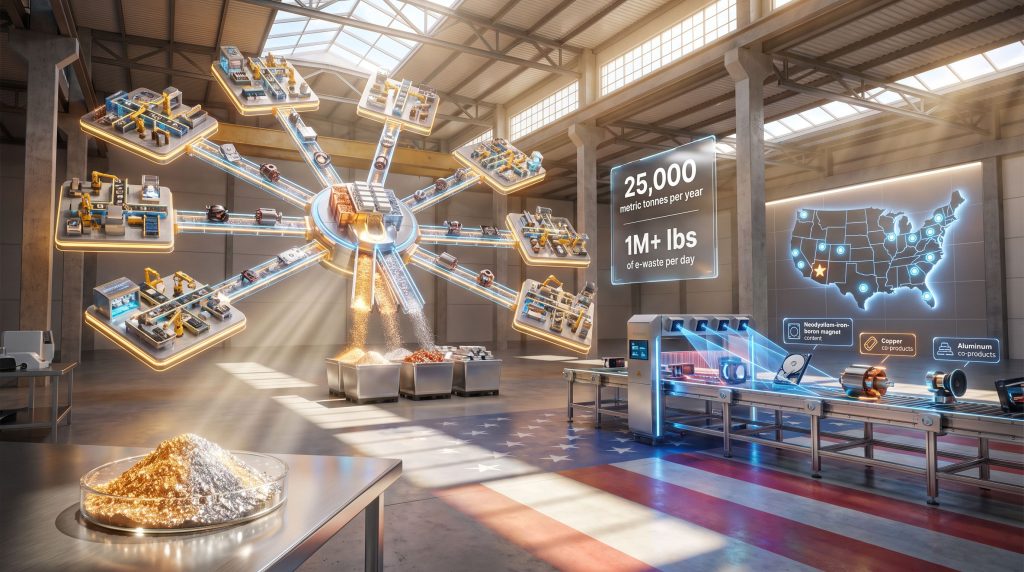
The Cyclic Materials and ERI rare earth recycling partnership combines two distinct capability sets into a single integrated supply chain. Electronic Recyclers International brings collection scale that few organisations in the U.S. can match, processing more than one million pounds of electronic waste per day across eight recycling centres nationwide. Cyclic Materials brings the downstream processing infrastructure, with an Arizona facility capable of handling up to 25,000 metric tonnes of end-of-life components annually while recovering rare earth oxides alongside copper and aluminium as co-products.
The architecture connecting these two capabilities follows a spoke-and-hub model:
- ERI collects end-of-life electronics through its nationwide network
- Proprietary AI-driven software and hardware identify and sort products containing rare earth permanent magnets
- Magnet-bearing components are pre-processed and consolidated at regional spoke facilities
- Qualified feedstock is shipped to Cyclic Materials' Arizona hub
- Hydrometallurgical processing separates mixed rare earth oxides from the magnet material
- Recovered rare earths, along with copper and aluminium co-products, re-enter domestic supply chains
The feedstock qualification process is a technically important step that is easy to overlook. Before high-volume shipments begin, both companies analyse material samples to confirm the rare earth content, physical form, and processing compatibility of specific product categories. This ensures the Arizona facility receives consistent, predictable input chemistry rather than heterogeneous scrap with variable recovery economics.
| Capability | ERI's Contribution | Cyclic Materials' Contribution |
|---|---|---|
| Collection network | 8 U.S. recycling centres | Not applicable |
| Daily throughput | 1M+ lbs of e-waste | Not applicable |
| AI-powered sorting | Magnet identification and pre-processing | Not applicable |
| Processing facility | Not applicable | Arizona hub |
| Annual capacity | Not applicable | Up to 25,000 metric tonnes |
| Output materials | Not applicable | Rare earth oxides, copper, aluminium |
| Commercial scope | Joint RFP pursuit | Joint RFP pursuit |
The AI Sorting Layer: Why Identification Is Half the Battle
One of the least-discussed bottlenecks in rare earth recycling is not chemistry — it is logistics. The challenge of identifying which incoming devices contain recoverable magnet material, at throughput volumes measured in millions of pounds per day, has historically made selective rare earth recovery impractical at scale.
ERI's deployment of proprietary AI-driven identification systems addresses this directly. The technology scans incoming e-waste streams and flags products with magnet-bearing components, including hard disk drives, consumer speakers, electric motors in power tools, and precision positioning systems. Automated sorting then segregates these items from general electronic scrap before pre-processing begins.
This identification capability has a compounding economic effect. By concentrating magnet-rich material before shipment to the Arizona hub, it reduces the volume of non-recoverable material entering the hydrometallurgical process and increases the effective grade of the feedstock Cyclic Materials receives. Higher-grade feedstock translates directly to better process economics and lower per-kilogram recovery costs, which in turn strengthens the commercial viability of the entire operation.
The principle here mirrors a concept well understood in conventional mining: ore grade matters as much as volume. A rare earth recycling operation receiving pre-sorted, magnet-concentrated feedstock is functionally equivalent to a miner processing high-grade ore rather than bulk low-grade material.
Economic Mechanics: Why Urban Mining Is Becoming Competitive
The economics of rare earth recovery from e-waste have historically struggled against the apparent cheapness of primary imported material. That comparison, however, rests on a misleading baseline. Primary rare earth mining involves capital expenditure measured in hundreds of millions of dollars, permitting timelines that routinely extend beyond a decade, ongoing environmental remediation obligations, and significant processing complexity to move from ore to separated oxide.
Urban mining from end-of-life electronics sidesteps many of these cost structures:
- Feedstock arrives at existing facilities rather than requiring new mine development
- No land disturbance, blasting, or tailings management
- Processing infrastructure already built and permitted
- Co-product revenue from copper and aluminium offsets rare earth processing costs
- Domestic origin eliminates import tariff exposure and logistics risk
| Factor | Cyclic-ERI Urban Mining | Primary Rare Earth Mining |
|---|---|---|
| Permitting timeline | Minimal (existing facilities) | 7 to 15+ years |
| Capital intensity | Moderate (technology scale-up) | Very high (greenfield development) |
| Feedstock source | Continuous domestic e-waste | Finite ore body |
| Environmental obligations | Low (circular model) | High (land disturbance, tailings) |
| Co-products | Copper and aluminium | Variable by deposit |
| Geopolitical exposure | Low (domestic supply) | High (import dependency) |
| Time to commercial operation | Near-term | Long-term |
The co-product economics deserve particular emphasis. Copper and aluminium recovered from the same end-of-life components that yield rare earths carry well-established commodity pricing and liquid end markets. This revenue diversification means the operation is not solely dependent on rare earth oxide pricing to generate positive unit economics — a meaningful advantage when rare earth prices are subject to periodic volatility driven by Chinese export policy.
Industries That Depend on What This Partnership Produces
The end markets for recovered rare earth oxides span the most strategically sensitive sectors of the U.S. economy.
Electric Vehicles and Clean Energy
NdFeB permanent magnets are central to the traction motors in battery-electric vehicles. A single EV motor typically contains between one and two kilograms of rare earth magnet material. As critical minerals demand scales alongside EV production, so does the need for neodymium, praseodymium, dysprosium, and terbium that define magnet performance. Domestically recycled rare earths offer automakers both supply chain resilience and a credible circularity narrative for sustainability reporting.
Defense and Aerospace
Rare earth permanent magnets appear in precision-guided munitions, radar and sonar systems, submarine propulsion, and advanced communications equipment. The U.S. Department of Defense has identified rare earth supply chain concentration as a material readiness risk. Furthermore, a domestic recycling loop that continuously recovers and recirculates these materials reduces strategic vulnerability without requiring new primary mining operations. Strengthening America's rare earth supply chain through circular models is consequently becoming a national security priority.
Artificial Intelligence and Data Infrastructure
The rapid expansion of AI computing has created an accelerating wave of data centre hardware deployment and, with a lag, decommissioning. Hard disk drives, which contain NdFeB magnets in their actuator assemblies, represent one of the highest-volume and most predictable rare earth feedstock streams available. As hyperscale operators refresh infrastructure on increasingly compressed cycles, the volume of magnet-bearing drives entering recycling streams is growing.
Advanced Manufacturing
Industrial motors, robotics actuators, medical imaging equipment, and precision sensors all depend on rare earth magnet performance. Scaling domestic recovery reduces the incremental demand that would otherwise flow entirely to primary imported supply. In addition, overcoming rare earth processing challenges at the facility level remains one of the most important technical hurdles for the sector overall.
The next major ASX story will hit our subscribers first
What Commercial Viability Requires Beyond the Initial Arrangement
The Cyclic Materials and ERI rare earth recycling partnership is explicitly structured to extend beyond its foundational feedstock arrangement. Both companies have indicated plans to jointly pursue government requests for proposals and commercial contracts related to critical mineral recovery and circular supply chain development.
Achieving sustained commercial scale will require parallel progress across several dimensions:
- Feedstock expansion: Qualifying additional high-volume product categories beyond the initial portfolio, including decommissioned EV motors, wind turbine generators, and industrial equipment
- Offtake agreements: Securing long-term supply commitments from magnet manufacturers, defence contractors, and technology companies that can provide revenue certainty
- Government procurement: Accessing federal programmes that prioritise domestically sourced critical minerals, including DOE-backed processing initiatives and Department of Defense procurement preferences
- Industry standardisation: Developing consistent rare earth content reporting standards across electronics categories to improve identification accuracy and recovery efficiency
The joint RFP pursuit signals a commercially sophisticated understanding that scale requires institutional buyers, not just spot market sales. Government agencies operating under critical mineral sourcing requirements represent anchor demand that can underpin facility utilisation rates during the market development phase.
The Circularity Gap This Model Is Built to Close
For rare earth recycling to function as a genuine supply chain alternative rather than a marginal supplement, it must achieve what the industry calls circularity at scale. That means the volume of rare earths recovered and reintroduced into productive use must represent a meaningful fraction of total domestic consumption — not a rounding error.
The combination of ERI's throughput infrastructure and Cyclic Materials' processing capacity positions the Cyclic Materials and ERI rare earth recycling partnership to operate at a scale relevant to actual supply chain metrics. With 25,000 metric tonnes of annual processing capacity fed by a collection network handling over one million pounds of e-waste daily, the operational foundation exists for output volumes that matter to procurement decisions.
Rare earth recycling globally has historically recovered less than 1% of end-of-life rare earth content, according to assessments by materials researchers and the International Energy Agency. The infrastructure gap, not the chemistry, has been the primary constraint. Partnerships that combine collection scale with processing technology directly address that gap.
The broader U.S. rare earth recycling landscape is evolving in parallel, with DOE-backed processing pilots and emerging regional rare earth hubs building out a distributed national infrastructure. However, the Cyclic-ERI model contributes a commercially oriented, privately funded node to that developing network — one designed to operate at throughput volumes that can genuinely shift supply chain metrics rather than simply demonstrate technical feasibility.
Key Facts at a Glance
- 8 ERI recycling centres across the United States form the collection backbone of the partnership
- 1 million+ pounds of e-waste processed daily by ERI, with AI-driven sorting identifying magnet-bearing products
- 25,000 metric tonnes per year processing capacity at Cyclic Materials' Arizona hub facility
- Copper and aluminium co-recovery alongside rare earth oxides strengthens the unit economics of the model
- Joint government and commercial RFP pursuit extends the partnership beyond feedstock logistics into market development
- Heavy rare earth recovery including dysprosium and terbium from aged magnet stock may yield above-average value feedstock per kilogram
- Feedstock qualification through sample analysis and product category identification ensures processing consistency before high-volume shipments begin
Disclaimer: This article is intended for informational purposes only and does not constitute financial or investment advice. Forecasts and projections regarding rare earth market dynamics, processing economics, and commercial outcomes involve inherent uncertainty and should not be relied upon as guarantees of future performance. Readers should conduct their own due diligence before making investment or procurement decisions.
Want to Stay Ahead of the Next Major Critical Minerals Discovery?
Discovery Alert's proprietary Discovery IQ model scans ASX announcements in real time, instantly identifying significant mineral discoveries — including critical minerals driving the clean energy and defence supply chain transformation — and delivering actionable insights directly to subscribers. Explore historic discoveries and their returns or start your 14-day free trial today to position yourself ahead of the broader market.