June 15, 2026
The Hidden Bottleneck Nobody Talks About: Chemical Dependency in Rare Earth Refining
Rare earth supply chains almost universally fixate on geography. Where is the ore mined? Which country controls the separation facility? These are legitimate questions, but they frame the problem incompletely. A refinery built in Belfast, Ohio, or Bavaria still requires industrial-scale chemical inputs to function, and for decades, the dominant source of those inputs has been China. This chemical layer of dependency sits beneath the more visible geographic one, and it is precisely where the Nth Cycle and Ionic RE rare earth recycling partnership is now attempting to intervene.
Understanding why this matters requires a brief detour into refining chemistry before the strategic implications become clear.
When big ASX news breaks, our subscribers know first
Oxalic Acid: The Invisible Link to Chinese Supply Chains
When rare earth elements are separated from ore or recycled material and dissolved into solution, they cannot simply be extracted by filtering. A precipitation agent is required to convert dissolved rare earth ions into solid oxide form. For most of the industry's modern history, that agent has been oxalic acid.
The problem is not that oxalic acid is exotic or difficult to manufacture. It is that industrial-scale oxalic acid production is heavily concentrated in China, meaning Western refiners who build onshore facilities to escape geographic dependency on Chinese processing can still find themselves reliant on Chinese chemical supply chains at a critical process step. This is what makes the vulnerability structurally invisible: it does not appear on a mine map, but it runs through every batch of rare earth oxide produced using conventional precipitation methods.
Furthermore, the rare earth supply chains that Western nations are urgently trying to build face this hidden chemical layer of dependency at every stage. For Ionic Rare Earths (ASX: IXR), this is not an abstract risk. According to the company's own benchmarking, oxalic acid accounts for approximately 50% of its benchmark carbon footprint in its current refining process. That figure is striking in its own right, but it also signals a proportionally large operational and supply chain exposure that a well-designed technology integration could address simultaneously.
The challenge facing Western rare earth refinery developers is not simply replacing Chinese mines with non-Chinese mines. It is replacing every Chinese input across the full production stack, including the chemistry that makes the final oxide possible.
What the Nth Cycle and Ionic RE Rare Earth Recycling Partnership Actually Does
The joint development and licensing agreement signed between Ionic RE and Massachusetts-based Nth Cycle is structured around a specific technical objective: inserting Nth Cycle's electro-extraction precipitation step into the refining flowsheet that Ionic RE is demonstrating at its Belfast, Northern Ireland pilot facility.
The underlying separation technology used at that facility was developed at Queen's University Belfast and is patented by Ionic Technologies, an Ionic RE subsidiary. It uses a long-loop hydrometallurgical process to separate and refine the four magnet rare earth elements most critical to modern industrial applications: neodymium (Nd), praseodymium (Pr), dysprosium (Dy), and terbium (Tb). These four oxides are the essential inputs for neodymium-iron-boron (NdFeB) permanent magnets, which power electric vehicle traction motors, direct-drive wind turbine generators, and a wide range of defence electronics.
What the Belfast facility has lacked, until now, is a precipitation step that does not rely on oxalic acid. Nth Cycle's Oyster system fills that gap by replacing chemical precipitation with an electrically driven process that achieves equivalent oxide purity while simultaneously regenerating hydrochloric acid for continuous closed-loop reuse. Integration at the Belfast facility is scheduled to begin in Q4 2026. The partnership also includes exploration of additional recycling and refining opportunities in the United States, giving both companies optionality beyond the initial demonstration scope.
How Nth Cycle's Oyster System Works
The Oyster platform represents a fundamentally different design philosophy from conventional hydrometallurgical precipitation. Rather than introducing a chemical reagent to force rare earth ions out of solution, it applies a controlled electrical current across specially designed electrochemical cells to selectively deposit target metals as high-purity oxides.
The process sequence, broken down into its core stages, looks like this:
- Feedstock dissolution – Spent magnets or other rare earth-bearing waste streams are processed into a dissolved rare earth solution using hydrometallurgical methods.
- Electrochemical deposition – Electrical current is applied across Oyster cells, driving selective deposition of target rare earth elements without any oxalic acid input.
- High-purity oxide recovery – Neodymium, praseodymium, dysprosium, and terbium oxides are recovered at commercially viable purity grades.
- Hydrochloric acid regeneration – The process regenerates hydrochloric acid as a byproduct, which is recirculated back into the system, creating a closed chemical loop.
- Continuous modular operation – Unlike batch precipitation processes, the Oyster cell design supports continuous production without periodic reagent replenishment cycles.
Nth Cycle rates its Oyster cells at an average output of approximately 3,100 tonnes per annum of metal, though actual throughput is feedstock-dependent. The modular architecture means capacity can be scaled by adding cells rather than constructing entirely new process infrastructure.
The commercial case for this approach becomes clearer when set against conventional refinery economics:
| Attribute | Oxalic Acid Precipitation | Nth Cycle Electro-Extraction |
|---|---|---|
| Primary input | Oxalic acid (chemical reagent) | Electricity |
| Chemical supply dependency | High (China-concentrated supply) | Minimal |
| Acid regeneration | No | Yes (HCl closed loop) |
| Carbon footprint | Higher | Materially lower |
| Scalability model | Fixed batch volumes | Modular, continuous |
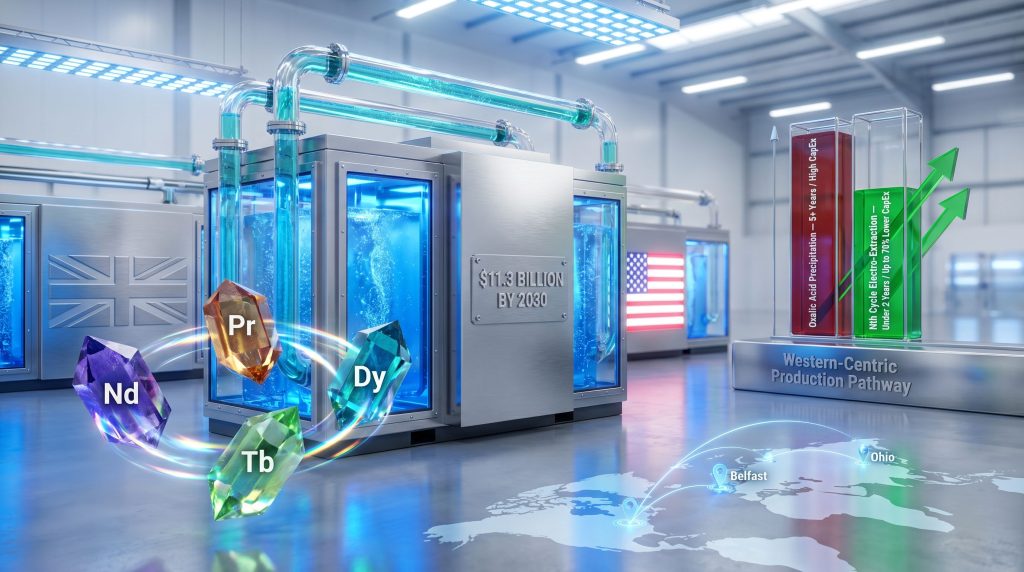
| Typical build timeline | Five or more years | Under two years |
| Capital intensity reduction | Baseline | Up to 70% lower |
| Profitable operating scale | Large fixed volumes required | Viable at five to ten times smaller scale |
This last point carries particular strategic weight. Conventional rare earth refinery economics require enormous throughput to justify capital costs, which has historically limited the number of viable projects outside China. Nth Cycle's modular design breaks this constraint, enabling profitable operation at scales that would previously have been considered sub-commercial.
The Carbon Footprint Dimension: Why It Goes Beyond ESG Compliance
Ionic RE's benchmarking data indicates that its hydrometallurgical process already achieves a carbon footprint approximately 60% lower than primary mined supply of rare earth oxides. This figure is significant for reasons that extend well beyond ESG reporting.
Western industrial purchasers, particularly in the automotive and defence sectors, are increasingly required to document the embedded carbon of their supply chains under both regulatory frameworks and procurement standards. A rare earth oxide with a validated, low-carbon provenance commands genuine commercial differentiation. By eliminating oxalic acid, which accounts for roughly half of Ionic RE's existing carbon benchmark, the electro-extraction integration could reduce process-level emissions intensity further still.
This creates a compounding strategic advantage: not only does the partnership reduce Chinese chemical dependency, it simultaneously produces material that is more defensible under incoming carbon border adjustment mechanisms and more attractive to procurement officers operating under scope three emissions obligations. The rare earth processing challenges that have long constrained Western ambitions are, consequently, being addressed from multiple angles simultaneously.
Nth Cycle's Commercial Validation and Investor Base
The Nth Cycle and Ionic RE rare earth recycling partnership did not emerge from a standing start. Nth Cycle launched what it described as a commercial-scale Oyster module in Ohio, USA, in 2024, where it produced the country's first premium-grade nickel-cobalt mixed hydroxide precipitate from black mass feedstocks. This established that the technology functions at commercial throughput levels across more than one metal system, not merely in laboratory settings.
The company's investor base provides additional credibility signals. Nth Cycle has raised approximately $65 million in equity funding from a group that includes:
- VoLo Earth Ventures, a Colorado-based venture capital firm focused on environmental technology
- MassMutual, the US-based mutual life insurance and financial services company
- Caterpillar Venture Capital, the investment arm of the global equipment manufacturer
- Equinor Ventures, the venture capital division of energy group Equinor
These are not speculative early-stage backers. Caterpillar's participation in particular suggests alignment between Nth Cycle's technology and the industrial supply chain concerns of major equipment manufacturers. Equinor's involvement points toward the offshore wind sector, which depends heavily on rare earth permanent magnets in direct-drive turbine generators.
In March 2026, Nth Cycle announced an offtake agreement with Trafigura, the global commodities trading house, under which Nth Cycle could supply up to US$1.1 billion of recycled metals from black mass feedstocks. This is arguably the most important commercial data point in the Nth Cycle story. Trafigura is not a speculative counterparty; its involvement signals that electrochemical metal recovery has crossed a threshold from promising technology into commercially bankable supply infrastructure.
A US$1.1 billion offtake commitment from one of the world's largest commodities traders is the kind of external validation that no press release can substitute for. It suggests the market for electrochemically recovered metals is real, scaled, and competitive with conventionally sourced supply.
The next major ASX story will hit our subscribers first
Ionic RE's Belfast Facility and the Scale-Up Challenge
The Belfast pilot plant has been operational since early 2024, running at a current nameplate capacity of 10 tonnes per annum. The facility's demonstrated capability spans the full separation and refining of the four target magnet rare earths from spent magnets and industrial waste streams.
Ionic RE is seeking more than $100 million in capital to expand the Belfast facility to 400 tonnes per annum. The company has disclosed an offer of £12 million in grant funding from the UK government to support this expansion, though the broader capital raise remains the primary challenge for management to resolve.
At a current market capitalisation of approximately A$71 million, with a share price that has declined roughly 28% in 2026, the gap between Ionic RE's current market value and its capital requirements is substantial. This is a common structural tension for junior critical mineral companies: the technology may be validated, the strategic rationale may be compelling, and the market opportunity may be well-documented, yet bridging from pilot to commercial scale requires capital commitments that often exceed what equity markets are willing to provide at early-stage valuations.
The addition of a marquee technology partner in Nth Cycle, and the associated credibility of Nth Cycle's Trafigura offtake relationship and institutional investor base, may assist Ionic RE's efforts to attract the larger capital commitments required for the 400 tpa expansion.
Ionic RE's Broader Asset Portfolio
| Asset | Location | Structure | Status |
|---|---|---|---|
| Belfast pilot facility | Northern Ireland, UK | 100% owned via Ionic Technologies | Operational at 10 tpa |
| Uganda RE prospect | Uganda | 60% stake | Exploration stage |
| Colossus JV (Brazil) | Brazil | 50:50 JV with Viridis Mining and Metals | Development planning |
The Brazilian joint venture is particularly worth noting. Viridis Mining and Metals holds the Colossus RE project in Brazil, and the 50:50 JV with Ionic RE is designed to combine Ionic Technologies' separation capability with Viridis' Brazilian feedstock supply. If the combined Belfast flowsheet is proven at scale, its application to the Brazilian JV represents a potential pathway to significantly expanded commercial reach.
Why the Scale-Down Innovation May Matter More Than the Scale-Up Narrative
One underappreciated dimension of the Nth Cycle technology proposition is what its economics mean for the broader competitive landscape of rare earth refining. The conventional assumption in the industry has been that rare earth refining is inherently a high-capital, high-volume, long-horizon endeavour — a structural characteristic that has helped cement China's dominance by making it uneconomical for smaller Western players to compete.
However, China's export restrictions have accelerated the urgency for precisely this kind of structural innovation. Nth Cycle's claim that its Oyster platform reduces capital intensity by up to 70% and enables profitable margins at five to ten times smaller scale than conventional refineries challenges the old assumption directly. If validated at commercial throughput for rare earth oxides, it could lower the entry barrier for Western rare earth refining materially, enabling a broader ecosystem of smaller, regionally distributed facilities rather than a handful of large, centralised refineries.
This would represent a structural shift in the competitive economics of the sector, not merely an incremental improvement in one company's operating costs.
Market Outlook: The $11.3 Billion Backdrop
Ionic RE projects that global magnet rare earth oxide demand will reach a market value of $11.3 billion by 2030. The critical minerals demand driving this forecast is well-established across multiple end markets:
- EV traction motor demand for NdFeB magnets is growing in line with vehicle electrification rates across major automotive markets
- Offshore wind capacity additions, particularly in the UK, Europe, and the US, require large volumes of rare earth permanent magnets in direct-drive generators
- Defence procurement across NATO-aligned nations is driving sustained demand for rare earth-dependent guidance, propulsion, and communications systems
- Consumer electronics, industrial robotics, and medical equipment provide a stable baseline of demand independent of energy transition cycles
Against this backdrop, recycled rare earth oxides carry a structural advantage beyond carbon metrics. The energy security implications of building a recycled supply base are considerable, given that primary mining supply chains for the four magnet rare earths are geographically concentrated in ways that create political and logistical risk. Recycled supply, by contrast, draws from a distributed base of end-of-life materials that is growing in volume as the first generation of EV motors, wind turbines, and rare earth-containing electronics begins to reach decommissioning ages.
Disclaimer: Forecasts and market projections cited in this article are based on company-disclosed estimates and publicly available industry analysis. They involve assumptions about future demand, technology adoption rates, and policy environments that are inherently uncertain. This article is not financial advice. Investors should conduct independent due diligence before making any investment decisions.
Frequently Asked Questions: Nth Cycle and Ionic RE Rare Earth Recycling Partnership
What is the core purpose of the Nth Cycle and Ionic RE rare earth recycling partnership?
The agreement is designed to integrate Nth Cycle's electro-extraction technology into Ionic RE's existing rare earth recycling and refining flowsheet, replacing the oxalic acid precipitation step with an electricity-driven process. The goal is to create a rare earth oxide production pathway that does not depend on Chinese chemical inputs at any stage.
Which rare earth elements does the partnership target?
The flowsheet is focused on the four magnet rare earths: neodymium, praseodymium, dysprosium, and terbium. These are the critical inputs for NdFeB permanent magnets used in electric vehicles, wind turbines, and defence applications.
When is integration at the Belfast facility expected to begin?
Nth Cycle's electro-extraction step is targeted for integration at the Belfast pilot facility beginning in Q4 2026.
Does the partnership only cover recycled rare earth feedstocks?
No. While the initial focus is on recycled magnet material, the combined flowsheet is also being evaluated for application to primary mixed rare earth carbonate (MREC) refining, which would substantially expand the commercial addressable market for both companies.
What is the current production capacity of the Belfast facility?
The Belfast facility currently operates at 10 tonnes per annum. Ionic RE is seeking more than $100 million to scale this to 400 tpa.
How does Nth Cycle's technology differ from conventional rare earth refining?
Conventional refining uses oxalic acid to precipitate rare earth oxides from solution. Nth Cycle's Oyster system uses electrical current instead of chemical reagents, recovering high-purity oxides while regenerating hydrochloric acid for reuse, thereby eliminating the oxalic acid input and its associated supply chain and carbon footprint implications. For further context on how the agreement was announced, the joint development and licensing structure offers both companies a clear commercial pathway to scale.
For ongoing coverage of rare earth supply chain developments, critical mineral technology, and Western refinery strategy, readers can explore related analysis at Mining Beacon, which tracks developments across the full critical minerals value chain.
Want to Track the Next Major Critical Minerals Discovery Before the Market Does?
Discovery Alert's proprietary Discovery IQ model delivers real-time ASX alerts the moment significant mineral discoveries are announced, transforming complex data across more than 30 commodities into clear, actionable insights for both traders and long-term investors — explore the historic returns major discoveries have generated and begin your 14-day free trial to secure a genuine market-leading edge.