August 5, 2026
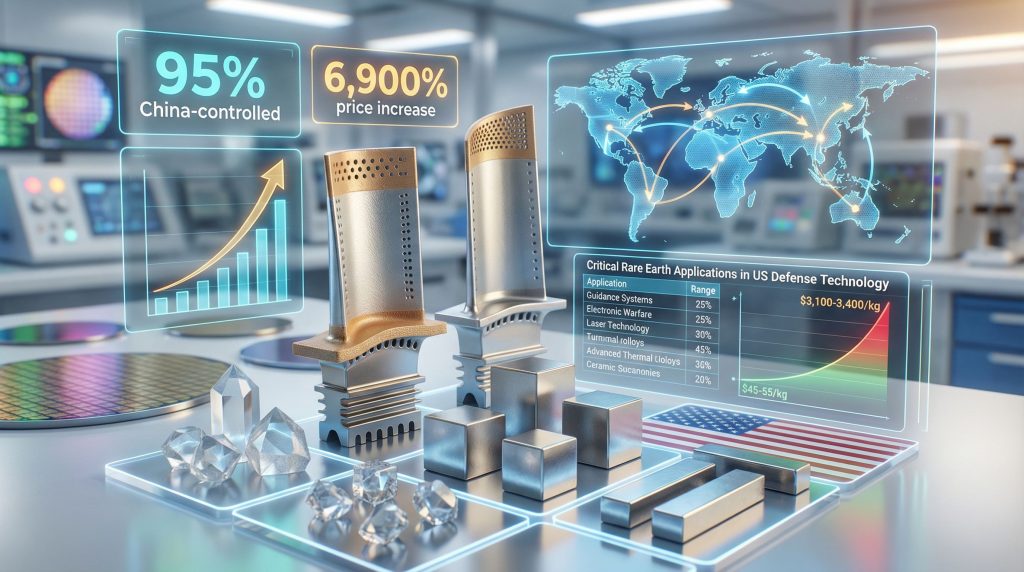
Defense contractors face mounting pressure as rare earth shortages in US aerospace and chips threaten America's technological superiority across multiple critical sectors. Global supply chain vulnerabilities have reached unprecedented levels, with specialized elements essential for military applications becoming increasingly difficult to secure through traditional procurement channels.
The semiconductor industry's dependence on exotic materials creates systemic risks that extend far beyond individual company operations. Manufacturing processes for advanced defense systems require precise material specifications that cannot be easily substituted, leaving entire production networks exposed to supply disruptions originating from geographically concentrated sources.
Understanding America's Strategic Mineral Dependencies
Strategic vulnerability assessment reveals that US defense manufacturing relies heavily on materials sourced primarily from a single nation. According to data from Chinese customs authorities, China exported only 17 tons of yttrium products to the US in the eight months following April 2025 export controls, compared to 333 tons in the eight months before these measures were implemented. This represents a 94.9% reduction in critical material flows.
The aerospace sector faces particularly acute challenges, as yttrium oxide serves as the foundation for thermal barrier coatings enabling military aircraft engines to operate under extreme conditions. Without these specialized coatings, engine components cannot withstand operational temperatures, creating immediate maintenance requirements that cascade through military readiness calculations.
Furthermore, a comprehensive rare earth reserves analysis demonstrates the geographic concentration of these critical resources. This concentration creates additional strategic vulnerabilities for nations dependent on imported materials.
Current Market Dynamics:
- Yttrium prices have increased 69 times higher than year-ago levels
- 60% price increase recorded since November 2025 alone
- Global scandium production limited to several tens of tons annually
- US domestic scandium production currently at zero operational capacity
Kevin Michaels, Managing Director at AeroDynamic Advisory, characterised the situation as representing a tangible example of how China exercises control over rare earth supply chains. He emphasised that yttium shortages have become a critical monitoring point requiring immediate attention from aerospace manufacturers.
When big ASX news breaks, our subscribers know first
What Makes Yttrium and Scandium So Critical to Defense Systems?
The Aerospace Engine Coating Crisis
Table: Critical Rare Earth Applications in Defence Technology
| Element | Primary Defence Use | Operational Impact | Supply Risk Assessment |
|---|---|---|---|
| Yttrium | Turbine blade coatings | Engine durability | Extreme scarcity |
| Scandium | Aluminium aerospace alloys | Structural integrity | No US production |
| Neodymium | Guidance system magnets | Navigation accuracy | Limited alternatives |
| Terbium | High-temperature magnets | Electronic systems | Supply concentration |
Yttrium applications in defence technology cannot be easily replaced through alternative materials or manufacturing processes. The element enables engines and turbines to function at temperatures that would otherwise cause immediate component failure. Without regular application of yttrium-based coatings, military aircraft engines become inoperable within relatively short operational periods.
This dependency creates compounding effects throughout defence procurement cycles. Engine manufacturers already struggle to meet demand for spare parts from commercial airlines and increased production requirements from Boeing and Airbus, according to aerospace supply chain specialists. Adding yttrium shortages to this stressed environment creates additional bottlenecks that could affect military readiness timelines.
Semiconductor Manufacturing Dependencies
Dylan Patel, CEO of SemiAnalysis, indicated that major US semiconductor manufacturers depend entirely on scandium for producing chip components that are integrated into essentially every 5G smartphone and base station. The element plays crucial roles in fuel cells, speciality aluminium aerospace alloys, and advanced chip processing and packaging operations.
Critical Semiconductor Applications:
- 5G Infrastructure: Base station component manufacturing
- Advanced Packaging: Precision chip assembly processes
- Aerospace Electronics: Specialised alloy production
- Defence Systems: High-performance electronic components
US chipmakers have experienced significant delays in receiving new scandium export licences from China in recent months. Industry sources report that companies have reached out to Washington for assistance in securing adequate material supplies for ongoing production requirements.
The challenge extends beyond direct Chinese suppliers, as many firms had obtained scandium from third-country sources. However, China requires licence applicants to declare their end-users, creating friction throughout international supply chains regardless of the immediate source country.
How Are Current Supply Chain Disruptions Manifesting?
Production Facility Responses to Material Shortages
Manufacturing Facility Disruptions:
- Two North American coating manufacturers have temporarily suspended production operations
- One firm is prioritising larger defence contractors while turning away smaller customers
- Third facility completely halted sales of yttrium oxide-containing products due to material depletion
Company executives report implementing rationing protocols as material availability continues declining. Some coatings manufacturers have begun allocating remaining inventory to essential defence applications while discontinuing service to commercial and offshore customers entirely.
These operational adjustments represent the first tangible evidence of rare earth scarcity directly impacting manufacturing capabilities rather than simply affecting pricing structures. In addition, the situation highlights how critical minerals energy security concerns are materialising in real-world production environments.
Price Volatility and Market Distortions
Market pricing for yttrium has reached levels not seen in previous commodity cycles. Current pricing reflects fundamental supply-demand imbalances rather than speculative trading activity, according to industry executives and commodity traders familiar with rare earth markets.
Price Escalation Evidence:
- February 2026: Approximately 69 times higher than February 2025 levels
- Since November 2025: 60% additional price increase
- Export Volume Impact: 94.9% reduction in US imports from China
- Production Response: Coating manufacturers implementing rationing systems
The price escalation timeline correlates directly with Chinese export control implementation rather than broader commodity market trends. This suggests that pricing reflects actual physical scarcity rather than financial market speculation or inventory management strategies.
A US government official acknowledged that some manufacturers now face genuine shortages of certain rare earth elements from China. However, the same official noted that shortages have not yet impacted actual production of jet engines or semiconductor devices, indicating early-stage supply pressure without immediate operational shutdown.
What Strategic Responses Are Emerging from Washington?
Federal Policy and Trade Strategy
The Trump administration faces complex negotiation dynamics as President Trump prepares to meet Chinese President Xi Jinping in Beijing during March 2026. The summit agenda will likely centre on rare earth export licensing rather than traditional trade balance discussions, according to government sources.
A White House official stated that the administration remains committed to ensuring access to critical minerals for all US businesses. This commitment encompasses both negotiating with China and monitoring compliance with existing agreements between President Trump and President Xi, whilst simultaneously developing alternative supply chains as conditions warrant.
Strategic Policy Framework:
- Bilateral Negotiations: Direct engagement with Chinese leadership on export controls
- Alternative Supply Development: Investment in non-Chinese rare earth sources
- Stockpile Management: Strategic reserve enhancement for critical applications
- Allied Partnerships: Coordination with friendly nations for supply diversification
The October 2025 agreement between Trump and Xi, which temporarily paused certain export restrictions, will be evaluated for compliance and effectiveness. Industry sources indicate that despite this agreement, yttrium shipments to the US have not recovered to pre-control levels.
Domestic Production and Supply Chain Development
US semiconductor industry representatives acknowledge the severity of supply chain vulnerabilities but have declined public commentary on specific mitigation strategies. The Semiconductor Industry Association has not provided detailed responses to inquiries about scandium availability or alternative sourcing arrangements.
Consequently, industry experts are exploring various alternative approaches. These include deep-sea mining challenges that could potentially unlock new sources of rare earth elements from ocean floor deposits.
Alternative Supply Chain Strategies:
- Deep-sea mining exploration for rare earth deposits
- Electronic waste processing enhancement for material recovery
- Allied nation partnerships for processing and refining capabilities
- Technology substitution research for critical applications
Current US stockpiles likely provide coverage measured in months rather than years, according to industry analysts familiar with strategic reserve calculations. This timeline creates urgency for both diplomatic solutions and alternative supply development initiatives.
How Vulnerable Are Specific Industry Sectors?
Aerospace Manufacturing Exposure
Table: Defence System Dependencies and Risk Assessment
| System Category | Critical Elements | Alternative Options | Timeline Impact |
|---|---|---|---|
| Engine turbines | Yttrium, specialised alloys | No viable substitutes | Immediate |
| Avionics packages | Neodymium, scandium | Limited alternatives | 6-12 months |
| Structural components | Scandium-aluminium alloys | Partial substitution | 12-18 months |
| Guidance systems | Multiple rare earths | Moderate alternatives | 18-24 months |
Major aircraft engine manufacturers including GE Aerospace, RTX's Pratt & Whitney, and Honeywell have declined to comment on specific supply chain challenges or mitigation strategies. This silence likely reflects both competitive sensitivities and national security considerations surrounding defence contractor operations.
The aerospace sector's vulnerability stems from the specialised nature of high-temperature applications that cannot accommodate material substitutions without extensive testing and certification processes. Military aircraft engines operate under conditions that require precise material specifications developed over decades of engineering optimisation.
Semiconductor Industry Risk Analysis
5G infrastructure deployment faces the most immediate supply chain threats, as base station manufacturers require consistent scandium availability for advanced chip packaging processes. The semiconductor industry's lean inventory management practices amplify these vulnerabilities, as companies typically maintain minimal strategic material reserves.
Semiconductor Supply Chain Vulnerabilities:
- Just-in-time inventory: 30-90 day material reserves typical
- Single-source dependencies: Limited supplier diversification
- Specialised processing: Material substitution technically challenging
- Production scaling: Volume requirements exceed alternative sources
A US government official suggested that semiconductor manufacturers are being specifically targeted through Chinese export control policies. This targeting approach creates strategic pressure on industries deemed critical to US technological competitiveness and military capabilities.
Many semiconductor firms had established third-country supply relationships to diversify away from direct Chinese sources. However, Chinese licensing requirements for end-user declarations have created oversight mechanisms that extend Chinese influence throughout international supply chains.
What Alternative Supply Chain Models Are Being Explored?
Deep-Sea Mining and Unconventional Sources
Emerging Supply Chain Innovations:
- Ocean floor extraction: Pacific nodule deposits containing scandium concentrations
- Electronic waste enhancement: Improved rare earth recovery from discarded devices
- Synthetic material development: Laboratory alternatives for specific defence applications
- Allied processing partnerships: Joint facilities in friendly nations
These alternative approaches require significant development timelines and substantial capital investment before achieving commercial viability. Deep-sea mining operations face environmental regulatory challenges and technical complexity that could extend development periods beyond immediate supply needs.
Electronic waste processing represents a more immediate opportunity, as existing facilities could potentially be enhanced to improve rare earth recovery rates. For instance, battery recycling solutions are demonstrating how advanced recycling technologies can recover valuable materials from electronic waste streams.
International Partnership Frameworks
Allied Nation Collaboration Strategies:
- Australia: Raw material extraction and initial processing capabilities
- Canada: Advanced refining and separation technologies
- European Union: Joint research initiatives and strategic stockpiling
- Japan: Technology sharing for efficient processing methods
These partnerships could provide supply chain resilience over medium-term timeframes, typically requiring 3-7 years for full operational capability. However, immediate supply challenges require solutions that can be implemented within months rather than years.
Research initiatives exploring ceramic matrix composites could potentially reduce yttrium requirements by significant percentages in certain aerospace applications. These alternatives require extensive testing and certification processes before deployment in critical defence systems, typically spanning 3-5 years of development.
The next major ASX story will hit our subscribers first
How Are Other Nations Responding to Supply Chain Pressures?
European Strategic Autonomy Initiatives
The European Union has implemented comprehensive critical raw materials legislation mandating domestic rare earth production capabilities by 2030. German and French manufacturers have established joint processing facilities specifically designed to reduce dependencies on Chinese supply chains.
EU Response Framework:
- Domestic production targets: 10% rare earth self-sufficiency by 2030
- African partnerships: Long-term supply agreements with producing nations
- Processing infrastructure: Joint facilities for strategic material refining
- Strategic reserves: Coordinated stockpiling across member nations
European approaches emphasise supply chain diversification rather than complete independence, recognising the technical challenges and capital requirements associated with rare earth processing operations.
Japan and South Korea Adaptation Strategies
Both nations have accelerated rare earth stockpiling programmes whilst developing alternative supply relationships with Australia, Vietnam, and Myanmar. Japan's strategic reserve now provides approximately 60 days of industrial consumption coverage, compared to 30 days maintained during 2024.
Table: Asian Strategic Reserve Comparison
| Nation | Strategic Reserve Coverage | Primary Alternative Sources | Investment Timeline |
|---|---|---|---|
| Japan | 60 days consumption | Australia, Vietnam | 2024-2027 |
| South Korea | 45 days consumption | Australia, Myanmar | 2025-2028 |
| Taiwan | 90 days consumption | Australia, Canada | 2024-2026 |
South Korean manufacturers have established direct investment relationships with Australian rare earth projects, providing capital for production expansion in exchange for guaranteed supply allocations. This approach creates bilateral supply security whilst supporting allied nation mining development.
What Long-Term Scenarios Could Reshape Global Supply Dynamics?
Scenario Analysis: Accelerated Decoupling (2026-2030)
Complete separation of US-China rare earth trade relationships could trigger fundamental market restructuring with cascading effects throughout global technology supply chains. Price increases of 300-500% for critical elements would likely accompany such decoupling, creating inflationary pressures across multiple industry sectors.
Accelerated Decoupling Implications:
- Aircraft production delays: 18-24 month extensions for new military platforms
- Semiconductor relocation: Manufacturing capacity shifts to allied nations
- Emergency authorities: Defence Production Act invocation for critical materials
- Strategic partnerships: Accelerated allied nation supply agreements
This scenario would require immediate government intervention through emergency procurement authorities and strategic material allocation systems. Military aircraft production would likely receive priority access to available supplies, potentially constraining commercial aerospace operations.
Scenario Analysis: Managed Interdependence (2026-2035)
Negotiated frameworks establishing quota-based export systems could provide supply predictability whilst maintaining Chinese market position. Such arrangements might include guaranteed minimum export volumes for critical US applications alongside technology sharing agreements for processing improvements.
Managed Interdependence Framework:
- Export quotas: Predetermined annual volumes for strategic materials
- Joint reserves: Coordinated stockpile management between nations
- Technology cooperation: Shared research for processing efficiency improvements
- Dispute mechanisms: Formal procedures for addressing supply disruptions
This approach could stabilise pricing whilst ensuring adequate supply availability for essential defence applications. However, implementation would require ongoing diplomatic maintenance and potential concessions in other trade areas.
Scenario Analysis: Technological Breakthrough (2027-2032)
Successful development of synthetic rare earth alternatives or revolutionary recycling technologies could fundamentally alter market dynamics and reduce Chinese leverage over global supply chains. Commercial-scale synthetic production would require breakthrough advances in materials science and manufacturing processes.
Moreover, asteroid mining innovations could provide access to virtually unlimited supplies of rare earth elements, though such technologies remain in early development stages.
Technology Transformation Possibilities:
- Synthetic rare earth production: Laboratory-scale manufacturing achieving commercial viability
- Advanced recycling: 90%+ recovery rates from electronic waste streams
- Nanotechnology applications: Reduced material requirements through precision engineering
- Space-based extraction: Asteroid mining for exotic element supplies
Such technological developments typically require 7-15 years from laboratory demonstration to commercial deployment. However, government investment and emergency development programmes could potentially accelerate these timelines under national security imperatives.
Preparing for Supply Chain Resilience: Strategic Implementation
Government Policy Optimisation
Immediate Response Capabilities (0-12 months):
- Emergency procurement expansion: Enhanced Defence Production Act rare earth authorities
- Allocation protocol development: Priority systems for critical defence contractors
- Permitting acceleration: Streamlined approvals for domestic rare earth projects
- Bilateral supply frameworks: Formal agreements with allied producing nations
These immediate measures could provide short-term supply stability whilst longer-term solutions develop operational capability. Emergency procurement authorities would enable government intervention in market allocation during severe shortage periods.
Medium-term Strategic Development (1-5 years):
- Recycling infrastructure expansion: Enhanced rare earth recovery from electronic waste
- Research funding acceleration: University programmes for alternative material development
- Regional processing establishment: Allied nation refining and separation facilities
- Public-private partnerships: Strategic stockpiling with industry cost-sharing
Medium-term strategies require sustained political commitment and substantial capital investment to achieve meaningful supply chain diversification. Success depends on coordination between government agencies, private industry, and international partners.
Industry Adaptation Requirements
Manufacturing sectors must develop resilient supply chain architectures that eliminate single-point-of-failure vulnerabilities. This transformation requires establishing relationships with emerging producers across multiple continents whilst investing in material efficiency technologies.
Industrial Resilience Framework:
- Multi-source procurement: Diversified supplier relationships across allied nations
- Strategic inventory expansion: Extended material reserves beyond just-in-time models
- Alternative material research: Investment in substitution technologies for non-critical applications
- Allied partnership development: Long-term supply agreements with friendly nations
Companies operating in defence-critical sectors should evaluate their rare earth dependencies and develop contingency plans for extended supply disruptions. This planning must consider both material substitution possibilities and production process modifications that could reduce overall consumption requirements.
Investment in domestic rare earth projects provides another avenue for supply chain resilience, though such investments typically require 5-10 years to achieve full production capability. Early-stage financing for promising domestic projects could provide future supply security whilst supporting American mining sector development.
The convergence of national security imperatives, technological dependencies, and geopolitical tensions creates an environment requiring strategic foresight and decisive action. Organisations that proactively address rare earth shortages in US aerospace and chips will maintain competitive advantages during periods of international supply chain stress.
According to recent analysis, the situation continues to evolve rapidly as defence contractors seek alternative sourcing strategies. The rare earth shortages in US aerospace and chips represent more than temporary market disruptions—they signal fundamental shifts in global strategic material dependencies that require comprehensive policy responses and industry adaptation strategies.
This analysis is based on publicly available information and industry sources. Supply chain conditions and geopolitical relationships remain subject to rapid change. Organisations should consult with qualified specialists for specific investment and operational decisions.
Ready to Capitalise on Critical Minerals Opportunities?
Discovery Alert's proprietary Discovery IQ model delivers real-time alerts on significant ASX mineral discoveries, including critical minerals essential for aerospace and semiconductor applications. Subscribers receive rapid insights into actionable trading and investment opportunities, ensuring quick and informed decisions ahead of market movements. Begin your 14-day free trial today and secure your market-leading advantage whilst exploring historic examples of exceptional discovery outcomes.