August 14, 2026
Global supply chains for critical materials face unprecedented vulnerability as single-source dependencies create systemic risks across multiple industries. The concentration of rare earth element processing capabilities in one geographic region has emerged as a strategic weakness that threatens both economic stability and national security objectives. This dependency becomes particularly acute for heavy rare earth elements, where limited global production capacity intersects with rapidly expanding demand from electric vehicle manufacturing, renewable energy infrastructure, and defense applications. The Aclara Resources Penco project represents a significant development in addressing these supply chain vulnerabilities through innovative extraction methodology in Chile.
The emergence of ionic clay deposits as an alternative source represents a fundamental shift in rare earth extraction methodology. Unlike traditional hard-rock mining operations that require extensive mechanical processing, ionic clay formations enable more selective extraction processes with reduced environmental impact. Chile's position within this evolving landscape reflects both geological advantages and strategic infrastructure capabilities that could reshape global supply chain dynamics.
Strategic Imperatives Behind Heavy Rare Earth Diversification
The concentration of global dysprosium and terbium processing capabilities creates vulnerabilities that extend far beyond simple market dynamics. According to the U.S. Geological Survey Mineral Commodity Summaries, China maintains dominant control over rare earth processing infrastructure, with facilities concentrated in Guangdong, Shandong, and Sichuan provinces. This concentration affects pricing, availability, and supply security for downstream industries across multiple continents.
The technical irreplaceability of heavy rare earth elements distinguishes them from other critical materials where substitution pathways exist. Dysprosium increases coercivity in permanent magnets, providing resistance to demagnetization essential for motors operating at temperatures above 150°C. Terbium enhances magnetic properties and thermal stability in neodymium-iron-boron formulations, enabling performance in the 150-250°C operating range demanded by modern electric vehicle powertrains.
Defense Sector Dependencies and Strategic Considerations
NATO member states have identified rare earth permanent magnets as critical components for military readiness, particularly in advanced radar systems, missile guidance platforms, and electronic warfare equipment. The defense applications require consistent supply chains that operate independently of geopolitical tensions or trade restrictions.
Furthermore, the intersection of critical minerals and energy security creates strategic imperatives that extend beyond commercial considerations.
Modern military systems incorporate permanent magnets in:
• Precision guidance systems requiring temperature stability and magnetic field consistency
• Electronic warfare platforms where magnetic performance affects operational capability
• Radar arrays demanding long-term reliability under extreme operating conditions
• Communications equipment requiring miniaturization without performance degradation
Renewable Energy Infrastructure and Magnet Demand
The European Union's offshore wind capacity targets create substantial long-term demand for permanent magnets containing heavy rare earth elements. Direct-drive wind turbines, favoured for offshore installations due to reduced maintenance requirements, incorporate permanent magnet generators with significant dysprosium and terbium content.
The EU's target of 480 GW offshore wind capacity by 2050 implies cumulative magnet demand across multiple decades. Each megawatt of direct-drive wind capacity typically requires 200-600 kilograms of permanent magnet material, depending on turbine design and generator configuration. This demand profile creates predictable, long-term offtake opportunities for qualified suppliers meeting European industrial specifications.
When big ASX news breaks, our subscribers know first
European Union Policy Framework and Supply Chain Security
The European Commission's Critical Raw Materials Act, which entered into force in May 2023, establishes binding frameworks for supply chain diversification across strategic materials. The regulation categorises dysprosium and terbium as Critical Raw Materials requiring specific attention to supply security and processing capacity development within EU borders or through strategic partnerships.
European institutional analysis recognises that over 95% of rare earth processing occurs outside EU borders, with approximately 70% dependent on Chinese facilities. Policy documents frame this concentration as a strategic vulnerability comparable to energy security concerns that became apparent following geopolitical events in 2022.
The European raw materials facility initiatives demonstrate this commitment to supply chain independence, creating opportunities for strategic partnerships with qualified suppliers.
Brussels' Systematic Evaluation of Alternative Sources
The delegation visit to the Aclara Resources Penco project represents systematic due diligence rather than casual diplomatic engagement. European Union technical teams evaluate potential suppliers based on multiple criteria including geological resource base, processing methodology, environmental compliance, and integration potential with European industrial infrastructure.
This evaluation process considers:
• Technical specifications and chemical purity requirements for downstream processing
• Environmental compliance with EU taxonomy requirements for sustainable finance
• Geographic positioning relative to European processing and manufacturing facilities
• Political stability and regulatory frameworks in host jurisdictions
• Timeline alignment with European industrial policy objectives
Timeline Pressures from Green Deal Implementation
The European Green Deal targets climate neutrality by 2050 with intermediate 55% emissions reduction by 2030. This trajectory requires rapid electrification of transport systems and expansion of renewable energy infrastructure, creating front-loaded demand for permanent magnets in the 2025-2032 period.
The compressed timeline for industrial transformation means that rare earth supply projects must reach Final Investment Decision and permitting approval by 2025-2026 to contribute meaningfully to European magnet supply chains by 2030. Projects experiencing delays beyond this window may miss the critical demand buildup phase.
Technical Fundamentals of the Penco Development
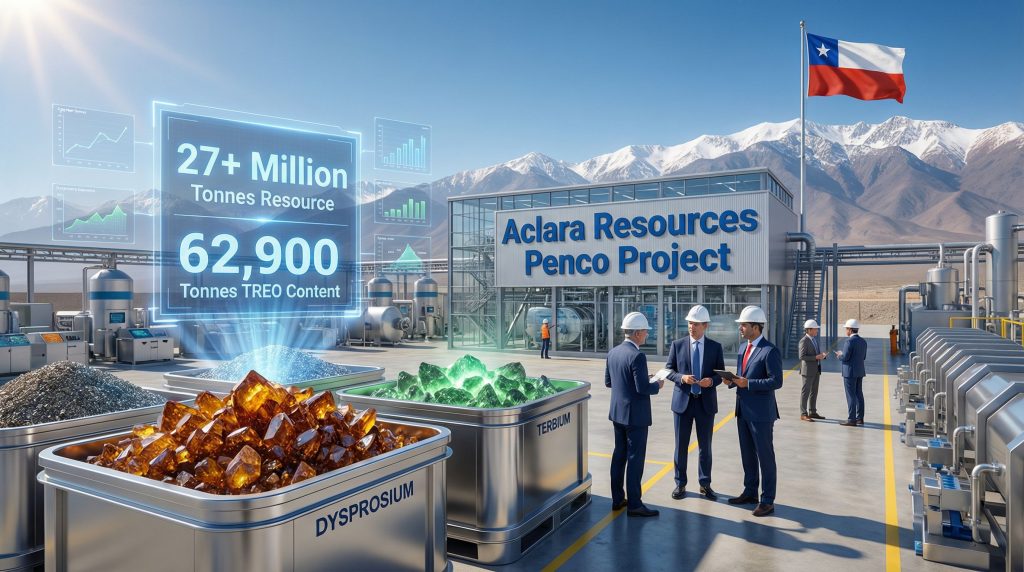
The Aclara Resources Penco project encompasses a comprehensive resource base spanning 6 square kilometres in Chile's Biobío Region. Technical specifications demonstrate the project's potential to contribute meaningfully to global heavy rare earth supply chains, subject to successful completion of permitting and construction phases.
Resource Characteristics and Geological Advantages
| Technical Parameter | Penco Project Specifications | Industry Context |
|---|---|---|
| Total Resource Base | 27+ million tonnes | Large scale by ionic clay standards |
| TREO Grade | ~2,292 ppm | Competitive with established operations |
| TREO Content | ~62,900 tonnes | Substantial long-term supply potential |
| Heavy Rare Earth Proportion | Dysprosium/Terbium focused | Addresses specific supply constraints |
| Extraction Methodology | Ionic clay leaching | Lower energy intensity vs. hard-rock |
| Target Production Timeline | 2027+ | Aligns with EU industrial requirements |
Ionic clay formations enable selective extraction processes that differ fundamentally from conventional rare earth mining. The geological structure allows for in-situ or heap leaching methodologies that require significantly less mechanical processing than hard-rock alternatives.
This technological approach aligns with broader trends in mining industry evolution towards more sustainable extraction methodologies.
Circular Mineral Harvesting: Process Innovation and Environmental Impact
The project's Circular Mineral Harvesting approach incorporates closed-loop water recycling systems designed to achieve 90-95% water recovery rates. This methodology reduces fresh water requirements to approximately 0.5-1.0 cubic metres per tonne of ore processed, substantially below conventional mining operations.
Process advantages include:
• Minimal tailings generation through in-situ leaching methodology
• Energy intensity reduction of 50-70% compared to hard-rock extraction
• Land restoration potential through post-mining neutralisation and revegetation
• Reduced infrastructure requirements for waste storage and management
However, these environmental benefits require independent verification through Life Cycle Assessment studies and third-party Environmental, Social, and Governance audits. Until such documentation becomes publicly available, these specifications should be considered engineering design targets rather than proven operational performance.
The emphasis on environmental restoration reflects broader industry trends in mine reclamation innovation that prioritise sustainable land use practices.
Capital Requirements and Funding Structure
Ionic clay rare earth projects typically require substantial capital investment across multiple development phases. Industry benchmarking suggests the following capital requirements for projects of comparable scale:
Development Phase Capital Requirements:
• Exploration to Pre-Feasibility Study: $10-30 million over 2-3 years
• Pre-Feasibility to Definitive Feasibility Study: $20-50 million over 2-3 years
• Mine construction and commissioning: $200-500 million depending on production targets
• Downstream separation facility development: $300-600 million for integrated processing
The Aclara Resources Penco project benefits from strategic investor backing through Hochschild Mining, a precious metals producer with operations across the Americas, and CAP S.A., a major Chilean industrial conglomerate. This partnership structure provides access to mining expertise, regional infrastructure, and potential co-financing arrangements.
Execution Risks and Development Challenges
Mining project development involves complex interdependencies across regulatory approval, community engagement, technical execution, and market conditions. The Aclara Resources Penco project faces specific challenges that could affect development timelines and project economics.
Regulatory Approval Pathway and Environmental Assessment
Chilean Environmental Impact Assessment procedures require comprehensive documentation of environmental effects, mitigation strategies, and monitoring protocols. The approval process typically involves multiple government agencies, public consultation periods, and technical review phases that can extend over 18-24 months.
Critical regulatory milestones include:
• Environmental Impact Assessment submission and technical review
• Community consultation processes and stakeholder engagement
• Water rights allocation and usage permit approvals
• Mining concession finalisation and operational permits
• Construction permit issuance and compliance verification
The project's resubmission of environmental documentation indicates previous submissions required modifications or additional information. While this represents normal regulatory process, it introduces timeline uncertainty that could affect the targeted 2027 production commencement.
Multi-Jurisdictional Integration Complexity
The proposed business model involves coordination across three distinct jurisdictions: mining operations in Chile, separation processing in Louisiana, and magnet alloy production through partnerships in South America. This geographic distribution creates execution complexity not present in vertically integrated single-jurisdiction projects.
Integration challenges include:
• Regulatory compliance across Chilean mining law, U.S. processing regulations, and international trade requirements
• Quality control maintenance throughout multi-stage processing and transportation
• Foreign exchange exposure across multiple currencies and jurisdictions
• Supply chain logistics coordination across intercontinental shipping routes
Critical Risk Assessment: Success requires simultaneous execution across permit approval, community relations, funding completion, and technical scale-up while coordinating across multiple jurisdictions with different regulatory frameworks.
Community Relations and Social License Considerations
Modern mining operations require ongoing community support throughout project lifecycle. Chilean mining regulations mandate community consultation processes, but social licence extends beyond regulatory compliance to encompass long-term relationships with local stakeholders.
Ionic clay mining operations affect land use patterns, water resources, and local economic conditions. While the environmental footprint may be smaller than conventional mining, community acceptance depends on transparent communication, benefit-sharing arrangements, and demonstrated environmental compliance.
Global Heavy Rare Earth Market Positioning
The Aclara Resources Penco project enters a market characterised by supply constraints, geopolitical considerations, and technological transformation across multiple end-use sectors. Understanding market dynamics provides context for project economics and strategic positioning.
Supply-Demand Fundamentals for Critical Applications
Global dysprosium and terbium demand reflects growth in electric vehicle production, renewable energy infrastructure, and defense applications. Electric vehicle traction motors typically require 5-10 kilograms of permanent magnets per vehicle, with heavy rare earth content varying by motor design and performance requirements.
Market drivers include:
• Electric vehicle production targets across major automotive markets requiring consistent magnet supply
• Wind energy capacity expansion particularly in offshore installations utilising permanent magnet generators
• Defence modernisation programmes incorporating advanced electronics and precision guidance systems
• Industrial automation growth demanding high-performance motors and actuators
Current global recycling rates for rare earth elements remain below 5% for most applications, meaning primary supply will continue dominating the market through at least 2035. This limitation strengthens the strategic case for new primary sources meeting industrial specifications.
Competitive Landscape and Alternative Supply Sources
Several projects worldwide compete to supply non-Chinese heavy rare earth materials, each facing distinct advantages and challenges:
Australian heavy rare earth developments: Advanced permitting but increased logistics costs due to geographic distance from major processing centres.
African ionic clay projects: Substantial resource potential offset by infrastructure gaps and political risk considerations affecting development timelines.
Greenland rare earth initiatives: Political and environmental opposition has delayed multiple projects since 2012, with permit revocations affecting investor confidence.
The Aclara Resources Penco project benefits from proximity to potential U.S. processing infrastructure and established shipping routes to European markets, providing logistical advantages over competitors in more remote locations.
Furthermore, Chile's commitment to green metals leadership positions the project within a supportive national framework for sustainable mining development.
Premium Pricing Potential and Offtake Considerations
European and North American industrial customers demonstrate willingness to pay premium pricing for supply chain security and regulatory compliance. Non-Chinese sources command price premiums reflecting:
• Supply chain risk mitigation and geopolitical independence
• Environmental and social governance compliance meeting Western standards
• Quality consistency and technical specifications required for high-performance applications
• Long-term contract availability providing supply security for industrial planning
Strategic Partnerships and Value Chain Integration
The Aclara Resources Penco project leverages strategic partnerships to access technical expertise, financial resources, and market connections essential for successful development. These relationships provide competitive advantages while introducing execution dependencies.
Hochschild Mining's Strategic Investment Framework
Hochschild Mining brings precious metals production expertise and regional operational experience to the partnership. The company's established presence across the Americas provides access to mining infrastructure, regulatory knowledge, and skilled workforce availability.
Strategic contributions include:
• Operational expertise in complex mining environments and regulatory frameworks
• Financial capacity to support project development through construction phases
• Regional infrastructure access reducing development costs and timelines
• Technical knowledge transfer from successful mining operations across similar jurisdictions
Eduardo Hochschild's role as Chairman of Aclara Resources demonstrates senior management commitment to the project's strategic development and long-term success.
CAP S.A. Industrial Integration Strategy
CAP S.A.'s position as a major Chilean industrial conglomerate provides downstream processing capabilities and market access for value-added products. The joint venture structure for metals and alloys development enables vertical integration within the Chilean industrial ecosystem.
Integration benefits include:
• Downstream processing capabilities reducing dependence on external facilities
• Local market knowledge and regulatory navigation support
• Established industrial relationships facilitating offtake negotiations
• Technology development potential for specialised alloy production
European Partnership Development Potential
The delegation visit creates opportunities for formal partnerships with European industrial entities seeking supply chain diversification. Potential collaboration areas include technology transfer, co-financing arrangements, and long-term offtake agreements.
Partnership frameworks may include:
• Technical collaboration with European magnet manufacturers for product specification development
• Co-financing structures under European strategic autonomy initiatives providing development capital
• Research partnerships with European universities and technical institutes for process optimisation
• Certification and quality assurance programmes meeting European industrial standards
The next major ASX story will hit our subscribers first
Environmental Sustainability and Regulatory Compliance
Modern critical materials projects must demonstrate environmental sustainability to access capital markets and secure offtake agreements with major industrial customers. The Aclara Resources Penco project positions environmental performance as a competitive differentiator.
ESG Compliance and Investment Qualification
The European Union Taxonomy Regulation establishes criteria for classifying economic activities as environmentally sustainable. Critical mineral extraction and processing can qualify as sustainable activities only when meeting strict Environmental, Social, and Governance criteria affecting financing costs and investor eligibility.
ESG compliance requirements include:
• Independent environmental impact assessment and ongoing monitoring
• Community engagement protocols and benefit-sharing arrangements
• Water management systems with recycling and discharge controls
• Land restoration planning and implementation verification
• Carbon footprint assessment and reduction strategies
Until third-party ESG audits and Life Cycle Assessment studies become publicly available, environmental claims should be evaluated as engineering design specifications rather than proven operational performance.
Sustainable Finance and Capital Access
European financial institutions increasingly require sustainability compliance for project financing, particularly in extractive industries. The EU Taxonomy framework affects access to institutional capital and influences financing costs based on environmental performance verification.
Projects demonstrating measurable environmental benefits may access:
• Green bond financing at reduced interest rates
• European Investment Bank co-financing for strategic projects
• Institutional investor capital committed to sustainability mandates
• Government-backed financing programmes supporting critical material security
Development Timeline and Critical Milestones
The Aclara Resources Penco project faces a compressed timeline to contribute meaningfully to European supply chain requirements by 2030. Critical path analysis reveals dependencies that could affect production commencement timing.
Integrated Development Schedule
| Development Phase | Target Timeline | Critical Dependencies | Risk Factors |
|---|---|---|---|
| Environmental Impact Assessment Approval | 2025-2026 | Community consultation completion | Regulatory review timelines |
| Final Investment Decision | 2026 | Funding completion, permit finalisation | Capital market conditions |
| Construction and Commissioning | 2026-2027 | Contractor availability, equipment delivery | Supply chain disruptions |
| Production Commencement | 2027+ | Technical commissioning success | Process scale-up challenges |
| Commercial Production | 2028+ | Market development, offtake execution | Demand timing alignment |
Integration with U.S. Processing Infrastructure
The proposed Louisiana separation plant development requires parallel execution with Chilean mining operations. Coordination challenges include:
• Synchronised permitting across U.S. and Chilean regulatory frameworks
• Technology integration ensuring ore characteristics match processing specifications
• Logistics infrastructure development for intercontinental material transportation
• Quality assurance protocols maintaining consistency across processing stages
Investment Analysis and Valuation Considerations
The Aclara Resources Penco project presents a complex risk-reward profile reflecting both strategic market positioning and execution challenges. Investment analysis requires evaluation across multiple scenarios and timeframes.
Upside Value Drivers and Strategic Positioning
Market positioning advantages include:
• Premium pricing potential for non-Chinese heavy rare earth sources
• Long-term offtake opportunities with European industrial customers seeking supply security
• Technology licensing revenue potential from innovative extraction methodologies
• Regional expansion opportunities across South American ionic clay deposits
The project's focus on dysprosium and terbium addresses specific supply constraints in high-growth markets, potentially commanding premium pricing relative to light rare earth alternatives.
Risk Factors and Mitigation Strategies
Primary downside risks include:
• Regulatory approval delays affecting timeline to market and competitive positioning
• Capital cost escalation during construction phases exceeding funding availability
• Technical scale-up challenges from pilot operations to commercial production
• Market price volatility affecting project economics and financing availability
Risk mitigation depends on management execution across multiple parallel workstreams, requiring coordination between technical development, regulatory approval, and market development activities.
Comparative Valuation Framework
Peer group analysis with other rare earth development companies provides valuation context, though the Aclara Resources Penco project's focus on heavy rare earth elements from ionic clay deposits creates unique positioning within the sector.
Valuation considerations include:
• Resource base size and grade quality relative to established projects
• Processing methodology advantages and environmental compliance standards
• Strategic partnership value and market access facilitation
• Timeline to production and competitive positioning at commercial operation
Disclaimer: This analysis contains forward-looking statements and speculative projections based on publicly available information. Mining project development involves substantial risks including regulatory approval uncertainty, technical execution challenges, and market volatility. Readers should conduct independent research and consult qualified professionals before making investment decisions. Past performance of comparable projects does not guarantee future results.
Interested in Capitalising on the Next Critical Metals Discovery?
Discovery Alert's proprietary Discovery IQ model delivers real-time notifications on significant ASX mineral discoveries, empowering subscribers to identify actionable opportunities in critical metals, rare earths, and strategic commodities ahead of the broader market. Explore how historic mineral discoveries have generated substantial returns and begin your 30-day free trial today to position yourself at the forefront of the critical materials boom.