June 4, 2026
The Race to Build a Rare Earth Supply Chain That Doesn't Run Through Beijing
For decades, the economics of rare earth production followed a simple and uncomfortable logic: China could produce these materials cheaper than almost anyone else, and the rest of the world largely accepted that reality. Western manufacturers sourced what they needed, rare earth supply chains integrated deeply with Chinese processing infrastructure, and the geopolitical risks were treated as manageable. That calculation has now broken down in ways that are structural, not cyclical, and the investment community is beginning to price that shift into how it evaluates projects, jurisdictions, and offtake arrangements.
Viridis rare earth sales to US and European buyers, rather than Chinese customers, represents a deliberate positioning within this broader restructuring. The company's Colossus project in Brazil's Minas Gerais state is being developed from the outset with Western supply chains in mind, and the commercial logic behind that decision extends well beyond current geopolitical tensions.
When big ASX news breaks, our subscribers know first
China's Processing Dominance: The Number That Actually Matters
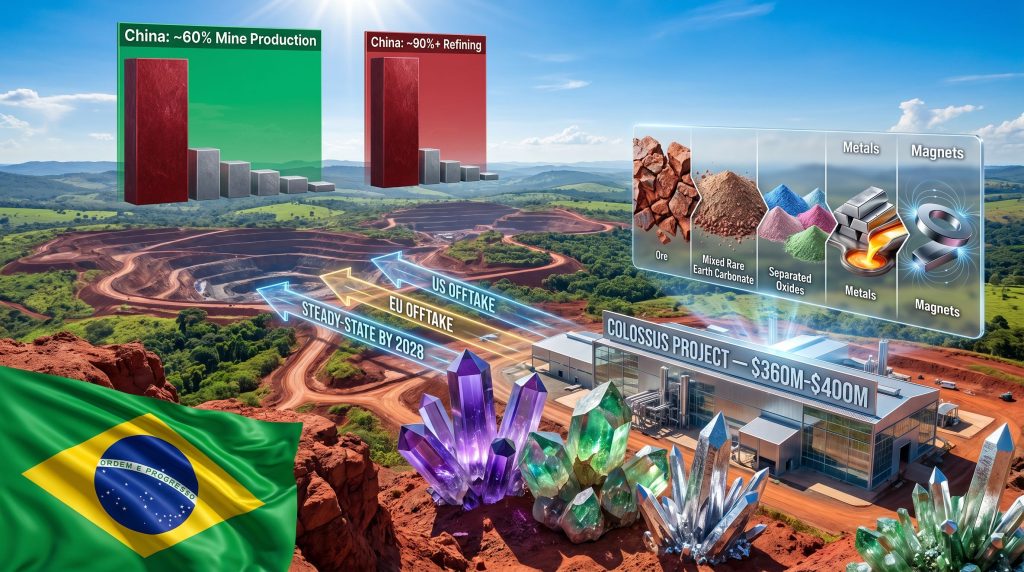
Most public discussion of rare earth dependence focuses on mine production, where China accounts for roughly 60% of global output. That figure is significant, but it understates the depth of the structural problem facing Western manufacturers.
The more consequential number is China's share of global rare earth refining and processing capacity, which exceeds 90%. This means that even ore mined outside China frequently travels to Chinese facilities for the chemical separation processes that convert raw material into usable industrial inputs. The dependency is not primarily at the extraction stage; it exists at every subsequent step in the value chain.
| Metric | China's Share |
|---|---|
| Global rare earth mine production | ~60% |
| Global rare earth refining and processing | ~90%+ |
| Year Beijing introduced export restrictions | April 2025 |
| Restriction trigger | Retaliatory response to US tariffs |
When Beijing introduced China's export restrictions in April 2025 as part of a broader set of retaliatory measures against US tariff policy, the downstream effect was immediate. Western manufacturers of electric vehicle motors, defense guidance systems, wind turbine generators, and advanced electronics found themselves navigating an acute supply uncertainty that years of policy discussion had failed to prevent.
The risk to Western manufacturers is not simply access to raw ore. It is the near-total reliance on Chinese processing infrastructure that converts mined material into usable industrial inputs. Diversifying at the mining stage alone does not resolve the deeper structural exposure.
Price Suppression: The Hidden Mechanism of Market Control
Beyond export restrictions, China's processing dominance enables a subtler form of market leverage that receives less attention than it deserves. When a single nation controls the overwhelming majority of a commodity's refining capacity, it retains the ability to influence global benchmark prices by adjusting throughput, export volumes, and domestic allocation policies.
For rare earth producers outside China, this creates a structural dilemma. Even if a project can mine and concentrate material at competitive cost, routing that product through Chinese-linked demand channels exposes the producer to pricing environments that Chinese state-linked entities can influence. This is why offtake strategy, not just resource quality, has become a central variable in how Western rare earth projects are evaluated by both lenders and equity investors.
The Colossus Project: What's Being Built and Why Brazil Matters
A Jurisdiction Outside the Chinese Sphere
Brazil's Minas Gerais state is better known for its iron ore and gold production, but the region hosts significant rare earth mineralisation that has attracted growing attention as Western governments and industrial buyers search for supply sources beyond Chinese influence. Minas Gerais benefits from established mining infrastructure, a relatively mature regulatory environment, and Brazil's broader positioning as a resource supplier with historical ties to both North American and European markets.
Viridis Mining operates across multiple Western-aligned jurisdictions, with assets in Australia and Canada in addition to the Colossus project in Brazil. This multi-country footprint provides diversification across political and regulatory environments while maintaining the Western supply chain alignment that the company has identified as central to its commercial strategy.
Project Parameters: Scale, Cost, and Timeline
The Colossus project's key financial and operational parameters are outlined below:
| Parameter | Detail |
|---|---|
| Base capital cost estimate | $360 million to $370 million |
| Upside capital scenario | Up to $400 million (if lenders require additional working capital reserves) |
| Target steady-state production | End of 2028 |
| Processing capacity | Up to 100 kilograms of ore per hour |
| First product | Mixed rare earth carbonate |
| Key elements in product | Neodymium, terbium, and other rare earth elements |
| Project financing target | Q3 of current year |
The Poços de Caldas research and processing centre, inaugurated in May 2026, functions as both a proof-of-concept facility and a commercial tool. By producing the project's first mixed rare earth carbonate at this stage, Viridis provides potential offtake buyers with verifiable product quality data, which directly supports contract negotiations and lender due diligence.
Understanding the Rare Earth Processing Chain
The product that Colossus will initially produce, a mixed rare earth carbonate, sits at an early but critical point in the value chain. Understanding where it fits helps clarify why Western buyers find it commercially attractive. Furthermore, the rare earth processing challenges involved at each stage help explain the strategic significance of this approach:
-
Ore extraction at the mine site produces raw rock containing rare earth-bearing minerals at relatively low concentration levels.
-
Beneficiation and concentration separates the rare earth-bearing fraction from waste rock, producing a concentrate.
-
Hydrometallurgical processing converts the concentrate into a mixed rare earth carbonate, a chemical intermediate containing multiple rare earth elements in combined form. This is the stage at which Colossus' processing centre operates.
-
Solvent extraction and separation at a downstream refinery separates the mixed carbonate into individual rare earth oxides such as neodymium oxide and terbium oxide.
-
Metal production converts separated oxides into rare earth metals.
-
Alloy and magnet manufacturing combines metals into neodymium-iron-boron (NdFeB) permanent magnets, the primary end-use for neodymium and terbium in electric vehicles and defense applications.
By producing at step three, Viridis positions itself as a supplier to Western refiners capable of handling steps four and five, bypassing the need for Chinese processing infrastructure entirely. This is a strategically significant design choice, not an operational afterthought.
Why Neodymium and Terbium Are the Elements That Matter Most
Not all rare earth elements carry equal strategic weight. Neodymium is the primary magnetic element in NdFeB permanent magnets, which are essential in the drive motors of battery electric vehicles and in the direct-drive generators used in offshore wind turbines. A single electric vehicle motor typically requires between one and two kilograms of rare earth magnets, with neodymium comprising the largest share.
Terbium plays a different but equally important role. Added in small quantities to NdFeB magnets, terbium improves thermal stability, allowing magnets to maintain their performance at the elevated temperatures found inside EV motors and industrial equipment. Without terbium, magnet performance degrades significantly under operating conditions, which is why it commands a substantial price premium relative to more abundant rare earths.
Both elements are produced in commercially meaningful quantities by very few operations outside China, which amplifies the strategic value of projects like Colossus that can supply them into Western processing chains.
The Western-Only Offtake Strategy: Commercial Logic and Investor Alignment
Why Excluding Chinese Buyers Is a Value Decision, Not Just a Political One
Viridis made the decision to pursue exclusively Western offtake partners early in its commercial development process. As reported by Bloomberg, CEO Rafael Moreno has articulated that the rationale centres on value capture rather than simply geopolitical positioning. Routing product through buyers connected to Chinese processing and distribution networks exposes producers to the price suppression dynamics described above.
Western buyers operating under supply diversification mandates, and subject to domestic content requirements under legislation such as the US Inflation Reduction Act, represent a structurally different demand environment — one where origin and supply chain integrity carry genuine commercial value. The company has also indicated that discussions with potential investors and lenders have incorporated the explicit expectation that Colossus output remain outside Chinese supply chains.
Floor Pricing: The Mechanism That Protects Producer Economics
A floor price in an offtake agreement establishes a minimum price at which the buyer is obligated to purchase material, regardless of where spot prices trade. In commodity markets subject to Chinese benchmark pricing influence, floor pricing mechanisms serve a critical function for producers.
Without floor pricing protection, a non-Chinese rare earth producer faces the risk that Chinese state-linked entities can temporarily flood the market with discounted material at strategic moments, suppressing spot prices below the producing project's cost of operation. This is not a theoretical concern; it has occurred in rare earth markets before, most notably in the period following China's relaxation of export quotas in 2012–2015, when rare earth prices collapsed and several Western projects became economically unviable.
Floor pricing structures in Western offtake agreements represent a mechanism to insulate project economics against this risk, and they are increasingly standard in serious offtake negotiations involving non-Chinese critical mineral producers.
The Target Buyer Ecosystem
| Buyer Category | Role in Supply Chain | Strategic Interest in Non-Chinese Supply |
|---|---|---|
| Rare earth refineries (US/EU) | Convert carbonate to separated oxides | Reduce processing dependence on China |
| Permanent magnet manufacturers | Produce NdFeB magnets for EVs and defense | Comply with domestic content requirements |
| EV automakers (indirect) | Consume magnets in drive motors | Secure supply chain resilience |
| Defense contractors (indirect) | Use rare earth magnets in guidance systems | Meet national security sourcing requirements |
Signing multiple offtake agreements with different buyers across these categories, rather than relying on a single dominant purchaser, reduces concentration risk at the project level and improves the risk profile that lenders assess during project financing.
Risks, Obstacles, and the Financing Gating Factor
Capital Requirement and Financing Timeline
The base capital cost range of $360 million to $370 million is significant for a project at Colossus' development stage. The potential escalation to $400 million under lender-directed working capital requirements reflects a common dynamic in project finance, where debt providers seek additional liquidity buffers to protect against operational cost overruns during the ramp-up phase.
The Q3 financing completion target represents the most critical near-term milestone for the project. Slippage in financing timelines can cascade into construction schedule delays, which in turn affect when steady-state production begins and when offtake agreements require first deliveries.
The Refining Infrastructure Gap in the West
A persistent and underappreciated challenge facing Western rare earth projects is the limited downstream processing infrastructure available outside China. Colossus will produce a mixed rare earth carbonate, but converting that carbonate into separated oxides and ultimately into metals requires solvent extraction facilities with rare earth-specific chemistry capabilities.
The West currently has limited capacity at this stage of the processing chain. Consequently, without sufficient Western refining capacity, even a successfully producing project like Colossus could face a processing bottleneck that forces material through non-Western channels. Europe's critical raw materials push and America's rare earth buildout are both addressing this gap, but these efforts remain years behind the scale required to process anticipated new mine output.
Geopolitical Scenario Risk
A legitimate question for investors is whether the premium that Western buyers are currently willing to pay for non-Chinese-origin rare earths would compress if US-China trade tensions de-escalated materially. The honest answer is that some premium compression is plausible under a partial trade normalisation scenario.
However, structural factors are likely to insulate a meaningful portion of Western demand for non-Chinese supply even in that scenario. US domestic content requirements embedded in the Inflation Reduction Act, defense procurement regulations that mandate material origin traceability, and EU Critical Raw Materials Act targets are legislative frameworks with multi-year implementation timelines. These do not disappear with a bilateral trade deal. The floor of Western demand for non-Chinese rare earths is therefore more durable than a purely spot-market analysis would suggest.
The Broader Picture: Supply Chain Bifurcation and the 2028 Convergence Point
A Two-Track Rare Earth Market in Formation
The global rare earth market is in the early stages of dividing into two parallel systems: a Chinese-linked supply chain serving markets where origin certification is not required, and a Western-aligned supply chain serving markets where it is. Projects like Colossus are early nodes in the Western track, and their commercial success will influence how much capital flows into the next generation of non-Chinese development projects.
The 2027–2029 window is particularly significant because multiple non-Chinese rare earth projects with meaningful scale are converging on similar production targets during this period. If several of these projects reach production simultaneously, the Western rare earth supply picture could improve substantially within a relatively short window. If financing delays push several projects back, however, the supply gap widens and Chinese pricing leverage over Western manufacturers persists.
Policy Frameworks Shaping Western Demand
-
The EU Critical Raw Materials Act establishes binding targets: 10% of annual consumption from domestic EU extraction, 40% from domestic processing, and 25% from recycled sources by 2030.
-
US Inflation Reduction Act domestic content provisions create financial incentives for EV manufacturers to source battery and magnet materials from non-Chinese suppliers, which propagates upstream demand through the magnet and refining sectors.
-
US Defense Production Act mechanisms have been applied to critical mineral supply chains, enabling government support for projects deemed essential to national security supply chains.
-
Brazil's status as a Western-aligned resource partner in broader US-Latin America resource diplomacy provides a relatively stable operating environment for projects like Colossus, though this does not constitute project-specific government support.
The next major ASX story will hit our subscribers first
Frequently Asked Questions
What rare earth elements does the Viridis Colossus project produce?
The project's processing centre produces a mixed rare earth carbonate containing neodymium, terbium, and other rare earth elements. Neodymium and terbium are the highest-value components due to their central role in permanent magnet manufacturing for electric vehicles and defense applications.
Why is Viridis not selling to Chinese buyers despite strong Chinese interest?
The company determined early in its development that routing product through Chinese-linked demand channels exposes producers to systematic price suppression, because Chinese entities controlling end-market pricing can influence benchmark rates. Western buyers operating under supply diversification requirements offer more favourable long-term pricing dynamics and floor price protections. In addition, Viridis rare earth sales to US and European buyers aligns with the company's broader strategy of supply chain integrity.
When will the Viridis Colossus project reach full production?
The project targets steady-state production by the end of 2028, with project financing expected to be finalised during Q3 of the current year.
What is the total cost to develop Colossus?
The base capital estimate is $360 million to $370 million, with a potential increase to $400 million if lenders require Viridis to hold additional working capital reserves during the operational ramp-up phase.
What is a rare earth offtake agreement and why is it important for project financing?
An offtake agreement is a contractual commitment by a buyer to purchase specified volumes of a commodity at agreed pricing terms over a defined period. For project lenders, executed offtake agreements provide revenue visibility that reduces perceived financing risk and supports debt service projections. Without credible offtake arrangements, securing project finance at commercially viable terms is significantly more difficult.
How does China's April 2025 export restriction policy affect the commercial environment for Colossus?
The restrictions increased urgency among Western industrial buyers to secure reliable non-Chinese rare earth supply, improving the negotiating position of Western-aligned producers. Buyers who previously treated supply diversification as a medium-term objective were prompted to accelerate offtake discussions, which directly benefits projects at the stage Colossus has now reached. Furthermore, as covered by Mining.com, Viridis rare earth sales to US and European buyers have gained considerable commercial momentum in this environment.
Key Takeaways for Investors and Industry Observers
-
Refining dependency is the core vulnerability, not mine production dependency. Projects that address the processing gap, not just the extraction gap, will command greater strategic value in Western supply chain buildout.
-
Floor pricing in offtake agreements is an underappreciated but critical structural protection against Chinese benchmark price manipulation, and its presence in Western rare earth contracts distinguishes commercially robust projects from those exposed to spot market volatility.
-
The Q3 2026 financing milestone for Colossus is the most important near-term indicator of capital market confidence in Western-aligned rare earth development at this scale.
-
Neodymium and terbium demand is structurally growing with EV penetration rates and offshore wind deployment, and both elements are produced in meaningful non-Chinese quantities by very few projects globally.
-
2028 is a convergence year for multiple non-Chinese rare earth projects, and the degree to which these projects reach production on schedule will substantially determine whether Western manufacturers retain meaningful Chinese supply chain exposure through the early 2030s.
-
Legislative frameworks in the US and EU create durable structural demand for non-Chinese rare earth supply that is unlikely to disappear with changes in bilateral trade conditions, providing a more stable commercial foundation than pure spot-market price signals would suggest.
Want to Track the Next Major Mineral Discovery Before the Broader Market Does?
Discovery Alert's proprietary Discovery IQ model delivers real-time alerts on significant ASX mineral discoveries — including critical minerals like rare earths — instantly transforming complex geological data into actionable investment opportunities for both traders and long-term investors. Explore how historic discoveries have generated substantial returns and begin your 14-day free trial today to position yourself ahead of the market.