June 13, 2026
The Separation Problem at the Heart of Western Rare Earth Ambition
For decades, the rare earth supply chain has operated less like a free market and more like a chokepoint. Mining activity is distributed across multiple continents, but the processing, separation, metallization, and magnet manufacturing stages that transform raw ore into functional materials have become almost entirely concentrated within China's industrial base. This is not an accident of geology.
It is the result of deliberate, long-term policy investment by Beijing spanning more than thirty years, during which Chinese processors achieved scale economies, chemical expertise, and cost advantages that effectively priced Western competitors out of the market before they could establish themselves.
Understanding this structural reality is essential context for evaluating the scale and ambition of the USA Rare Earth federal funding arrangements that have taken shape through mid-2026. What is unfolding is not simply a company securing capital. It represents a federally co-invested attempt to reconstruct an entire industrial value chain that the West largely allowed to atrophy.
When big ASX news breaks, our subscribers know first
A Capital Structure Built for an Industrial-Scale Problem
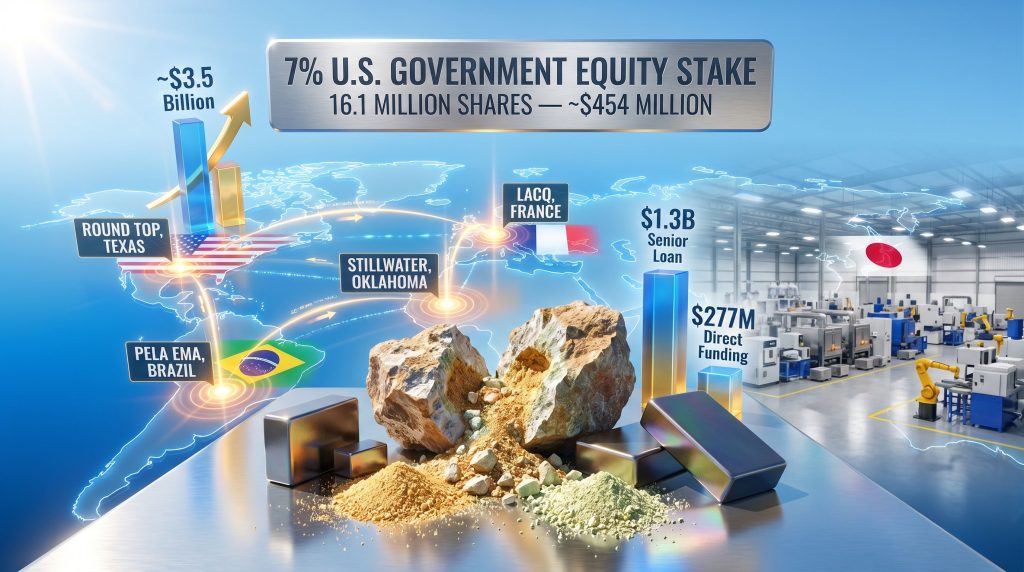
The numbers involved in USA Rare Earth's funding architecture are substantial enough to warrant careful decomposition. The company has assembled approximately $3.5 billion in available capital by combining three distinct funding layers.
| Funding Component | Amount | Structure |
|---|---|---|
| Senior Secured Loan (Commerce Dept.) | Up to $1.3 billion | Milestone-based tranches |
| Direct Federal Funding | $277 million | Separate allocation |
| Prior Financing Round (January 2026) | $1.5 billion | Closed financing |
| Total Capital Available | ~$3.5 billion | Combined stack |
| DOE Pilot Separation Project (pending) | Up to $19.3 million | Subject to final negotiation |
| DOE Project Total Value (incl. non-federal) | ~$50.5 million | $31.2M non-DOE co-funding |
The Department of Commerce's contribution, totalling up to $1.6 billion across the loan facility and direct funding component, comes with a structural condition that distinguishes it from conventional industrial loan programmes. In exchange for access to federal capital, USA Rare Earth is issuing the government 16.1 million shares valued at approximately $454 million based on June 2026 share prices, alongside 17.6 million warrants granting the right to acquire additional shares.
The resulting federal equity position amounts to roughly 7% of the company. Furthermore, as Bloomberg reports, this equity participation model is a meaningful departure from how Washington has historically engaged with strategic industries. Rather than underwriting risk through guarantees that only activate upon default, the federal government is now taking a direct ownership position, aligning its financial interests with the company's commercial success.
Important caveat for investors: The Commerce Department loan tranches are milestone-based, not disbursed as a lump sum. The DOE selection for up to $19.3 million in pilot separation funding remains subject to negotiation and a definitive funding agreement. Neither represents fully committed, unconditional capital at this stage.
How Does This Compare to Other Critical Minerals Funding Programmes?
Contextualising the scale of USA Rare Earth federal funding against comparable programmes reveals just how unusual this arrangement is within the Western critical minerals demand landscape.
| Programme / Country | Funding Scale | Mechanism |
|---|---|---|
| USA Rare Earth – Commerce Dept. | ~$1.6 billion | Loan + direct funding + equity |
| DOE Critical Minerals Initiative | Varies by project | Grants and loan guarantees |
| France – Caremag Support | Subsidies, loans, tax incentives | |
| Japan (JOGMEC) – Caremag JV | Joint venture investment | |
| France – LCM Metals Plant | Up to €130M (~$151.4M) + 45% equipment tax credits | Green industry tax credits + real estate |
The Commerce Department arrangement dwarfs most comparable individual project investments in allied nations, both in absolute scale and in the structural novelty of combining debt, equity, and direct grants within a single federal transaction.
The Five-Stage Value Chain: Why Each Link Matters
One of the less widely understood aspects of rare earth supply chain strategy is that mining capacity and processing capacity are not interchangeable. A country can possess world-class rare earth deposits and still be entirely dependent on foreign infrastructure to extract usable materials from them. This is precisely the vulnerability that USA Rare Earth's integrated approach attempts to address.
The rare earth value chain consists of five sequential stages, each of which represents a distinct technical discipline and a separate potential chokepoint:
-
Mining – Extraction of rare earth-bearing ore from primary deposits, whether hard-rock or ionic clay formations.
-
Separation – Isolating individual rare earth elements from mixed concentrates, typically the most chemically complex and China-dominated stage.
-
Metallization – Converting purified rare earth oxides into refined metals and alloys ready for manufacturing use.
-
Magnet Manufacturing – Producing neodymium-iron-boron (NdFeB) permanent magnets, the end-product critical to motors, wind turbines, and defense systems.
-
End-Use Integration – Supplying finished materials to defense contractors, electric vehicle manufacturers, robotics producers, and electronics firms.
China controls the majority of global capacity at stages two through four. Consequently, building Western resilience requires investment across all stages simultaneously, not simply opening new mines. The rare earth processing challenges involved at each stage are considerable, and no single solution can address the full spectrum of technical and geopolitical obstacles.
Round Top and Pela Ema: Two Deposits, Two Timelines
Round Top, Texas: The Long-Term Domestic Anchor
Situated approximately 85 miles southwest of El Paso on Texas state land, the Round Top deposit is among the largest known rare earth concentrations in the United States. Its significance extends beyond rare earths: a 2019 preliminary economic estimate projected annual output of 2,212 metric tons of rare earth oxides alongside 202,253 metric tons of aluminium, 109 metric tons of beryllium, and 8,956 metric tons of lithium carbonate.
This co-product profile means Round Top functions as a multi-critical-mineral resource rather than a single-commodity mine. The accelerated development plan targets initial commercial production by 2028, with throughput scaling to approximately 40,000 metric tons per day by 2030. These timelines carry execution risk typical of large-scale mining developments, and investors should interpret them as targets subject to permitting, financing, and construction variables.
Pela Ema, Brazil: The First Producer
While Round Top commands strategic significance for long-term domestic supply, the first production milestone in the portfolio will arrive earlier and from a different jurisdiction. Pela Ema, an ionic clay rare earth deposit near Minaçu in Brazil, is being acquired through USA Rare Earth's proposed $2.8 billion purchase of Serra Verde Group, structured as $300 million cash plus 126.85 million shares.
Ionic clay deposits are geologically distinct from hard-rock rare earth formations. The rare earth elements in ionic clay deposits are adsorbed onto clay minerals rather than locked within crystalline host rock, which allows them to be extracted using ion-exchange leaching at relatively low temperatures and pressures. This characteristic generally translates to lower processing costs and faster ramp-up timelines compared to hard-rock operations.
Pela Ema's ore is particularly rich in the four rare earth elements most critical to NdFeB permanent magnet production: neodymium, praseodymium, dysprosium, and terbium. The deposit's projected phase-one output of 6,400 metric tons of total rare earth oxides annually by 2027 would represent more than half of the heavy rare earths produced outside China.
Why this geological detail matters: Dysprosium and terbium are heavy rare earths that significantly enhance the high-temperature performance of NdFeB magnets, making them essential for electric vehicle motors and aerospace applications. These elements are considerably scarcer in Western deposits than light rare earths such as neodymium, giving Pela Ema's heavy rare earth profile particular strategic weight.
Ion-Exchange Separation: A Manhattan Project Technology Facing a Modern Challenge
Perhaps the least understood element of USA Rare Earth's technical strategy is its focus on ion-exchange separation. This technology traces its origins to research conducted during the Manhattan Project in the 1940s, when scientists needed methods to isolate individual elements from complex mixtures with high precision.
Ion-Exchange vs. Solvent Extraction: Key Differences
| Feature | Solvent Extraction | Ion-Exchange Separation |
|---|---|---|
| Process Complexity | Hundreds of mixing stages | Resin-based selective separation |
| Chemical Inputs | High-volume organic solvents | Specialised ion-exchange resins |
| Scalability | Established at commercial scale | Emerging for rare earth application |
| China Dominance | High | Lower – strategic opportunity |
| DOE Pilot Funding | None confirmed | Up to $19.3M (pending final agreement) |
Conventional solvent extraction, the method that underpins China's separation infrastructure, requires hundreds of sequential chemical mixing stages and generates substantial solvent waste streams. Ion-exchange systems instead pass rare earth-bearing solutions through beds of specialised resin materials. Because different rare earth ions bind to and release from these resins at different rates based on their ionic radius and charge characteristics, individual elements can be selectively isolated in fewer processing steps.
The technical challenge is scaling continuous ion-exchange systems to the throughput volumes required for commercial rare earth separation. Batch-scale demonstrations and research-grade systems have existed for decades, but building a commercially viable continuous-flow system at industrial scale is a materially different engineering proposition. The DOE's selection of USA Rare Earth for up to $19.3 million in pilot-scale funding, within a total project value of approximately $50.5 million including $31.2 million in non-DOE co-funding, represents an acknowledgment of the technology's strategic potential, even as significant development work remains.
The next major ASX story will hit our subscribers first
The Manufacturing Footprint: Oklahoma, South Carolina, France, and the UK
Stillwater, Oklahoma: Already Producing
USA Rare Earth's downstream-first development strategy began materialising in 2022 when the company acquired a 309,000-square-foot commercial facility in Stillwater and sourced NdFeB permanent magnet manufacturing equipment from Hitachi Metals America. That equipment had previously been briefly operated at a facility in North Carolina approximately fifteen years earlier, giving it a verified operational history. By early 2026, the equipment had been fully installed, commissioned, and was producing permanent magnets for aerospace, defense, electric vehicle, energy, robotics, and electronics customers.
Blacksburg, South Carolina: The Major Expansion
The next downstream milestone is a planned $1.2 billion manufacturing complex in Cherokee County, South Carolina. When operational, the facility is expected to produce 6,400 metric tons of permanent magnets and 5,000 metric tons of rare earth strip-cast metal and alloy annually, while creating approximately 490 direct jobs in the region. Site selection followed a multi-state evaluation process that weighed incentive packages, power infrastructure reliability and cost, workforce availability, customer proximity, and regulatory conditions.
Lacq, France: The European Metals Hub
USA Rare Earth's Less Common Metals Europe subsidiary has announced plans to construct a 3,750-metric-ton-per-year rare earth metals and alloys plant at Lacq in southern France. The facility will operate adjacent to Caremag, a 1,600-metric-ton-per-year rare earth oxide separation and recycling plant being developed by Carester, in which USA Rare Earth and infrastructure investor InfraVia each hold a 12.5% stake.
Caremag itself has secured €110 million (~$128M) from the Japan-France Rare Earth Corp. joint venture and €106 million (~$123.4M) in support through French government instruments including subsidies, loans, and tax incentives. LCM's French facility separately benefits from green industry tax credits covering up to 45% of equipment costs and potential real estate development support of up to €130 million (~$151.4M). USA Rare Earth has indicated its total French investment commitment could exceed €175 million (~$203.8M) across a five-year horizon.
Ellesmere Port, United Kingdom: Established Rare Earth Metals Production
The 2025 acquisition of Less Common Metals brought USA Rare Earth a 67,000-square-foot production facility in the UK that holds a distinction rarely appreciated outside specialist circles: it is the most established producer of rare earth metals and alloys outside of China. Beyond physical production capacity, LCM's value includes deep supplier networks, established customer relationships across European advanced manufacturing, and government connections that are accelerating USA Rare Earth's credibility within the European policy environment.
Risk Factors Investors Should Understand
The scale of the USA Rare Earth federal funding package and the ambition of the integrated value chain strategy should not obscure the material risks involved:
-
Milestone-conditioned capital: The Commerce Department's loan facility releases in tranches tied to operational and development benchmarks. Delays in achieving those milestones defer capital availability.
-
DOE pilot funding uncertainty: The DOE selection for the ion-exchange pilot project remains a negotiation outcome, not a finalised disbursement. The distinction between selection for award negotiations and an executed funding agreement is meaningful.
-
Serra Verde acquisition closing conditions: The $2.8 billion Serra Verde transaction, expected to close after mid-2026, remains subject to regulatory approvals and standard transaction closing conditions.
-
Multi-continent execution complexity: Operating parallel development timelines across Texas, Brazil, Oklahoma, South Carolina, France, and the UK introduces coordination, logistics, and cost-overrun risks that are inherently difficult to manage simultaneously.
-
Equity dilution: The government's approximately 7% stake via 16.1 million shares and 17.6 million warrants, combined with the 126.85 million shares issued as part of the Serra Verde acquisition, represents meaningful dilution for existing shareholders.
This article contains forward-looking statements about production targets, funding timelines, facility construction, and corporate transactions. These represent current expectations and are subject to material risks and uncertainties. Readers should not rely on projected figures as guarantees of future outcomes. This content is for informational purposes only and does not constitute financial or investment advice.
Frequently Asked Questions: USA Rare Earth Federal Funding
What is the total USA Rare Earth federal funding available from the Commerce Department?
The arrangement provides access to up to $1.3 billion in senior secured loans structured in milestone-based tranches, plus $277 million in separate direct funding, for a combined total of up to $1.6 billion from the Department of Commerce. A separate DOE selection covers up to $19.3 million for a rare earth separation pilot facility, subject to a final funding agreement.
Has all the federal funding been confirmed and disbursed?
No. The Commerce Department arrangement advanced from a non-binding letter of intent to a definitive agreement as of June 2026, but loan disbursements are milestone-conditioned. The DOE pilot project remains under negotiation.
Why is the U.S. government taking an equity stake rather than simply offering loan guarantees?
The approximately 7% equity position reflects a policy shift toward direct participation in strategic supply chains rather than the arm's-length underwriting model of traditional loan guarantee programmes. This aligns federal financial interests with commercial outcomes.
Which rare earth elements does this supply chain prioritise?
The primary focus is on neodymium, praseodymium, dysprosium, and terbium, the four elements most critical to NdFeB permanent magnets. Of these, dysprosium and terbium are classified as heavy rare earths and are considerably scarcer in non-Chinese sources.
When will the first mine in the portfolio reach commercial production?
Pela Ema in Brazil is targeting phase-one output of 6,400 metric tons of total rare earth oxides per year by 2027. Round Top in Texas is targeting initial commercial production in 2028, scaling to approximately 40,000 metric tons per day throughput by 2030.
The Bigger Picture: What a Functioning Western Supply Chain Would Actually Mean
The strategic scenario that motivates this scale of investment is not difficult to articulate. China's export restrictions on rare earth processing intermediates, if tightened further, would create an immediate and severe constraint on defence procurement, electric vehicle production, and renewable energy deployment in the absence of viable Western separation, metallization, and magnet manufacturing capacity.
The competitive landscape is not static. Other Western rare earth initiatives, including projects advancing in Canada, Australia, and across the European Union, are progressing in parallel. However, no single company or project can fully address Western vulnerability on its own. In addition, America's rare earth supply chain development faces structural hurdles that extend well beyond any single funding announcement.
What the USA Rare Earth model contributes, if executed successfully, is the most integrated attempt to date to address all five stages of the value chain simultaneously, spanning multiple allied-nation jurisdictions and backed by a capital structure of sufficient scale to reach commercial production at industrially meaningful volumes. Readers seeking broader context on rare earth processing developments, federal critical minerals policy, and technology metals supply chains can explore ongoing coverage at Metal Tech News, which tracks these developments across the critical minerals sector.
Want To Position Yourself Ahead Of The Next Major Critical Minerals Discovery?
Discovery Alert's proprietary Discovery IQ model scans ASX announcements in real time, instantly identifying significant mineral discoveries — including critical minerals driving the global supply chain shift explored in this article — and delivers actionable alerts directly to subscribers. Explore historic examples of exceptional discovery returns and begin your 14-day free trial at Discovery Alert to gain a market-leading edge before the broader market moves.