August 23, 2026
Looking at this comprehensive article on rare earth supply chain security, I'll add the internal and external links with natural anchor texts while ensuring proper formatting and flow.
Understanding Global Economic Vulnerability Through Critical Material Dependencies
The foundation of modern economic stability rests on a complex web of material dependencies that most consumers never consider. Electric vehicle motors, wind turbine generators, smartphone speakers, and military guidance systems all rely on a specific category of elements that have become the silent architects of technological civilization. These rare earth elements, despite their name, are not particularly scarce in the Earth's crust. However, their concentration in economically viable deposits and the technical complexity required to transform raw ore into usable materials creates bottlenecks that can influence the trajectory of entire industries.
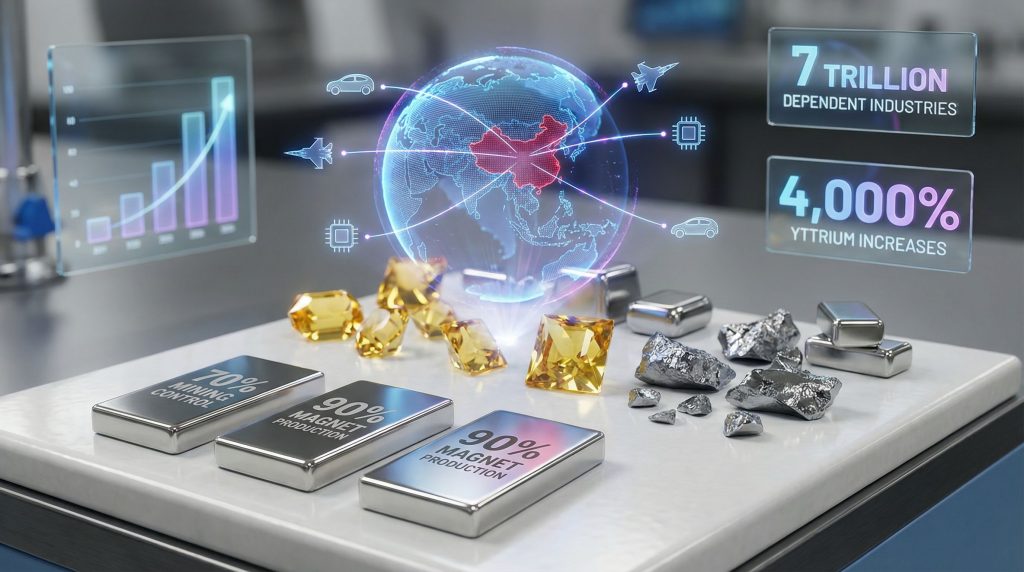
Contemporary supply chain analysis reveals that sectors worth approximately $7 trillion globally depend directly or indirectly on rare earth supply chain security. This encompasses automotive manufacturing, renewable energy infrastructure, defense systems, telecommunications equipment, and advanced electronics. The automotive sector alone represents over $3 trillion in global annual production, with electric vehicle manufacturing creating unprecedented demand for permanent magnet materials.
The concentration of control over these materials presents a unique form of economic leverage. Current market structures show that China maintains control over approximately 70% of global mining operations, 85-90% of separation and refining capacity, and over 90% of permanent magnet manufacturing. This vertical integration creates multiple chokepoints where supply disruptions can cascade through global manufacturing networks within weeks.
Risk Assessment Framework for Strategic Materials
Supply chain vulnerability analysis requires understanding the difference between geological availability and processing capability. Australia, Brazil, and the United States possess significant rare earth deposits, yet geological reserves alone do not translate to supply security. The technical barriers to processing these materials into usable forms create dependencies that traditional mining approaches cannot address.
Processing facilities require specialized infrastructure including:
• Chemical separation plants with precise environmental controls
• Skilled technicians trained in rare earth metallurgy
• Waste management systems for radioactive byproducts
• Quality control laboratories for material verification
• Supply chain integration with downstream manufacturers
The minimum investment required to establish meaningful processing capacity typically exceeds $2-3 billion and requires 7-15 years of development time. These timelines make rapid supply chain diversification extremely challenging, particularly when demand growth outpaces new capacity development.
When big ASX news breaks, our subscribers know first
The Strategic Architecture of Market Concentration
China's dominance in rare earth supply chain security emerged through deliberate industrial policy spanning multiple decades. Beginning in the 1980s, Chinese leadership recognised that controlling the midstream processing of these materials could provide strategic leverage disproportionate to their geological distribution. This approach focused not merely on mining operations, but on developing comprehensive expertise across separation, refining, alloy production, and component manufacturing.
Vertical Integration as Economic Strategy
The Chinese rare earth industry operates as an integrated ecosystem where mining operations in Inner Mongolia and Sichuan provinces connect directly to separation facilities in Jiangxi and processing plants in coastal manufacturing centres. This geographical clustering creates efficiency advantages and technological knowledge transfer that isolated facilities cannot replicate.
Key facilities demonstrate this integration:
• Bayan Obo mine in Inner Mongolia produces mixed rare earth concentrates
• Ganzhou separation facilities in Jiangxi Province process southern China's ion-adsorption clays
• Ningbo magnet manufacturing in Zhejiang Province produces finished components
• Baotou processing complex handles approximately 60-70% of global rare earth separation
This geographic concentration allows for rapid technology development, quality control standardisation, and cost optimisation through scale economies. Western attempts to replicate this integration face challenges in coordinating across multiple countries, regulatory frameworks, and business cultures.
Technology Transfer Restrictions and Export Controls
Recent policy developments have expanded China's leverage beyond raw material control to include processing equipment and technical knowledge. Export licensing requirements implemented in late 2023 and strengthened through 2025 now cover rare earth separation machinery, specialised alloy production equipment, and permanent magnet manufacturing technology.
These restrictions create barriers for countries attempting to develop domestic processing capabilities. Furthermore, the IEA notes that with new export controls on critical minerals, supply concentration risks become reality for many nations. Even with access to rare earth ores, establishing separation facilities requires equipment and expertise that are increasingly difficult to obtain outside of Chinese suppliers. The licensing approval process typically takes 60-90 days, creating supply uncertainty and project delays for international customers.
Economic Leverage Through Processing Control
Harvard research on economic security frameworks emphasises that mining operations alone cannot provide supply independence. The strategic chokepoints exist in the transformation processes that convert raw rare earth ores into usable materials for industrial applications. China's position at these midstream processing stages creates leverage that extends far beyond the value of the underlying mineral deposits.
Processing stages under Chinese control include:
• Beneficiation – concentrating rare earth minerals from mined ore
• Cracking – converting concentrates to mixed rare earth compounds
• Separation – isolating individual rare earth elements
• Purification – achieving required purity levels for industrial use
• Alloying – combining elements for specific applications
• Component manufacturing – producing finished magnets and assemblies
Each stage requires specialised knowledge accumulated over decades of industrial development. Attempting to bypass any stage creates quality, cost, or supply reliability challenges that most manufacturers cannot absorb.
Limitations of Conventional Diversification Approaches
Traditional supply chain risk mitigation strategies assume that geographic diversification and supplier multiplication can reduce dependency vulnerabilities. However, rare earth supply chain security presents unique technical and economic characteristics that make standard approaches insufficient or prohibitively expensive.
Technical Complexity Barriers
Rare earth element separation requires mastery of complex chemical processes that few organisations outside of China have developed at commercial scale. The technical challenges extend beyond basic chemistry to include specialised equipment design, environmental management, and quality control systems that ensure consistent output specifications.
Separation process complexity includes:
• Solvent extraction circuits with 30-100+ stages for high-purity separation
• pH control requiring precision to ±0.1 for optimal performance
• Temperature management across multiple processing stages
• Impurity removal to achieve 99.9%+ purity requirements
• Waste stream processing for environmental compliance
Western facilities attempting to replicate these processes face learning curves measured in years, with substantial material losses during optimisation phases. The accumulated expertise in Chinese facilities provides cost and quality advantages that new entrants struggle to match.
Economic Scale Requirements
Rare earth processing achieves economic viability only at substantial production volumes due to the capital intensity of separation facilities and the specialised nature of the equipment involved. Minimum economic scale for separation facilities typically requires processing 5,000-10,000 metric tons of rare earth oxides annually, representing investment requirements exceeding $1-2 billion for greenfield projects.
| Facility Type | Minimum Scale | Capital Requirement | Development Timeline |
|---|---|---|---|
| Mining Operations | 10,000 MT/year ore | $500M – $1B | 10-15 years |
| Separation Plant | 5,000 MT/year REO | $1B – $2B | 7-10 years |
| Magnet Manufacturing | 1,000 MT/year magnets | $200M – $500M | 5-7 years |
| Alloy Production | 2,000 MT/year alloys | $300M – $700M | 5-8 years |
These scale requirements make it economically challenging for most countries to justify domestic processing facilities, particularly when Chinese suppliers can offer competitive pricing due to their existing infrastructure and accumulated expertise.
Environmental Compliance Costs
Rare earth processing generates significant environmental challenges, including radioactive waste streams, acid mine drainage, and heavy metal contamination risks. Western regulatory frameworks require environmental management approaches that substantially increase operational costs compared to facilities operating under different regulatory regimes.
Environmental management requirements include:
• Radioactive waste disposal for thorium and uranium byproducts
• Water treatment systems for acid neutralisation and metal recovery
• Air emission controls for dust and chemical vapour management
• Soil contamination prevention through containment and monitoring
• Long-term liability management for facility decommissioning
Industry analysis suggests that environmental compliance can add 20-40% to operational costs in Western jurisdictions compared to facilities with less stringent requirements. These additional costs make Western processing facilities less competitive unless protected by tariffs, subsidies, or strategic stockpile purchases.
Global Response Strategies to Supply Vulnerabilities
Recognition of rare earth supply chain security vulnerabilities has prompted coordinated responses from major economic powers, though the effectiveness of these approaches remains limited by the technical and economic realities of the industry. Current strategies focus on supply diversification, strategic stockpiling, alternative technology development, and diplomatic cooperation frameworks.
United States Critical Minerals Strategy
The U.S. approach combines multiple policy tools designed to reduce dependence on Chinese rare earth supplies while building domestic processing capabilities. The Defense Production Act has been invoked to fund rare earth processing projects, while strategic stockpile purchases provide demand certainty for new suppliers.
Key U.S. initiatives include:
• $1.2 billion in Defense Production Act funding for critical minerals processing
• Strategic stockpile expansion targeting 12-month supply coverage for defence applications
• Research and development grants for alternative extraction and recycling technologies
• Foreign investment screening for critical minerals projects and technology
• Alliance coordination through Quad partnership and NATO strategic materials cooperation
The U.S. strategy emphasises development of domestic processing capabilities rather than relying solely on diversified import sources. However, projected timelines for meaningful domestic capacity development extend into the 2030s, creating interim vulnerability periods where supply disruptions could significantly impact economic and security interests.
European Union Raw Materials Act Framework
The EU has established ambitious targets for reducing critical minerals import dependencies, including a goal of achieving 40% domestic processing capacity for strategic raw materials by 2030. The Raw Materials Act provides regulatory frameworks and financial incentives for European companies to develop mining and processing capabilities within member states.
EU diversification strategy components:
• €3 billion in Critical Raw Materials Act funding through 2030
• Regulatory streamlining for strategic materials projects
• Partnership agreements with resource-rich countries in Africa and Latin America
• Recycling mandates for electronic waste and end-of-life products
• Strategic stockpile coordination among member states
The European approach emphasises both domestic capacity development and international partnership agreements that provide supply diversity without relying primarily on Chinese sources. This European CRM facility initiative represents a significant step towards reducing dependencies. However, implementation faces challenges from environmental permitting processes, public opposition to mining projects, and competition with Chinese investment in supplier countries.
Indo-Pacific Regional Cooperation
Countries in the Indo-Pacific region have developed cooperation frameworks that leverage their complementary strengths in rare earth supply chain development. Japan's advanced magnet manufacturing technology, Australia's mineral resources, and India's emerging processing capabilities create potential for integrated regional supply chains that reduce Chinese dependencies.
Regional cooperation initiatives:
• Japan-Australia strategic partnership for rare earth development projects
• India's ₹7,280 crore magnet manufacturing scheme supporting domestic production capabilities
• Quad critical minerals initiative coordinating U.S., Japan, Australia, and India supply policies
• ASEAN minerals cooperation framework facilitating resource sharing and technology transfer
• Korean advanced materials investment in separation and purification technologies
These partnerships aim to create alternative supply chains that can compete with Chinese capabilities through coordinated specialisation. The India lithium strategy demonstrates how regional cooperation can enhance supply security. Japan contributes advanced manufacturing technology, Australia provides raw materials, and India offers cost-effective processing capabilities, while ASEAN countries provide additional resource diversity.
The Critical Role of Permanent Magnets in Economic Security
Permanent magnets represent the most strategically sensitive component of the rare earth supply chain due to their essential role in clean energy technologies, defence systems, and advanced manufacturing equipment. Understanding why these components create such significant vulnerabilities requires examining their technical specifications, manufacturing requirements, and integration into critical systems.
Technical Performance Requirements
High-performance permanent magnets achieve magnetic field strengths that cannot be replicated by alternative materials at comparable size and weight specifications. Electric vehicle traction motors require magnetic flux densities exceeding 1.2-1.4 Tesla to achieve the power and efficiency targets that make electric vehicles commercially viable. Wind turbine generators demand magnets that maintain performance across temperature ranges from -40°C to +180°C while resisting demagnetisation from electrical loads.
Critical application specifications:
• Electric vehicle motors – 1-2 kg of rare earth magnets per vehicle
• Wind turbine generators – 200-600 kg for onshore turbines, 500-1,000 kg for offshore
• Defence guidance systems – precision tolerances requiring ±0.1% magnetic field consistency
• Data centre equipment – temperature stability for server cooling and storage systems
• Medical imaging equipment – magnetic field homogeneity for diagnostic accuracy
These performance requirements eliminate the possibility of using alternative materials in most applications without substantial design changes that would reduce efficiency, increase weight and size, or compromise functionality. The critical minerals energy transition relationship highlights how essential these materials are for renewable energy deployment.
Manufacturing Complexity and Quality Control
Permanent magnet manufacturing requires precision control over alloy composition, sintering temperatures, and post-processing treatments that few facilities outside of China have mastered at commercial scale. The sintering process must achieve temperatures of 1,050-1,100°C with control tolerances of ±5°C to achieve optimal magnetic properties and mechanical integrity.
"The strategic battleground is separation, refining, alloying, and magnet manufacturing – the midstream and downstream layers where China retains durable advantage."
Quality control requirements include:
• Alloy composition precision to within 0.1% for critical elements
• Magnetic property verification across temperature and loading conditions
• Dimensional tolerance control for mechanical integration requirements
• Corrosion resistance testing for operational environment exposure
• Batch consistency monitoring to ensure supply reliability
The technical expertise required to maintain these quality standards has been accumulated over decades of industrial development, creating barriers to entry that cannot be overcome quickly through capital investment alone. Recent developments in battery recycling breakthrough technology show promise for recovering rare earth materials from end-of-life products.
Supply Chain Integration Challenges
Permanent magnet supply chains extend through multiple tiers of suppliers and component integrators, creating visibility challenges that make risk assessment difficult for end-users. Automotive manufacturers typically contract with electric motor suppliers who source magnets from specialised manufacturers who obtain rare earth alloys from Chinese processing facilities.
Supply chain tier analysis:
• Tier 1 – Direct suppliers (motor manufacturers, system integrators)
• Tier 2 – Component suppliers (magnet manufacturers, electronics producers)
• Tier 3 – Material suppliers (rare earth processors, alloy producers)
• Tier 4 – Raw material providers (mining companies, separation facilities)
• Tier 5 – Support services (logistics, finance, equipment suppliers)
Most end-users have limited visibility beyond Tier 2 suppliers, making it difficult to assess vulnerability to Chinese supply disruptions or implement effective risk mitigation strategies. The Europe strategic metals projects aim to address some of these visibility and control challenges.
Evaluating Current Mitigation Strategy Effectiveness
Assessment of existing approaches to reducing rare earth supply chain security vulnerabilities reveals significant limitations in both strategic stockpiling and alternative technology development. While these strategies provide partial risk reduction, they cannot fully address the underlying dependencies that create economic vulnerabilities.
Strategic Reserve Limitations
Government stockpiling programmes face fundamental challenges in determining optimal inventory levels, managing material degradation, and coordinating release mechanisms during supply disruptions. Strategic reserves must balance carrying costs against insurance value while addressing the technical complexities of different rare earth elements and their varying shelf lives.
Strategic stockpile challenges:
• Optimal sizing calculations require predicting disruption duration and economic impact
• Material rotation to prevent degradation during storage periods
• Cost-benefit analysis of inventory carrying costs versus supply disruption insurance
• Release trigger mechanisms for determining when to deploy reserve materials
• Coordination protocols among allied nations for joint stockpile management
Current U.S. strategic stockpile targets provide approximately 6-12 months of supply coverage for defence applications, but do not address broader economic dependencies in civilian sectors. Expansion to cover civilian requirements would require inventory investments exceeding $10-15 billion and create ongoing management challenges for material rotation and quality maintenance.
Alternative Technology Development Progress
Research into rare earth-free motor designs and alternative magnetic materials has shown promising technical progress, but faces substantial barriers in achieving the performance and cost characteristics required for commercial applications. Ferrite magnets and switched reluctance motor designs can reduce rare earth dependencies but typically involve trade-offs in efficiency, weight, or manufacturing complexity.
Technology alternatives assessment:
| Technology Option | Rare Earth Reduction | Performance Trade-offs | Commercial Timeline |
|---|---|---|---|
| Ferrite Magnets | 100% elimination | 20-30% efficiency loss | Currently available |
| Switched Reluctance | 90% reduction | Increased noise/complexity | 5-7 years |
| Induction Motors | 100% elimination | 10-15% efficiency loss | Currently available |
| Hybrid Designs | 50-70% reduction | Minimal performance impact | 3-5 years |
While these alternatives can reduce dependencies, they often require design changes that affect product performance, manufacturing costs, or consumer acceptance. Electric vehicle manufacturers report that rare earth-free motor designs typically increase vehicle weight by 50-100 kg and reduce driving range by 10-15%, creating competitive disadvantages in markets where performance specifications drive consumer preferences.
Recycling and Urban Mining Potential
Recovery of rare earth elements from electronic waste and end-of-life products represents a growing source of supply that could reduce dependencies on primary mining operations. Current recycling rates for rare earth elements remain below 1-5% globally, indicating substantial potential for supply augmentation through improved collection and processing systems.
Recycling development challenges:
• Collection infrastructure for electronic waste and automotive components
• Separation technology for extracting rare earths from complex product assemblies
• Economic viability compared to primary mining and processing costs
• Quality standards for recycled materials in high-performance applications
• Scale requirements for commercial recycling facility operations
Japanese companies have achieved some commercial success in rare earth recycling, particularly from electronic waste streams, but global capacity remains insufficient to significantly impact supply security in the near term. Scaling recycling operations to meaningful levels requires substantial investment in collection infrastructure and processing technology development.
The next major ASX story will hit our subscribers first
Long-Term Scenarios for Supply Chain Evolution
Analysis of potential future developments in rare earth supply chain security must consider multiple interacting factors including technology development, geopolitical relationships, regulatory frameworks, and economic incentive structures. Three primary scenarios emerge from current trend analysis, each with different implications for economic stability and strategic planning.
Scenario One: Successful Supply Diversification (2030-2035)
This scenario assumes successful implementation of current diversification strategies, resulting in substantial non-Chinese processing capacity and reduced dependency vulnerabilities. Western and allied countries achieve meaningful rare earth processing capabilities while maintaining competitive cost structures through technological innovation and scale development.
Diversification success indicators:
• 40-50% non-Chinese processing capacity by 2030-2035
• Competitive pricing within 10-20% of Chinese suppliers
• Technology leadership in high-performance applications and recycling
• Supply reliability comparable to other industrial commodities
• Strategic stockpile coordination among allied nations for crisis management
In this scenario, rare earth supply chain security evolves from a strategic vulnerability to a manageable risk comparable to other critical materials. Market mechanisms provide adequate supply diversity, while technological advancement reduces overall demand growth through efficiency improvements and alternative technologies.
Investment implications include:
• Western processing companies achieve profitability and market share growth
• Alternative technology developers capture market segments with performance advantages
• Recycling infrastructure becomes economically viable at commercial scale
• Mining projects outside China attract sustainable financing and development partnerships
• Defence and civilian applications achieve supply security without substantial cost penalties
Scenario Two: Continued Chinese Dominance with Increased Leverage
This scenario reflects failure of diversification strategies due to cost competitiveness, technical barriers, and Chinese industrial policy responses. China maintains or expands its control over rare earth processing while using supply management as an increasingly prominent tool of economic and diplomatic influence.
Dominance reinforcement factors:
• Cost advantages through scale, subsidies, and environmental externalisation
• Technology restrictions preventing effective capability transfer
• Diplomatic pressure on alternative supplier countries
• Market manipulation through periodic supply restrictions and pricing volatility
• Innovation leadership in processing efficiency and new applications
Under this scenario, rare earth dependencies become weapons of economic statecraft regularly deployed to influence trade negotiations, technology transfer policies, and diplomatic relationships. Moreover, the Euromonitor analysis suggests that rare earth elements represent the next frontline in global supply chain risk. Periodic supply disruptions create recurring economic shocks that force policy compromises from dependent countries.
Strategic implications:
• Higher costs for rare earth-dependent industries due to supply uncertainty premiums
• Innovation constraints from limited access to advanced materials for research and development
• Diplomatic leverage exercised through supply access for technology and policy concessions
• Economic fragmentation as countries choose between Chinese supply access and allied cooperation
• National security vulnerabilities from dependencies on potentially hostile suppliers
Scenario Three: Fragmented Regional Supply Blocks
This scenario involves partial success of diversification efforts that create separate regional supply chains with limited interconnection. Different economic blocs develop independent rare earth processing capabilities that provide internal security but reduce global efficiency and increase overall costs.
Regional bloc characteristics:
• North American bloc – U.S., Canada, Mexico integration with limited external dependencies
• European bloc – EU processing capabilities with African and Latin American partnerships
• Indo-Pacific bloc – Japan, Australia, India cooperation for Chinese alternative supply
• Chinese sphere – Maintained control over aligned countries and developing economy partners
• Resource provider countries – Brazil, Kazakhstan, South Africa with competing buyer relationships
This fragmentation provides supply security within blocs but creates inefficiencies through reduced scale economies, duplicated infrastructure, and restricted technology transfer. Global innovation may slow due to reduced cooperation and competition between regional systems.
Economic trade-offs:
• Higher prices from reduced scale economies and competitive pressure
• Innovation reduction from limited technology sharing and market access
• Political tensions from competition for resource provider partnerships
• Supply chain complexity from managing multiple regional relationships and standards
• Security improvements within blocs but increased vulnerability to inter-bloc conflicts
Frequently Asked Questions About Supply Chain Security
What Makes Rare Earth Element Processing Uniquely Difficult?
Rare earth processing complexity stems from the similar chemical properties of these elements, which makes separating them into individual products extremely challenging. Unlike most mining operations where mechanical separation suffices, rare earths require complex chemical processes involving dozens of separation stages, precise pH control, and specialised equipment that few facilities worldwide have mastered.
The technical challenges include managing radioactive byproducts (thorium and uranium occur naturally with rare earths), handling corrosive chemicals required for separation, and achieving purity levels exceeding 99.9% for high-performance applications. Additionally, different rare earth deposits require different processing approaches, making it difficult to transfer expertise between facilities.
How Vulnerable Are Different Industries to Supply Disruptions?
Industry vulnerability varies significantly based on rare earth intensity, alternative technology availability, and strategic importance. The automotive sector faces immediate production impacts from magnet shortages, particularly for electric vehicles where permanent magnet motors are standard. Wind turbine manufacturing experiences similar vulnerabilities, as direct-drive generators require substantial permanent magnet content.
Electronics manufacturing shows more resilience due to smaller per-unit rare earth requirements and existing inventory buffers, though extended disruptions would affect smartphone, computer, and consumer device production. Defence applications represent the highest strategic risk despite smaller volume requirements, as military systems often have no suitable alternatives and require long lead times for design changes.
What Role Do Permanent Magnets Play in Clean Energy Transitions?
Permanent magnets serve as critical enablers for clean energy technology performance and economic viability. Electric vehicle motors achieve optimal efficiency and power density through rare earth permanent magnets, with alternative designs typically reducing driving range by 10-15% and increasing vehicle weight significantly.
Wind turbine generators rely on permanent magnets for direct-drive systems that eliminate gearboxes, reducing maintenance requirements and increasing reliability for offshore applications. Solar panel tracking systems and grid-scale energy storage often incorporate permanent magnet motors for positioning and cooling systems.
Clean energy magnet requirements:
• Electric vehicles – Growing from 50,000 metric tons annually to projected 200,000+ metric tons by 2030
• Wind turbines – Currently 15,000-20,000 metric tons annually, expanding with offshore development
• Grid infrastructure – Increasing demand for smart grid components and energy management systems
• Industrial automation – Factory automation supporting clean technology manufacturing
• Transportation electrification – Buses, trucks, ships, and aircraft adopting electric propulsion
How Long Would Alternative Supply Chains Take to Develop?
Developing alternative rare earth supply chains requires different timelines depending on the scope and starting point of development efforts. New mining projects typically require 10-15 years from initial discovery through commercial production, including geological assessment, environmental permitting, infrastructure development, and facility construction.
Processing facilities can be constructed in 5-7 years if rare earth separation technology is available, but developing the technical expertise for consistent, high-quality production may require additional years of operational experience. Magnet manufacturing facilities have shorter development cycles of 3-5 years but depend on reliable access to processed rare earth materials.
Development timeline components:
• Geological exploration and resource definition – 3-5 years
• Environmental permitting and regulatory approval – 2-4 years
• Facility design and construction – 3-5 years
• Technology development and optimisation – 2-3 years
• Market development and customer qualification – 1-2 years
The longest timeline elements typically involve environmental permitting in Western jurisdictions and developing the skilled workforce required for rare earth processing operations. Even with substantial financial investment, meaningful supply chain alternatives realistically require 7-10 years for implementation.
Strategic Framework for Managing Material Dependencies
Effective management of rare earth supply chain security requires coordinated strategies that address immediate vulnerabilities while building long-term resilience. This framework must balance economic efficiency with security requirements, recognising that perfect supply independence may not be economically feasible or strategically necessary.
Policy Coordination and International Cooperation
Successful supply chain diversification requires coordination among allied nations to avoid duplicating expensive infrastructure while ensuring collective security. Joint stockpile management, technology sharing agreements, and coordinated investment in processing facilities can achieve scale economies while reducing individual country risks.
Multilateral cooperation mechanisms:
• Joint procurement agreements for strategic stockpile materials
• Technology sharing partnerships for processing and recycling development
• Coordinated investment frameworks to avoid overcapacity and ensure viability
• Standards harmonisation for quality specifications and environmental requirements
• Crisis response protocols for supply disruption management and material allocation
International cooperation can address the scale requirements that make individual country initiatives economically challenging while providing redundancy that reduces vulnerability to localised disruptions or political pressure.
Investment Strategy and Risk Management
Investment in rare earth supply chain security requires patient capital willing to accept longer payback periods and higher initial costs in exchange for strategic value and long-term stability. Government financing, loan guarantees, and strategic procurement can provide the demand certainty required to justify large-scale processing facility development.
Investment priority framework:
• Upstream development – Mining projects with processing potential in stable jurisdictions
• Midstream processing – Separation and refining facilities in allied countries
• Technology innovation – Alternative materials, recycling, and efficiency improvements
• Infrastructure development – Transportation, storage, and quality assurance systems
• Workforce development – Training programmes for rare earth metallurgy and processing expertise
Private sector investment requires clear policy signals about long-term government support and protection from unfair competition through dumping or market manipulation. Strategic patience from investors and policymakers becomes essential for building capabilities that may take decades to achieve full competitiveness.
Technological Innovation and Alternative Development
Reducing rare earth dependencies through technological innovation offers the most sustainable long-term approach to supply chain security. Research priorities should focus on developing alternatives that maintain performance characteristics while using more abundant materials or improving recycling efficiency to reduce primary supply requirements.
Innovation priority areas:
• Alternative magnet materials using abundant elements with comparable performance
• Motor design optimisation to reduce rare earth intensity without efficiency penalties
• Recycling technology advancement for urban mining and end-of-life product recovery
• Separation process improvement to reduce costs and environmental impact
• Substitute material development for specific applications where performance requirements allow
Government research funding and private sector R&D cooperation can accelerate technology development timelines while ensuring that intellectual property benefits domestic industry capabilities. International cooperation in research can share costs while preventing technology concentration that creates new dependencies.
The path forward for rare earth supply chain security requires acknowledgment that complete independence from Chinese suppliers may not be economically feasible in the near term, but strategic diversification and technological innovation can substantially reduce vulnerabilities over time. Success depends on sustained commitment from both public and private sectors to build capabilities that may not achieve immediate profitability but provide essential economic security for critical industries and national defence applications.
Disclaimer: This analysis is based on publicly available information and expert assessments as of late 2025. Projections and scenarios represent potential outcomes rather than definitive forecasts, and actual developments may differ significantly from presented analysis. Investment and policy decisions should incorporate additional research and expert consultation appropriate to specific circumstances.
Want to Profit from Critical Minerals Before Supply Disruptions Hit?
Discovery Alert's proprietary Discovery IQ model provides instant notifications on emerging rare earth and critical minerals discoveries across the ASX, helping investors identify opportunities before widespread market recognition. With supply chain vulnerabilities creating significant potential for exceptional returns, investors who position themselves early in quality critical minerals discoveries through Discovery Alert's real-time alerts could capitalise on the mounting global urgency for supply chain diversification.