August 5, 2026
The Processing Bottleneck That Has Defined Rare Earth Project Economics for Decades
Across the global critical minerals landscape, the graveyard of failed rare earth projects shares a common epitaph: the metallurgy did not cooperate. For decades, the pathway from discovery to production in rare earths has been obstructed less by geology and more by processing complexity. Hard rock deposits demand energy-intensive cracking, aggressive reagent chemistry, and capital-heavy circuits that routinely blow out cost estimates by hundreds of millions of dollars. The result is a sector where only a handful of projects have successfully bridged the gap between resource definition and commercial production.
Clay-hosted ionic adsorption deposits represent a fundamentally different paradigm. Rather than locking rare earth elements inside mineral crystal structures, these deposits bind target elements loosely to clay particles through electrostatic adsorption. This means rare earths can, in theory, be released through relatively gentle leaching chemistry rather than high-temperature metallurgical processes. In theory, the economics should be far more attractive. In practice, that theory only holds if testwork confirms favourable leach kinetics, reagent performance, and filtration characteristics at the specific deposit in question.
That is precisely why the Victory Metals North Stanmore PFS testwork results, published in early May 2026, carry meaningful weight for anyone tracking Western rare earth development.
When big ASX news breaks, our subscribers know first
What the North Stanmore Deposit Actually Looks Like at a Geological Level
Scale, Grade, and the Significance of HREE Dominance
The North Stanmore heavy rare earth project sits near Cue in Western Australia's Murchison region, a jurisdiction with established mining infrastructure and a long history of mineral extraction. The deposit carries a JORC-compliant resource of 321 million tonnes, a scale that immediately sets it apart from most rare earth projects in the development pipeline.
What matters as much as size, however, is composition. The deposit averages 39% heavy rare earth content as a proportion of total rare earth oxide (TREO), with select zones reaching concentrations of 83% HREE within TREO. This is a critical distinction that is often lost in broad rare earth coverage.
The rare earth industry is frequently discussed as a monolith, but the market for light rare earths and heavy rare earths operates quite differently. Furthermore, understanding the strategic importance of rare earths helps contextualise why HREE dominance matters so significantly:
- Light rare earths (LREEs) such as Lanthanum and Cerium are relatively abundant globally and command lower prices
- Heavy rare earths (HREEs) including Dysprosium, Terbium, Holmium, and the critical NdPr pairing are far scarcer outside of China
- HREE-dominant deposits represent a materially different commercial proposition compared to LREE-weighted projects
A deposit averaging 39% HREE content with peaks approaching 83% in high-grade zones is genuinely unusual in the global ionic clay deposit inventory. Most comparable deposits, including the Chinese southern ionic clay deposits that have historically dominated HREE supply, operate at HREE percentages well below this level.
The projected mine life exceeds 60 years, a duration that carries implications far beyond simple resource economics. Long-dated supply underpins the kind of offtake commitments and project financing structures that Western manufacturers and governments need to justify shifting procurement away from established Chinese supply chains.
Why Ionic Adsorption Clay Chemistry Changes the Processing Equation
In a conventional hard rock rare earth deposit, target elements are embedded within phosphate or carbonate mineral lattices. Extracting them requires either high-temperature roasting, concentrated acid digestion, or both. These processes demand significant thermal energy infrastructure, produce complex waste streams, and create substantial capital expenditure even before a tonne of ore has been processed.
Ionic clay deposits behave differently at a molecular level. Rare earth cations are held on clay mineral surfaces through weak electrostatic bonds rather than crystallographic bonds. Introducing a competing cation through a leach solution, typically ammonium sulphate or a similar compound, displaces the rare earth ions into solution. The process requires no furnace, no roaster, and considerably less aggressive chemistry.
The selectivity of ionic adsorption leaching is one of its most underappreciated advantages. Because the mechanism targets loosely bound surface cations rather than mineral crystal structures, the process naturally excludes many of the gangue minerals that create downstream purification problems in hard rock flowsheets.
This mechanistic advantage is why leach kinetics, reagent selection, and filtration characteristics are the three critical variables that determine whether an ionic clay project is commercially viable. All three have now been confirmed favourably through the Victory Metals North Stanmore PFS testwork program. The rare earth processing challenges that have historically derailed comparable projects make these confirmations particularly significant.
What the PFS Testwork Confirmed and Why Each Result Matters
The Leach Kinetics Breakthrough
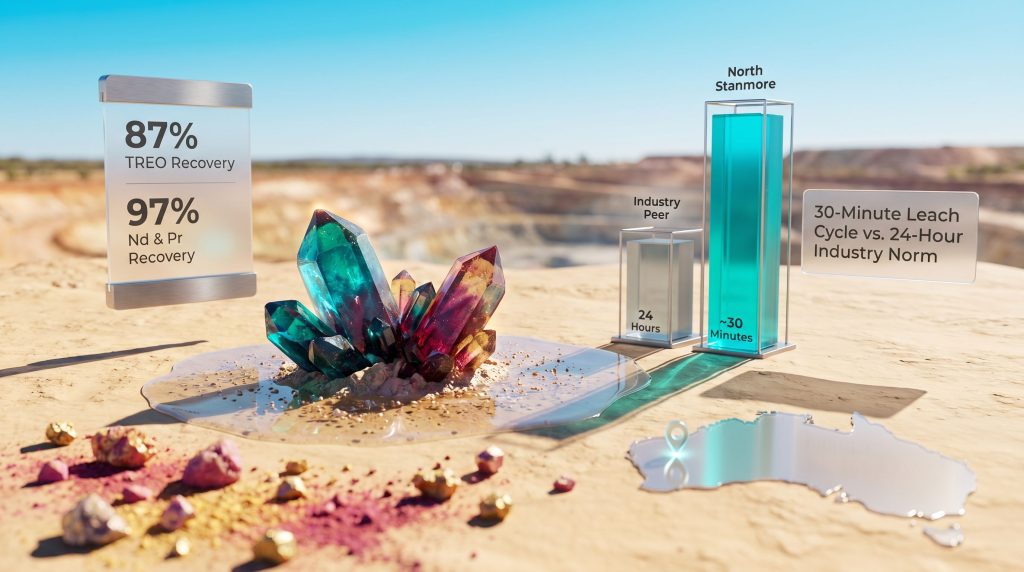
Perhaps the most structurally significant outcome of the ALS-conducted testwork program is the confirmation of leach cycle duration. The scoping study baseline assumed a 4-hour leach cycle, which itself was already shorter than the industry norm for comparable ionic clay deposits, where approximately 24-hour leach times are typical.
The PFS testwork confirmed that roughly 80% of rare earth recovery is achieved within just 30 minutes, with overall TREO recovery reaching 87% across the full cycle.
The engineering implications of this compress across multiple cost centres simultaneously:
| Cost Centre | Impact of 30-Minute vs. 4-Hour Leach Cycle |
|---|---|
| Leach vessel count | Proportionally reduced |
| Civil and structural works | Smaller footprint, lower construction cost |
| Reagent inventory requirements | Reduced storage and handling infrastructure |
| Working capital | Faster cycle time reduces in-circuit inventory |
| Commissioning timeline | Simpler circuit commissions faster |
Against the broader industry benchmark of 24-hour leach times, the North Stanmore confirmation represents an approximately 48-fold improvement in leach speed. This is not an iterative efficiency gain. It is a categorical processing advantage that reshapes how the entire circuit is designed and costed.
The reason this matters beyond pure capital cost is process scalability. Shorter leach cycles allow the same physical infrastructure to process substantially higher ore throughput, or alternatively allow a smaller, cheaper plant to achieve the same annual production target.
Reagent Selection and the 50% Cost Reduction
Flotation reagent costs represent one of the most persistent operational expenditure lines across a mine's life. Unlike labour or energy, which can be partially mitigated through automation or renewable power procurement, reagent costs track directly with ore throughput. Over a 60-year mine life, even modest reductions in reagent unit cost compound into hundreds of millions of dollars in cumulative savings.
The testwork identified a lower-cost reagent alternative that delivered 50% savings on flotation reagent costs compared to the baseline assumption, while simultaneously producing superior metallurgical performance. This is an unusual combination. In most processing optimisation exercises, cost reduction and performance improvement exist in tension with each other.
Discovering a reagent that achieves both simultaneously suggests the original scoping study baseline assumption was overly conservative in its reagent selection, which is common at early study stages where testwork has not yet been conducted. The compounding effect of this finding is worth noting explicitly:
- Lower unit cost per kilogram of reagent
- Faster leach kinetics reduce total reagent consumption per tonne of ore
- Both savings apply across the full ore throughput across the 60-year mine life
- Total lifecycle saving substantially exceeds the headline 50% unit cost figure
Ambient Temperature Processing and What It Eliminates from the Capital Budget
The confirmation that ambient temperature processing delivers equivalent metallurgical performance to heated alternatives removes an entire infrastructure category from the capital expenditure estimate.
Thermal processing infrastructure in a mining context typically includes:
- High-capacity boilers or steam generation systems
- Heat exchangers and temperature control equipment
- Fuel storage and handling facilities
- Additional safety and environmental controls for high-temperature operations
- Increased maintenance requirements associated with thermal cycling
In a remote Western Australian setting, where construction costs are elevated and supply chain logistics add significant cost premiums, eliminating a thermal processing requirement is materially different from doing so at a site with established infrastructure. The capital and operational savings are amplified by location.
Victory Metals CEO Brendan Clark confirmed that the testwork outcomes simplified the entire process flowsheet and materially reduced both capital and operational expenditure estimates, as reported by Mining Weekly on 4 May 2026.
Clay Handling and Filtration Characteristics
The fourth confirmatory outcome from the testwork program, and perhaps the least intuitively understood by non-specialist observers, relates to clay filtration behaviour. Clay-hosted deposits can present significant challenges during the solid-liquid separation stage of processing. Clays with poor filtration characteristics require larger filtration equipment, longer filtration cycles, and more complex dewatering circuits, all of which add capital cost and operational complexity.
The North Stanmore testwork confirmed excellent filtration characteristics, meaning the clay separates cleanly from the pregnant leach solution. This has downstream benefits throughout the processing flowsheet, including:
- Reduced reagent loss through entrainment in the solids stream
- Cleaner pregnant leach solution requiring less downstream purification
- Simpler filtration equipment selection
- Reduced water consumption and tailings management complexity
How These Outcomes Collectively Reshape the Project Economics
The Compounding Effect of Simultaneous Improvements
It is worth emphasising that these four testwork outcomes — improved leach kinetics, reagent cost reduction, thermal energy elimination, and superior filtration characteristics — are not independent. Each one reinforces the others within the process flowsheet.
A shorter leach cycle reduces reagent consumption. Better filtration reduces reagent loss. Ambient temperature processing simplifies the circuit that connects these stages. The result is a compounding improvement across CAPEX and OPEX that is greater in aggregate than any single line item reduction suggests in isolation.
Prefeasibility studies carry cost accuracy ranges of approximately plus or minus 20 to 25 percent, compared to plus or minus 35 to 50 percent for scoping studies. The testwork outcomes feed directly into the PFS cost model, meaning improvements translate into real narrowing of cost uncertainty, not just directional optimism.
NdPr Recovery Rates and Revenue Architecture
The testwork confirmed 97% recovery rates for both Praseodymium (Pr) and Neodymium (Nd), the two elements that form NdPr oxide, the critical feedstock for neodymium-iron-boron permanent magnets.
This matters because NdPr is the value driver within most rare earth project revenue models. Furthermore, the critical minerals demand growth driven by the energy transition has made these recovery rates more commercially significant than ever. Permanent magnets made from NdPr alloys are indispensable in:
- Electric vehicle traction motors, where each vehicle typically requires 1 to 2 kilograms of NdPr oxide
- Direct-drive offshore wind turbines, where each turbine may require 300 to 600 kilograms of NdPr oxide
- Industrial motors, robotics, and defence applications
A 97% NdPr recovery rate sits at the high end of the performance spectrum for ionic clay processing. Variable recovery rates, typically cited in the 70 to 90 percent range for comparable deposits, can dramatically alter the project's revenue per tonne of ore processed.
The following comparison illustrates how North Stanmore's confirmed metrics position it against typical ionic clay peers:
| Metric | North Stanmore | Typical Ionic Clay Peer |
|---|---|---|
| HREE content (% of TREO) | Up to 83% | 20 to 40% typical |
| Confirmed leach time | ~30 minutes | ~24 hours |
| NdPr recovery | 97% | 70 to 90% variable |
| Overall TREO recovery | 87% | 60 to 85% variable |
| Mine life | 60+ years | Typically 15 to 30 years |
The Strategic Context: Why Western HREE Supply Is a Structural Priority
China's Dominance and Why It Creates Opportunity
Heavy rare earths are disproportionately concentrated in Chinese-controlled production and processing capacity. China's rare earth trade strategy has long leveraged this dominance, with Chinese state-owned enterprises controlling the majority of downstream HREE separation and processing infrastructure globally.
For Western manufacturers of electric vehicles, wind turbines, defence electronics, and industrial motors, this concentration creates a supply chain vulnerability that has become increasingly difficult to ignore. Trade policy shifts and export control measures applied to critical minerals in recent years have accelerated the urgency of diversifying HREE sourcing beyond Chinese supply chains.
Australia's geological endowment in clay-hosted HREE deposits, combined with its established mining regulatory framework and proximity to Asian processing hubs, positions it as one of the most credible alternative supply jurisdictions available to Western manufacturers and their procurement teams.
Long Mine Life as a Commercial Differentiator
The 60-plus year mine life at North Stanmore is not simply a marketing statistic. It directly shapes what types of commercial arrangements are feasible for the project.
Offtake agreements for critical minerals typically extend across 10 to 20-year terms, with options for renewal. Financiers structuring project loans against long-life assets can amortise debt over extended periods, reducing annual debt service requirements and improving project economics. Development finance institutions, which increasingly play a role in funding critical minerals projects aligned with Western supply chain priorities, typically prefer assets with mine lives that substantially exceed the financing tenor.
A 60-year deposit also provides optionality that shorter-lived projects cannot offer. If rare earth prices move through cycles, as all commodity prices do, a long-life project can optimise mine scheduling, defer lower-grade ore, and extend production through price downturns without jeopardising the business case.
What the Q2 2026 PFS Publication Will Deliver
Translating Testwork Gains into Financial Metrics
The PFS, expected for publication during the second quarter of 2026, will translate the testwork outcomes described above into formal financial modelling. For the first time, investors and potential partners will see quantified estimates of:
- Capital expenditure across major cost centres, incorporating testwork-validated circuit sizing
- Operating expenditure per tonne of ore processed, including optimised reagent costs and energy assumptions
- Net present value and internal rate of return under defined rare earth price assumptions
- Payback period estimates against capital invested
The distance between the prior scoping study estimates and the PFS figures will itself be informative. Scoping studies for ionic clay projects frequently make conservative assumptions on processing chemistry because testwork has not yet validated alternatives. Where testwork confirms improvements across multiple simultaneous parameters, as has occurred here, the gap between scoping and PFS economics can be substantial.
Key Variables Beyond Metallurgy
The metallurgical testwork program has addressed the processing economics variables. However, the PFS will also need to incorporate several additional considerations. Permitting and project development timelines, in particular, can significantly influence overall project sequencing and cost outcomes.
Beyond permitting, the study will address:
- Mining method and schedule: Open-cut clay mining at large scale in a remote Western Australian setting involves logistics, water management, and rehabilitation planning specific to the Murchison region
- Infrastructure requirements: Port access, road transport corridors, water supply, and power availability all feed into capital cost estimates
- Rare earth price assumptions: NdPr and HREE pricing scenarios used in revenue modelling will drive wide variance in NPV outcomes, and the assumptions chosen will warrant close scrutiny
- Environmental pathway: Western Australian project development timelines are influenced by environmental assessment processes, with realistic timelines for approval varying significantly by project category and location
Disclaimer: This article contains references to forward-looking statements including PFS completion timelines, project economics, and development sequencing. These involve assumptions and uncertainties that may differ materially from actual outcomes. This article does not constitute financial advice. Readers should conduct their own due diligence and consider seeking independent financial advice before making investment decisions.
The next major ASX story will hit our subscribers first
Frequently Asked Questions
What is the Victory Metals North Stanmore PFS testwork program?
The Victory Metals North Stanmore PFS testwork program is a series of metallurgical tests conducted by ALS laboratories to generate the processing data required to build a prefeasibility study for the North Stanmore heavy rare earth project. The testwork program has now been finalised, with results confirming favourable leach kinetics, reagent performance, temperature requirements, and clay filtration characteristics.
What makes ionic adsorption clay deposits different from hard rock rare earth projects?
Rare earth elements in ionic clay deposits are electrostatically adsorbed onto clay mineral surfaces rather than locked within crystal lattices. This allows them to be extracted through relatively gentle leach chemistry without the high-temperature roasting or aggressive acid digestion required for hard rock deposits, generally resulting in simpler processing flowsheets and lower energy consumption. The Victory Metals extraction process provides further detail on how this applies specifically to North Stanmore.
Why are Praseodymium and Neodymium recovery rates the most commercially important metric?
NdPr oxide is the feedstock for neodymium-iron-boron permanent magnets used in electric vehicle motors and wind turbine generators. These magnets represent the largest and fastest-growing demand segment for rare earths, and NdPr commands significantly higher prices than most other rare earth elements. High NdPr recovery rates maximise the revenue-generating fraction of each tonne of ore processed.
When will the North Stanmore PFS be published?
Victory Metals has confirmed the PFS is on track for publication during the second quarter of 2026, with all major metallurgical testwork inputs now finalised and incorporated into the study model.
What is the significance of ambient temperature processing in rare earth extraction?
Processing at ambient temperature eliminates the need for boiler systems, steam generation infrastructure, and heat management equipment, reducing both capital expenditure and ongoing energy costs. In remote Western Australian settings where construction and operational costs carry significant location premiums, this elimination carries greater financial weight than it would at a more accessible site.
Want to Track the Next Major Mineral Discovery Before the Market Catches On?
Discovery Alert's proprietary Discovery IQ model delivers real-time ASX alerts on significant mineral discoveries — including rare earth projects with transformative potential like those reshaping Western critical mineral supply chains — turning complex data into actionable investment insights the moment announcements hit the exchange. Explore historic discoveries and their returns to understand why early positioning matters, then begin your 14-day free trial to secure a market-leading edge.