August 19, 2026
The Engineering Reality Behind Rare Earths in Electric Vehicle Motors
Permanent magnet technology has quietly become one of the most consequential material dependencies in modern transportation. Long before debates about battery chemistry or charging infrastructure dominated headlines, a more fundamental question was being resolved inside research laboratories: what material could generate the most powerful magnetic field in the smallest possible volume, reliably, across tens of thousands of hours of operation? The answer that emerged in 1984 set the trajectory of rare earths in electric vehicle motors for the following four decades and continues to shape strategic decisions made by automakers, governments, and investors today.
Understanding the role of rare earths in electric vehicle motors requires moving beyond surface-level supply chain anxiety and engaging directly with the physics, chemistry, and economics that make these elements genuinely difficult to replace.
When big ASX news breaks, our subscribers know first
Why Electric Drivetrains Represent a Fundamental Engineering Discontinuity
The comparison between combustion and electric propulsion is often framed in terms of emissions, but the more consequential difference is thermodynamic. A gasoline engine in a typical passenger vehicle achieves peak thermal efficiency somewhere between 35% and 40% under optimised conditions, according to U.S. Department of Energy assessments, but real-world cycle efficiency across mixed driving patterns typically falls closer to 20-25% once transient operation, idling, and part-load losses are factored in. The energy not converted to motion is expelled as heat through the exhaust system, radiator, and engine block.
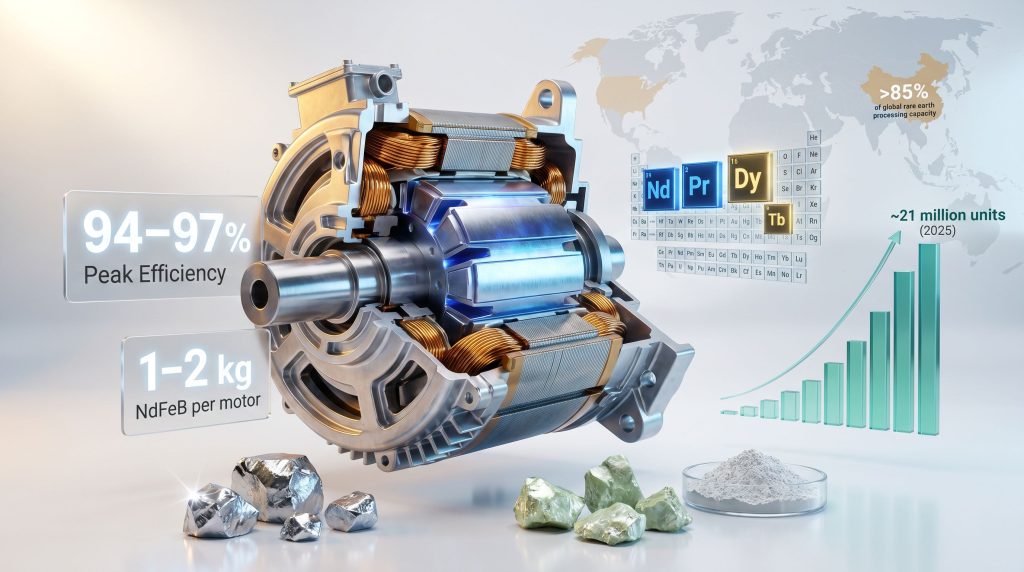
Permanent magnet synchronous motors used in high-performance EVs convert electrical energy to mechanical output at peak efficiencies of 94-97%, with system-level drivetrain efficiency remaining above 85-90% across a broad operating range. That is not a marginal improvement. It represents a structural change in how efficiently stored energy becomes motion.
The mechanical simplification is equally significant. A conventional automatic transmission may contain anywhere from 5 to 10 forward gear ratios, together with torque converters, clutch packs, and hydraulic control systems. An EV drivetrain typically uses a single fixed-ratio reduction gear. The elimination of gear-shifting entirely changes the energy management profile of the vehicle and removes a major source of mechanical wear.
The practical result is a drivetrain that can deliver maximum torque instantaneously from zero speed, without the need to rev into an efficiency sweet spot, and sustain near-peak efficiency across conditions that would force a combustion engine into its least efficient operating modes. For fleet operators calculating total cost of ownership across hundreds of thousands of service kilometres, this efficiency profile changes the financial arithmetic entirely.
Which Rare Earth Elements Are Actually Used and What Each One Does
The phrase rare earths in electric vehicle motors covers a more specific set of elements than casual usage implies. Not all 17 rare earth elements contribute meaningfully to motor performance, and the ones that do play chemically distinct roles.
The Neodymium-Praseodymium Foundation
Neodymium (Nd) and praseodymium (Pr) form the magnetic backbone of neodymium-iron-boron (NdFeB) permanent magnets. These two light rare earth elements are geologically co-located and co-processed in most mining and separation operations, making them functionally interchangeable across a range of magnet formulations. Together they create a crystal lattice structure with an exceptionally high magnetic energy product, the quantity that determines how much force a given volume of magnet can exert.
NdFeB magnets contain approximately 30% rare earth elements by weight, with neodymium representing the dominant fraction. The energy density advantage over previous magnet generations is substantial: NdFeB delivers roughly double the magnetic energy product of samarium-cobalt at a lower raw material cost, which explains why the technology displaced earlier permanent magnet designs so rapidly after its introduction. Furthermore, understanding rare earth supply chains helps clarify why this material dominance has such far-reaching strategic consequences.
Dysprosium and Terbium: The Thermal Stability Problem
The fundamental weakness of NdFeB magnets is their susceptibility to coercivity loss at elevated temperatures. Coercivity is the resistance of a magnet to demagnetisation, and for a traction motor, maintaining it above the operating temperature range is not optional. A magnet that partially demagnetises under thermal load loses power output permanently, and no control algorithm can compensate for lost magnetic flux in the rotor.
Dysprosium (Dy) and terbium (Tb) are added to NdFeB formulations specifically to solve this problem. Both are heavy rare earth elements that strengthen the grain boundary structure of the magnet, substantially increasing resistance to demagnetisation above 150°C. Typical addition rates fall in the range of 2-8% by weight, and the cost implications are material: dysprosium oxide has traded in a price range of approximately $200-$400 per kilogram over recent years, well above the $50-$150/kg range seen in neodymium-praseodymium oxide.
The driving scenarios that push motor temperatures into critical ranges include:
- Sustained climbing on steep highway grades
- Repeated hard acceleration from standstill in performance driving
- Continuous towing near maximum rated capacity
- Extended high-speed motorway cruising in warm ambient conditions
- Stop-start urban operation in delivery vehicles with high daily duty cycles
The grain boundary diffusion technique, developed and refined primarily by Japanese manufacturers, addresses this cost challenge by applying heavy rare earths selectively to grain boundaries rather than distributing them homogeneously throughout the magnet bulk. This targeted application reduces Dy and Tb consumption by an estimated 50-70% while preserving coercivity performance, and it is now considered standard practice in premium magnet manufacturing.
Samarium-Cobalt and the Cost Barrier to Extreme Performance
Samarium (Sm) appears in a separate magnet chemistry, samarium-cobalt (SmCo), that offers operating stability across a temperature range from approximately -270°C to over 350°C. SmCo magnets also exhibit superior corrosion resistance compared to NdFeB. These properties make them the preferred choice in aerospace, defence, and specialist industrial applications where operating environments exceed what NdFeB can sustain.
The cost-performance tradeoff has kept SmCo magnets out of consumer EV drivetrains. Cobalt pricing and samarium processing costs combine to make SmCo magnets significantly more expensive per unit of magnetic output than optimised NdFeB formulations, and the temperature range advantage is not required by most automotive duty cycles.
The Cerium-Lanthanum Paradox
A counterintuitive feature of rare earth supply chain analysis is that the two most geologically abundant rare earth elements contribute almost nothing to high-performance motor magnets. Cerium and lanthanum are produced in large quantities as co-products of neodymium-praseodymium mining, but their inferior magnetic properties mean demand for them is structurally lower than their natural abundance in ore bodies would suggest. This abundance-demand mismatch creates a persistent economic distortion in rare earth project economics. Research into partial cerium substitution for neodymium in magnet formulations continues, however the performance ceiling on Ce-substituted magnets remains a barrier to widespread adoption.
How Rare Earth Magnets Generate Torque: The Physics Inside an IPM Motor
Interior permanent magnet (IPM) motors became the dominant architecture for passenger EV traction applications because they capture two distinct torque-producing mechanisms simultaneously.
The first is magnetic torque, produced by the interaction between the permanent magnetic field of the NdFeB rotor magnets and the rotating electromagnetic field created by alternating current flowing through the copper stator windings. This interaction exerts a force that pulls the rotor into alignment with the stator field, generating rotation continuously as the stator field cycles.
The second is reluctance torque, which arises from the tendency of ferromagnetic materials to align with magnetic fields. In an IPM design, the embedded magnets create a rotor geometry with directional variation in magnetic permeability, and the motor controller can exploit this asymmetry to extract additional torque without increasing current. Capturing both mechanisms improves efficiency across a wider speed range than surface-mounted permanent magnet designs can achieve.
Field-weakening strategies extend the high-speed operating range by using stator current to partially oppose the rotor magnetic field, effectively allowing the motor to spin faster than its natural back-EMF limit without requiring higher inverter voltage. This technique requires precise rotor position data updated at high frequency, which is where resolver sensors and their rare earth components become relevant. Small rare earth magnets within resolver sensors track rotor position thousands of times per second, feeding the field-oriented control algorithm with the positional accuracy it needs to manage current injection optimally.
The evolution from IGBT-based switching to silicon carbide (SiC) power electronics has sharpened control precision further, enabling faster switching frequencies and lower switching losses that allow the control algorithm to respond more accurately to changing load conditions. The result is a traction system that extracts near-maximum efficiency from the magnetic circuit across conditions that would previously have required compromises between peak power and sustained efficiency.
Motor Technology Comparison: Where Rare Earths Win and Where They Don't
Not every electric vehicle uses rare earth magnets. Understanding the landscape of alternative motor architectures clarifies both why NdFeB-based designs dominate and where the realistic boundaries of that dominance lie. According to research on EV motor materials, the efficiency and packaging advantages of rare earth magnets remain difficult to replicate through alternative chemistries.
| Motor Type | Rare Earths Required | Peak Efficiency | Key Tradeoff | Primary Application |
|---|---|---|---|---|
| Interior Permanent Magnet (IPM) | Yes (NdFeB) | 94-97% | Supply chain exposure | Passenger EVs |
| Induction Motor | No | 85-91% | Lower torque density | Commercial vehicles, legacy platforms |
| Switched Reluctance Motor | No | 85-92% | Acoustic noise, control complexity | Niche and emerging applications |
| Wound Rotor Synchronous | No | 88-93% | Slip rings, maintenance requirements | Some commercial applications |
| Samarium-Cobalt PM | Yes (SmCo) | 94-96% | High material cost | Aerospace and defence |
The efficiency gap between IPM motors and the nearest rare-earth-free alternative is not trivial when examined across a vehicle's operating life. A 5-6% efficiency advantage translates to approximately 15-20 additional miles of driving range per charge, assuming equivalent battery capacity. Across a fleet of a hundred thousand vehicles operating for ten years each, the cumulative energy difference becomes significant. For an average driver covering 12,000 miles per year, a 5% motor efficiency improvement saves an estimated 150-200 kWh annually, roughly equivalent to two months of electricity consumption by a standard household refrigerator.
"The packaging dimension matters equally. Rare earth magnets enable motors that are physically smaller for a given power output than any commercially viable rare-earth-free alternative. Smaller motors leave more room for battery cells, reduce overall vehicle mass, and improve handling dynamics."
In the context of integrated e-axle design, where the motor, inverter, and single-speed reduction gearbox must fit within a volume comparable to a traditional differential, this compactness is not a secondary advantage.
Induction motors remain viable for commercial vehicle applications where the efficiency premium of IPM designs is less decisive relative to the value of supply chain independence and lower magnet cost. Switched reluctance motors are attracting renewed engineering attention for specific commercial segments, though acoustic noise and control complexity continue to limit their mainstream penetration.
From Ore Body to Traction Motor: Eight Stages of Transformation
The supply chain connecting a rare earth mineral deposit to a finished traction motor involves more processing stages than most supply chain analyses convey. Each stage introduces technical complexity, capital requirements, and geographic concentration that collectively define the strategic vulnerability of the system. In addition, the rare earth processing challenges at each stage compound the difficulty of building alternative supply chains outside established industrial centres.
- Mining and ore extraction — Rare earth elements occur in mixed mineral deposits including bastnäsite, monazite, and ion-adsorption clays, each requiring different physical separation approaches before chemistry begins.
- Concentrate production — Crushing and flotation processes create a mixed rare earth concentrate, typically assaying 50-60% total rare earth oxide content before chemical processing.
- Solvent extraction and separation — Hundreds of sequential pH-controlled extraction stages isolate individual elements from the mixed concentrate. This stage requires substantial chemical engineering expertise and generates process waste streams requiring careful management.
- Oxide-to-metal conversion — Electrolysis or metallothermic reduction converts individual oxides into metals with the purity levels required for magnet alloy formulation.
- Alloy formulation — Neodymium, praseodymium, dysprosium, iron, and boron are blended in precisely controlled ratios and melted together to form a homogeneous alloy.
- Powder processing and sintering — The alloy is pulverised into micron-scale particles, pressed into shape under applied magnetic fields that orient the crystalline structure, then sintered at high temperature to achieve full density.
- Coating, magnetisation, and machining — Protective coatings prevent corrosion, full magnetisation is applied, and dimensional finishing brings magnets to automotive-grade tolerances.
- Motor assembly — Rotor integration using adhesives or mechanical retention systems engineered to withstand centrifugal loads at operating speeds that can exceed 15,000 RPM in some high-performance configurations.
Critical Bottleneck: Separation capacity is structurally the tightest constraint in the entire pipeline. Major separation facilities require capital investment in the hundreds of millions of dollars, multi-year construction periods, and chemical engineering expertise that remains concentrated in a small number of countries. Environmental permitting adds further timeline uncertainty. New facilities initiated today are realistically years from meaningful production.
Heavy rare earth supply faces an additional structural constraint beyond the generic separation bottleneck. Dysprosium and terbium occur at much lower concentrations than light rare earths in most deposit types, and their primary global source is ion-adsorption clay deposits concentrated in southern China and Myanmar. These deposits are amenable to relatively low-cost in-situ leaching extraction but are geographically and politically concentrated in ways that create persistent supply security concerns for importing nations.
China controls over 85% of global rare earth processing capacity, and its share of sintered NdFeB magnet manufacturing is even higher. Consequently, even where raw material diversity improves through new mining projects in Australia, the United States, or Canada, the downstream processing and magnet manufacturing bottleneck persists unless parallel investment in separation and fabrication capacity materialises on a comparable timeline.
The next major ASX story will hit our subscribers first
Demand Metrics: What the Numbers Actually Reveal
| Metric | Value | Context |
|---|---|---|
| Global EV sales (2023) | 14.2 million units | Driving approximately 20 million traction motors annually |
| Global EV sales (2025) | ~21 million units | Approximately 1 in 4 new cars sold worldwide (IEA, 2026) |
| Rare earth content per standard motor | 1-2 kg NdFeB | Typical 100-150 kW passenger traction motor |
| Rare earth content per high-performance system | 3-4 kg NdFeB | Dual-motor AWD or performance-grade configurations |
| Nd-Pr oxide price range (5-year) | $50-$150/kg | Significant volatility for motor cost structures |
| Dysprosium oxide price range | $200-$400/kg | Heavy rare earth premium above light rare earth pricing |
| Peak IPM motor efficiency | 94-97% | Versus 85-91% for induction motor alternatives |
| Range benefit of 5% efficiency gain | +15-20 miles per charge | Compounding effect across vehicle lifetime |
| Annual electricity saving per vehicle | 150-200 kWh | From a 5% motor efficiency improvement |
| China share of rare earth processing | Over 85% of global capacity | Structural concentration in separation and magnets |
The dual-motor dynamic deserves specific attention. All-wheel-drive EV configurations using two IPM motors consume twice the rare earth magnet content of equivalent single-motor platforms. As automakers standardise AWD configurations across mid-range and performance segments, the per-vehicle rare earth intensity of the global fleet increases even without any change in motor technology. The critical minerals demand trajectory reflects this multiplication effect, which is partially obscured in aggregate demand statistics that report total vehicle volumes without disaggregating by drivetrain configuration.
The simultaneous growth in wind turbine deployment creates a demand overlap that is structurally significant. Large direct-drive offshore wind generators use NdFeB permanent magnets at scales far exceeding automotive traction motors, and both sectors are drawing from the same neodymium-praseodymium supply base. Demand forecasts projecting a doubling of Nd-Pr consumption by 2030 reflect this parallel growth trajectory rather than EV demand alone.
The Engineering History That Made NdFeB Automotive-Grade
The parallel discovery of NdFeB magnet chemistry by General Motors and Sumitomo Special Metals in 1984 created the material foundation for modern EV motors, but commercial readiness for automotive traction applications required roughly another fifteen years of development. Early NdFeB magnets exhibited unacceptable variation in magnetic properties between production batches and insufficient coercivity at the temperatures generated during sustained motor operation.
Japanese manufacturers, particularly Shin-Etsu Chemical and TDK, developed quality control methodologies that reduced inter-batch property variation to levels compatible with the tight tolerances of automotive production. Chinese producers subsequently scaled these processes dramatically, driving down costs through vertical integration spanning mining, separation, alloy production, and magnet fabrication within single corporate structures.
The grain boundary diffusion innovation that emerged in the 2000s represented a materials science refinement with significant economic implications. By recognising that coercivity loss initiates at grain boundaries rather than uniformly through the magnet bulk, researchers demonstrated that applying heavy rare earths selectively to those boundaries was both more effective and far more material-efficient than homogeneous blending. This insight reduced the dysprosium and terbium content required for automotive-grade thermal performance substantially without compromising the coercivity characteristics that prevent demagnetisation under load.
The Geopolitical Dimension: Supply Chain Concentration and Its Documented Consequences
China's dominance in rare earth processing is frequently described in terms of raw material production, but this framing understates the more strategically significant concentration in downstream processing and fabrication. Other countries can mine rare earth ores, but converting those ores into separated oxides, then metals, then precision magnet alloys, requires accumulated technical expertise and industrial infrastructure that took decades to build and cannot be replicated quickly. Furthermore, China export restrictions have demonstrated empirically how policy decisions can trigger price volatility measured in months, not years.
Historical episodes of Chinese export restrictions on rare earths created documented price spikes and triggered strategic inventory responses from Japanese automakers and magnet producers. These events demonstrated empirically that price volatility in rare earth markets can be triggered by policy decisions rather than fundamental supply-demand shifts, and that the lead time between a supply disruption and a meaningful alternative supply response is measured in years, not months.
Automakers have responded to this exposure through several mechanisms:
- Maintaining strategic magnet inventories above immediate production requirements
- Qualifying multiple magnet suppliers across different geographies where possible
- Investing in motor design flexibility that allows specification adjustments when specific rare earth grades face supply pressure
- Participating in or funding upstream rare earth projects in non-Chinese jurisdictions
Governments in the United States, European Union, and Australia have committed funding to domestic separation facilities and magnet manufacturing capacity. However, analysts tracking project timelines consistently identify 2030 as the earliest realistic date for meaningful alternative capacity to reach production scale, and even then, cost competitiveness against Chinese-scale producers remains an open question.
Three Scenarios for the Rare Earth Motor Ecosystem Through 2030
| Scenario | Description | Key Driver |
|---|---|---|
| Supply Chain Diversification Succeeds | Western separation and magnet capacity reaches meaningful scale by 2030; pricing stabilises relative to historical volatility | Government investment execution speed, permitting reform effectiveness |
| Continued Chinese Dominance with Managed Risk | China retains cost leadership; automakers use inventory buffers, supplier diversification, and design flexibility to manage exposure | Capital intensity of alternatives, Chinese scale and technical advantages |
| Accelerated Rare-Earth-Free Transition | Switched reluctance and induction motors gain share in mainstream segments following sustained supply disruption or price spike | Severity and duration of supply event, pace of alternative motor control software maturation |
The most analytically defensible near-term outlook involves parallel development across all three pathways rather than convergence on any single outcome. High-performance passenger vehicles will continue prioritising NdFeB IPM motors where the efficiency and packaging advantages justify the supply chain exposure. Mainstream platforms will increasingly incorporate grain boundary diffusion magnets that reduce heavy rare earth intensity while retaining light rare earth magnetic performance. Commercial vehicle segments, where continuous-duty thermal requirements differ from passenger vehicle peak-performance requirements, represent the most credible near-term market for rare-earth-free motor architectures.
What Engineering Innovations Are Reducing Rare Earth Dependency?
Beyond grain boundary diffusion, the research and commercial development pipeline contains several pathways for reducing rare earth intensity without accepting the full efficiency penalty of rare-earth-free architectures. Ongoing rare earth exploration activity in diverse geographies also supports longer-term supply resilience alongside these technical innovations.
Magnet recycling is transitioning from research to early commercial scale. Production scrap recycling is already economically viable and widely practised within magnet manufacturing facilities, where clean scrap with known composition can be reprocessed with relatively modest losses. End-of-life motor magnet recovery is more technically challenging due to contamination, oxidation, and the mixed material streams present in disassembled vehicles, but commercial processes are advancing. The strategic significance of closed-loop rare earth recovery from EV motors at end of life grows as the installed vehicle fleet accumulates over the coming decade.
Axial flux motor designs offer packaging advantages in space-constrained applications through their disc-shaped geometry, which reduces axial length compared to conventional radial flux motors. Several commercial implementations have reached production status, and the architecture continues attracting engineering investment particularly for applications where motor diameter is less constrained than motor length.
Hybrid reluctance-permanent magnet designs reduce rare earth content by deliberately sizing the permanent magnet circuit to contribute partial rather than full torque, with reluctance torque making up the difference. This approach occupies a design space between full rare-earth-free switched reluctance motors and conventional IPM designs, potentially offering an intermediate efficiency-cost-supply chain tradeoff suitable for cost-sensitive mainstream segments. For a broader perspective on how manufacturers are approaching this challenge, efforts to eliminate rare earths from motor supply chains are increasingly influencing platform-level engineering decisions.
Frequently Asked Questions: Rare Earths in Electric Vehicle Motors
Which rare earth elements are most critical for EV motor performance?
Neodymium and praseodymium provide the fundamental magnetic energy density in NdFeB traction motor magnets. Dysprosium and terbium are added in smaller quantities to maintain coercivity at the elevated temperatures generated during high-load driving.
Do all EVs use rare earth motors?
No. Induction motors, used in some EV platforms, require no rare earth magnets but sacrifice efficiency and power density relative to NdFeB permanent magnet designs. Switched reluctance and wound-rotor synchronous motors also operate without rare earths, each involving distinct performance tradeoffs.
How much rare earth material does a typical EV motor contain?
Standard passenger vehicle traction motors contain approximately 1-2 kg of NdFeB magnet material. Dual-motor all-wheel-drive or high-performance configurations may use 3-4 kg in total across both motor assemblies.
Are rare earths used in EV batteries?
No. Lithium-ion battery chemistry involves lithium, cobalt, nickel, and manganese. Rare earth elements are a motor supply chain consideration, not a battery chemistry issue.
What is grain boundary diffusion and why does it matter economically?
Grain boundary diffusion applies dysprosium or terbium specifically to magnet grain boundaries rather than throughout the bulk material. This targeted approach reduces heavy rare earth consumption by an estimated 50-70% while preserving thermal performance, with significant implications for motor cost structures given dysprosium oxide pricing in the $200-$400/kg range.
How long does it take to build new rare earth separation capacity?
Major separation facilities typically require five to ten years from project initiation to full production, incorporating permitting, construction, and process qualification phases. This timeline creates a structural lag between investment decisions and meaningful supply diversification outcomes.
Can EV motor magnets be recycled at end of life?
Commercial-scale recycling of end-of-life motor magnets remains in early development, though it is advancing. Production scrap recycling within magnet manufacturing is already economically viable and widely practised, providing a cleaner and more immediately accessible recycling stream than post-consumer motor disassembly.
This article contains forward-looking statements, demand projections, and price range references derived from publicly available industry data and energy agency assessments. All projections involve uncertainty, and actual market outcomes may differ materially from those described. Nothing in this article constitutes financial or investment advice. Readers should conduct independent research before making any investment decisions related to rare earth markets or related sectors.
Want to Know When the Next Major Rare Earth Discovery Hits the ASX?
Discovery Alert's proprietary Discovery IQ model scans ASX announcements in real time, delivering instant alerts on significant rare earth and critical mineral discoveries — turning complex geological data into clear, actionable opportunities for investors at every level. Explore historic discoveries and their exceptional returns, then begin your 14-day free trial at Discovery Alert to position yourself ahead of the market.