August 21, 2026
The Engineering Reality of Rare Earths in Space Habitats
Long before the first astronaut spent months aboard an orbital platform, engineers grappled with a deceptively simple question: what materials can simultaneously minimise mass, survive extreme temperature swings, tolerate radiation, and operate without interruption for years? The answer, refined across decades of aerospace development, keeps returning to the same family of elements. Rare earths in space habitats are not a design preference. They are a consequence of physics operating under the harshest constraints humans have ever engineered around.
The International Space Station has sustained uninterrupted human presence since November 2, 2000, according to NASA's Space Station Facts and Figures documentation. More than 280 astronauts and cosmonauts from roughly 20 countries have lived and worked aboard that platform. Every single day of that operational record has depended on motors, pumps, actuators, and lighting systems whose performance characteristics trace directly back to rare earth chemistry.
When big ASX news breaks, our subscribers know first
Why Mass, Power, and Volume Make REE Substitution Structurally Impractical
Understanding why rare earth materials are so deeply embedded in habitat engineering requires examining the three simultaneous constraints that define space systems design: mass, power, and volume. These constraints do not operate independently. A heavier motor demands more launch propellant. A less efficient motor generates more waste heat. More waste heat requires larger radiators. Larger radiators add mass. The cascade is relentless.
Life support and thermal control systems, which form the operational backbone of any long-duration habitat, typically account for 20 to 30 percent of total habitat mass and consume 40 to 50 percent of available on-board power, consistent with NASA engineering assessments of the ISS Environmental Control and Life Support System (ECLSS). Furthermore, even fractional efficiency gains in individual motors or lighting units propagate through the entire system architecture as meaningful reductions in power generation requirements and thermal rejection capacity.
A ferrite magnet motor delivering equivalent torque to an NdFeB design typically carries a mass penalty of approximately four to five times. In a launch-cost environment where every kilogram to low Earth orbit represents thousands of dollars, that penalty is not a tradeoff. It is a programme-level problem.
A Systems-Level Map: Where Rare Earth Elements Appear Inside a Habitat
Rare earth elements are distributed across virtually every functional subsystem of a modern space habitat, though the quantities involved are modest relative to total structure mass. The functional importance is disproportionate to the mass fraction. Consequently, understanding rare earth supply chains is as critical to habitat engineers as understanding the materials themselves.
| Habitat System | Primary REEs | Key Function | Magnet or Material Type |
|---|---|---|---|
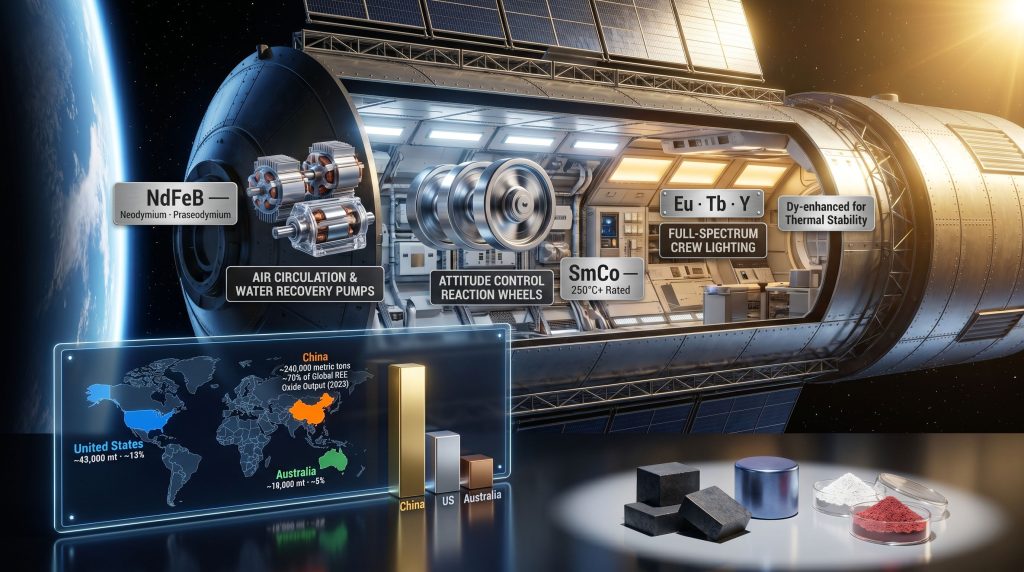
| Air Circulation Blowers | Neodymium, Praseodymium | High-torque compact motor drives | NdFeB Permanent Magnets |
| Water Recovery Pumps | Neodymium, Dysprosium | Fluid transfer in variable-temperature zones | Dy-enhanced NdFeB |
| Attitude Control Wheels | Samarium, Cobalt | Precision momentum management | SmCo Permanent Magnets |
| Crew Lighting Systems | Europium, Terbium, Yttrium | Full-spectrum phosphor conversion | Rare Earth Phosphors |
| Robotic Arm Actuators | Neodymium, Dysprosium | High-torque precision joint control | NdFeB Permanent Magnets |
| Antenna Pointing Gimbals | Samarium, Cobalt | High-temperature stable positioning | SmCo Permanent Magnets |
| Optical Sensors and Cameras | Cerium, Lanthanum | Lens polishing and specialty optics | Oxide compounds |
| Thermal Management Pumps | Neodymium, Dysprosium | Coolant circulation reliability | Dy-enhanced NdFeB |
The air revitalisation system illustrates the dependency most clearly. Carbon dioxide accumulates continuously from crew respiration and must be scrubbed from cabin air without interruption. High-efficiency NdFeB-driven blowers move air through scrubbing filters around the clock. Their superior torque density allows smaller, lighter motor housings while still moving the required air volume. Failure is not a maintenance event. It is a crew safety emergency.
NdFeB vs. SmCo: Matching Magnet Chemistry to Habitat Thermal Zones
Not all rare earth magnets perform identically across habitat environments, and the choice between neodymium-iron-boron and samarium-cobalt systems reflects a deliberate matching of material properties to operational conditions.
Technical Comparison:
NdFeB magnets deliver the highest magnetic energy product of any commercially available permanent magnet technology. However, their coercivity degrades significantly above roughly 80°C without the addition of dysprosium or terbium at grain boundaries.
SmCo magnets operate reliably at temperatures exceeding 250°C and demonstrate substantially superior radiation resistance, making them the preferred choice for external mechanisms, nuclear-adjacent subsystems, and lunar surface hardware where thermal swings range from -173°C to +127°C across each two-week lunar day-night cycle.
Ferrite alternatives can theoretically replace REE magnets in non-critical applications but require four to five times the mass for equivalent motor output, a penalty that is prohibitive in launch-cost-sensitive programmes.
The developmental history of these technologies underscores their aerospace significance. Samarium-cobalt magnets emerged from research in the 1960s and 1970s, offering roughly five times the energy product of earlier permanent magnet materials and enabling dramatic miniaturisation in aerospace motor design. The independent development of NdFeB magnets in the 1980s by General Motors and Sumitomo Special Metals pushed performance benchmarks further still, using more widely available rare earth feedstocks to achieve even stronger magnetic fields.
The Role of Dysprosium and Terbium as Thermal Stabilisers
One of the less widely understood aspects of rare earth magnet engineering is the specific role that heavy rare earth additions play at the microstructural level. Dysprosium and terbium are not bulk ingredients in NdFeB magnets. They are precision additives concentrated at grain boundaries to increase coercivity, which is the magnet's resistance to demagnetisation under thermal stress.
Emerging grain boundary diffusion processing techniques apply dysprosium or terbium only at the grain boundary regions rather than distributing them throughout the bulk material. This approach has demonstrated the potential to reduce heavy rare earth consumption by 50 to 70 percent while preserving thermal performance, a development with significant implications for supply chain risk management if it achieves full commercial-scale production.
Rare Earth Phosphors and the Crew Health Dimension
The role of rare earth phosphors in habitat lighting represents one of the most underappreciated dimensions of REE dependency in space systems. Europium, terbium, and yttrium form the functional triad behind full-spectrum LED conversion, enabling lighting systems to produce the specific wavelength combinations that support human circadian biology.
Advances in rare earth phosphor chemistry contributed to a roughly tenfold improvement in LED luminous efficacy, from approximately 20 lumens per watt in early solid-state lighting to over 200 lumens per watt in current high-performance systems. This progression transformed space-qualified lighting from a power-budget liability into a tool with genuine crew health applications.
The medical implications are significant for mission planning. Poor lighting quality in isolated environments has been linked to disrupted sleep architecture, mood dysregulation, and measurable cognitive performance degradation. For missions extending multiple years, such as a crewed Mars transit, lighting quality transitions from a comfort consideration into a clinical one. Quantum dot technologies offer a partial alternative for some applications, but current versions face unresolved challenges related to stability and space qualification under radiation exposure.
From Ore to Orbit: The Supply Chain Architecture
The pathway from raw mineral deposit to a flight-qualified rare earth component involves a sequence of highly specialised industrial stages, each with its own capital requirements, timeline constraints, and technical barriers. In addition, the rare earth processing challenges at each stage compound the difficulty of building resilient supply pipelines for aerospace programmes.
- Ore extraction and concentration removes bulk rock and increases rare earth mineral content before further processing.
- Chemical separation uses solvent extraction across hundreds or thousands of sequential stages to isolate individual rare earth oxides at sufficient purity. This stage alone can require weeks of processing and generates acidic waste streams requiring careful environmental management.
- Reduction and alloying converts separated oxides into metals and combines them in precise compositional ratios through strip casting.
- Powder metallurgy and sintering mills the alloy into fine powder, presses it under magnetic fields to align grains, and sinters it at high temperature to develop optimal magnetic properties.
- Space qualification adds coatings resistant to vacuum outgassing, establishes complete material traceability documentation, and subjects components to vibration, thermal cycling, and radiation testing that commercial-grade products do not face.
Supply Chain Chokepoint: Chemical separation is the most capital-intensive and time-constrained stage in the entire rare earth pipeline. Constructing a new separation facility requires hundreds of millions of dollars in capital expenditure and multi-year construction timelines. This structural reality means that even clear demand signals cannot rapidly translate into expanded supply.
The next major ASX story will hit our subscribers first
Global Supply Concentration: The 70 Percent Problem
The geographic distribution of rare earth oxide production represents one of the most consequential supply risk factors for any programme dependent on these materials.
| Country | 2023 REE Oxide Production (metric tons) | Approximate Share of Global Output |
|---|---|---|
| China | ~240,000 | ~70% |
| United States | ~43,000 | ~13% |
| Australia | ~18,000 | ~5% |
| Rest of World | ~29,000 | ~12% |
Source: U.S. Geological Survey, Mineral Commodity Summaries, 2024.
Two distinct risk vectors exist within this concentration picture and are frequently conflated. Mining concentration refers to where ore is extracted from the ground. Processing concentration refers to where separated oxides and magnet alloys are produced. Even ore mined in Australia or the United States commonly flows to Chinese separation facilities before entering downstream manufacturing.
Heavy rare earths, particularly dysprosium and terbium, face tighter constraints than light rare earths because they occur in lower concentrations across fewer deposit types, predominantly ionic clay deposits concentrated in southern China. This geological reality compounds the geopolitical concentration risk for the specific elements most critical to high-temperature magnet performance. The broader surge in critical minerals demand across multiple industries further tightens the competitive environment for aerospace-grade procurement.
What Commercial Station Programmes Mean for REE Demand
NASA's Commercial Low Earth Orbit Destinations programme is targeting a transition away from ISS operations toward multiple commercially operated stations before 2030. Companies including Axiom Space, Blue Origin, and Voyager Space are developing platforms that will each require hundreds of rare earth-enabled motors, sensors, actuators, and lighting units. At the component level, each station represents a substantial cluster of qualified procurement requirements.
The binding constraint for these programmes is unlikely to be raw material availability at the oxide level. It is more likely to be qualified manufacturing capacity at the finished component level. Establishing aerospace-grade production lines requires years of investment and certification work that cannot be compressed simply because demand signals are present.
Lunar architecture requirements introduce additional complexity. The extreme thermal environment of the lunar surface, cycling between -173°C and +127°C with no atmospheric buffering, eliminates many of the thermal management assumptions that govern low Earth orbit hardware design. Lunar regolith development research reinforces just how demanding in-situ resource utilisation becomes under these conditions. SmCo magnet systems become substantially more valuable in this context precisely because of their thermal stability characteristics that NdFeB systems cannot match without heavy REE enhancement.
ISS Benchmarks and the Cascade Efficiency Effect
The ISS Water Recovery System, a component of the ECLSS, achieves approximately 93 percent recovery of all water used by the crew, including processing of urine, atmospheric condensate from respiration, and other sources. This operational benchmark represents one of the most demanding closed-loop fluid management achievements in human spaceflight history, and it depends on the continuous reliable operation of pumps whose performance characteristics are enabled by rare earth magnet technology.
The cascade efficiency principle is critical to understanding why component-level REE performance matters at the whole-habitat level. A more efficient pump motor generates less waste heat. Less waste heat means a smaller thermal rejection radiator. A smaller radiator reduces structural mass and exposed surface area vulnerable to micrometeorite impacts. The reduction in one subsystem propagates as a benefit through multiple others. This interconnection explains why aerospace engineers cannot simply substitute lower-performance magnet technologies and absorb the efficiency penalty locally.
Strategies for Managing REE Supply Risk in Habitat Programmes
Aerospace programmes are not passive observers of rare earth supply dynamics. Several active risk management strategies are being developed and deployed across the industry.
- Multi-supplier qualification across geographically distributed processing jurisdictions reduces single-source dependency without requiring complete supply chain restructuring.
- Strategic stockpiling of critical magnet alloys at the programme level provides a buffer against short-term geopolitical or logistics disruptions.
- Modular hardware design enables component-level replacement without triggering full system re-qualification, reducing the operational consequence of supply interruptions.
- Grain boundary diffusion adoption can materially reduce heavy REE content in future magnet generations as the technique matures toward commercial production scale.
- Recycling development offers a longer-term supplementary supply vector. Laboratory-scale demonstrations of rare earth recovery from end-of-life magnets have achieved recovery rates exceeding 97 percent through hydrometallurgical and pyrometallurgical processes, though collection infrastructure and economic scaling at the programme level remain unresolved challenges.
Disclaimer: Forward-looking statements regarding grain boundary diffusion commercialisation timelines, recycling infrastructure development, and commercial station deployment schedules involve significant uncertainty. Actual outcomes will depend on engineering progress, regulatory developments, and market conditions that cannot be precisely forecast.
The 5 to 10 Year Trajectory for Rare Earths in Space Habitat Programmes
Commercial stations launching in the late 2020s will rely overwhelmingly on current-generation rare earth materials. The industrial qualification base that exists today reflects NdFeB and SmCo magnet systems, europium-terbium-yttrium phosphor lighting, and cerium-lanthanum optical compounds. Transitioning to lower-REE-content alternatives requires completing qualification cycles that themselves consume years.
The realistic near-term scenario involves gradual rather than step-change evolution. Grain boundary diffusion techniques will likely reduce heavy REE intensity in new magnet production as they achieve cost-competitive commercial scale, but this transition will be measured in years rather than programme cycles. LED and phosphor technology will continue improving through hybrid approaches that blend rare earth phosphors with emerging quantum dot systems for appropriate applications.
The longer-term structural question is whether in-space resource utilisation can meaningfully reduce dependence on Earth-sourced REE imports. Asteroid mining prospects are frequently cited in this context, and according to researchers, carbonaceous chondrite asteroids do contain rare earth elements, but at concentrations that do not support economically rational Earth-return extraction for precision components. Lunar regolith contains rare earth bearing minerals, but extraction and processing infrastructure capable of producing flight-grade magnet alloys in-situ remains a research-stage concept rather than an operational planning assumption.
Frequently Asked Questions: Rare Earths in Space Habitats
Do space habitats contain large quantities of rare earth elements by mass?
Rare earth elements occupy a small fraction of total habitat mass, concentrated in specific high-performance components including permanent magnets, phosphors, and optical materials. Their functional importance is disproportionate to their mass contribution because they enable the continuous-operation systems that are most critical to crew survival.
Can life support systems function without rare earth magnets?
Theoretically yes, but not within the mass, volume, and power constraints that define practical habitat engineering. Alternative motor technologies typically require four to five times the mass to deliver equivalent performance, a penalty that is prohibitive in launch-cost-sensitive programmes.
Why not eliminate dysprosium and terbium to reduce supply risk?
Removing heavy rare earth additions reduces magnet coercivity at elevated temperatures, which either reduces thermal operating margin or requires larger, heavier motor assemblies to maintain equivalent performance. Current strategies focus on reducing heavy REE content through microstructural engineering rather than eliminating these elements entirely.
Are rare earths primarily battery materials in space habitats?
No. Lithium-ion batteries used in space habitats rely primarily on lithium, cobalt, nickel, manganese, and phosphate chemistries at the electrode level. Rare earths in space habitats appear most significantly in rotating machinery magnets, phosphor-based lighting systems, and optical manufacturing inputs.
How do Earth-side supply disruptions affect space habitat construction timelines?
Supply disruptions affect aerospace programmes primarily through procurement and qualification schedules rather than through direct material shortages. Aerospace-grade components have long lead times and require stable, traceable inputs. Disruptions in separation or specialty manufacturing can delay hardware builds even when the total REE mass content of finished components is modest. This is why habitat programmes increasingly manage critical material availability as a formal programme risk category. For further academic context, peer-reviewed analysis of space resource economics provides useful background on the broader constraints shaping these decisions.
Readers seeking broader coverage of rare earth supply chains, market intelligence, and critical minerals industry developments can explore resources at Rare Earth Exchanges.
Want to Invest in the Critical Minerals Powering the Next Space Race?
Discovery Alert's proprietary Discovery IQ model delivers real-time alerts on significant ASX mineral discoveries — including rare earths and critical minerals essential to aerospace and space habitat programmes — instantly equipping subscribers to identify actionable opportunities ahead of the broader market. Explore historic discoveries and their extraordinary returns, then begin your 14-day free trial to position yourself at the forefront of the critical minerals investment landscape.