July 26, 2026
The Supply Chain Sovereignty Race That Is Reshaping Global Mining
Somewhere between a lithium-ion battery cell and the electric motor that drives a modern EV lies one of the most concentrated chokepoints in global industrial supply chains. Rare earth permanent magnets, the invisible workhorses inside every EV drivetrain, wind turbine generator, and precision defence system, depend on a processing infrastructure that remains overwhelmingly controlled by a single nation. That concentration is not an accident of geology. It is the accumulated result of decades of industrial policy, subsidised processing capacity, and strategic patience. For the rest of the world, the race to build credible alternatives is now urgent, and the Zandkopsdrift rare earths project in South Africa's Northern Cape is emerging as one of the most advanced and economically compelling candidates to help close that gap.
When big ASX news breaks, our subscribers know first
Why Rare Earth Supply Concentration Creates Systemic Risk
China currently controls an estimated 85% to 90% of global rare earth processing capacity and battery-grade manganese sulphate production. To understand why this matters, it helps to appreciate the scale mismatch between the upstream and downstream industries involved. Rare earth oxides represent a market valued at under $20 billion at the oxide level. Yet the industries that cannot function without them, covering electric vehicles, robotics, wind energy, and advanced defence systems, collectively represent a $4 trillion to $5 trillion global economy.
This extraordinary leverage ratio is precisely why, as explored in analyses of rare earth geopolitics, rare earths have become the most geopolitically weaponised critical raw material category in the world today.
The 17 metallic elements that make up the rare earth group are not particularly scarce in the earth's crust. What makes them strategically sensitive is the complexity of separating, refining, and alloying them into commercially useful forms. China invested decades in building that processing expertise. Non-Chinese producers are now scrambling to replicate it.
The four elements that matter most for permanent magnet applications are:
- Neodymium (Nd) and praseodymium (Pr) – the primary driver elements for magnet strength, typically sold as a combined NdPr oxide
- Dysprosium (Dy) – a heavy rare earth that improves high-temperature magnet performance, critical for EV motors
- Terbium (Tb) – a heavy rare earth used to reduce dysprosium requirements while maintaining coercivity
Demand for rare earth permanent magnets is forecast to grow substantially between now and 2040, driven by accelerating EV penetration and offshore wind capacity expansion. Furthermore, industry analysis points to a material supply shortfall emerging in this window, creating significant upward pressure on pricing for producers that can deliver into the gap. Understanding critical minerals demand in the context of the energy transition helps frame just how significant this shortfall could become.
The rare earths market is not simply a mining investment story. It is fundamentally a supply chain sovereignty story. Nations and manufacturers that secure access to non-Chinese rare earth supply before 2030 are positioning for a structural competitive advantage in clean energy manufacturing for decades to come.
What Makes the Zandkopsdrift Rare Earths Project Unique
The Zandkopsdrift rare earths project sits in South Africa's Northern Cape Province, approximately 450 km north of Cape Town. The deposit is a carbonatite-hosted rare earth and manganese system, a geology type known for producing high-grade, mineralogically consistent ore that responds well to standard flotation and hydrometallurgical processing. The project is developed by Luxembourg-headquartered Frontier Rare Earths, listed on the Toronto Stock Exchange (TSX).
What distinguishes Zandkopsdrift from most of its peers globally is not any single feature but the combination of characteristics it brings together:
- A 45-year reserve life supported by proven and probable reserves, among the largest undeveloped rare earth deposit bases outside China
- A fully permitted status, with both a mining right and environmental authorisation already in place
- A dual-commodity flowsheet producing both magnet rare earths and battery-grade manganese sulphate from the same ore system
- Proximity to existing road, rail, and port infrastructure, materially reducing greenfield logistics capital requirements
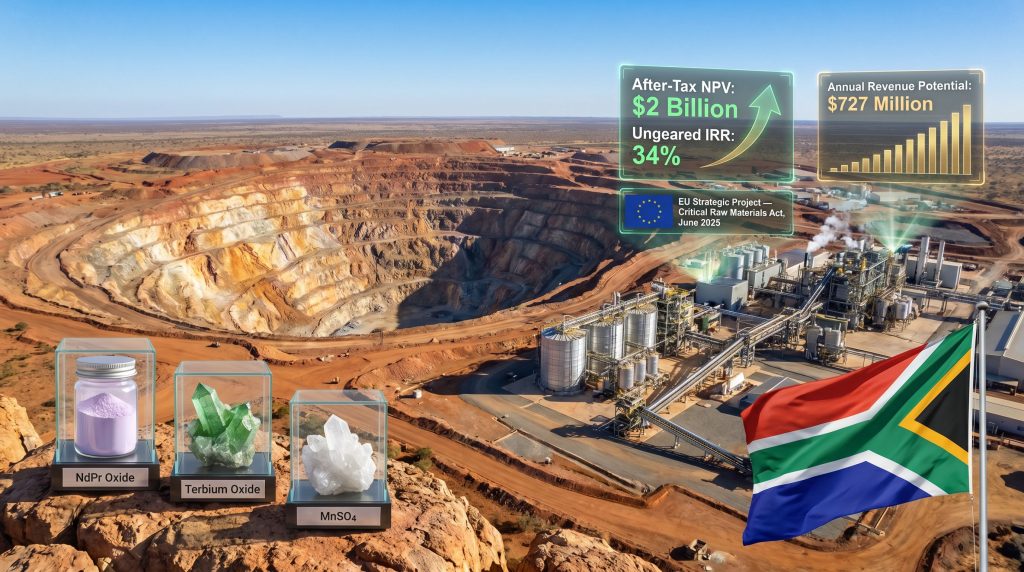
- An estimated after-tax NPV of $2 billion and an ungeared IRR of 34% at mid-cycle pricing
Production Profile: What Zandkopsdrift Will Deliver
| Commodity | Annual Production Target | Product Form |
|---|---|---|
| NdPr Oxide | 3,038 t/y | High-purity neodymium/praseodymium oxide |
| Dysprosium Oxide | 114 t/y | Heavy rare earth oxide |
| Terbium Oxide | 25 t/y | Heavy rare earth oxide |
| Total Magnet Rare Earths | ~4,000 t/y | Mixed rare earth stream |
| Battery-Grade HPMSM | 100,000 t/y | Battery-grade manganese sulphate monohydrate |
| Battery-Grade Mn₃O₄ | TBC | Modified flowsheet output |
The integration of a high-purity manganese sulphate monohydrate (HPMSM) production circuit within the same project footprint is a structural differentiator that most rare earth developers do not possess. HPMSM is a critical input for lithium-manganese-iron-phosphate (LMFP) battery cathodes, a chemistry gaining significant traction in Chinese and increasingly Western EV supply chains as a lower-cost, thermally stable alternative to NMC formulations. Zandkopsdrift's ability to serve two independently growing critical material demand pools from one mine site improves both revenue stability and project economics significantly.
Project Economics: A Detailed Look at the Numbers
The financial metrics underpinning the Zandkopsdrift rare earths project are notable relative to the peer group of undeveloped rare earth assets globally.
| Financial Metric | Estimated Value |
|---|---|
| After-Tax Net Present Value (NPV) | $2 billion |
| Internal Rate of Return (Ungeared) | 34% |
| Internal Rate of Return (Geared) | 50% |
| Estimated Annual Revenue | $727 million |
| IDC DFS Investment | $20 million |
The project's pricing assumptions are anchored to mid-cycle NdPr pricing around $40/kg, a level considered competitive with Chinese production costs. This is a deliberate conservatism. The project's economics are not predicated on a premium Western pricing differential, which may prove transient as geopolitical tensions evolve. Instead, they are built to remain viable at pricing levels where Chinese producers remain competitive, which provides a meaningful margin of safety in the base case.
The geared IRR of 50% reflects the leverage effect of project financing and suggests that appropriately structured debt will materially enhance equity returns, a feature that will attract attention from infrastructure-oriented capital providers once the Definitive Feasibility Study (DFS) is complete. You can explore Frontier Rare Earths' full project overview for further detail on their development strategy and asset portfolio.
At an after-tax NPV of $2 billion with a 34% ungeared IRR, Zandkopsdrift's economics are compelling relative to most undeveloped rare earth projects globally. The critical investment variable is execution timing, not project quality.
The Processing Flowsheet: From Ore to Magnet-Ready Products
Understanding how carbonatite-hosted rare earth ore is converted into the high-purity oxides required for permanent magnet production is essential context for evaluating the project's technical risk profile. The Zandkopsdrift flowsheet follows a logical progression through several distinct stages:
- Open-pit mining of carbonatite ore bearing rare earth minerals and manganese in the Northern Cape
- Froth flotation to physically concentrate rare earth and manganese minerals from gangue material, producing a high-grade concentrate
- Hydrometallurgical processing involving acid leaching and selective precipitation to produce a mixed rare earth carbonate intermediate
- Rare earth separation using Carester's proprietary solvent extraction technology to yield high-purity NdPr oxide and mixed heavy rare earth carbonate (MHREC)
- Manganese processing circuit producing battery-grade HPMSM and manganese tetroxide for the LMFP battery supply chain
A critical technical detail that is often overlooked in commentary on rare earth projects is the difference between producing a mixed rare earth carbonate and producing separated, high-purity individual oxides. Many projects, including the Longonjo rare earth project in Angola, stop at the mixed carbonate stage and rely on third-party separation for downstream refining.
Pensana's CEO Tim George has described the mixed rare earth carbonate as essentially a white powder containing all of the rare earths still mixed together, with separation representing the more technically demanding subsequent step. Zandkopsdrift's arrangement with Carester addresses this directly by incorporating a separation step into the production chain, albeit with MHREC further processed at Carester's Lacq facility in France rather than on-site in South Africa.
This two-geography processing model introduces logistical complexity and counterparty dependency but simultaneously removes the capital burden of constructing a full separation plant at the mine site, which is typically the most technically demanding and expensive component of any rare earth development.
Strategic Partners: Who Is Behind Zandkopsdrift
South Africa's Industrial Development Corporation
The Industrial Development Corporation (IDC), South Africa's state-owned development finance institution, has committed a $20 million investment to finance the project's Definitive Feasibility Study. The IDC's involvement comes with a conditional offtake option covering up to 10% of production at prevailing market prices, subject to the condition that the material be used in downstream processing within South Africa. This structure signals a policy intent to develop in-country beneficiation capability, not simply facilitate raw material exports, a distinction that has significant implications for how South Africa positions itself within global rare earth supply chains.
Carester: European Separation Technology
Carester brings proprietary rare earth solvent extraction technology and a seven-year offtake arrangement for MHREC to be processed at its Lacq facility in southern France. This agreement provides Frontier with access to European separation infrastructure and effectively plugs Zandkopsdrift's output directly into the European clean energy manufacturing ecosystem without requiring Frontier to build its own separation plant.
South Korean Strategic Interest
Korea Mine Rehabilitation and Mineral Resources Corporation (Komir), a South Korean government-linked entity, holds a stake in the project. South Korea's involvement reflects the broader anxiety among Asian manufacturing economies about their dependence on Chinese rare earth supply chains for EV motor and electronics production. South Korea is home to major permanent magnet and EV component manufacturers whose long-term competitiveness is directly tied to securing non-Chinese rare earth supply.
EU Strategic Project Designation
In June 2025, the European Union designated Zandkopsdrift as a Strategic Project under its Critical Raw Materials Act (CRMA). This designation opens preferential pathways to EU financing mechanisms and streamlines offtake arrangements with European manufacturers. Consequently, the CRMA framework, which was designed specifically to accelerate non-Chinese critical mineral supply development, positions Zandkopsdrift as one of the most advanced qualifying projects globally. For broader context on how this fits within European critical materials supply strategy, the CRMA represents a pivotal policy shift.
It is important to note that this designation provides access to financing frameworks and streamlined regulatory pathways under the CRMA structure. It does not constitute a direct funding commitment or government contract from the European Union.
The next major ASX story will hit our subscribers first
Development Timeline and Key Milestones
The project's development pathway from its current stage to first production follows a clearly defined sequence:
- Updated Pre-Feasibility Study completed in 2025
- Definitive Feasibility Study underway, IDC-funded, targeted for completion in H1 2027
- Infrastructure planning completed to support a smooth DFS-to-development transition
- Final investment decision and project financing anticipated following DFS completion
- First production targeted for 2030, following mine construction and commissioning
- Initial operating mine life of 25 years under DFS parameters, with reserve base supporting up to 45 years
The DFS completion in H1 2027 represents the single most important near-term catalyst for the project. It will confirm definitive capital costs, operating costs, and production parameters, transforming the project from a prefeasibility-stage asset into a fully investment-ready development. Any slippage in this timeline has a direct knock-on effect on first production, making DFS execution the critical path for the entire project schedule.
Competitive Positioning Among Non-Chinese Rare Earth Projects
| Project | Developer | Location | First Production Target | Key Products | EU Strategic Status |
|---|---|---|---|---|---|
| Zandkopsdrift | Frontier Rare Earths | South Africa | 2030 | NdPr, Dy, Tb, HPMSM | Yes (June 2025) |
| Longonjo | Pensana | Angola | ~2026/2027 | Mixed RE Carbonate | TBC |
| Donald Project | Various | Australia | TBC | RE + Mineral Sands | No |
| Norra Kärr | Various | Sweden | TBC | Heavy RE | Under review |
One comparative insight worth highlighting comes from Pensana's Longonjo project in Angola. Pensana's CEO has noted that the $250 million capital cost for Longonjo, which benefits from existing rail, hydroelectric power, and port infrastructure along the Lobito Corridor, is already an order of magnitude lower in capital intensity than many projects currently under final investment decision globally. Zandkopsdrift similarly benefits from proximity to established Northern Cape infrastructure.
Both projects illustrate that African rare earth developments can compete on capital intensity with projects from traditional mining jurisdictions, a point that has not been widely absorbed by institutional investors still anchored to the perception that African project execution carries automatic cost premiums.
Pensana's leadership has also drawn attention to what they describe as an emerging pricing differential between Western and Eastern markets for heavy rare earths such as dysprosium and terbium. This differential reflects current geopolitical sentiment rather than structural supply economics, and the view from within the industry is that projects must be competitive at mid-cycle Chinese pricing levels, around $40/kg for NdPr, rather than relying on a sustained Western premium that could narrow or disappear if geopolitical conditions shift.
Key Risks That Investors and Observers Should Understand
No rare earth development project is without material risk, and honest analysis of Zandkopsdrift requires acknowledging the challenges alongside the opportunities.
Market and pricing risks:
- NdPr pricing is cyclical and volatile; mid-cycle assumptions may prove optimistic in a scenario where China expands production or relaxes export controls
- The West-East heavy rare earth pricing premium that currently exists may compress materially if geopolitical tensions ease
- Battery chemistry evolution could alter the demand profile for HPMSM if alternative cathode chemistries gain market share over LMFP
Execution and development risks:
- DFS delays beyond H1 2027 would push first production beyond 2030, potentially into a more competitive supply landscape
- The two-geography processing model introduces counterparty dependency on Carester and logistical complexity between South Africa and France
- Scaling hydrometallurgical circuits to commercial volumes involves inherent technical risk that cannot be fully de-risked until commissioning
Structural and regulatory risks:
- The IDC offtake option, conditional on South African downstream processing, may limit Frontier's flexibility to maximise revenue through alternative arrangements
- South Africa's mining regulatory environment, while currently stable for this project, carries sovereign risk that institutional investors from outside the continent must price in
The most significant strategic risk for Zandkopsdrift is not geology, economics, or permitting. It is timing. Projects that achieve first production before 2032 will enter a supply-constrained market with significant pricing power. Those delayed beyond that window will face growing competition from Australian, Canadian, and Greenlandic projects advancing on overlapping timelines.
What the Zandkopsdrift Story Means for South Africa's Critical Minerals Future
South Africa's Northern Cape is already a globally significant source of manganese ore, producing a substantial share of the world's seaborne manganese supply. Zandkopsdrift extends this mineral endowment into the rare earths domain and, critically, does so within a framework that explicitly targets in-country value addition rather than raw ore exports.
The IDC's conditional offtake structure and South Africa's broader critical minerals strategy both signal an intent to move up the value chain. Whether this ambition translates into a fully integrated domestic rare earth processing capability, including separation, will depend on the commercial terms negotiated during and after the DFS process. The current arrangement routes MHREC to France for separation, which means a meaningful portion of value creation occurs outside South Africa. The IDC's domestic processing condition on its offtake option suggests this may be a negotiating position for future arrangements rather than a permanent feature of the project's structure.
For the African critical minerals landscape more broadly, Zandkopsdrift joins a growing roster of advanced-stage projects, from cobalt and copper in the DRC to lithium in Zimbabwe, that are collectively reframing the continent's role in global clean energy supply chains. The common thread across these projects is infrastructure. Where logistics connectivity exists, as it does along the Lobito Corridor for Pensana in Angola and along the Northern Cape road and rail network for Frontier, project economics improve dramatically. Africa's critical mineral potential has long been acknowledged. The emerging question is whether the infrastructure, financing, and processing ecosystem required to convert that potential into reliable supply can be built quickly enough to meet the 2030 demand window. A detailed analysis of the Zandkopsdrift project by Climate Change News outlines how this South African development aims to rival Chinese producers through its low-cost model.
Frequently Asked Questions About the Zandkopsdrift Rare Earths Project
What rare earth elements does Zandkopsdrift produce?
The project targets production of neodymium-praseodymium oxide, dysprosium oxide, and terbium oxide, the three most commercially critical magnet rare earths, alongside battery-grade manganese sulphate monohydrate and manganese tetroxide.
Is the Zandkopsdrift rare earths project fully permitted?
Yes. As of 2026, the project holds both a mining right and environmental authorisation, placing it among the very few fully permitted advanced-stage rare earth projects outside China.
When will Zandkopsdrift start producing?
The current project schedule targets first production in 2030, following DFS completion in H1 2027 and subsequent mine construction and commissioning.
Who owns the project?
Frontier Rare Earths, a TSX-listed company headquartered in Luxembourg, is the developer. Strategic investors include South Africa's IDC and South Korean government-linked entity Komir.
What makes Zandkopsdrift different from other rare earth projects?
Its dual-commodity design combining magnet rare earths with battery-grade manganese sulphate, fully permitted status, 45-year reserve base, and EU Strategic Project designation collectively make it one of the most de-risked non-Chinese rare earth development projects currently in the global pipeline.
Disclaimer: This article is provided for informational purposes only and does not constitute financial or investment advice. Forward-looking statements regarding project economics, timelines, production targets, and market forecasts involve material uncertainty and should not be relied upon as guarantees of future outcomes. Readers should conduct their own independent research and consult qualified financial advisors before making investment decisions.
Want To Stay Ahead of the Next Major Mineral Discovery on the ASX?
Discovery Alert's proprietary Discovery IQ model scans ASX announcements in real time, instantly identifying high-potential opportunities across rare earths, critical minerals, and over 30 other commodities — turning complex data into clear, actionable insights for investors at every level. Explore historic discoveries and the returns they generated, then start your 14-day free trial to ensure you're positioned before the broader market catches on.