June 9, 2026
The Separation Problem Western Industry Has Yet to Fully Solve
Rare earth elements are not rare in the geological sense. They appear in economically significant concentrations across dozens of countries, from Scandinavia to South America to the Australian outback. The real scarcity is not in the ground. It lives in the chemistry lab, the processing plant, and the engineering pipeline that converts mineral concentrate into the high-purity separated oxides that advanced manufacturing actually needs.
This distinction matters enormously. The lanthanide series elements that define rare earth chemistry are notoriously similar to one another at the atomic level. Separating neodymium from praseodymium, or dysprosium from holmium, requires not just industrial infrastructure but highly specialised hydrometallurgical expertise that has taken decades to accumulate. China built that expertise systematically, and today controls an estimated 85 to 90 percent of global rare earth separation and refining capacity. For Western nations trying to build independent clean energy and advanced manufacturing supply chains, this single bottleneck represents the most consequential vulnerability in the entire critical minerals landscape.
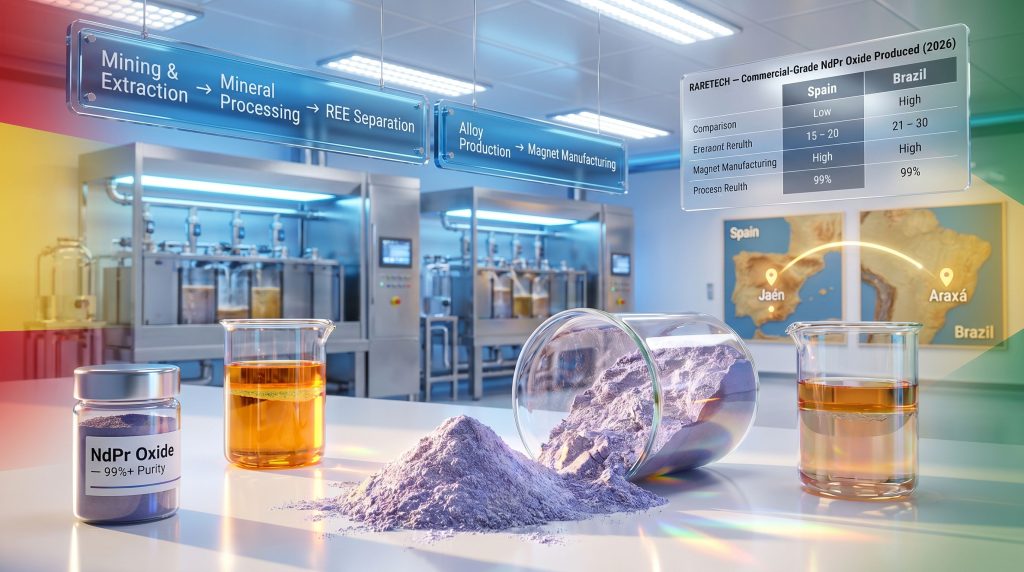
Against this backdrop, Técnicas Reunidas rare earth separation technology, branded as RARETECH, has achieved something that very few non-Chinese technology platforms have managed: the production of commercial-grade neodymium-praseodymium (NdPr) oxide at a standard suitable for permanent magnet manufacturing.
When big ASX news breaks, our subscribers know first
Why Separation Is Harder Than Mining (And Why It Matters More)
Most public discussion of the rare earth supply chain vulnerability focuses on mining. That framing undersells the actual problem. Mining rare earth deposits is technically challenging but increasingly achievable across multiple jurisdictions. The processing stage is where the expertise gap becomes acute.
Lanthanide elements share remarkably similar chemical properties because they fill the same inner electron shell (the 4f orbital) as atomic number increases. This makes conventional separation chemistry largely ineffective. Techniques that work cleanly for separating copper from iron, or gold from silver, cannot discriminate meaningfully between neodymium and its neighbours on the periodic table.
The dominant industrial solution is solvent extraction (SX), a liquid-liquid separation process that exploits the very slight differences in how each lanthanide element partitions between an aqueous solution and an immiscible organic solvent phase. By cascading this process through dozens or hundreds of mixer-settler stages, each with carefully controlled pH and solvent chemistry, individual rare earth elements can be progressively isolated to commercial purity levels.
The challenge is that designing and operating an effective SX circuit for rare earths requires:
- Deep knowledge of lanthanide coordination chemistry and thermodynamic equilibrium constants
- Precise engineering of mixer-settler contact stages and phase separation equipment
- Management of impurity elements (particularly thorium in monazite feedstocks) that interfere with separation performance
- Significant capital investment in corrosion-resistant processing infrastructure
- Operational experience accumulated over years of pilot and commercial-scale running
This is why engineering companies with genuine SX expertise are emerging as strategic assets in the rare earth supply chain, not just as contractors, but as technology developers and IP holders. Furthermore, understanding rare earth processing challenges helps contextualise why so few Western platforms have reached commercial viability.
RARETECH: What the Technology Actually Does
RARETECH is Técnicas Reunidas' proprietary answer to the rare earth separation problem. Developed internally by a Spanish industrial engineering firm with an established track record across nuclear energy, petroleum refining, and low-carbon processing technologies, RARETECH applies solvent extraction methodology to the specific challenge of separating magnet-critical rare earth elements from mixed mineral concentrates.
The processing pathway moves through several distinct stages:
| Processing Stage | Key Operation | Commercial Output |
|---|---|---|
| Feedstock Preparation | Mineral concentrate input (typically monazite) | Rare earth-bearing slurry |
| Leaching | Acid dissolution of REE-bearing minerals | Mixed rare earth solution |
| Solvent Extraction | Selective lanthanide partitioning across SX stages | Purified individual REE streams |
| Precipitation and Calcination | Conversion to solid product forms | Carbonates and oxides |
| Final Product Grade | Commercial specification for magnet manufacturing | NdPr oxide and other separated REOs |
The technology has been specifically optimised for monazite feedstocks. This matters for several strategic reasons. Monazite is a phosphate mineral that naturally concentrates the magnet-critical rare earths, particularly neodymium and praseodymium, at higher grades relative to other common rare earth minerals like bastnäsite. Several significant European and South American rare earth deposits have monazite as their primary ore mineral, making RARETECH's monazite optimisation directly relevant to the projects where it is being deployed.
However, monazite also contains thorium, a mildly radioactive element that complicates processing and waste management. Thorium must be separated and managed as a radioactive material, introducing regulatory requirements around licensing, waste classification, and disposal that add cost and complexity to any monazite processing operation. RARETECH's processing design must accommodate this reality, and the regulatory pathway for commercial-scale monazite processing in European jurisdictions will be a critical factor in project timelines.
As of mid-2026, RARETECH is in the patent application process, meaning its core separation chemistry and engineering configurations are being actively protected as proprietary intellectual property. This positions the technology as both a deployable asset in specific projects and a potential licensing platform for third-party rare earth developers.
The PERMANET Milestone: What Commercial-Grade Really Means
The production of commercial-grade NdPr oxide under the PERMANET initiative is the result that separates a working technology from a laboratory concept. Understanding why this distinction is significant requires clarity on what commercial-grade actually demands.
Technical note: Commercial-grade NdPr oxide requires a combined neodymium-praseodymium purity level typically exceeding 99 percent, with a controlled ratio of neodymium to praseodymium (commonly around 75:25 to 80:20 by weight), and strict limits on contamination by other lanthanides such as cerium, lanthanum, or samarium. Magnet alloy manufacturers purchasing NdPr oxide as a feedstock apply rigorous quality specifications, and material that does not meet these parameters cannot be used in NdFeB magnet production without further processing.
Achieving this specification in a laboratory is one challenge. Achieving it in a reproducible, scalable process is another entirely. The PERMANET framework, funded by the European Union with the explicit objective of constructing a resilient permanent magnet value chain within Europe, provided the institutional and technical context in which this demonstration occurred.
PERMANET's broader mandate encompasses the full permanent magnet value chain, from raw material sourcing through alloy production to magnet manufacturing and end-use deployment. Técnicas Reunidas was selected to lead the initiative, a role that signals institutional confidence in both RARETECH's technical capabilities and the company's EPC delivery credentials.
The significance of this validation for European industrial strategy should not be understated. Without domestic separation capacity, every European magnet manufacturer and every European electric vehicle and wind turbine producer remains dependent on separated rare earth oxides imported predominantly from China. A commercially validated separation technology, developed and demonstrated on European soil, represents the first concrete step toward eliminating that dependency.
How RARETECH Compares to Other Western Separation Platforms
RARETECH is not the only non-Chinese rare earth separation technology currently advancing toward commercial scale. A number of platforms are in various stages of development across North America and Europe, each with distinct technical approaches and deployment contexts. In addition, China's export restrictions have accelerated urgency behind each of these competing platforms.
| Technology Platform | Origin | Core Method | Stage as of Mid-2026 |
|---|---|---|---|
| RARETECH (Técnicas Reunidas) | Spain | Solvent extraction, monazite-optimised | Commercial-grade NdPr produced |
| RapidSX (Ucore Rare Metals) | Canada/USA | Continuous accelerated SX | Pentagon-cleared; pilot-scale advancement |
| Aclara REE Process | Chile/USA | Ionic adsorption plus SX | Virginia pilot plant inaugurated |
| USA Rare Earth Processing | USA | SX-based refining | DOE-backed pilot expansion underway |
Several dimensions differentiate RARETECH from its North American counterparts:
- Geographic positioning: RARETECH is the only major SX-based separation platform developed within the EU, making it strategically aligned with European policy frameworks and geographically proximate to European magnet manufacturing demand
- EPC integration: Técnicas Reunidas brings full engineering, procurement, and construction capability, meaning RARETECH can be deployed as part of a complete project delivery rather than as a standalone technology license
- Monazite specificity: The technology's optimisation for monazite feedstocks directly serves several of the most advanced European and South American rare earth deposit types
- Institutional validation: PERMANET selection and EU funding provide a level of independent technical validation that pure private-sector technology developers lack
One area where North American platforms currently have an advantage is regulatory progress. Projects in the United States operate under more mature and established frameworks for rare earth processing licensing, while European regulatory pathways for monazite processing in particular remain less defined.
Two Projects, Two Continents: RARETECH's First Commercial Deployments
The commercial-grade NdPr milestone has translated directly into contracted project engagements, with two agreements signed in 2026 with Australian-listed mineral developers targeting deployments in Spain and Brazil.
The Orión Project, Jaén, Spain (Osmond Resources)
Signed in February 2026, the agreement with Osmond Resources for the Orión EU Critical Minerals Project in Spain's Jaén region represents RARETECH's most strategically symbolic deployment. Orión is positioned as a potential candidate for the EU's first fully integrated rare earth production operation in the European Union, a project that would span from monazite mineral extraction through to separated rare earth oxide production without any processing steps occurring outside European territory.
The strategic value of this model is significant. Current European rare earth development projects typically produce mixed mineral concentrates or partially processed intermediate products that must be shipped to non-European processors, primarily in China, before commercial-grade separated oxides can be returned. A fully integrated domestic operation would retain both the economic value and the strategic processing knowledge within the EU.
Técnicas Reunidas' role encompasses full EPC services, meaning the company is responsible not just for technology provision but for project design, equipment procurement, and construction delivery.
The Araxá Project, Brazil (St George Mining)
The May 2026 agreement with St George Mining targets the Araxá region of Brazil, a globally recognised mineral province already established as the world's dominant niobium production area. The co-occurrence of rare earth mineralisation with niobium and phosphate deposits in this region is geologically significant. Carbonatite-hosted rare earth deposits like those found in the Araxá district typically contain elevated concentrations of the light rare earth elements, including neodymium and praseodymium, making them well-suited to NdPr-focused processing strategies.
St George Mining's CEO John Prineas has publicly acknowledged the standing of Técnicas Reunidas within European rare earth processing circles, describing the engagement as focused on optimising the processing strategy for the Araxá deposit. The relationship carries additional long-term potential: St George controls six additional critical minerals projects in Australia, creating a prospective pipeline for Técnicas Reunidas rare earth separation technology deployment across Australian jurisdictions that could eventually connect into European processing infrastructure.
The next major ASX story will hit our subscribers first
The Emerging Allied-Nation Supply Chain Architecture
The pattern visible across both RARETECH deployments reveals something larger than individual project agreements. A structural model is taking shape in which:
- Resource-rich allied nations (Australia, Brazil, select European countries) hold the mineral deposits
- European engineering firms provide the separation technology and processing infrastructure
- European magnet manufacturers provide the downstream demand anchor
- Australian-listed development companies serve as the capital markets vehicle connecting the resource to the processing technology
This architecture is designed to route rare earth supply chains through jurisdictions that sit outside Chinese processing dominance, while leveraging existing engineering expertise concentrated in Europe. It aligns with the EU Critical Raw Materials Act's target of processing at least 10 percent of annual European consumption of strategic raw materials domestically by 2030, a benchmark that rare earth separation capacity is specifically measured against.
The role of industrial engineering firms in this model deserves particular attention. Traditional rare earth supply chain development focused on mining companies and chemical processors. Engineering companies like Técnicas Reunidas bring a different and arguably more deployable capability set: project execution experience, scalable delivery infrastructure, and the ability to integrate proprietary processing technology into bankable EPC contracts that project finance lenders can assess and underwrite. Consequently, the broader rare earth geopolitical impact of these structural shifts is reshaping how allied governments approach industrial policy.
Applications Dependent on NdPr Oxide Supply Security
The downstream applications that depend on reliable NdPr oxide supply span some of the highest-growth technology sectors of the coming decade:
| End-Use Sector | Specific Application | NdPr Dependency Level |
|---|---|---|
| Electric Vehicles | Traction motor permanent magnets | Very High |
| Wind Energy | Direct-drive turbine generators | Very High |
| Industrial Robotics | Servo motors and precision actuators | High |
| Consumer Electronics | Hard drives, speakers, sensors | Moderate to High |
| Defense and Aerospace | Guidance systems, radar, actuators | Critical |
Each NdFeB magnet in an electric vehicle traction motor contains roughly 1 to 2 kilograms of NdPr alloy. A direct-drive offshore wind turbine generator can contain upward of 600 kilograms of rare earth permanent magnet material. As electrification accelerates across transport and energy infrastructure, the demand trajectory for commercial-grade NdPr oxide points consistently upward through the 2030s. Furthermore, these volumes underscore why critical materials transition strategies are now central to European industrial planning.
Key Challenges on the Path to Full Commercial Scale
Despite the significance of the NdPr production milestone, important challenges remain between demonstrated technology and operating commercial-scale separation facilities:
- Capital intensity: Building a full-scale rare earth SX circuit requires hundreds of millions of dollars in processing infrastructure, requiring offtake commitments and project finance structures that take years to arrange
- Thorium management: Monazite feedstock processing generates thorium-bearing waste streams that require licensed radioactive material handling, a regulatory complexity that varies significantly by jurisdiction
- Permitting timelines: European environmental and industrial permitting processes for novel processing technologies involving radioactive materials are lengthy and uncertain
- Workforce development: Skilled rare earth SX operators and process chemists are in short supply outside China, requiring investment in training and knowledge transfer
- Offtake security: Magnet manufacturers will require consistent quality specifications and long-term supply security before committing to purchase agreements from new non-Chinese sources
These are not insurmountable obstacles, but they are the variables that will determine whether RARETECH moves from a validated technology to an operating contributor to European rare earth supply over the next five to ten years.
Summary: RARETECH's Position in the Global Rare Earth Technology Race
| Assessment Dimension | Current Status |
|---|---|
| Technology Maturity | Commercial-grade NdPr oxide demonstrated under PERMANET |
| IP Protection | Patent applications in progress as of mid-2026 |
| Deployment Pipeline | EPC contracts signed for Spain (Orión) and Brazil (Araxá) |
| EU Policy Alignment | Directly supports CRMA 2030 domestic processing targets |
| Competitive Differentiation | EPC-integrated delivery; monazite-optimised SX process |
| Geopolitical Relevance | European-based alternative to Chinese separation capacity |
| Primary Scale-Up Risks | Capital requirement, thorium regulation, permitting timelines |
The rare earth separation landscape is at an inflection point. For the first time in decades, multiple non-Chinese technology platforms are advancing toward commercial viability simultaneously, driven by a convergence of policy pressure, industrial demand, and engineering investment. Técnicas Reunidas rare earth separation technology sits at the European centre of this shift, with validated output, contracted deployments, and the institutional backing of EU-funded programmes supporting its trajectory.
Whether RARETECH ultimately delivers at industrial scale will depend on capital markets, regulatory processes, and the long-term commitment of magnet manufacturers to diversify their oxide supply. However, the chemistry has been proven. The engineering pathway exists. And for a supply chain problem that once seemed intractable outside China, that represents meaningful progress.
This article is informational in nature and does not constitute financial or investment advice. Statements regarding future project timelines, technology deployments, and market outcomes involve inherent uncertainty and should not be relied upon as forecasts. Readers considering investment decisions related to companies or technologies discussed in this article should conduct independent due diligence and consult qualified financial advisors.
Want to Stay Ahead of the Next Major Rare Earth Discovery on the ASX?
Discovery Alert's proprietary Discovery IQ model instantly scans ASX announcements to identify significant mineral discoveries — including rare earth and critical minerals opportunities — converting complex data into clear, actionable insights for both short-term traders and long-term investors. Explore how historic discoveries have generated substantial returns on the Discovery Alert discoveries page, and begin your 14-day free trial today to position yourself ahead of the broader market.