July 27, 2026
Global energy infrastructure represents one of the most interconnected yet vulnerable networks in the modern world. Critical facilities operating thousands of miles apart form delicate supply chains that can experience cascading disruptions from localised incidents. When these systems face coordinated attacks, the ripple effects extend far beyond regional boundaries, reshaping international markets and forcing fundamental reassessments of energy security frameworks. The recent Ras Laffan attacks have demonstrated precisely how regional conflicts can rapidly transform into systemic market disruptions.
Understanding Qatar's Strategic Energy Infrastructure
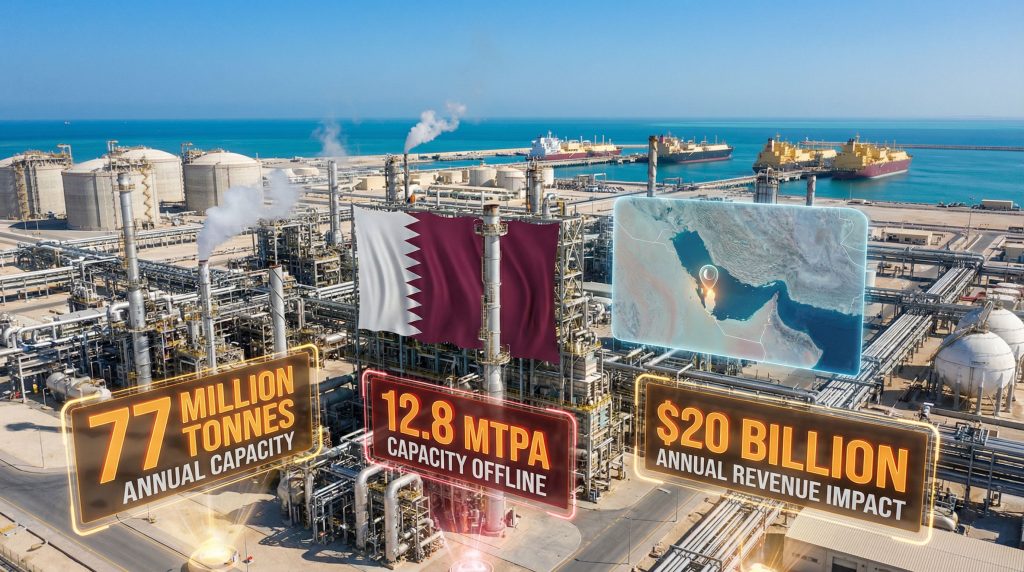
Qatar's Ras Laffan Industrial City functions as one of the world's most concentrated energy production hubs, processing 77 million tonnes of LNG annually across multiple integrated facilities. This massive complex combines liquefied natural gas production with gas-to-liquids conversion, condensate recovery systems, and specialised processing for associated products including helium, naphtha, and sulphur.
The facility's integrated architecture creates both operational efficiency and systemic vulnerability. When LNG Trains 4 and 6 sustained damage during the March 2026 attacks, the impact extended beyond simple production capacity loss. These specialised trains process disproportionate volumes of associated products, indicating design optimisation that concentrates specific processing capabilities rather than distributing them across all production lines.
Critical Infrastructure Vulnerability Assessment
The attacks targeted infrastructure representing 12.8 million tonnes per annum of LNG capacity, approximately 17% of Qatar's total export capability. However, the damage assessment reveals the complexity of modern energy facilities:
| Facility Component | Capacity Impact | Recovery Timeline |
|---|---|---|
| LNG Trains 4 & 6 | 12.8 MTPA offline | 3-5 years |
| Pearl GTL facility | 50% production disrupted | 1+ years |
| Associated products | Multiple percentage losses | Varies by product |
The Pearl Gas-to-Liquids facility, operated through a Shell joint venture, exemplifies the interconnected nature of these installations. GTL technology converts natural gas into liquid fuels, base oils, and petrochemical feedstocks, creating dependencies that extend into multiple downstream industries. When one of its two production trains went offline, the disruption affected not just energy markets but also petrochemical supply chains across Europe and Asia.
When big ASX news breaks, our subscribers know first
Quantifying the Global Supply Shock
The $20 billion annual revenue impact reflects more than simple production multiplication by current market prices. This figure encompasses the complex interaction between long-term contract obligations, force majeure declarations, and spot market displacement effects that occur when major suppliers experience extended outages. Furthermore, the current oil price rally has amplified these financial implications across global energy markets.
Qatar's projected losses include 18.6 million barrels of condensates (24% of exports), 1.28 million tonnes of LPG (13%), and critical helium supplies (14% reduction), demonstrating how integrated facilities create cascading supply disruptions across multiple product categories.
Force Majeure Contract Mechanics
The declaration of force majeure on long-term LNG contracts for up to five years represents a fundamental shift in global gas market dynamics. Unlike typical commodity disruptions that affect spot markets primarily, this situation forces contracted buyers to source replacement supplies from alternative providers, potentially creating permanent demand redistribution.
Long-term LNG contracts typically include force majeure provisions that excuse performance during extraordinary circumstances. However, the extended 3-5 year repair timeline pushes these contracts into unprecedented territory. Buyers who relied on Qatari LNG under 15-20 year agreements must now secure alternatives, often at significantly higher costs and with different delivery terms.
Associated Product Market Implications
The disruption extends beyond LNG into specialised product markets where Qatar held significant market shares:
• Condensates: 18.6 million barrels annually (24% export reduction)
• Liquefied Petroleum Gas: 1.28 million tonnes (13% reduction)
• Naphtha: 0.59 million tonnes (6% reduction)
• Sulphur: 0.18 million tonnes (6% reduction)
• Helium: 309.54 million cubic feet annually (14% reduction)
These associated products serve critical industrial applications. Helium shortages affect semiconductor manufacturing, medical equipment production, and scientific research. Naphtha disruptions impact petrochemical feedstock availability for plastics production. The interconnected nature of these losses amplifies the economic impact beyond the headline LNG figures.
Regional Market Exposure Analysis
The global nature of LNG trade means supply disruptions in Qatar create immediate pressures across multiple continents. However, the severity of impact varies significantly based on each region's supply diversification, storage capacity, and alternative sourcing options. Additionally, the US natural gas forecast indicates significant volatility that could affect regional supply alternatives.
Asia-Pacific Vulnerability Concentration
China, as the world's largest LNG importer with annual consumption exceeding 60 million tonnes, faces immediate supply pressures from the Qatari disruption. The country's regasification capacity of approximately 75 million tonnes annually provides some flexibility, but contract portfolio concentration with specific suppliers creates pricing pressures when alternatives must be secured rapidly.
South Korea's industrial economy demonstrates particular vulnerability to LNG supply shocks. The nation's petrochemical, steel, and refining sectors depend heavily on consistent gas supplies, with limited pipeline alternatives. Korean regasification terminals operate near capacity utilisation, constraining the ability to absorb additional spot market volumes when regular contract supplies face disruption.
European Energy Security Implications
European markets face different but equally significant challenges from the Qatari supply disruption. Italy and Belgium, identified as primary importers of Qatari LNG, serve broader regional distribution networks. Belgium's Zeebrugge terminal functions as a critical chokepoint for northwestern European gas supplies, amplifying the regional impact of supply reductions.
The European LNG market's structure differs from Asia-Pacific in several key aspects:
• Greater supplier diversification following Russian pipeline disruptions
• Established spot trading mechanisms through established hubs
• Integrated pipeline networks allowing regional redistribution
• Higher storage capacity utilisation providing short-term flexibility
However, these advantages come with limitations. European LNG import terminals already operate at high utilisation rates, constraining the ability to absorb displaced Qatari volumes. Competition with Asian buyers for alternative supplies creates pricing pressures that affect industrial competitiveness.
Geopolitical Risk Framework Analysis
The targeting of Ras Laffan attacks represents an evolution in regional conflict dynamics, where energy infrastructure becomes a strategic weapon rather than collateral damage. The Iranian missile strikes demonstrate how local geopolitical tensions can rapidly escalate into global energy market disruptions, creating significant global trade impacts that extend far beyond energy markets.
Regional Proxy Conflict Expansion
The connection between Iran's South Pars gas field and the Qatar disputes illustrates how shared hydrocarbon resources can become focal points for broader regional tensions. The escalation from Iran-Israel conflicts to infrastructure targeting in Qatar demonstrates the interconnected nature of Middle Eastern geopolitical risks.
Historical precedents for energy infrastructure targeting include the 2019 Abqaiq-Khurais attacks on Saudi Aramco facilities, which temporarily reduced global oil production by approximately 5%. However, the Ras Laffan attacks represent a qualitative escalation due to their extended impact timeline and integration with broader regional conflict patterns.
International Law and Deterrence Implications
The attacks raise complex questions about energy infrastructure protection under international law. Critical energy facilities serve civilian populations globally, yet their dual civilian-strategic nature complicates legal frameworks for protection and response. UN Security Council Resolution 2817, referenced in the geopolitical context, addresses energy infrastructure protection but enforcement mechanisms remain limited.
Deterrence strategies for energy infrastructure protection face fundamental challenges:
- Geographic concentration of facilities creates attractive targets
- Economic multiplier effects reward successful attacks
- Limited defensive options for offshore or remote facilities
- International law gaps in enforcement mechanisms
Market Adaptation and Price Discovery Mechanisms
LNG spot markets operate through complex price discovery mechanisms that must rapidly adjust to supply disruptions. The Asia-Pacific market, anchored by benchmark pricing at Singapore (JKM – Japan Korea Marker), faces immediate volatility when major suppliers experience extended outages.
Spot Market Dynamics During Supply Shocks
Normal LNG spot trading relies on relatively stable supply-demand balances with seasonal fluctuations. Major supply disruptions create several market distortions:
• Bid-offer spread widening as buyers compete for limited supplies
• Geographic arbitrage opportunities between regional markets
• Storage utilisation optimisation to manage supply security
• Contract renegotiation pressures for long-term agreements
Historical precedents demonstrate the magnitude of potential price impacts. During Japan's post-Fukushima LNG import surge in 2011-2012, spot prices exceeded $50/MMBtu in Northeast Asian markets, representing 300-400% premiums over long-term contract pricing.
Alternative Supply Source Development
The Qatari supply disruption accelerates development of alternative LNG sources, though lead times for major projects typically span 5-7 years. Key alternative supply regions include:
United States Gulf Coast: Existing export capacity can absorb some displaced demand, though transportation costs to Asia create pricing disadvantages versus regional suppliers.
Australia: Major LNG projects in Western Australia and Queensland possess expansion potential, but infrastructure constraints limit short-term capacity increases.
Russia: Existing LNG facilities and pipeline capacity offer alternative supplies, though geopolitical considerations affect long-term supply security perceptions.
Industrial Downstream Impact Assessment
The Ras Laffan attacks create cascading effects throughout global industrial supply chains. Petrochemical producers, steel manufacturers, and power generation facilities face immediate input cost pressures and potential supply security concerns. These disruptions contribute to broader energy transition risks affecting global industrial transformation.
Petrochemical Industry Disruptions
Integrated petrochemical facilities depend on consistent feedstock supplies from LNG processing. The loss of Qatari naphtha exports (590,000 tonnes annually) affects crackers and reformers across Europe and Asia. These facilities typically operate on just-in-time inventory management, making them particularly vulnerable to supply disruptions.
Helium supply reductions create particularly acute challenges for high-technology industries. Semiconductor fabrication requires ultra-pure helium for cooling and atmospheric control. Medical equipment manufacturing, particularly MRI systems, depends on liquid helium for superconducting magnets. The 14% reduction in Qatari helium exports represents a significant percentage of global tradeable supply.
Manufacturing Sector Cost Transmission
Energy-intensive manufacturing faces dual pressures from the Qatari disruption:
| Industry Sector | Impact Type | Adjustment Mechanism |
|---|---|---|
| Steel production | Input cost increases | Fuel switching, production cuts |
| Aluminium smelting | Power cost inflation | Contract renegotiation |
| Chemical processing | Feedstock shortages | Alternative supplier development |
| Glass manufacturing | Natural gas price spikes | End-user price increases |
These industrial adjustments create broader economic implications as manufacturers pass through increased costs to consumers or reduce production volumes to maintain margins.
The next major ASX story will hit our subscribers first
Investment Framework and Risk Assessment
The Ras Laffan attacks fundamentally alter risk assessment frameworks for energy infrastructure investment. Traditional financial models must now incorporate extended disruption scenarios and geopolitical risk premiums that reflect the interconnected nature of regional conflicts. Consequently, these developments significantly affect investment market impacts across multiple sectors.
Geopolitical Risk Premium Recalibration
Energy infrastructure investments require return premium adjustments to reflect demonstrated vulnerability to coordinated attacks. Key risk factors requiring reassessment include:
• Geographic concentration risk: Facilities in politically unstable regions demand higher returns
• Supply chain integration vulnerability: Integrated facilities face cascading failure risks
• Insurance market capacity constraints: Limited coverage availability increases self-insurance requirements
• Regulatory response uncertainty: Government intervention potential affects investment returns
Investment analysts must develop new methodologies for quantifying these risks. Monte Carlo modelling approaches can simulate various attack scenarios and their financial implications, though the relative rarity of such events makes statistical modelling challenging.
Portfolio Diversification Strategies
Energy infrastructure portfolios require fundamental restructuring to address demonstrated vulnerabilities:
- Geographic distribution: Avoiding concentration in single regions or countries
- Technology diversification: Balancing traditional and renewable energy assets
- Supply chain redundancy: Investing in multiple processing and transportation options
- Strategic reserve opportunities: Developing storage and buffer capacity investments
Institutional investors increasingly incorporate environmental, social, and governance (ESG) criteria that include geopolitical stability assessments. The Ras Laffan attacks demonstrate how regional conflicts can rapidly transform into ESG investment risks.
Long-Term Structural Market Changes
The extended nature of the disruption forces permanent structural adjustments in global energy markets. Unlike temporary supply interruptions, the 3-5 year repair timeline requires market participants to develop alternative arrangements that may persist beyond the facility restoration.
Energy Security Architecture Redesign
Governments and industry participants must reassess fundamental assumptions about energy supply security. Traditional approaches focused on diversification among reliable suppliers, but the Qatar attacks demonstrate how geopolitical conflicts can rapidly eliminate major supply sources.
New energy security frameworks require:
• Infrastructure hardening investments: Physical protection and cyber security enhancement
• Redundancy building: Multiple processing and transportation pathways
• International cooperation strengthening: Shared security responsibility frameworks
• Emergency response capability development: Rapid alternative sourcing mechanisms
Accelerated Energy Transition Implications
The vulnerability demonstrated by centralised fossil fuel infrastructure accelerates investment in distributed renewable energy systems. Solar and wind power generation, combined with battery storage, offer inherent resilience advantages through geographic distribution and modular scaling. However, the Qatar LNG facilities have been significantly impacted, highlighting the need for energy diversification strategies.
However, renewable energy systems face their own infrastructure vulnerabilities. Critical mineral supply chains for batteries and solar panels demonstrate geographic concentration risks similar to traditional energy infrastructure. Rare earth element processing, lithium refining, and polysilicon production remain concentrated in specific regions subject to geopolitical disruption.
Grid interconnection becomes increasingly important as renewable penetration increases. International transmission networks can provide supply security through geographic diversification, but these systems also create new infrastructure targets for potential attacks.
Strategic Risk Management Recommendations
Market participants must develop comprehensive risk management strategies that address both immediate supply disruption effects and longer-term structural changes in energy markets.
What Are the Immediate Response Strategies?
• Contract portfolio review: Assess force majeure exposure across supply agreements
• Alternative supplier development: Establish relationships with multiple LNG providers
• Storage capacity utilisation: Optimise inventory management for supply security
• Price hedging mechanisms: Implement derivatives strategies for cost volatility management
Medium-Term Infrastructure Adaptation
• Supply chain diversification: Reduce dependence on single-source critical supplies
• Technology investment: Develop flexible processing capabilities for multiple feedstocks
• Regional cooperation: Participate in shared storage and emergency supply arrangements
• Insurance enhancement: Secure comprehensive coverage for geopolitical risks
Long-Term Strategic Planning
• Energy transition acceleration: Balance security and sustainability investment priorities
• Geopolitical monitoring systems: Develop early warning capabilities for regional conflicts
• Regulatory engagement: Participate in international energy security policy development
• Scenario planning: Model various disruption scenarios and response strategies
The Ras Laffan attacks represent a watershed moment in global energy security, demonstrating how regional conflicts can rapidly transform into systemic market disruptions. The extended recovery timeline forces permanent adjustments in supply relationships, investment strategies, and risk management frameworks that will reshape energy markets for decades. Success in this new environment requires sophisticated understanding of geopolitical-energy market interactions and proactive adaptation to emerging vulnerabilities.
This analysis is based on reported events and market assessments as of March 2026. Actual infrastructure damage assessments, repair timelines, and financial impacts may vary. Investors should conduct independent due diligence and consider consulting with qualified financial advisors before making investment decisions based on geopolitical risk scenarios.
Are You Positioning Your Portfolio for Major Energy Market Disruptions?
Geopolitical tensions increasingly transform local incidents into global supply shocks, creating substantial opportunities for investors who can identify critical infrastructure vulnerabilities before they impact markets. Discovery Alert's proprietary Discovery IQ model delivers real-time notifications on significant ASX mineral discoveries, empowering subscribers to capitalise on energy transition opportunities and critical resource developments ahead of mainstream market awareness.