June 18, 2026
Understanding the Sensor Technologies Transforming Mineral Exploration
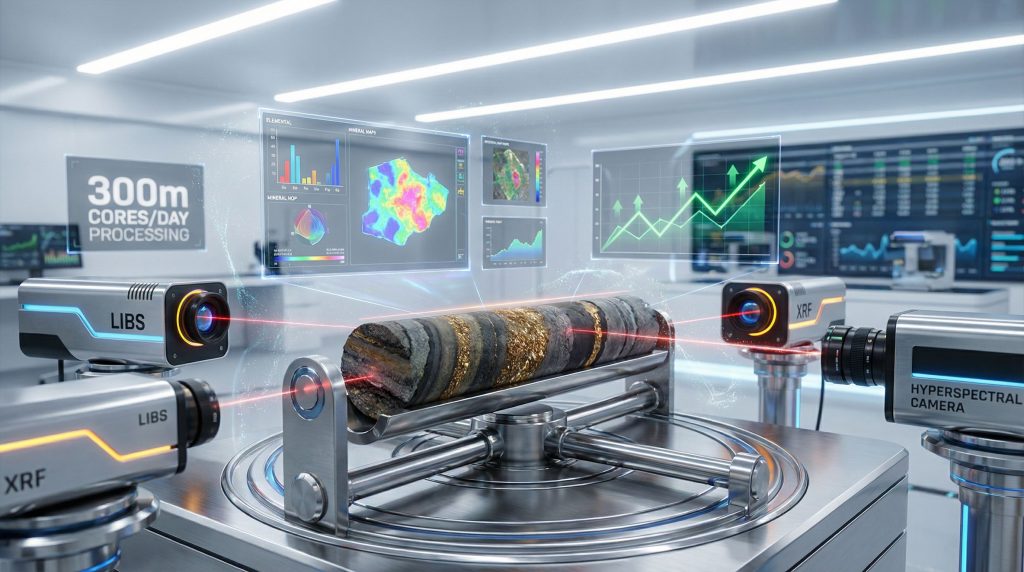
Mining exploration has traditionally relied on visual core assessment and laboratory analysis cycles stretching weeks or months. However, the integration of real-time core scanning in mining operations represents a fundamental shift toward immediate geochemical data acquisition, enabling same-shift drilling decisions that can transform exploration outcomes. This technological evolution combines multiple sensor technologies—including Laser-Induced Breakdown Spectroscopy (LIBS), X-Ray Fluorescence (XRF) analysis, and hyperspectral imaging—to deliver laboratory-quality results within hours rather than weeks.
The economic implications extend beyond simple time savings. Real-time scanning enables adaptive drilling strategies where exploration teams modify programs based on continuous data feedback, potentially avoiding costly dry holes while maximising high-grade intersections through informed hole extension decisions.
When big ASX news breaks, our subscribers know first
What Core Technologies Drive Real-Time Mineral Analysis?
Real-time core scanning in mining leverages multiple analytical technologies working in integrated platforms. The most significant advancement involves combining traditional geological judgment with quantitative sensor data, eliminating the uncertainty period between drilling and laboratory confirmation.
Primary Sensor Technologies:
• Laser-Induced Breakdown Spectroscopy (LIBS): Delivers precise elemental composition through laser ablation and spectral analysis
• X-Ray Fluorescence (XRF) Systems: Provides continuous elemental profiling for major and trace elements
• Hyperspectral Imaging: Captures detailed mineral signatures across visible and near-infrared spectra
• Multi-sensor Integration Platforms: Combine multiple technologies for comprehensive core analysis
Comparative Technology Performance
| Technology | Processing Capability | Primary Applications | Data Output Type |
|---|---|---|---|
| LIBS Systems | High-precision elemental analysis | Critical mineral detection | Quantitative geochemistry |
| XRF Scanners | Continuous profiling | Base metal exploration | Real-time element maps |
| Hyperspectral Imaging | Instant mineral identification | Alteration zone mapping | Mineral composition data |
| Integrated Platforms | Multi-parameter analysis | Comprehensive exploration | 3D geological modeling |
The integration of these technologies enables mining teams to receive geochemical data within hours of core extraction, fundamentally altering traditional exploration workflows. Furthermore, modern core scanning techniques deliver immediate feedback that can influence drilling decisions during active operations, unlike laboratory analysis requiring sample preparation and multi-week processing times.
Advanced Sensor Calibration Requirements
Real-time scanning accuracy depends on sophisticated calibration protocols specific to geological matrices. Each technology requires regular validation against certified reference materials, with calibration adjustments for varying ore types and host rock compositions. Environmental factors including temperature, humidity, and altitude can influence sensor performance, necessitating field-specific calibration procedures.
How Real-Time Data Transforms Exploration Decision-Making
Traditional mineral exploration follows predetermined drilling patterns based on limited geological knowledge. Real-time core scanning in mining enables dynamic program modification where teams make drilling decisions based on continuous geochemical feedback rather than visual core assessment alone.
A compelling example occurred during a 2025 exploration program where real-time scanning prevented premature hole termination. Visual geology at 250 metres depth suggested limited mineralisation potential, which would typically trigger hole abandonment. However, simultaneous real-time geochemical data from nearby holes indicated potential mineralisation at greater depths, justifying hole extension that ultimately intersected 39 metres grading 1.16% copper equivalent within a broader 93-metre interval averaging 0.77% copper equivalent.
Immediate Operational Benefits
Decision Timeline Acceleration:
• Traditional exploration: 2-4 week laboratory turnaround before drilling decisions
• Real-time scanning: Shift-by-shift decision-making capability
• Risk reduction through immediate uncertainty resolution
• Enhanced targeting accuracy through continuous feedback
Cost Efficiency Improvements:
Real-time scanning reduces laboratory assay requirements by enabling targeted sampling based on immediate anomaly detection. Rather than assaying entire core intervals, teams can focus laboratory analysis on zones identified through real-time screening, significantly reducing analytical costs while maintaining exploration effectiveness.
Geological Model Enhancement:
Continuous data acquisition enables real-time geological model updating during active drilling programs. Traditional exploration requires completion of all drilling before comprehensive geological interpretation, whilst real-time scanning allows model refinement throughout the exploration cycle. Consequently, this approach supports more effective data-driven mining operations across the industry.
Strategic Impact on Resource Definition and Development
Real-time core scanning in mining accelerates resource definition timelines by enabling immediate geological interpretation during active drilling programs. Rather than waiting for complete drilling cycles and laboratory results, exploration teams can begin formal resource estimation using real-time data validated against selective laboratory confirmation.
Adaptive Exploration Strategy Framework
Modern exploration programs utilising real-time scanning follow dynamic modification protocols:
-
Initial Drilling Phase: Deploy predetermined drilling patterns based on geological targets
-
Real-Time Data Integration: Receive continuous geochemical data during drilling operations
-
Decision Point Assessment: Evaluate hole extension, termination, or redirection based on immediate results
-
Program Modification: Adjust drilling locations and depths based on real-time mineralisation continuity
-
Resource Model Updates: Integrate real-time data into evolving geological and resource models
This workflow represents a fundamental departure from traditional exploration where drilling continues to predetermined depths regardless of interim results. Real-time feedback enables teams to maximise high-grade intersections while avoiding unnecessary drilling in barren zones.
Enhanced Resource Inventory Integration
Companies utilising real-time scanning can advance exploration targets to resource definition status during active drilling programs. Traditional exploration requires complete drilling cycles, laboratory confirmation, and geological modelling before resource estimation begins. In addition, real-time data enables preliminary resource inventory integration while drilling programs continue, significantly accelerating project development timelines.
Technical Implementation Challenges and Solutions
Data Quality and Validation Protocols
Real-time scanning requires robust quality control procedures to ensure analytical accuracy comparable to traditional laboratory methods. Validation protocols include regular calibration against certified reference standards, duplicate analysis for statistical confidence, and selective laboratory confirmation of real-time results.
Critical Implementation Consideration: Real-time scanning complements rather than replaces laboratory analysis. Successful implementation involves strategic integration where real-time data guides immediate decisions while laboratory analysis provides final confirmation for resource estimation and regulatory compliance.
Quality Control Framework:
• Calibration Standards: Deploy certified reference materials specific to target ore types
• Statistical Validation: Maintain correlation coefficients above 0.95 between real-time and laboratory results
• Environmental Controls: Monitor and adjust for temperature, humidity, and altitude variations
• Operator Training: Ensure geological staff understand technology capabilities and limitations
Infrastructure Requirements and Cost Considerations
Real-time scanning implementation requires significant capital investment and infrastructure development. Mobile laboratory units must be deployed to remote exploration sites, often requiring custom transportation and power generation solutions.
Investment Requirements:
• Equipment Costs: $200,000-$500,000+ per integrated scanning system
• Infrastructure Development: Mobile laboratory deployment, power systems, communication networks
• Training Programs: Geological staff certification on real-time interpretation protocols
• Maintenance Systems: Field servicing capabilities and spare parts inventory
For instance, CSIRO's advanced drill core facilities demonstrate the level of infrastructure sophistication required for comprehensive implementation.
Artificial Intelligence Integration in Real-Time Core Analysis
Advanced artificial intelligence algorithms enhance real-time core scanning through automated pattern recognition and predictive modelling capabilities. Machine learning systems trained on extensive geological databases can identify mineral signatures and predict ore body continuity with increasing accuracy.
Automated Geological Interpretation
AI in drilling operations provides several analytical enhancements:
• Continuous Lithological Classification: Automated rock type identification based on spectral signatures
• Predictive Mineralisation Modelling: Machine learning algorithms predict ore body continuity based on real-time geochemical trends
• Anomaly Detection Systems: Automated flagging of unusual geochemical signatures requiring immediate attention
• Multi-sensor Data Fusion: Integration of LIBS, XRF, and hyperspectral data into comprehensive geological models
These AI enhancements enable geological teams to process complex real-time data streams more efficiently while reducing interpretation variability between different operators. Furthermore, AI enhanced exploration capabilities continue expanding as machine learning algorithms become more sophisticated.
The next major ASX story will hit our subscribers first
Future Technology Development and Industry Adoption
Real-time core scanning in mining continues evolving through emerging sensor technologies and enhanced data processing capabilities. Next-generation systems integrate portable mass spectrometry, advanced electromagnetic conductivity mapping, and enhanced X-ray computed tomography for comprehensive core characterisation.
Emerging Technology Trends
Advanced Sensor Integration:
• Portable Mass Spectrometry: Molecular-level analysis capabilities for complex mineral identification
• Enhanced Electromagnetic Mapping: Three-dimensional conductivity profiling for structural interpretation
• Advanced CT Scanning: High-resolution internal core structure analysis
• Satellite Communication Integration: Real-time data transmission from remote exploration sites
Industry Adoption Patterns and Market Expansion
Real-time scanning adoption varies significantly across mining sectors and company sizes. Major mining corporations increasingly implement fleet-wide systems to standardise exploration protocols, while junior exploration companies leverage technology for competitive advantage in resource discovery.
Adoption Drivers:
• Exploration Cost Pressure: Increasing pressure to reduce exploration timelines and costs
• Resource Discovery Competition: Enhanced technology adoption for competitive exploration advantage
• Regulatory Efficiency: Faster resource definition supports accelerated permitting processes
• Investment Community Expectations: Real-time data capabilities increasingly expected by exploration investors
However, the broader context of mining industry innovation suggests that technological advancement will continue accelerating across all operational aspects.
Implementation Strategy and Return on Investment Analysis
Mining companies evaluating real-time scanning investment should consider phased implementation approaches that demonstrate technology value before full-scale deployment. Pilot programs enable teams to establish performance benchmarks and refine operational procedures before company-wide adoption.
Strategic Implementation Framework
Phase 1: Technology Assessment and Pilot Development
• Evaluate geological requirements specific to target ore types and exploration environments
• Select appropriate technology combinations based on primary mineral targets
• Establish baseline performance metrics comparing traditional and real-time exploration approaches
• Develop staff training protocols and operational procedures
Phase 2: Controlled Deployment and Performance Validation
• Implement real-time scanning on selected exploration targets
• Monitor cost savings through reduced laboratory requirements and accelerated decision-making
• Validate real-time results against laboratory confirmation analysis
• Refine operational procedures based on field experience
Phase 3: Full-Scale Implementation and Optimisation
• Deploy company-wide real-time scanning standards and protocols
• Integrate real-time data into corporate exploration databases and resource modelling systems
• Establish maintenance and calibration procedures for multiple exploration sites
• Monitor long-term performance metrics and return on investment
ROI Calculation Methodology
Quantifiable Benefits Assessment:
• Laboratory Cost Reduction: Calculate savings from reduced routine assay requirements
• Exploration Timeline Acceleration: Quantify value of faster resource definition and development progression
• Enhanced Discovery Probability: Assess increased success rates through real-time targeting
• Operational Efficiency Gains: Measure reduced drilling costs through optimised hole placement and extension decisions
Strategic Value Considerations:
Investment analysis should include competitive positioning benefits, risk reduction through immediate uncertainty resolution, and enhanced investor confidence through demonstrated technological capabilities. Real-time scanning represents both operational improvement and strategic positioning for companies competing in increasingly efficiency-focused exploration markets.
Risk Management and Quality Assurance Protocols
Successful real-time core scanning implementation requires comprehensive risk management addressing potential technology limitations and data quality concerns. Quality assurance protocols ensure real-time results maintain accuracy standards necessary for exploration decision-making.
Technology Limitation Management
Matrix Effect Considerations: Different host rock types can influence sensor accuracy, requiring ore-type-specific calibration protocols. Teams must understand technology limitations in complex geological environments and maintain laboratory confirmation procedures for critical decisions.
Environmental Impact Mitigation: Field conditions including temperature extremes, humidity, and altitude variations can affect sensor performance. Robust environmental monitoring and calibration adjustment procedures ensure consistent accuracy across diverse exploration environments.
Data Integration Challenges: Real-time data must integrate seamlessly with existing geological databases and resource modelling software. Comprehensive data management systems prevent information loss while maintaining exploration workflow efficiency.
Long-Term Industry Implications
Real-time core scanning in mining represents a permanent shift toward data-driven exploration decision-making. As technology costs decrease and accuracy improves, real-time scanning will likely become standard practice rather than competitive advantage, fundamentally altering exploration economics and investor expectations.
Companies implementing real-time scanning early gain operational experience and competitive positioning benefits while technology adoption remains limited. However, long-term success depends on integrating real-time capabilities into comprehensive exploration strategies rather than treating technology as standalone solutions.
Investment decisions regarding real-time core scanning should consider specific geological requirements, operational contexts, and long-term strategic positioning within competitive exploration markets. Technology selection and implementation strategies require careful evaluation of costs, benefits, and operational integration requirements specific to individual mining operations.
Want to Stay Ahead of Mining Innovation Developments?
Discovery Alert's proprietary Discovery IQ model delivers real-time alerts on significant ASX mineral discoveries, including companies implementing cutting-edge exploration technologies like real-time core scanning. Understand why major mineral discoveries can lead to significant market returns by exploring Discovery Alert's dedicated discoveries page, showcasing historic examples of exceptional outcomes, and begin your 14-day free trial today to position yourself ahead of the market.