
June 13, 2026
What Drives Record Gold Predictions Amid Oil Market Weakness in 2026?
Strategic commodity positioning for 2026 reveals unprecedented divergence between precious metals strength and energy sector vulnerability. While traditional correlation patterns suggest synchronized movement across raw materials, emerging structural forces indicate record gold weak oil 2026 scenarios will define the investment landscape ahead.
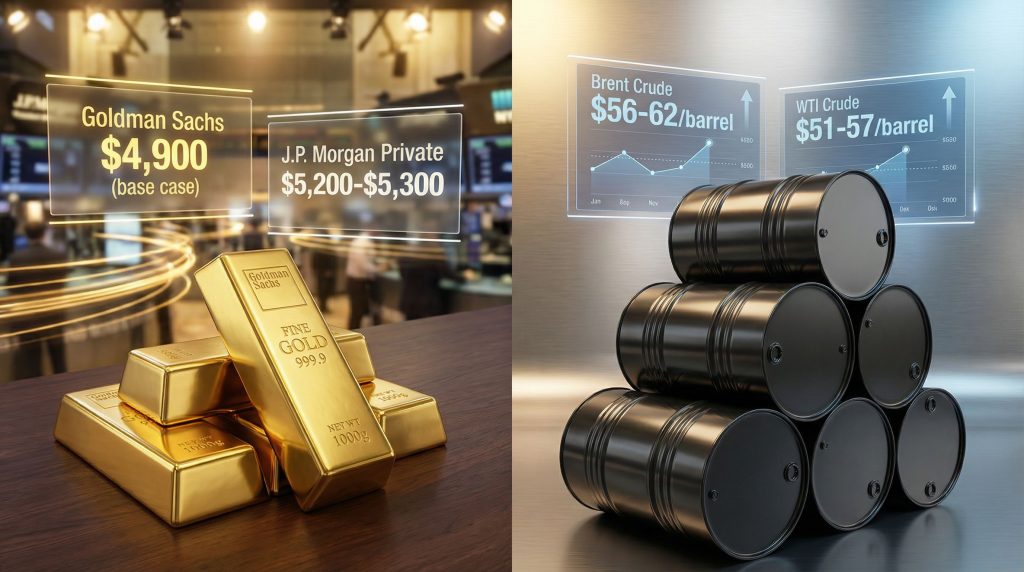
Goldman Sachs analysts project gold reaching $4,900 per ounce by December 2026, representing approximately 12% upside from current levels near $4,323. This bullish outlook contrasts sharply with their oil forecasts, where Brent crude averages $56-62 per barrel and WTI trades between $51-57, reflecting persistent oversupply conditions.
When big ASX news breaks, our subscribers know first
Central Bank Accumulation Strategies Reshaping Global Gold Demand
Central bank purchasing patterns have fundamentally altered gold market dynamics since 2022. The World Gold Council documented 1,037 tonnes of official sector purchases in 2024, marking the highest annual accumulation since systematic record-keeping began in 1950. This structural shift reflects deliberate reserve diversification away from traditional currency holdings.
Emerging market central banks drive this unprecedented demand surge through strategic de-dollarization initiatives. Countries including India, Turkey, and several BRICS nations expanded gold reserves substantially throughout 2024-2025, viewing precious metals as the ultimate outside money requiring no counterparty credit risk.
The Reserve Bank of India exemplifies this trend, adding significant tonnage during 2024 as part of a multi-year accumulation program. Similarly, central Asian economies increased allocations following geopolitical tensions that highlighted sanctions exposure risks in traditional reserve assets.
Federal Reserve Rate Policy Impact on Precious Metals Investment Flows
Interest rate dynamics create the cyclical foundation supporting Goldman's $4,900 gold target. The Federal Reserve reduced rates by 100 basis points across 2024, moving the federal funds rate from 5.25-5.50% to 4.25-4.50% by year-end. Additional easing expected in 2026 would compress real yields further.
Real yield calculations reveal gold's attractiveness mechanism. When nominal Treasury yields minus expected inflation approach zero or turn negative, the opportunity cost of holding non-yielding bullion diminishes significantly. This dynamic directly links to the broader historic gold surge explained by similar monetary policy shifts.
The transmission mechanism operates through portfolio rebalancing. As fixed-income assets offer lower inflation-adjusted returns, institutional investors reallocate toward commodities and alternative stores of value. This dynamic explains why Goldman analysts note ETF investors beginning to compete for limited bullion with central banks.
Exchange-Traded Fund Positioning and Institutional Portfolio Shifts
U.S. gold ETFs experienced record inflows exceeding $15 billion during 2024, with SPDR Gold Shares and other major funds adding substantial new holdings. This institutional adoption reflects evolving asset allocation strategies incorporating precious metals as portfolio stabilizers rather than speculative positions.
BlackRock and other index providers expanded gold offerings for institutional access, recognizing demand for non-correlated diversification tools. ESG-compliant investment mandates increasingly view gold as acceptable alternative to traditional haven assets, supporting sustained inflow potential throughout 2026.
The institutional investor base differs qualitatively from retail gold buyers. Professional portfolio managers allocate based on volatility reduction and tail-risk hedging rather than inflation expectations alone. This sophisticated demand provides price support even during periods of moderate economic stability.
How Will Oil Market Fundamentals Create Sustained Price Pressure Through 2026?
Oil market rebalancing requires significant price compression to clear anticipated supply surpluses throughout 2026. Goldman Sachs identifies 4.2 million barrels per day of excess production that must either reduce output or accumulate in commercial storage facilities.
Global Supply-Demand Imbalance Analysis and OECD Inventory Builds
The fundamental driver behind weak oil forecasts stems from non-OPEC production growth exceeding demand expansion. U.S. shale output reached record levels during 2024, with Permian Basin producers achieving breakeven economics below $40 per barrel. Brazilian offshore projects and Guyanese developments add further structural supply.
OECD commercial stockpiles currently hold approximately 1.7-1.9 billion barrels of crude and refined products. When oil prices average $55-62 per barrel, storage becomes financially attractive for investors and traders willing to hold physical inventory. The carry cost structure incentivizes inventory builds that absorb surplus production.
Historical precedent from 2015-2016 demonstrates how inventory accumulation dynamics affect price discovery. During that period, commercial stocks built aggressively while prices fell from $105 to $28 per barrel despite production cuts. The market required extreme price levels to balance underlying supply surplus against storage capacity.
Furthermore, this oil price stagnation analysis reveals similar patterns emerging in current market conditions, where fundamental oversupply creates persistent downward pressure.
OPEC Production Strategy Limitations in Current Market Environment
OPEC+ coordination faces internal fractures that limit production discipline effectiveness. Saudi Arabia and United Arab Emirates signaled disagreements over cut extension beyond 2025, with market share concerns outweighing price support objectives among several members.
Russia's position adds complexity to OPEC+ dynamics. Western sanctions constrain export capability but Moscow remains a significant non-OPEC producer with economic incentives to maintain output levels. This creates asymmetric pressures within the production management framework.
The cartel's previous success relied on swing producer capacity during periods of supply shortage. Current market conditions feature abundant spare capacity across multiple regions, reducing OPEC's ability to single-handedly rebalance global supply-demand fundamentals.
US Shale Output Sustainability and Geopolitical Supply Risk Assessment
American shale producers demonstrated remarkable cost reduction achievements since the previous downturn. Efficient operators in core Permian acreage achieve full-cycle returns at sub-$40 Brent prices, creating a structural floor that prevents bankruptcy-driven supply destruction.
Technology improvements in hydraulic fracturing and horizontal drilling reduced breakeven costs by 30-40% compared to 2015 levels. This operational efficiency eliminates traditional price-driven supply adjustment mechanisms that previously supported oil during downturns.
Geopolitical risk premiums have eroded as markets recognise ample global spare capacity. Venezuela's political tensions and Middle Eastern conflicts generate headlines but fail to sustain price increases when fundamental supply availability exceeds demand requirements.
Which Commodity Sectors Present the Strongest Investment Opportunities in 2026?
Base metals reveal performance divergence patterns that create targeted investment opportunities across industrial commodity sectors. Copper leads outperformance expectations while aluminium faces headwinds from energy costs and demand weakness.
Current market pricing as of December 19, 2025 shows copper trading at $5.5267 per pound, up 1.83% on the day, while aluminium futures reached $2,959.50 per ton with 1.34% gains. These price levels provide context for Goldman's relative performance forecasts.
Copper vs Aluminium Performance Divergence in Industrial Metals
Copper demand benefits from structural electrification trends across multiple sectors. Electric vehicle production requires 3-4 kilograms of copper per vehicle compared to traditional internal combustion engines, while renewable energy infrastructure demands 4-8 tonnes per megawatt of installed capacity.
Global copper consumption growth of 2-3% annually through 2026-2030 reflects grid modernisation requirements and expanding renewable deployment. The International Copper Study Group estimates total demand reaching 28-30 million tonnes by 2026, supported by energy transition infrastructure buildout.
The interplay between gold and copper dynamics demonstrates how both metals benefit from different structural trends, though copper faces additional industrial demand drivers.
Aluminium faces contrasting dynamics despite similar end-use exposure to electrification themes. European and Australian smelters operate under elevated power costs that reduce competitiveness, while Chinese overcapacity approximates 40 million tonnes annual capacity against 35-37 million tonnes domestic demand.
Aluminium production requires 13-15 kilowatt-hours of electricity per kilogram, making energy costs the primary variable expense. Coal-based power provides Chinese producers cost advantages, but environmental regulations and carbon pricing threaten this competitive position over medium-term horizons.
Natural Gas Market Transformation Under Record Supply Expansion
Natural gas trading near $3.942 per MMBtu reflects Goldman's forecast for continued weakness throughout 2026. Analysts project $4.00 average pricing with a $3.50-4.50 range, representing the largest ever wave of supply expansion hitting global markets.
Global LNG export capacity increases by 25-30 million tonnes per annum through 2026-2027. Mozambique LNG Phase 1 commenced production at 15.3 million tonnes annually during 2024, while Papua New Guinea expansions and other mega-projects add further supply.
U.S. Appalachian shale production continues expanding despite current price levels. The Marcellus and Utica formations demonstrate resilient economics that support output growth even under $4.00 pricing scenarios. This domestic supply complements international LNG capacity additions.
Demand destruction occurs at lower price thresholds as industrial users optimise fuel switching capabilities. Power generation facilities can substitute between natural gas and alternative fuels when pricing differentials justify operational changes, creating demand elasticity that supports Goldman's price forecasts.
Iron Ore Production Surge Impact on Steel Industry Pricing
Iron ore faces weakness from burgeoning mine production across major producing regions. Australian output from Vale, BHP, and Rio Tinto combined approaches 750-800 million tonnes annually, while Brazilian expansion accelerates as Vale rebuilds following dam safety incidents.
Chinese domestic iron ore production remains elevated despite steel demand softness. Local mines maintain output to capture current pricing levels, adding supply pressure to imported ore pricing dynamics.
Steel industry consolidation in China creates oligopolistic purchasing power that pressures iron ore pricing. Major steel producers negotiate volume-based pricing agreements that reduce spot market premium capture for mining companies.
What Economic Scenarios Support $4,900 Gold Targets?
Multiple financial institutions project gold reaching record gold weak oil 2026 levels throughout the year, with consensus targets ranging from $4,500 to $5,300 per ounce. These forecasts reflect convergent analysis of monetary policy, currency dynamics, and institutional demand patterns.
According to Goldman Sachs' latest commodity outlook, the investment bank maintains its bullish stance on gold while remaining cautious on oil prospects.
| Institution | Target Price (USD/oz) | Key Drivers | Timeline |
|---|---|---|---|
| Goldman Sachs | $4,900 (base case) | Central bank demand, Fed cuts | December 2026 |
| J.P. Morgan Private | $5,200-$5,300 | Sustained institutional demand | Q4 2026 |
| Deutsche Bank | $4,950 (high scenario) | Geopolitical uncertainty | Mid-2026 |
| Morgan Stanley | $4,500 | Portfolio diversification | Mid-2026 |
Interest Rate Environment and Real Yield Calculations
Real yield compression represents the primary cyclical driver supporting higher gold prices. When 10-year Treasury yields minus expected inflation approach zero, gold's opportunity cost diminishes substantially compared to fixed-income alternatives.
Historical analysis reveals gold demonstrates approximately -0.8 correlation to real yields over rolling 12-month periods. Each 100 basis point decline in real rates corresponds to roughly $250-300 per ounce appreciation in gold prices, based on data spanning 2008-2024.
Federal Reserve policy expectations incorporate additional 75-100 basis points of cuts through 2026, assuming economic growth moderates without recession conditions. This monetary easing would compress real yields from current levels near 1.5-2.0% toward zero or negative territory.
The transmission mechanism operates through portfolio substitution effects. Insurance companies, pension funds, and sovereign wealth funds reallocate from low-yielding bonds toward alternative stores of value when real returns disappear.
Currency Debasement Concerns and Safe-Haven Asset Allocation
U.S. fiscal dynamics support currency debasement narratives that favour hard asset allocation. Federal debt-to-GDP ratios exceeding 100% create structural pressures for monetary accommodation that reduces dollar purchasing power over time.
International investors increasingly question long-term dollar hegemony as China, Russia, and other nations develop alternative payment systems. While these initiatives remain nascent, they signal potential erosion of traditional reserve currency advantages.
Gold functions as the ultimate outside money requiring no counterparty credit risk. Unlike bonds, equities, or bank deposits, physical gold carries no default probability or institutional performance dependency. This characteristic becomes increasingly valuable during periods of financial system stress.
Additionally, the broader economic context of US economic inflation dynamics creates additional pressure on currency stability, supporting gold's appeal as a hedge.
Inflation Hedge Positioning in Institutional Portfolios
Modern institutional portfolio theory incorporates gold as an inflation hedge distinct from traditional Treasury Inflation-Protected Securities. Unlike TIPS, gold provides protection against currency debasement and financial system risks beyond measured consumer price inflation.
Endowments and family offices allocate 5-10% portfolio weights to gold as permanent holdings rather than tactical positions. This strategic approach reflects recognition that gold serves insurance functions that outweigh short-term performance considerations.
The inflation hedge argument extends beyond headline CPI measures to encompass asset price inflation in real estate, equities, and other financial assets. Gold provides partial protection against broad monetary debasement effects that may not appear in traditional inflation statistics.
How Do Oil Market Fundamentals Signal Extended Weakness?
Oil price forecasts for 2026 reflect structural oversupply conditions that require significant demand stimulation or production cuts to achieve market balance. Current pricing near $60 per barrel for Brent crude already approaches Goldman's annual average targets.
| Benchmark | Average Price Target | Range | Supply/Demand Balance |
|---|---|---|---|
| Brent Crude | $56-62/barrel | $55-65 | 4.2M b/d oversupply |
| WTI Crude | $51-57/barrel | $49-58 | Inventory builds expected |
| Natural Gas | $4.00/MMBtu | $3.50-4.50 | Record supply wave |
OECD Commercial Stock Accumulation Patterns
Commercial inventory dynamics reveal the mechanism through which oil markets clear supply surpluses. OECD stocks typically fluctuate between 1.7-1.9 billion barrels, with builds occurring during oversupply periods and draws during shortage conditions.
Storage economics become favourable when forward price curves demonstrate sufficient contango to cover carrying costs. At $55-60 oil prices, financing, insurance, and physical storage expenses allow profitable inventory accumulation for sophisticated trading operations.
The International Energy Agency tracks commercial stock levels as a leading indicator of market balance. Sustained builds throughout 2026 would confirm Goldman's surplus projections and support lower price forecasts across benchmark crude oils.
Non-OPEC Production Growth and Market Share Dynamics
U.S. shale production drives non-OPEC supply growth that constrains OPEC pricing power. Permian Basin output reached record levels exceeding 5.5 million barrels per day during 2024, with further expansion planned across core acreage positions.
Brazilian pre-salt developments add approximately 200,000-300,000 barrels per day annually through 2026-2027. These deepwater projects feature low operating costs once initial capital investments achieve production, creating resilient supply additions.
Guyana emerged as a significant non-OPEC producer following ExxonMobil's offshore discoveries. Production ramp-up continues throughout 2025-2026, contributing additional supply pressure to Atlantic Basin crude oil markets.
Technology improvements across unconventional production reduce breakeven costs that previously provided price support during downturns. Efficient operators achieve full-cycle returns below $40 per barrel, eliminating traditional supply destruction mechanisms.
Demand Destruction Thresholds in Key Consuming Regions
Oil demand demonstrates price elasticity that supports lower pricing scenarios when consumption growth moderates. Developed economies exhibit mature demand patterns with limited growth potential regardless of pricing levels.
Transportation fuel consumption peaked in several OECD countries as vehicle efficiency improvements and electric vehicle adoption reduce per-capita oil requirements. This structural demand decline offsets economic growth effects in developed regions.
Emerging market demand growth remains positive but sensitive to pricing levels. When crude exceeds $70-80 per barrel, industrial users and transportation sectors reduce consumption through efficiency measures and fuel switching where technically feasible.
Price thresholds for demand destruction vary by region and sector. Petrochemical industries demonstrate relatively inelastic demand compared to power generation, where natural gas substitution becomes economic above certain price differentials.
The next major ASX story will hit our subscribers first
What Base Metal Trends Will Define 2026 Market Performance?
Industrial metals face divergent performance patterns based on supply-demand fundamentals specific to each commodity. Copper leads expected outperformance while aluminium confronts headwinds from energy costs and oversupply conditions.
Copper Supply Constraints vs Industrial Demand Growth
Copper mine development faces extended lead times that limit near-term supply response to current price levels. Major deposit discoveries require 10-15 years from exploration to production, creating structural supply constraints that support higher pricing.
Chilean production, representing approximately 25% of global output, encounters declining ore grades that increase mining costs and reduce output per facility. The average copper grade in Chilean mines decreased from 1.0% to 0.7% over the past decade.
Labour disputes and permitting challenges affect major producing regions including Chile, Peru, and the Democratic Republic of Congo. These operational risks create supply uncertainty that supports price premiums for reliable copper supply sources.
Demand growth accelerates through renewable energy deployment and electric vehicle adoption. Grid modernisation requires substantial copper investment as utilities upgrade transmission infrastructure to accommodate distributed generation sources.
Aluminium Production Capacity and Energy Cost Pressures
Aluminium smelting requires massive electricity consumption that makes energy costs the determining factor in production economics. European smelters face power prices 2-3 times higher than Chinese competitors using coal-based electricity generation.
Chinese overcapacity approximates 5 million tonnes annually based on current demand patterns. This excess production capability pressures global aluminium pricing and reduces profitability for higher-cost producers in developed economies.
Environmental regulations increasingly restrict coal-fired power generation that provides Chinese aluminium producers cost advantages. Carbon pricing mechanisms and renewable energy mandates will gradually erode these competitive positions.
Recycling rates for aluminium exceed 90% in developed economies, reducing primary metal demand growth compared to other industrial commodities. This circular economy dynamic limits long-term demand expansion potential.
Critical Minerals Supply Chain Reshoring Impact
Western governments prioritise domestic critical mineral production to reduce dependence on Chinese processing capacity. Lithium, rare earth elements, and other strategic materials receive policy support through subsidies and regulatory streamlining.
The U.S. Inflation Reduction Act and European Critical Raw Materials Act provide financial incentives for domestic mineral processing development. These initiatives support higher-cost Western production against lower-cost Chinese competitors.
Supply chain reshoring creates investment opportunities in processing facilities and mining projects located in allied countries. Australia, Canada, and African nations benefit from Western strategic sourcing preferences.
How Should Investors Position for Divergent Commodity Performance?
Commodity market divergence creates specific positioning opportunities that require sophisticated understanding of correlation patterns and risk management techniques. Successful strategies exploit structural trends rather than short-term price movements.
Portfolio Allocation Strategies for Gold-Oil Spread Trading
Long gold, short oil positioning captures the fundamental divergence between precious metals strength and energy weakness. This trade benefits from both absolute and relative performance differences projected throughout 2026.
Risk management requires careful position sizing due to potential volatility in both commodities. Gold demonstrates lower volatility than oil historically, but concentration risk exists when both positions move adversely simultaneously.
Implementing effective gold market strategies becomes crucial for capitalising on the projected price appreciation while managing downside exposure.
Options strategies provide asymmetric exposure to extreme scenarios while limiting downside risk. Long gold calls combined with short oil calls create leveraged exposure to the fundamental divergence theme with defined maximum loss.
Currency hedging considerations affect international investors implementing USD-denominated commodity strategies. Gold performs differently in various base currencies, requiring careful analysis of exchange rate impacts.
Sector Rotation Opportunities in Mining Equity Markets
Mining company valuations reflect underlying commodity price expectations with leverage effects that amplify returns. Gold miners benefit from expanding margins when bullion prices reach new records while maintaining operational cost structures.
Copper producers demonstrate strong free cash flow generation at current price levels exceeding $5.50 per pound. Major operators including Freeport-McMoRan and Southern Copper achieve attractive returns on invested capital.
Energy sector weakness creates relative performance opportunities in commodity-producing equities. Mining stocks historically outperform energy stocks during periods of oil weakness and metals strength.
Dividend yields among established mining companies become attractive as commodity prices support cash generation. Companies with strong balance sheets can maintain or increase distributions throughout the cycle.
Risk Management Through Commodity Correlation Analysis
Historical correlation patterns provide insufficient guidance during structural market transitions. Traditional relationships between commodities may break down when fundamental drivers diverge significantly.
Diversification benefits exist within commodity sectors rather than across all raw materials. Industrial metals, precious metals, and energy exhibit different correlation patterns with macroeconomic variables.
"The 2026 commodity landscape presents unprecedented divergence between precious metals strength and energy sector weakness. Successful positioning requires understanding structural demand shifts, monetary policy transmission, and supply-side disruption risks across different commodity classes."
Volatility forecasting becomes critical for position sizing and risk budgeting. Monte Carlo simulations incorporating various scenarios help determine appropriate exposure levels for different commodity strategies.
What Are the Downside Risks to Bullish Gold Scenarios?
Despite consensus bullish forecasts, several risk factors could undermine gold's advance toward $4,900 per ounce. Interest rate policy, central bank behaviour, and ETF flows represent the primary vulnerability sources.
Federal Reserve Policy Pivot Probability Assessment
Unexpectedly strong economic growth could force the Federal Reserve to reverse course on rate cuts planned for 2026. Persistent inflation above target levels would require continued monetary tightening that increases gold's opportunity cost.
Real yield expansion represents gold's primary cyclical headwind. If 10-year Treasury yields rise faster than inflation expectations, real yields could reach 3-4% levels that historically suppress precious metals performance.
Labour market resilience and productivity growth might sustain economic expansion without requiring aggressive monetary easing. This scenario would maintain higher interest rates that benefit competing fixed-income investments.
Central Bank Gold Purchase Sustainability Analysis
Central bank accumulation patterns may moderate if geopolitical tensions subside or alternative reserve assets become more attractive. The unprecedented pace of official sector purchases during 2024-2025 might not continue indefinitely.
Currency diversification objectives could shift toward other non-dollar assets including the euro, yen, or potential central bank digital currencies. While these alternatives remain limited, technological developments might provide future competition.
Fiscal constraints in emerging market economies could reduce gold purchasing capacity. Countries facing balance of payments pressures might need to maintain liquid reserves rather than accumulate non-yielding assets.
ETF Outflow Risk Under Rising Real Yields
Institutional ETF investors demonstrate sensitivity to relative performance compared to traditional asset classes. If real yields rise significantly, portfolio managers might reduce gold allocations in favour of fixed-income securities.
Performance chasing behaviour affects ETF flows during extended trends. Gold's recent strength attracted momentum investors who might exit positions if price appreciation stalls or reverses.
Regulatory changes affecting commodity investment could impact ETF demand. Pension fund restrictions or fiduciary regulations might limit institutional gold exposure in certain jurisdictions.
Can Oil Markets Recover Without Major Supply Disruptions?
Oil price recovery scenarios require either significant supply disruptions or coordinated production cuts to overcome the 4.2 million barrel per day surplus projected for 2026. Market rebalancing appears unlikely without external intervention.
OPEC+ Coordination Challenges and Market Share Competition
OPEC+ unity faces increasing strain as members prioritise revenue generation over price support. Countries requiring higher oil revenues to balance fiscal budgets demonstrate reluctance to maintain production discipline.
Market share erosion to non-OPEC producers creates incentives for cartel members to increase output. U.S. shale growth particularly threatens traditional OPEC market dominance in key consuming regions.
Internal disputes over production quotas and compliance monitoring undermine collective action effectiveness. Previous successful cooperation relied on clear external threats that currently appear absent.
Geopolitical Risk Premium Erosion in Current Environment
Oil markets historically incorporated risk premiums for potential supply disruptions in key producing regions. Current ample spare capacity reduces these premiums as alternative supplies can replace any reasonable disruption scenario.
Middle Eastern tensions generate headline attention but fail to sustain price increases when fundamental availability exceeds demand. Venezuelan political instability similarly produces limited price impact.
Strategic petroleum reserve releases from major consuming countries provide additional supply cushion during temporary disruptions. Coordinated IEA member responses limit spike potential during geopolitical events.
Demand Recovery Timeline in Post-Pandemic Economic Cycle
Global oil demand growth remains below historical averages as efficiency improvements and alternative energy adoption reduce consumption intensity. Developed economy demand appears to have peaked permanently.
Transportation sector transformation through electric vehicle adoption creates structural demand headwinds over medium-term horizons. While current EV penetration remains limited, growth trajectories indicate accelerating adoption.
Industrial demand demonstrates sensitivity to global manufacturing cycles and economic growth patterns. Slower GDP expansion in major economies reduces derived demand for petroleum-based inputs.
Frequently Asked Questions About 2026 Commodity Outlook
Why are analysts so confident about gold reaching new records?
Analyst confidence in record gold weak oil 2026 scenarios stems from convergent structural and cyclical factors rarely aligned simultaneously. Central bank purchasing reached historic levels during 2024 with continued accumulation expected throughout 2026. Federal Reserve rate cuts compress real yields that reduce gold's opportunity cost compared to bonds.
Yahoo Finance's analysis of Goldman's commodity outlook highlights the firm conviction behind these precious metals projections.
Institutional adoption through ETF vehicles provides sustained demand beyond traditional retail and central bank buyers. Portfolio diversification strategies increasingly incorporate gold as permanent allocation rather than tactical positioning, supporting price stability during volatile periods.
Currency debasement concerns reflect fiscal dynamics in major economies where debt-to-GDP ratios exceed sustainable levels. Gold provides insurance against monetary accommodation effects that may not appear in traditional inflation measures.
What would cause oil prices to recover faster than expected?
Oil price recovery requires eliminating the projected 4.2 million barrel per day surplus through supply disruptions or coordinated production cuts. Major geopolitical events affecting Saudi Arabia, Iran, or other significant producers could temporarily rebalance markets.
OPEC+ deeper production cuts beyond current levels might support higher prices if cartel discipline improves. However, member incentives favour revenue maximisation over price support given fiscal requirements across producing nations.
Demand acceleration from unexpected economic growth or delayed energy transition could absorb excess supply. This scenario appears unlikely given mature consumption patterns in developed economies and structural efficiency improvements.
How do these forecasts compare to historical commodity cycles?
Current commodity divergence patterns lack clear historical precedent given the unique combination of monetary policy, geopolitical tensions, and energy transition dynamics. Previous cycles typically demonstrated synchronised movement across raw materials sectors.
Gold's projected performance exceeds most historical bull markets when adjusted for inflation. The 1970s precious metals rally reflected different fundamental drivers including currency system breakdown and supply shortages that differ from current conditions.
Oil weakness during periods of gold strength occurred during specific recessionary environments that do not match current economic conditions. The projected divergence reflects structural rather than cyclical factors distinguishing 2026 from historical patterns.
Which mining companies benefit most from these price projections?
Gold miners with low-cost operations and expansion capacity benefit most from $4,900 price targets. Companies including Newmont, Barrick Gold, and other established producers demonstrate operational leverage to higher bullion prices while maintaining dividend sustainability.
Copper producers achieve attractive free cash flow generation at current price levels exceeding $5.50 per pound. Freeport-McMoRan, Southern Copper, and other major operators benefit from both copper strength and operational efficiency improvements.
Geographic diversification provides additional value during geopolitical uncertainty periods. Companies with operations across multiple stable jurisdictions reduce regulatory and political risks compared to single-country exposure.
Quality management teams with proven capital allocation discipline create shareholder value during commodity upturns. Historical performance during previous cycles provides insight into likely outperformers during 2026 price appreciation.
Disclaimer: Commodity price forecasts involve substantial uncertainty and risk. Past performance does not guarantee future results. Investors should conduct thorough due diligence and consider their risk tolerance before making investment decisions. Market conditions can change rapidly, and actual outcomes may differ significantly from projections.
Looking to Capitalise on the Next Major Commodity Discovery?
Discovery Alert's proprietary Discovery IQ model delivers real-time notifications on significant ASX mineral discoveries, instantly empowering subscribers to identify actionable opportunities ahead of the broader market. Understand why historic discoveries can generate substantial returns by visiting Discovery Alert's dedicated discoveries page, showcasing exceptional outcomes from major mineral finds, and begin your 30-day free trial today to position yourself ahead of the market.