July 23, 2026
The Anatomy of a Chokepoint Crisis: Why Two Tankers in the Red Sea Signal Something Far Larger
Historically, maritime chokepoints have served as silent multipliers of geopolitical leverage. From the British blockades of the Napoleonic era to Cold War submarine campaigns in the North Atlantic, whoever controls narrow sea passages holds disproportionate influence over global commerce. Today, that dynamic is playing out in real time across two of the world's most critical waterways simultaneously, and the consequences for energy markets, commodity supply chains, and shipping insurance are accelerating faster than most market participants had priced in.
The Houthi strikes on two vessels in the Red Sea on 22 July 2026 are not isolated acts of maritime aggression. They represent the enforcement mechanism of a deliberate strategic doctrine, one that has been expanding its targeting logic with each new escalation cycle since late 2023.
When big ASX news breaks, our subscribers know first
The Red Sea as a Structural Vulnerability in Global Trade
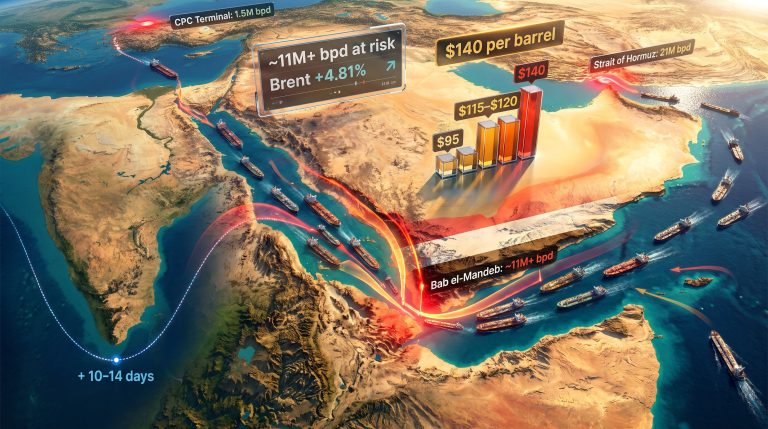
The Red Sea is not merely a body of water. It is the connective tissue between the Suez Canal and the Gulf of Aden, carrying an estimated 10 to 15 percent of global seaborne trade through the narrow chokepoint at Bab el-Mandeb. Energy shipments, steel cargoes, agricultural commodities, and consumer goods all funnel through this corridor, making any sustained disruption disproportionately damaging relative to the geographic scale of the conflict producing it.
What makes the current situation categorically different from previous oil market disruption events is the simultaneous pressure at Hormuz. These two chokepoints effectively bracket Saudi Arabia's primary crude export infrastructure, and the overlap is not coincidental.
Key geographic facts worth understanding:
- Bab el-Mandeb, the strait at the southern entrance to the Red Sea, is approximately 18 miles wide at its narrowest point
- The Strait of Hormuz, at its narrowest navigable channel, is roughly 21 miles wide
- Together, they handle a combined share of global oil trade that analysts estimate at roughly 30 percent
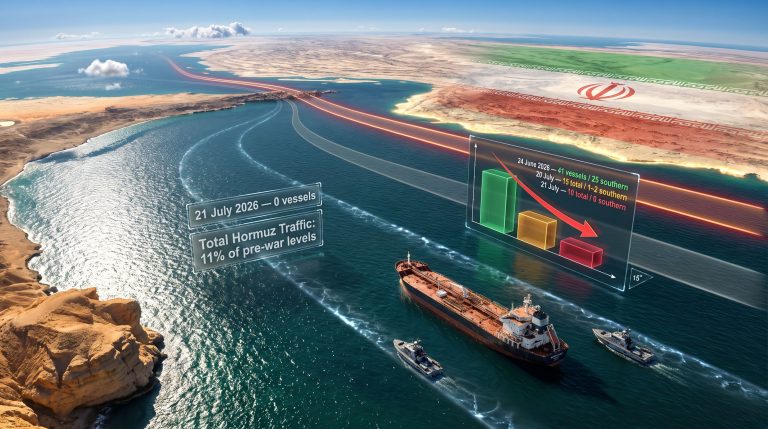
- Vessel traffic through Hormuz has fallen to approximately 11 percent of pre-war levels, according to vessel tracking data from Windward
From Opportunistic Attacks to Declared Navigation Bans: The Escalation Arc
Understanding the Houthi campaign requires tracing its evolution rather than treating each incident as a standalone event. According to a detailed timeline of Houthi attacks compiled by the Wilson Center, the targeting logic has widened in clearly defined stages.
The targeting logic has widened in stages:
- Late 2023: The campaign begins, framed primarily around Israeli-linked vessel targeting in solidarity with Gaza
- 2024: Criteria expand to include US-affiliated shipping and vessels with indirect commercial ties to allied interests
- July 2025: The tankers Magic Seas and Eternity C are reported sunk, representing a significant kinetic escalation
- 29 September 2025: The Dutch-flagged cargo vessel Minervagracht is struck in the Red Sea, the most recent confirmed attack before the July 2026 incidents
- 20 July 2026: The Houthi movement formally declares a total ban on Saudi Arabian maritime navigation, effective immediately, under a self-described "siege for siege" formula
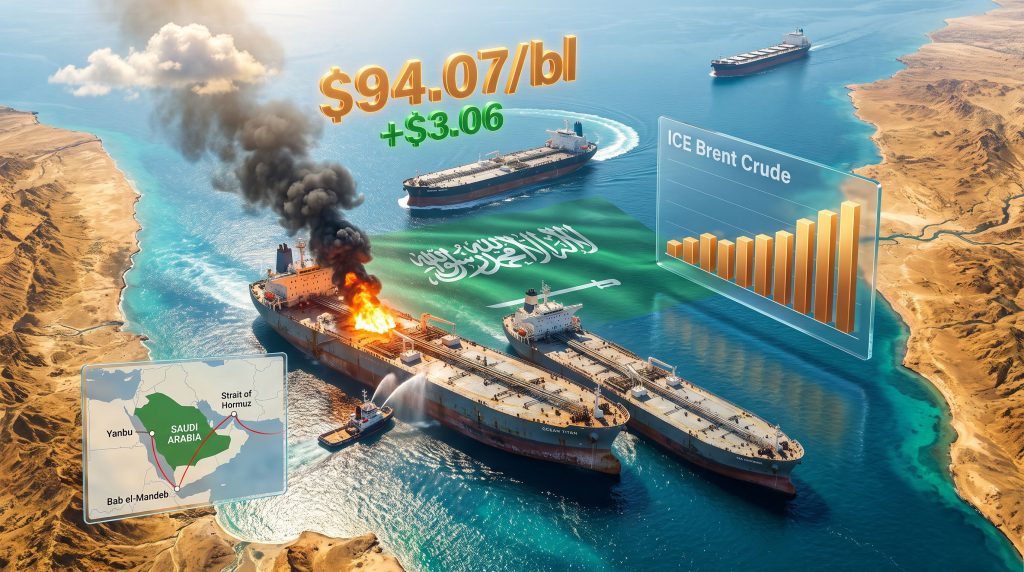
- 22 July 2026: Houthi forces claim strikes on Saudi crude tankers Encelia and Layla, with the UKTMO confirming at 21:00 GMT that one tanker had been struck by an unknown projectile causing a fire onboard
Pattern Recognition: Each phase of the Houthi campaign has introduced a broader and more commercially disruptive targeting classification. The progression from Israeli-linked vessels to US-affiliated shipping and now to all Saudi maritime navigation represents a systematic widening of the threat envelope that affects an ever-larger segment of global carriers.
Yanbu Port: The Epicentre of Saudi Export Vulnerability
A critical piece of context that is underappreciated in mainstream coverage is why Saudi crude is now flowing through Yanbu in the first place. Since late March 2026, Saudi Arabia has been redirecting a significant portion of its energy exports away from Ras Tanura, its primary terminal in the Mideast Gulf, toward the Red Sea port of Yanbu. The driving factor is Iran's intermittent effective closure of the Strait of Hormuz, which has made Ras Tanura-based exports operationally unreliable.
The strategic irony is stark. Iran's pressure at Hormuz forced Saudi crude onto Red Sea routes, and those Red Sea routes are now directly exposed to Houthi interdiction. The VL Pioneer, a very large crude carrier, reversed course in the Red Sea on 17 July rather than proceed to Yanbu.
The Farhah, another VLCC that had loaded at Yanbu on 10 July, made a U-turn at Bab el-Mandeb on the same date and returned to port, according to vessel tracking data from Kpler. These behavioural responses from operators signal that the market is already pricing in substantially elevated risk ahead of any formal escalation.
The Encelia and Layla Incident: Verified Data Points
| Metric | Detail |
|---|---|
| Vessels claimed struck | Encelia and Layla (Saudi crude tankers) |
| Houthi claim timestamp | 21:32 GMT, Wednesday 22 July 2026 |
| UKTMO confirmed report | 21:00 GMT, one tanker struck, fire onboard |
| Casualties confirmed | None at time of reporting |
| Environmental impact | None reported at time of reporting |
| Previous Red Sea attack | 29 September 2025, Dutch-flagged Minervagracht |
The gap between what the Houthis claimed (two vessels struck) and what UKTMO independently confirmed (one vessel, one fire) is itself analytically significant. It reflects a pattern of Houthi overclaiming that intelligence analysts track carefully, but it does not diminish the strategic signal being sent.
Oil Price Response and Energy Market Scenarios
September ICE Brent crude futures closed $3.06 per barrel higher on 22 July 2026, settling at $94.07/bl, with after-hours trading pushing prices further following confirmation of the strikes. The oil price shock this represents is significant. For context, prior Red Sea incidents in early 2024 produced short-term crude price spikes of approximately 2 to 5 percent, and the market is now operating under a structurally tighter supply backdrop.
Three forward-looking scenarios help frame the range of energy market outcomes:
Scenario A: Contained Escalation
- Houthi strikes remain selective and Saudi Arabia reroutes exports via the Cape of Good Hope
- Freight costs rise 15 to 25 percent; Brent sustains a $5 to $8/bl premium
- A diplomatic off-ramp emerges within 4 to 8 weeks
Scenario B: Sustained Blockade Enforcement
- Houthis actively enforce the navigation ban; Yanbu becomes effectively isolated
- Saudi export volumes decline materially; Brent crude tests the $100 to $105/bl range
- Secondary disruption spreads to LNG and refined product markets
Scenario C: Broader Regional Contagion
- Coordinated escalation across Yemen, Iraq, and the broader Gulf intensifies
- Gulf Keystone's Shaikan field in the Kurdistan region of Iraq, which had been producing 45,000 barrels per day before a precautionary shutdown on 20 July 2026, becomes a template for wider production curtailments across Kurdish and Iraqi fields
- Kuwait and Bahrain infrastructure strikes, already reported in late July 2026, intensify further
- Brent crude trajectory moves toward $110/bl or above; war risk insurance premiums surge beyond 1.5 percent of hull and machinery value
Disclaimer: The scenario projections above are analytical frameworks based on historical precedent and current market conditions. They are not price forecasts and should not be relied upon as investment advice. Commodity markets are subject to rapid and unpredictable change.
The next major ASX story will hit our subscribers first
The Dual Chokepoint Trap: Iran and the Houthis Working in Parallel
The Hormuz dimension of this crisis is receiving insufficient attention relative to its market significance. Vessel traffic through the strait has collapsed to approximately 11 percent of pre-war levels, according to Windward tracking data. On 21 July 2026, out of 10 vessels transiting Hormuz, eight used the Iranian-favoured northern route and only two used the centre lane.
The US-assisted southern transit lane, which had recorded 25 of 41 outbound transits on its peak day of 24 June 2026, has effectively dropped to zero following intensified Iranian attacks on vessels in Omani waters.
Iranian institutional posture has also hardened considerably. The IRGC-N publicly restated that it holds definitive control over the entry and exit points of the Strait of Hormuz. Iranian parliamentary speaker Mohammad Bagher Ghalibaf stated that the strait would not return to pre-conflict operating conditions, signalling that Iranian leverage over the chokepoint is now being treated as a permanent strategic asset rather than a temporary pressure instrument.
In a development that has no clear historical precedent, the Greek-owned tanker Kavomaleas, part of the Dynacom fleet, was seized after being attacked by Iranian forces on 20 July and escorted into Iranian territorial waters near Larak Island. Vessel tracking analysis assessed the presence of IRGC fast inshore attack craft alongside the tanker as consistent with a deliberate escorted movement rather than uncontrolled drift. This marks the first confirmed instance of an attacked vessel being brought into Iranian waters, representing a meaningful escalation in Iran's operational playbook.
Nine vessels have transited the Hormuz blockade zone since the US reimposed restrictions on 14 July, including six empty inbound tankers with a combined carrying capacity of approximately 2.35 million barrels.
Operation Aspides: The Limits of Defensive Naval Deterrence
The EU Naval Force's Operation Aspides was established as a defensive response to Houthi threats against Red Sea commercial shipping. On 22 July 2026, Aspides issued a formal advisory recommending that all merchant vessels with connections to Israeli, US, or Saudi Arabian interests avoid the Red Sea and Gulf of Aden entirely until the threat environment materially improves.
This advisory is significant not just for its content but for what it acknowledges operationally. A defensive maritime force conceding that merchant vessels should avoid the waters it was deployed to protect signals that the mission's threat threshold has been exceeded. Aspides can intercept incoming projectiles in some circumstances, but it cannot neutralise Houthi launch infrastructure or provide comprehensive escort coverage for the volume of commercial traffic that historically used this corridor.
Furthermore, according to reporting from the BBC on Houthi Red Sea attacks, the practical alternative for operators is the Cape of Good Hope rerouting, which introduces:
- Approximately 10 to 14 additional transit days per voyage
- Roughly 3,500 to 4,000 additional nautical miles of distance
- Materially higher fuel consumption, crew costs, and vessel utilisation inefficiency
- A compounding effect on fleet availability that tightens global shipping capacity over time
Hidden Supply Chain Exposure: Steel, Freight, and the Commodity Matrix
Energy markets dominate the headline coverage, but the steel trade implications deserve independent analysis. The broader commodity market volatility stemming from this crisis extends well beyond crude oil. Saudi Arabia imported approximately 3.1 million tonnes of steel products in Q1 2026, down from 3.8 million tonnes in Q1 2025, according to Global Trade Tracker data. China supplied the largest share at roughly 1.2 million tonnes in Q1 2026, including:
- 667,000 tonnes of hot-rolled coil
- 140,000 tonnes of hot-dipped galvanised steel
- 132,000 tonnes of semi-finished products including slabs and billets
- 21,000 tonnes of cold-rolled coil
As of 20 July 2026, at least two steel cargo vessels originating from China were en route to King Abdullah Port without reversing course. The 55,561 DWT Better Victory was carrying steel from Tangshan, whilst the 56,860 DWT Dato Success was sailing from Caofeidian, according to Kpler analytics. Neither vessel had altered its course at the time of reporting. The steel pricing dynamics for these cargoes remain under significant pressure given the evolving risk environment.
| Commodity | Exposure Level | Primary Risk Factor |
|---|---|---|
| Saudi crude oil exports | Critical | Yanbu port isolation |
| Chinese steel to Saudi Arabia | High | Bab el-Mandeb transit dependency |
| LNG flows (Asia to Europe) | Moderate to High | Rerouting cost pressure |
| Refined oil products | Moderate | Freight cost escalation |
| Agricultural commodities | Moderate | Transit delay and insurance cost |
| Consumer goods (Asia to Europe) | Low to Moderate | Cape rerouting adds 10 to 14 days |
War Risk Insurance: The Underappreciated Cost Multiplier
War risk premiums for Bab el-Mandeb transits were recorded at 0.20 to 0.30 percent of hull and machinery value for a seven-day coverage period as of mid-June 2026, inclusive of a 50 percent no-claim bonus. For historical reference, peak Red Sea disruption in early 2024 pushed some war risk premiums to between 0.5 and 1.0 percent per voyage.
Active enforcement of the Houthi navigation ban is expected to push premiums significantly above current levels. Underwriters may progressively introduce Saudi-flagged vessel and Saudi-cargo exclusion clauses if attacks continue. For operators running VLCCs valued at $100 million or more, even a move from 0.25 percent to 0.75 percent represents an additional $500,000 per voyage in insurance cost alone, before accounting for freight rate adjustments or rerouting expenses.
Geopolitical Off-Ramps: Low Probability, High Stakes
The wider geopolitical metals landscape and resource markets are increasingly sensitive to these off-ramp scenarios. Potential de-escalation pathways exist, however none carry strong near-term probability:
- A Saudi-Houthi back-channel negotiation, whilst historically precedented, is difficult to envision given the explicit "siege for siege" framing that the Houthis have publicly adopted
- A renewed US-Iran memorandum of understanding, an instrument that had temporarily paused hostilities before its expiry contributed to the current escalation cycle, remains theoretically possible but faces significant domestic political obstacles on both sides
- UN mediation has condemned Houthi attacks on civilian vessels but lacks any enforcement mechanism capable of producing behavioural change
Escalation triggers that market participants should monitor include further confirmed sinkings of Saudi-linked tankers, any Houthi strike on vessels transiting from Mediterranean ports through Suez, Saudi military retaliation against Houthi maritime infrastructure, and continued Iranian infrastructure strikes on Kuwait and Bahrain targets.
Frequently Asked Questions: Houthi Strikes on Two Vessels in the Red Sea
What vessels did the Houthis claim to have struck in the Red Sea in July 2026?
The Houthi movement claimed responsibility for strikes on two Saudi crude tankers, the Encelia and the Layla, on 22 July 2026, stating the attacks were carried out under a declared ban on Saudi Arabian maritime navigation announced on 20 July.
Why are Saudi-linked vessels specifically being targeted now?
Saudi Arabia rerouted a significant portion of its crude exports through the Red Sea port of Yanbu from late March 2026 onward, following Iran's effective restriction of Hormuz transits. This placed Saudi energy exports directly within the geographic reach of Houthi interdiction at Bab el-Mandeb.
How did crude oil markets respond?
September ICE Brent futures closed $3.06/bl higher at $94.07/bl on 22 July 2026, with further gains recorded in after-hours trading following confirmation of the Houthi strikes on two vessels in the Red Sea.
What is the Cape of Good Hope reroute and what does it cost operators?
The Cape reroute bypasses both the Red Sea and Suez Canal entirely, adding approximately 10 to 14 days and 3,500 to 4,000 nautical miles per voyage, substantially increasing operational costs across fuel, crew time, and vessel utilisation efficiency.
Is the Hormuz crisis connected to the Red Sea disruption?
The two crises are strategically linked. Iran restricts Hormuz, forcing Saudi crude onto Red Sea routes; Houthis then interdict those Red Sea routes. The combination places Saudi Arabia's two primary export corridors under simultaneous hostile pressure — a scenario without clear historical precedent in terms of scale and coordination.
Want to Track the Commodity Ripple Effects of Geopolitical Disruptions Before the Broader Market Does?
When chokepoint crises like the Red Sea and Hormuz disruptions send shockwaves through energy and commodity markets, Discovery Alert's proprietary Discovery IQ model scans ASX announcements in real time — instantly identifying significant mineral discoveries and actionable opportunities that emerge from shifting commodity dynamics. Explore historic discovery returns on Discovery Alert's dedicated discoveries page and begin your 14-day free trial to position yourself ahead of the market.