
August 14, 2026
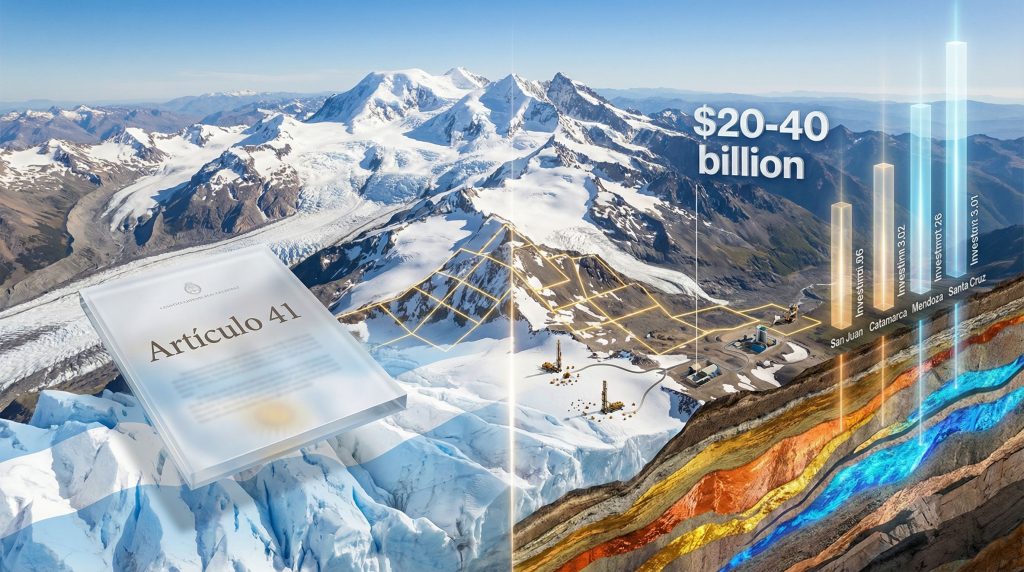
Environmental policy frameworks across Latin America face mounting pressure as economic priorities increasingly clash with conservation mandates. The tension between resource extraction opportunities and ecological protection has reached a critical juncture, particularly in countries where natural resource wealth remains largely untapped due to regulatory constraints. The reform of glacier law in Argentina exemplifies this dynamic, creating complex investment landscapes where policy shifts can unlock billions in dormant capital while simultaneously raising fundamental questions about long-term environmental stewardship.
Understanding Argentina's Current Glacier Protection Framework
Constitutional Environmental Foundations Under Article 41
Argentina's environmental protection system operates under constitutional Article 41, which establishes the fundamental right to a healthy environment for all citizens. This constitutional provision creates minimum protection standards that federal legislation must maintain, forming the legal foundation for the nation's glacial protection regime. The constitutional framework requires that any environmental legislation provide baseline protections that cannot be weakened by provincial authorities.
The 2010 Glaciers Law emerged from this constitutional mandate, establishing comprehensive protections for Argentina's estimated 17,000 glaciers and associated periglacial environments. The legislation created a framework requiring scientific inventory development, mandatory environmental impact assessments, and blanket prohibitions on economic activities within designated glacial zones.
National Inventory Requirements and Scientific Assessment Protocols
Current regulations mandate the development of a national glacial inventory through systematic scientific assessment. This inventory system categorises glacial formations based on hydrological function, ecological significance, and water resource contribution to downstream communities. The scientific assessment protocols require multi-disciplinary evaluation incorporating glaciology, hydrology, and ecosystem analysis.
The inventory process has identified critical water sources feeding 36 major river basins across approximately 400,000 square miles of watershed area. These assessments form the basis for protection zone designations that currently restrict mining activities in high-altitude regions where significant mineral deposits remain unexplored.
Federal Oversight Mechanisms and Enforcement Structures
The existing regulatory framework centralises authority within federal scientific institutions responsible for glacial classification and protection zone designation. Federal oversight mechanisms include mandatory environmental impact assessments, continuous monitoring requirements, and enforcement protocols that supersede provincial jurisdiction in protected areas.
Enforcement structures currently operate through inter-agency coordination between environmental authorities, water resource management agencies, and mining regulators. This centralised approach has created tensions with resource-rich provinces seeking greater autonomy over natural resource development decisions within their territories.
When big ASX news breaks, our subscribers know first
Provincial vs Federal Jurisdiction Conflicts
Historical Tensions Between Resource-Rich Provinces and National Government
Argentina's federal system has long experienced friction between provincial governments seeking economic development through resource extraction and national authorities prioritising environmental protection. Mining provinces such as San Juan, Catamarca, and Mendoza have consistently advocated for increased local control over resource development decisions, arguing that centralised environmental policies inhibit regional economic growth.
These jurisdictional conflicts intensified following implementation of the 2010 Glaciers Law, as provinces discovered that significant portions of their mineral-rich territories fell under federal protection mandates. Provincial governments have argued that blanket protections fail to account for local economic needs and scientific variations in glacial functionality.
Water Rights Allocation Disputes Across Basin Boundaries
Water resource allocation presents additional complexity within Argentina's glacier protection framework. River basins frequently cross multiple provincial boundaries, creating disputes over water rights priorities and downstream impact assessments. Mining operations in upstream glacial zones affect water availability for agricultural and urban uses in downstream provinces, generating inter-provincial conflicts over resource priorities.
Furthermore, the current regulatory system attempts to balance these competing interests through federal oversight. However, provincial governments argue that centralised decision-making inadequately reflects local water security needs and economic development opportunities.
Proposed Regulatory Changes Through Senate-Approved Reform
Decentralization of Glacier Classification Authority
The Senate-approved reform fundamentally restructures Argentina's glacier protection system by transferring classification authority from federal scientific institutions to provincial governments. This decentralisation enables provinces to determine which glacial formations qualify as "strategic water reserves" requiring protection versus those available for potential economic development.
The reform introduces new classification criteria distinguishing between "functional" and "non-functional" glaciers based on hydrological contribution assessments. Provincial authorities would gain discretion to reclassify glacial formations, potentially opening previously protected areas to mining exploration and development activities.
Under the proposed system, provinces could establish their own scientific assessment protocols and protection standards, provided these meet minimum federal requirements. This approach represents a significant shift from the current uniform national protection framework toward a decentralised, province-specific regulatory model.
Periglacial Zone Deregulation Framework
The reform specifically addresses periglacial zones – frozen soil ecosystems surrounding glacial formations – which currently receive comprehensive protection under existing legislation. The new framework would eliminate blanket periglacial protection, instead requiring case-by-case environmental assessment for proposed extractive activities.
This deregulation potentially opens vast high-altitude areas to mining exploration, as periglacial zones often contain significant mineral deposits while maintaining less direct hydrological connectivity than active glacial formations. The reform streamlines the mining permitting guide processes for mining operations in these areas, reducing environmental impact assessment requirements and approval timelines.
| Regulatory Aspect | Current Law (2010) | Proposed Reform |
|---|---|---|
| Classification Authority | National scientific body | Provincial discretion |
| Protection Scope | All glaciers + periglacial areas | "Functional" glaciers only |
| Investment Threshold | Complete prohibition | Conditional access |
| Water Security Priority | Federal mandate | Provincial determination |
| Environmental Assessment | Mandatory comprehensive review | Streamlined case-by-case analysis |
Constitutional Challenges to the Reform Framework
Article 41 Minimum Standards Doctrine
Environmental lawyers and constitutional experts argue that the proposed reform violates Article 41's minimum environmental protection requirements. The constitutional doctrine establishes that federal environmental legislation creates baseline standards that provincial governments cannot weaken, regardless of local economic interests or development priorities.
Legal challenges focus on whether transferring classification authority to provinces effectively circumvents constitutional environmental minimums by redefining protected resources rather than changing protection levels. Constitutional scholars suggest this distinction may not survive judicial scrutiny, particularly given Supreme Court precedent on environmental federalism.
In addition, the constitutional challenge strategy emphasises that Article 41 requires uniform minimum environmental protections across all provinces. This prevents the creation of a patchwork regulatory system where environmental standards vary based on local political and economic priorities.
Water Security as National Strategic Interest
Constitutional arguments extend beyond environmental protection to encompass water security as a fundamental national interest. Argentina's glacial systems provide critical water resources for agricultural production, urban water supply, and ecosystem maintenance across multiple provinces, creating national security implications that transcend provincial jurisdiction.
Legal experts argue that water resource protection constitutes a strategic national interest similar to defence and monetary policy, requiring federal oversight to prevent conflicts between provincial economic interests and national water security needs. This argument draws on constitutional provisions establishing federal authority over inter-provincial commerce and natural resources affecting multiple jurisdictions.
Constitutional law scholars emphasise that environmental protection frameworks established under Article 41 create legal obligations that cannot be circumvented through redefinition of protected resources or transfer of regulatory authority to provincial governments seeking economic development opportunities.
Mining Investment Opportunities Under Reform Framework
Quantifying Economic Impact Potential
Industry analysts estimate that the reform of glacier law in Argentina could unlock between $20-40 billion in previously restricted mining projects across the nation's Andean regions. These valuations reflect high-altitude copper, lithium, and gold deposits that remain largely unexplored due to current protective legislation.
The economic impact calculations encompass both direct mining investments and associated infrastructure development requirements for remote high-altitude operations. Mining companies have maintained exploration rights in many affected areas, positioning themselves for rapid development once regulatory restrictions ease. For instance, these opportunities align with broader industry evolution trends shaping the sector.
Investment projections consider the significant infrastructure costs associated with high-altitude mining operations, including transportation networks, power generation, and water management systems necessary for remote Andean projects. These infrastructure requirements represent substantial additional investment opportunities beyond direct extractive operations.
Geographic Distribution of Mining Assets Across Provinces
| Province | Estimated Investment Value | Primary Resources | Major Project Categories |
|---|---|---|---|
| San Juan | $8-12 billion | Copper, gold | High-altitude deposit expansion |
| Catamarca | $6-10 billion | Lithium, copper | Brine operation development |
| Mendoza | $4-8 billion | Copper, molybdenum | Cordillera exploration areas |
| Santa Cruz | $2-6 billion | Gold, silver | Patagonian periphery projects |
| Jujuy | $3-7 billion | Lithium, silver | Altiplano mineral development |
San Juan province represents the largest potential investment opportunity, with extensive copper and gold deposits in areas currently restricted by glacial protection regulations. The province has actively advocated for regulatory reform, citing economic development potential and employment opportunities from expanded mining operations.
Catamarca's lithium resources have gained strategic importance due to global battery supply chain demand, with several international mining companies maintaining exploration rights pending regulatory clarity. The province's high-altitude brine deposits could support significant lithium production expansion under reformed regulations, reflecting broader Argentina lithium insights in the region.
International Mining Company Strategic Positioning
Canadian and Australian mining companies with established Andean portfolios have positioned themselves strategically for potential regulatory changes in Argentina. These companies maintain exploration rights and preliminary feasibility studies for projects currently restricted by glacier protection laws.
Chinese state-owned enterprises have shown particular interest in Argentina's lithium resources, viewing potential regulatory reform as an opportunity to secure critical battery supply chain materials. European mining companies focused on sustainable battery supply chains face complex ESG considerations regarding operations in previously protected glacial zones.
International mining investment strategies increasingly incorporate regulatory risk assessments and scenario planning for potential policy changes affecting protected area access. Companies with Argentine exposure have developed contingency plans for rapid project advancement following regulatory approval, often employing junior mining strategies to navigate these complex environments.
Water Security Concerns in Investment Risk Assessment
Hydrological Impact Modeling Requirements
Investment risk assessment for mining projects in formerly protected glacial zones requires comprehensive hydrological impact modelling. These assessments must account for accelerated glacier melt under climate change scenarios and downstream water availability implications for agricultural and urban users.
Hydrological modelling incorporates complex variables including:
- Glacial mass balance projections under warming scenarios
- Seasonal water flow variability and peak demand periods
- Downstream ecosystem water requirements
- Agricultural irrigation system dependencies
- Urban water supply vulnerability assessments
Mining companies face significant technical challenges in developing accurate hydrological impact models for high-altitude operations where limited baseline data exists and climate change effects remain uncertain.
Regional Water Stress Indicators
Argentina's mining regions exhibit varying water stress levels that directly impact investment risk profiles. The Cuyo region, encompassing Mendoza and San Juan provinces, experiences periodic drought cycles that intensify competition between mining operations and agricultural water users.
Patagonian watersheds demonstrate high flow variability, with seasonal extremes affecting mining operation planning and water management system design. Northern Argentina's mining regions face additional complexity from trans-boundary water resource sharing with Bolivia and Chile.
Water stress indicators include:
- Annual precipitation variability exceeding 40% in key mining regions
- Groundwater depletion rates in agricultural areas
- Reservoir capacity relative to regional demand growth
- Inter-annual flow variation in critical river systems
Environmental, Social, and Governance Compliance Challenges
International investors face mounting ESG compliance pressure regarding mining operations in previously protected environmental areas. Institutional investors increasingly require comprehensive sustainability assessments and community engagement protocols for extractive industry investments.
ESG compliance challenges encompass environmental impact mitigation, social licence development with local communities, and governance framework establishment for responsible resource extraction. Mining companies must demonstrate adherence to international sustainability standards regardless of local regulatory changes. This includes incorporating advanced mine reclamation innovation techniques to ensure long-term environmental restoration.
Community resistance and social licence considerations present ongoing risks for mining projects in glacial regions, where environmental concerns intersect with indigenous rights and traditional land use patterns. Reputational risk factors for multinational corporations include potential consumer and investor backlash regarding operations in environmentally sensitive areas.
The next major ASX story will hit our subscribers first
Legislative Process and Market Impact Timeline
Chamber of Deputies Vote Projections and Political Dynamics
The Chamber of Deputies represents the final legislative hurdle for the glacier law reform, with current vote count projections indicating a competitive outcome dependent on coalition dynamics within President Milei's administration. Political analysis suggests sufficient support exists for passage, though opposition strategy and potential amendments could modify implementation timelines.
Coalition dynamics within the governing party reflect broader tensions between economic development priorities and environmental protection commitments. Regional representatives from mining provinces strongly support reform passage, while urban constituencies demonstrate greater environmental protection concerns.
Opposition strategy focuses on procedural delays, constitutional challenge preparation, and public opinion mobilisation against regulatory weakening. Environmental groups have organised demonstration campaigns across 35+ cities, creating political pressure on undecided legislators. According to Argentina's senate passed glacier law reform, the move aims to unlock significant mining investments.
Implementation Timeline and Regulatory Uncertainty
Following potential Chamber approval, implementation phases would extend over 12-18 months as provinces develop new regulatory frameworks and environmental assessment protocols. This transition period creates regulatory uncertainty for mining companies planning investment decisions.
Implementation timeline components include:
- Provincial regulation development (6-8 months): Individual provinces must establish classification criteria and permitting procedures
- Environmental impact assessment protocol updates (4-6 months): New streamlined assessment procedures require development and approval
- Permitting system restructuring (3-4 months): Administrative changes to accommodate provincial authority transfer
Regulatory uncertainty during transition periods historically affects mining investment timing, with companies preferring to delay major capital commitments until implementation clarity emerges.
Investment Decision Framework During Transition
Mining companies require structured decision frameworks for evaluating investment opportunities during regulatory transition periods. Due diligence considerations encompass legal challenge timelines, injunction risks, and international arbitration implications for existing agreements.
Key decision framework elements include:
- Legal challenge probability assessment: Constitutional court filing likelihood and timeline projections
- Provincial regulatory development monitoring: Tracking individual province policy development progress
- International arbitration risk evaluation: Existing investment treaty implications for regulatory changes
- Market timing optimisation: Balancing early-mover advantages against regulatory uncertainty costs
Investment decisions must account for potential policy reversal scenarios and associated stranded asset risks if legal challenges succeed or future administrations reverse regulatory changes.
Environmental and Civil Society Response
Nationwide Protest Movement Analysis
Environmental groups have mobilised comprehensive opposition to the glacier law reform through coordinated demonstrations across Argentina's major urban centres. February 2026 protests encompassed over 35 cities, demonstrating broad public concern regarding environmental deregulation.
Coalition building efforts have unified environmental organisations, indigenous rights groups, and water resource advocacy organisations around shared opposition to glacial protection weakening. This coalition strategy creates sustained political pressure through diverse constituency engagement.
Public opinion polling indicates majority support for maintaining current glacier protection levels, though regional variations exist with mining-dependent provinces showing greater reform support. Urban populations demonstrate stronger environmental protection preferences compared to rural areas dependent on mining employment.
Legal Challenge Strategy and Constitutional Precedent
Environmental legal organisations have prepared comprehensive constitutional challenges focusing on Article 41 minimum environmental protection requirements. Legal strategy emphasises Supreme Court precedent on environmental federalism and water resource protection as national strategic interests.
Constitutional court filing preparations include expert testimony from glaciologists, hydrologists, and constitutional law scholars supporting arguments that provincial classification authority violates federal environmental protection mandates.
Provincial court injunction possibilities provide additional legal avenue for challenging reform implementation, particularly in provinces with strong environmental protection constituencies. Legal precedent suggests temporary restraining orders could delay implementation pending constitutional review. Industry experts suggest the reform could unlock up to $40bn in mining projects if successful.
Regional Environmental Policy Implications
Latin American Deregulation Trends and Comparative Analysis
The reform of glacier law in Argentina reflects broader regional trends toward environmental regulation relaxation in favour of extractive industry development. Comparative analysis with Chile, Peru, and Bolivia reveals similar policy tensions between environmental protection and economic development priorities.
Chile has maintained stricter glacial protection standards while expanding mining operations in non-protected areas, creating a model for balanced resource development and environmental conservation. Peru's approach emphasises community consultation and benefit-sharing agreements for extractive operations near protected areas.
Bolivia's experience demonstrates potential risks from rapid environmental deregulation, including increased social conflict and water resource conflicts between mining operations and traditional users. These regional examples provide context for evaluating Argentina's policy direction and potential outcomes.
Mining Industry Influence on Environmental Legislation
The mining industry's advocacy for glacier law reform reflects broader patterns of corporate influence on environmental policy across Latin America. Industry arguments emphasise economic development benefits, employment creation, and government revenue generation through expanded resource extraction.
Mining company lobbying strategies have focused on provincial government engagement, economic impact studies, and technical arguments regarding glacial functionality assessments. Industry influence operates through direct political engagement, technical advisory roles, and economic dependency relationships in mining-dependent regions.
International climate commitment conflicts arise when domestic environmental deregulation contradicts national commitments under global climate agreements and sustainable development frameworks.
Strategic Investment Considerations
Risk Mitigation Strategies During Regulatory Transition
Mining companies require comprehensive risk mitigation strategies for navigating Argentina's regulatory transition period. Key risk factors include constitutional challenge outcomes, implementation timeline uncertainty, and potential policy reversal under future administrations.
Effective risk mitigation approaches include:
- Diversified portfolio strategies: Balancing Argentine investments with projects in stable regulatory jurisdictions
- Phased investment planning: Staging capital commitments based on regulatory clarity milestones
- Insurance and hedging mechanisms: Political risk insurance and financial hedging for currency and regulatory risks
- Community engagement protocols: Proactive social licence development regardless of regulatory requirements
Political risk assessment for long-term mining investments must consider Argentina's history of policy volatility and changing government priorities regarding foreign investment and environmental protection.
Long-term Strategic Implications for Water Resource Management
The reform of glacier law in Argentina's long-term implications extend beyond immediate mining investment opportunities to encompass fundamental changes in Argentina's water resource management approach. Provincial control over glacial classification could create fragmented water resource protection with varying standards across jurisdictions.
Water resource management evolution under reformed regulations requires coordination mechanisms between provinces sharing river basins and aquifer systems. Mining operations in upstream glacial zones affect downstream water users across provincial boundaries, necessitating inter-jurisdictional cooperation frameworks.
Environmental protection model sustainability depends on balancing economic development opportunities with long-term ecosystem preservation and water security maintenance. Argentina's experience with glacial deregulation may influence environmental policy development across Latin America's mining regions.
Consequently, mining sector competitiveness positioning through regulatory reform must account for global market trends toward sustainable resource extraction and ESG compliance requirements from international investors and consumers.
This analysis is based on publicly available information regarding Argentina's proposed glacier law reforms. Investment decisions should consider comprehensive due diligence including legal, environmental, and financial risk assessments. Regulatory outcomes remain uncertain pending legislative and potential judicial processes.
Ready to capitalise on emerging mining opportunities in Argentina?
Discovery Alert's proprietary Discovery IQ model delivers real-time alerts on significant ASX mineral discoveries, instantly empowering subscribers to identify actionable opportunities ahead of the broader market. Understand why major mineral discoveries can lead to substantial market returns by exploring Discovery Alert's dedicated discoveries page, showcasing historic examples of exceptional outcomes, and begin your 14-day free trial today to position yourself ahead of the market.