
May 21, 2026
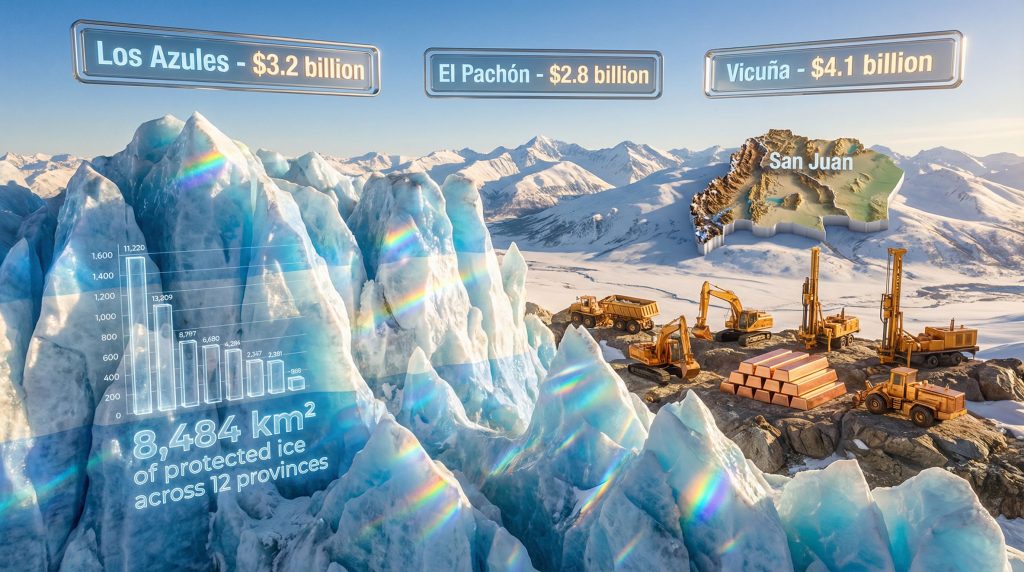
The reform to glacier law in senate discussions have intensified as Argentina faces mounting pressure to balance environmental protection with critical mineral extraction opportunities. Furthermore, regulatory uncertainty continues to plague Argentina's mining sector as investors grapple with evolving environmental frameworks across Latin America. The intersection of environmental protection and economic development demands sophisticated policy mechanisms that balance ecological preservation with strategic mineral extraction. Understanding these regulatory dynamics becomes crucial as global markets increasingly depend on critical minerals & energy transition while environmental safeguards intensify worldwide.
Understanding Argentina's Environmental Protection Architecture
Argentina's approach to glacier conservation operates through a complex federal framework established by Law No. 26,639, enacted in October 2010. This legislation creates comprehensive protection mechanisms for glacial environments across the Andean provinces, establishing the National Institute of Glaciology (IANIGLA) as the primary technical authority responsible for maintaining detailed inventories and conducting environmental assessments.
The constitutional foundation for environmental protection stems from Article 41 of Argentina's 1994 constitutional reform, which establishes citizens' rights to a healthy environment and mandates preventive measures against ecological damage. This framework requires government authorities to provide environmental information and ensure sustainable development practices across all economic sectors.
Current protection mechanisms include:
- Comprehensive glacier inventories maintained by IANIGLA
- Prohibition of activities that could affect glacial environments
- Mandatory environmental impact assessments for projects in periglacial zones
- Federal oversight of provincial mining activities in protected areas
- Water resource protection protocols for Andean watersheds
The existing system covers extensive territories across twelve provinces, with glacial and periglacial zones representing critical freshwater reserves for agriculture, urban consumption, and ecosystem maintenance. These protected areas function as natural water towers, storing precipitation and releasing it gradually throughout seasonal cycles.
When big ASX news breaks, our subscribers know first
Proposed Modifications to Glacial Protection Standards
The Senate reform initiative scheduled for February 26, 2026 debate represents a fundamental shift from blanket protection toward individualised assessment protocols. This proposed transformation would transfer primary authority from the federal IANIGLA institute to provincial governments, enabling regional authorities to conduct case-by-case evaluations using newly defined "strategic water function" criteria.
Key structural changes proposed:
Authority Transfer Mechanism
Provincial environmental agencies would assume primary assessment responsibilities. Technical evaluation protocols would incorporate local watershed characteristics. Regional expertise development programmes to support provincial capacity building. Intergovernmental coordination frameworks for cross-provincial projects.
Redefined Protection Criteria
Strategic water function assessments replacing automatic prohibitions. Direct impact thresholds for mining activity approval. Narrowed periglacial zone definitions focusing on active ice formations. Project-specific environmental impact methodologies.
The reform to glacier law in senate requires simple majority approval in the Senate during the extraordinary session period extending through February 27. Following Senate passage, the legislation would proceed to the Chamber of Deputies for final consideration before implementation.
Implementation timelines suggest provincial governments would need 12-18 months to develop technical capabilities and establish assessment protocols. This transition period would likely include federal technical assistance and standardised evaluation methodologies to ensure consistent application across jurisdictions.
Mining Investment Opportunities Under Reformed Regulations
Several major copper and lithium projects currently face regulatory constraints under existing glacier protection laws. These developments represent billions in potential investment across Argentina's mineral-rich Andean provinces, with reform potentially unlocking significant economic opportunities. The importance of mineral exploration importance cannot be overstated in this context.
| Project | Current Status | Province | Investment Scale | Primary Minerals |
|---|---|---|---|---|
| Los Azules | Development phase | San Juan | $3.2 billion | Copper, molybdenum |
| El Pachón | Under review | San Juan | $2.8 billion | Copper, gold |
| Vicuña | Feasibility study | San Juan | $4.1 billion | Copper |
| Agua Rica | Permitting stage | Catamarca | $2.1 billion | Copper, gold |
Critical correction: Lundin Mining acquired the El Pachón project from Glencore in 2023, representing a significant ownership change that reflects continued international interest despite regulatory uncertainties.
Lithium sector implications focus on:
- Salares development in northwestern provinces
- Brine extraction operations in the Lithium Triangle region
- Processing facility investments supporting domestic value addition
- Infrastructure development connecting remote deposits to export facilities
The global energy transition drives unprecedented demand for these critical minerals. For more insights on regional opportunities, consider exploring argentina lithium insights which detail the broader market context. International Energy Agency projections indicate lithium demand could increase 40-50% through 2030, while copper requirements for renewable energy infrastructure continue expanding rapidly.
Provincial governments in San Juan, Mendoza, and Catamarca actively promote mining investment as economic development strategies. These regions possess geological advantages including high-grade deposits, established mining infrastructure, and proximity to Chilean ports for export logistics.
Economic Arguments Supporting Regulatory Reform
President Javier Milei's administration, elected in December 2023 on a deregulation platform, positions glacier law reform within broader regulatory streamlining objectives. The government argues that current restrictions prevent Argentina from capitalising on global critical mineral demand whilst neighbouring countries expand production capacity.
Mining Sector Economic Contributions
Employment generation:
- Direct employment ranging from 1,500-5,000 jobs per major project
- Indirect employment multipliers of 3-4x in regional economies
- Specialised technical positions requiring advanced geological and engineering expertise
- Service sector expansion in remote communities supporting mining operations
Export revenue potential:
- Annual mining exports currently generate $2-3 billion in foreign currency
- Projected expansion to $8-10 billion with major project development
- Critical mineral premiums reflecting strategic importance in global supply chains
- Value-added processing opportunities for domestic industrial development
Provincial development priorities:
- Infrastructure investment accompanying mining project development
- Tax revenue generation supporting regional government budgets
- Technology transfer through international mining company partnerships
- Educational institution development providing technical training programmes
International competitiveness concerns centre on regulatory clarity compared to Chile and Peru, which operate different environmental assessment frameworks. Chile's environmental evaluation system processes mining projects through standardised timelines, whilst Peru balances environmental protection with economic development through sectoral coordination mechanisms.
Investment climate improvements could attract additional exploration funding, particularly for early-stage lithium and copper prospects throughout the Andes. Global mining companies increasingly prioritise jurisdictions offering regulatory certainty alongside geological prospectivity.
Environmental Opposition and Scientific Concerns
Environmental organisations and scientific institutions raise fundamental concerns about weakening glacier protection standards, citing irreversible ecological damage risks and constitutional violations. Their arguments centre on the precautionary principle and long-term water security for Argentina's western provinces.
Climate change impact documentation reveals:
- Accelerated glacier retreat rates throughout the Argentine Andes
- Reduced snowpack accumulation affecting seasonal water availability
- Altered hydrological patterns impacting agricultural systems
- Ecosystem disruption in high-altitude environments supporting unique biodiversity
The 2015 Veladero mine cyanide spill in San Juan Province serves as a cautionary example cited by environmental groups. This incident released approximately one million litres of sodium cyanide solution, requiring extensive environmental remediation and legal proceedings. The case demonstrates potential water contamination risks from mining operations in sensitive watersheds.
Constitutional challenges focus on:
- Article 41 environmental protection mandates requiring precautionary approaches
- Federal authority over environmental standards versus provincial development priorities
- Non-regression principles preventing weakening of existing protections
- Intergenerational equity considerations for future water resource availability
Scientific communities emphasise the strategic importance of Andean glaciers as freshwater reserves supporting agriculture, tourism, and urban populations. These natural systems provide ecosystem services including flood control, drought mitigation, and climate regulation extending far beyond immediate mining project areas.
Environmental groups reference the Escazú Agreement on environmental information access, although Argentina has signed but not yet ratified this regional treaty. The agreement includes non-regression principles requiring states to maintain existing environmental protection levels.
Federal-Provincial Jurisdictional Complexities
The proposed authority transfer creates significant constitutional and practical challenges regarding environmental protection responsibilities. Argentina's federal system establishes shared environmental authority between national and provincial governments, requiring careful balance between conservation mandates and regional development priorities.
Current federal framework provides:
- National environmental standards applicable across all provinces
- IANIGLA technical expertise and monitoring capabilities
- Uniform protection criteria preventing regulatory competition between provinces
- Centralised data collection and scientific assessment protocols
Technical Capacity Requirements
Provincial environmental agencies need glacier monitoring expertise. Specialised equipment and field research capabilities. Access to climate data and hydrological modelling tools. Professional staff training in glaciology and environmental assessment.
Understanding mining permitting guidelines becomes crucial as provinces develop their own assessment frameworks. However, regulatory consistency challenges persist.
Regulatory Consistency Challenges
Potential variation in protection standards between provinces. Coordination mechanisms for cross-provincial watershed management. Appeal processes for controversial project approvals. Monitoring and enforcement resource allocation.
Conflict resolution mechanisms:
- Inter-governmental coordination protocols for disputed assessments
- Federal intervention authority for constitutional violations
- Judicial review procedures for environmental protection challenges
- Stakeholder consultation requirements ensuring community participation
Provincial governments argue they possess superior knowledge of local conditions and economic needs, enabling more nuanced decision-making than centralised federal oversight. However, environmental organisations worry about regulatory capture and insufficient technical resources at provincial levels.
The next major ASX story will hit our subscribers first
International Regulatory Comparisons and Best Practices
Comparative analysis with regional mining jurisdictions reveals diverse approaches to balancing environmental protection with resource development. Chile operates through environmental impact assessment systems managed by the Environmental Assessment Service, whilst Peru employs sectoral coordination between mining and environmental ministries.
Chile's regulatory framework features:
- Standardised environmental impact declaration processes
- Technical review panels with specialised expertise
- Public participation mechanisms including community consultations
- Monitoring requirements throughout project lifecycles
Peru's coordination model includes:
- Inter-ministerial committees for complex environmental decisions
- Regional environmental authorities with technical support
- Water resource management integration with mining permitting
- Indigenous community consultation protocols
International best practices from OECD countries emphasise adaptive management approaches incorporating climate change considerations and cumulative impact assessments. These frameworks recognise that environmental conditions evolve over time, requiring monitoring and adjustment capabilities.
Global investment standards increasingly incorporate Environmental, Social, and Governance (ESG) criteria requiring mining companies to demonstrate sustainable practices throughout operations. Major institutional investors and development finance institutions mandate compliance with international environmental standards regardless of local regulatory requirements.
Legislative Timeline and Political Dynamics
The February 26 Senate debate occurs within Argentina's extraordinary session period, allowing consideration of specific legislation outside regular parliamentary schedules. The government requires simple majority support from senators present, with provincial representation potentially influencing voting patterns based on regional economic interests.
Key procedural considerations:
- Committee review processes preceding floor debate
- Amendment procedures allowing modifications during deliberation
- Voting requirements and quorum specifications
- Timeline for Chamber of Deputies consideration following Senate passage
Provincial Interests Affecting Outcomes
Mining-dependent provinces supporting regulatory flexibility. Agricultural regions prioritising water resource protection. Urban constituencies concerned about environmental standards. Indigenous communities asserting territorial and environmental rights.
Party positions:
- Government coalition promoting deregulation agenda
- Opposition parties emphasising environmental protection
- Regional parties balancing local economic and environmental concerns
- Cross-party environmental caucuses advocating precautionary approaches
Senate composition reflects federal representation with equal provincial representation regardless of population, potentially favouring mining provinces with smaller populations but significant mineral resources.
The broader context of mining industry evolution suggests these debates reflect global trends toward regulatory modernisation.
Potential Outcomes and Market Implications
Multiple scenarios could emerge from Senate deliberations, each carrying distinct implications for mining investment and environmental protection. Market participants monitor these developments closely given billions in potential project investments awaiting regulatory clarity.
Scenario Analysis
Full approval pathway:
- Provincial authority transfer implementation within 18 months
- Major project environmental assessments restarting under new criteria
- Mining sector stock performance improvements reflecting reduced regulatory risk
- International investment flow increases toward Argentine mining projects
Modified legislation outcome:
- Compromise amendments maintaining federal oversight with provincial input
- Graduated implementation timelines allowing technical capacity building
- Pilot programme testing in specific provinces before national expansion
- Enhanced monitoring requirements ensuring environmental protection maintenance
Rejection scenario:
- Status quo preservation with continued investment uncertainty
- Alternative reform proposals focusing on process improvements rather than authority transfer
- Continued delays for major mining projects awaiting regulatory approvals
- Investor attention shifting toward other regional mining jurisdictions
Extended deliberation possibility:
- Parliamentary committee review extending beyond extraordinary session period
- Additional stakeholder consultation processes
- Technical expert testimony on proposed assessment methodologies
- Public comment periods for civil society input
Market responses will likely reflect both immediate political outcomes and longer-term implementation prospects. Mining companies with Argentine exposure monitor developments closely, with project advancement decisions dependent on regulatory certainty achievement.
Technical Assessment Methodologies and Implementation Challenges
The proposed "strategic water function" criteria represent a fundamental shift from current blanket prohibitions toward technical evaluation systems. Understanding these methodologies becomes crucial for stakeholders navigating potential regulatory changes and their implementation complexities.
Strategic water function evaluation components:
- Hydrological contribution quantification to downstream watersheds
- Seasonal water flow patterns and storage capacity analysis
- Climate vulnerability assessments incorporating future scenarios
- Cumulative impact evaluation considering multiple development projects
Implementation Challenges
Data collection requirements:
- Baseline glacier monitoring establishing current conditions
- Stream flow measurement networks throughout affected watersheds
- Climate station data providing long-term precipitation and temperature records
- Groundwater interaction studies connecting surface and subsurface systems
Assessment standardisation:
- Methodology consistency across different provincial jurisdictions
- Quality control procedures ensuring scientific rigour
- Peer review processes for complex technical evaluations
- Appeal mechanisms for disputed scientific assessments
Provincial capacity building represents a critical implementation factor requiring substantial investment in technical expertise and monitoring infrastructure. Current provincial environmental agencies vary significantly in their technical capabilities and resource availability for conducting sophisticated glaciological assessments.
The reform timeline suggests provinces would need federal technical assistance during transition periods, potentially including personnel training, equipment provision, and methodology development support. International technical cooperation could provide additional expertise through bilateral agreements with countries operating similar assessment systems.
Economic Impact Assessment and Regional Development
Reformed glacier law implementation could generate significant economic impacts extending beyond immediate mining project development. Regional economic analysis suggests multiplier effects throughout provincial economies, particularly in remote areas currently lacking economic diversification opportunities.
Direct economic impacts:
- Construction phase employment averaging 2,000-4,000 workers per major project
- Operations phase employment ranging from 800-2,000 permanent positions
- Local procurement opportunities for goods and services
- Infrastructure development supporting broader regional connectivity
Indirect economic effects:
- Service sector expansion in hospitality, transportation, and professional services
- Educational institution development providing mining-related technical training
- Healthcare facility improvements serving expanded populations
- Financial services growth supporting increased economic activity
Government revenue implications:
- Provincial tax collection increases through mining royalties and corporate taxation
- Federal income tax generation from employment expansion
- Export duty collection on mineral product sales
- Infrastructure investment cost-sharing between government and private sector
Regional development planning requires coordination between mining investment and community development objectives. Successful implementation depends on ensuring local communities benefit from resource development through employment opportunities, infrastructure improvements, and social investment programmes.
International experience suggests mining-dependent economies require diversification strategies preventing over-reliance on commodity cycles. Provincial governments could use mining revenue to develop alternative economic sectors including tourism, agriculture, and manufacturing industries.
Argentina's reform to glacier law in senate represents a complex intersection of environmental protection, economic development, and regulatory governance. The February 26 Senate deliberations will determine whether Argentina adopts a more flexible approach to glacier protection, potentially unlocking billions in mining investment whilst maintaining essential water resource safeguards.
Success in this reform to glacier law in senate process requires balancing legitimate environmental concerns with economic development opportunities. Effective implementation depends on provincial technical capacity building, consistent scientific assessment methodologies, and robust monitoring systems ensuring long-term environmental protection.
The global energy transition creates unprecedented demand for Argentina's critical mineral resources, making regulatory clarity essential for attracting international investment. However, this development must occur within frameworks protecting irreplaceable freshwater resources upon which millions of Argentines depend for agriculture, industry, and domestic consumption. According to environmental organisations, the risks of amending current protections could threaten water security across the region. Furthermore, mining industry analysts suggest the upcoming legislative sessions will be decisive for the sector's future development.
Note: This analysis involves regulatory speculation and potential future developments. Readers should monitor official government announcements and legislative proceedings for current information regarding glacier law reform progress and implementation details.
Looking for Your Next Mining Investment Opportunity?
Discovery Alert delivers instant notifications on significant ASX mineral discoveries using its proprietary Discovery IQ model, transforming complex geological data into actionable investment insights for both short-term traders and long-term investors. Explore how historic mineral discoveries have generated exceptional returns and begin your 14-day free trial today to position yourself ahead of the market in this rapidly evolving mining landscape.